PhysicsQED's Posts
Nairaland Forum › PhysicsQED's Profile › PhysicsQED's Posts
1 2 3 4 5 6 7 8 ... 123 124 125 126 127 128 129 130 131 (of 154 pages)
 Politics › Re: Best And Worst States In Nigeria by PhysicsQED(m): 8:58pm On Oct 12, 2011 Politics › Re: Best And Worst States In Nigeria by PhysicsQED(m): 8:58pm On Oct 12, 2011 |
asha 80:I've seen it. Yeah it was a colony of Biafra, and there was intimidation and atrocities were committed according to various accounts, but this part "Before we knew it, all our Igbo friends and neighbors started saying “Kedu” to us. When you turn around to look at him in surprise, he would say, “Ah, unah, you never begin learn? Na wa. I’m sorry oh.” The big question was: Learn what? Do you mean Igbo is becoming the lingua-franca in “Benin Republic?”" sounds like nonsense. He should provide evidence if he really wants something like this to be believed. |
| Culture › Re: Benin Art And Architecture by PhysicsQED(m): 6:08pm On Oct 12, 2011 |
ezeagu:There is one drawing that I could post that is not from first hand observers or eye-witnesses, but it seems speculative and inaccurate and looks more like a European architectural imagining of the buildings than what they might have actually looked like. There are one or two more photographs of buildings, but these are all of run-down/ruined buildings, which I'm honestly not interested in posting. Unfortunately, both the visitors and the invaders did not often draw or photograph the buildings, despite both the visitors and invaders specifically taking the time to praise certain buildings and architectural features. The worst thing is that from what both the visitors and the invaders wrote it's clear that the buildings that we do have photographs of are not the best of the architecture. |
| Politics › Re: Lights Out: Another Threat To A Fragile Country’s Stability (Pakistan) by PhysicsQED(m): 7:46pm On Oct 11, 2011 |
The central government also continues to subsidise the cost of electricity to the tune of billions of dollars a year. That money, say the government’s critics, could be better used to pay its own bills and thereby free up unused capacity in power plants that are mothballed because of non-payment and disrepair. Cutting subsidies to people’s electricity bills, however, could lead to even more unrest. Critics argue that the government’s hand-to-mouth policymaking is self-defeating, and illustrates its general lack of planning.Looks familiar. |
| Politics › Re: Hon Patrick Obahiagbon On Fuel Subsidy Removal by PhysicsQED(m): 6:43pm On Oct 11, 2011 |
stepo707:This sounds very inauthentic and more like it was made up by some blogger or something. |
| Politics › Re: Group Wants Igbanke Included In The Proposed Anioma State by PhysicsQED(m): 1:59am On Oct 11, 2011 |
Relax101:No. Like I said, I don't know the Esan language. udezue:Like I said before, I'm extremely skeptical of claims about such a simple two syllable name being exclusive to any one group. This is kind of like claiming "ojo" is exclusive to Yorubas when we know that that's false. Keep in mind that a) "Oko" is a Bini word that can mean eminent; apparently it can also mean "comrade" b) There is a town called Oko in one of the Esan LGAs: http://nigerianobservernews.com/06032009/news/insideedo/indexnews1.html c) There are a legion of uses of "oko" in various Nigerian languages: https://www.nairaland.com/nigeria/topic-582516.0.html#msg7512926 d) Names like Okogie, Okosun, etc. make it very clear that the Esan have a word "oko", probably also meaning eminent, as suggested in the link immediately above e) Okoh could just be a variation on okor, which is a name in some other Edoid languages Given the above facts, I'd have to view the claim on "Okoh" being exclusive to Igbo as similar to the claim about "Ojo" being exclusive to Yoruba, or "Ala" being exclusive to only Igbo or Ijaw, unless an Esan speaker can come here and actually confirm that it's not an Esan name. Akhabue is also Igbo.My point about the pronunciation of "kh" is that it would probably be incorrect to pronounce it as "k" when it might really sound more like "Ahabue" than "Akabue". Then again, I am not Esan, so I can't be certain how they would pronounce it. I still think the name is Esan and not Igbo. I remember there was another Esan name "Egbele" that one non-Igbo and non-Esan poster on this forum confused with the Igbo name "Ebele" in one thread. I am very sure that Egbele does not mean "mercy" in Esan (http://www.google.com/search?q=Emhinh+erebhe+ne+ribhi+omh%E1%BB%8Dn+ti+egbele+itata&ie=utf-8&oe=utf-8&aq=t&rls=org.mozilla:en-US:official&client=firefox-a) regardless of whether "gb" is pronounced like "b" or not, so that is one example of a coincidence in appearance without one single origin for a word. Also, the name Osakwe (Osa (Olisa) + kwe) and Osakue (Osa (Osanobua) + kue) between Igbo and Bini is a similar example. Also the word "Okoro" is another example: http://www.edo-nation.net/okoro.htm |
| Politics › Re: Which State Is Least Known In Nigeria? Jigawa? by PhysicsQED(m): 8:32pm On Oct 10, 2011 |
The cities in Nigeria are far more well known than the names of the states, in most cases, and that's understandable, given that the names of the states for many places only gained any national prominence two or three decades ago. To those who aren't that geographically informed, I bet the name of the city of Calabar would be known much more widely than the state that it's in; same with Jos and most other major cities. |
| Politics › Re: Group Wants Igbanke Included In The Proposed Anioma State by PhysicsQED(m): 8:18pm On Oct 10, 2011 |
Relax101:http://umuanioma.com/2011/06/594/ |
| Politics › Re: Group Wants Igbanke Included In The Proposed Anioma State by PhysicsQED(m): 8:11pm On Oct 10, 2011 |
Relax101:Okafor may have something to do with Inyenlen being in the same LGA. Okoh, I'm not so sure about the exclusivity of that name. Okoh could just be an Esan variation on "Okor" which I think is a word found in some "Edoid" languages. However, I don't know the Esan language to be certain that it isn't indeed of non-Esan origin. As for Akhabue, I'm almost 100% certain that that's an indigenous Esan name, not Igbo. In fact, if they pronounce the name anything like how a Bini would read it, the "kh" part would sound more like "h" because the"k" sound would not be emphasized but instead sound like it's meant to be nearly silent. This is not to say that they necessarily do pronounce the name like that, but at first glance I have to say that the name looks very very "Edoid". |
| Politics › Re: Lagos Has Built More Roads Than Ghana & Sierra Leone - Fashola by PhysicsQED(m): 6:51pm On Oct 10, 2011 |
otumfour:I gotta admit, this is hilarious.  I completely missed that. I completely missed that. |
| Politics › Re: Group Wants Igbanke Included In The Proposed Anioma State by PhysicsQED(m): 6:46pm On Oct 10, 2011 |
Relax101:Went back and found out. The town called Inyele/Inyenlen in Esan Southeast LGA is of Igbo origin. What were these Esan names that you came across that looked Igbo? |
| Culture › Re: Benin Art And Architecture by PhysicsQED(m): 3:07am On Oct 10, 2011 |
Actually, I said above that the book was "intended for children" but I see now that that's incorrect. It says it's meant for ages 10 and up and it's not just meant for children. My mistake there. |
| Politics › Re: Group Wants Igbanke Included In The Proposed Anioma State by PhysicsQED(m): 2:43am On Oct 09, 2011 |
GAR3TH:Could you elaborate more on the parts in red? |
| Politics › Re: Group Wants Igbanke Included In The Proposed Anioma State by PhysicsQED(m): 2:35am On Oct 09, 2011 |
Relax101:I'm not Esan, but I do know from an argument/debate that I had on this forum earlier this year, that there is one group in an Esan area, besides Ekpon, that are Igbo in origin. I'll look through that thread again to see which group it is. |
| Culture › Re: Benin Art And Architecture by PhysicsQED(m): 2:21am On Oct 09, 2011*. Modified: 7:00pm On Jul 14, 2012 |
1. Booshman, no I'm definitely not an expert or scholar in Benin history and I've published nothing on Benin. I've figured out just from reading articles that I sometimes don't know as much as the professional historians in some areas of Benin's history, and I don't know as much as the non-professional historians on the more obscure and esoteric things. When I saw the first few really stunning pieces of Benin art and when I came across how Benin was so favorably described by those who visited it, I was so impressed and fascinated (and of course proud that I came from this culture that was so rich) that I was very determined to figure out "what went wrong?" and to figure out why Benin's situation wasn't better than it was when the inevitable confrontation with Europeans occurred. The simple, most straightforward answer to this question is that there was a devastating civil war (caused by a succession dispute between two princes) in the early 1700s that wrecked the capital city, which was the heart and soul of the kingdom. The prince who was on the losing side of the dispute was backed by a powerful and influential Iyase (the Iyase n'Ode) who had a lot of military support and who attacked the city successfully. After the resolution of that civil war, Benin recovered in that same century before the reign of Oba Eresoyen, and by the early 1800s, it looked like it was on its way to full recovery, since it was launching military expeditions to recapture some of its old territories, but then a series of succession disputes resulted in other smaller civil wars later in the century that weakened the kingdom. 2. As for shoes, yeah, I was initially surprised by the absence of shoes on all of the people (not just the warriors), but I think that this is just due to looking at it from an outside perspective. In an environment where it can actually get (truly) cold, it makes sense to wear protective covering for the feet, whether one is a soldier or not. In the absence of such cold, they would probably have as much motivation to go around wearing shoes in a hot environment as they would have to go around constantly wearing gloves for no reason. I don't think the Aztecs, Mayans, or Egyptians wore shoes frequently either and this is probably for the same reason. (Well, the Egyptians might have later adopted sandals from outside influence from Western Asian ('Asiatic') groups, but their art makes it obvious that they generally were not a shoe wearing culture either.) It isn't all civilizations that had an inclination towards shoes, but I see what you're saying about protecting the feet as well. I guess it just wasn't relevant somehow, as it wasn't relevant with the Aztecs, Maya, Egyptians, Nubians, etc. One thing I did notice however is that many of the figures have little bands of beads, leather or maybe other material around their and ankles and occasionally around their wrists. I don't know if that's just for style or if it has something to do with sweat, but it intrigued me that there was a fashion style involving covering their ankles or wrists but not their hands and feet. I kind of wish I knew for certain what the motivation was there as far as style or comfort. But yeah, in battle and in a rainy area (which they were in), I would think they would opt for some kind of footwear, but the heat probably prevented footwear from catching on in either the civilian or military populace. 3. With respect to daily life in Benin, I will definitely post some quotes from visitors to Benin which give some idea of how people were living. First I have some other things I want to post - some images of weapons, some general images of art, and an article on Benin astrology/divination beliefs. After that, I will post some information -some of them direct quotes from eyewitnesses (not all of the accounts of eyewitnesses are easily accessible, so I'll only post the ones available in English and accessible to me) - which show how very positively pre-civil war Benin was viewed and some quotes about their daily life. From what I've read, life in Benin had its good and bad points a) On the negative side, there was - Slavery, where prominent persons (not everybody) owned many people and used them as servants or sometimes soldiers - Human sacrifice of criminals and "witches" from Benin, and of slaves from outside Benin for ceremonies or funerals. However, despite these negatives, the overall atmosphere was positive as attested to by eyewitnesses, and the sacrifices were out of ignorance and not malevolence. For example, Olfert Dapper's source (Samuel Blommaart), says that when slaves were sacrificed on one ceremonial occasion it was because the people believed that after being killed the slaves would enter another land (the spirit world, obviously) where they would live more pleasantly than their current life. Of course, that's very faulty reasoning as any sort of justification for killing, but one can see that it was definitely not committed out of sheer malevolence or out of a desire to kill and inflict pain. b) On the positive side, They actually lived very well - comfortably and generally free of crime or hunger. They kept the streets and houses very clean. They were courteous and honest (I will post specific quotes to this effect later) Their soldiers, dignitaries, and of course the Oba, were very stately and dignified as attested to by eyewitnesses They were described as wealthy and industrious The markets were very orderly . . . and there are some other positives still, but I'll let the quotes that I post later paint a fuller picture 4. One prominent mythological figure I know of from Edo culture is the wrestler Joromi. In the myth, he was a powerful wrestler who went to what we would call "hell" and wrestled a monster with several heads and defeated it simply because he could. There's a lot more interesting detail to the story than that, which you might find elsewhere if you look around a bit, but that's the basic outline. There is a lot of other Edo mythology about different deities and creatures, but I would have a hard time directing you to any one really good source that has all of the different mythological beliefs compiled together. With regard to folktales, there is one book that I have yet to read (but I have read a few excerpts of it) called Dawn to Dusk: Folk Tales from Benin by Iro Eweka. The few bits of it that I've read were very interesting. That book would probably give some of the insight that you're looking for with regard to folktales. Here's a link to the book: http://www.amazon.com/Dawn-Dusk-Folktales-Iro-Eweka/dp/0714643629 Also, some of the accounts about conflicts between real historical figures are more interesting than the mythology. I would also suggest reading Egharevba's most famous book (A Short History of Benin) if you can find it at a library or obtain a copy (it's not that easy to get in America). It'll put things in better context and it is just a very interesting read, overall. 5. With regard to the book you posted, from the three pictures I was able to see, I can say that the images are beautifully and vividly drawn and imagined, and in many respects, they stick to the images and art that we do have and to what we know about some aspects of the layout (such as that of courtyards), but of course this re-creation cannot be truly accurate. Unfortunately, we really do not have enough detailed first hand drawings or photographs of Benin either in its glory period or even in its weaker periods. However, we do have several very important quotes from visitors to Benin. From what I could see, that book is intended for children and is therefore not a rigorous attempt at a reconstruction of what Benin could have really looked like. However, I have some criticisms of the book and because children are very impressionable and might take such images as being representative, I would not deliberately give that book to my future son or daughter many years from now. Despite their good intentions, the authors/artists of the book unintentionally diminish and depreciate, rather than accurately convey, the image of ancient Benin with their depiction. I did not see more than three images, but I saw the depiction of parts of the royal palace and I do not think I saw any real columns with figures carved into them or wooden pillars with plaques on them when we know that there were indeed such columns and pillars. Maybe other images that I can't see from amazon do indeed show those columns, but if they left them out, then they left out an entire architectural feature of the courtyards and buildings. Also, unless that re-imagining is specifically meant to be an exaggeratedly depopulated image of the city's appearance when the kingdom was in one of its periods of decline, I would have to say that the city had to have generally been much much more densely populated than the image conveys, based on the accounts of Olfert Dapper and Dierick Ruiters ('D.R') and some other writers. I will post some of their quotes later, as I mentioned above. I am certain that the scale of the city was larger than the image which the book conveys, when the kingdom was in its glory period and even when it was not in its glory period. In 1691, right before the kingdom's most glorious period ended, the capital city of the Benin kingdom was larger than 17th century Lisbon, as explicitly stated by a Portuguese ship captain (Lourenco Pinto) who visited the city. Therefore I do not think it is appropriate to call Benin City a "town" unless large cities like Madrid, Florence and Lisbon were only "towns" in ancient times. If they wanted to depict a good looking ancient African town (I see that this was their intention), then there are actual pre-colonial towns in Nigeria that they could have considered instead, and they did not need to reduce Benin - which was once one of the larger cities in the world - to the status of a "town". There is a certain painting of 16th century (1510) Lisbon from the "Chronicle of Afonso I of Portugal" which somebody uploaded to the wiki article for Lisbon : http://en.wikipedia.org/wiki/File:Lisboa_1500-1510.jpg Now since Lisbon was a) one of the largest cities in Europe, and since b) it only increased in size from 1510 to 1691, meaning that 1691 Lisbon was even larger than the extent which that painting conveys for 1510 Lisbon (so Lisbon was even larger than that painting makes it look at the time that it was being compared to Benin) and since c) a Portuguese ship captain testified without any qualifier or caveat that Benin City was definitely larger than Lisbon in 1691. then you should be able to see, after looking at that painting and comparing it with the depiction of Benin city on the cover of the book you gave me a link to, that the authors and artists of that book, despite their positive intentions, are actually lessening and diminishing the size and development of ancient Benin city, probably based on preexisting stereotypes about the scale or extent that African cities could reach. . . Another problem is with the streets. Dapper's source (Blommaart) said there were "thirty very straight broad streets, each about 120 feet wide", and that there were "many broad intersecting streets" that were "somewhat narrower" in addition to the 30 broad streets. So as you can see, that image does not convey the true extent of things when the city really was ancient and there is a strange absence of straight streets. Yet another problem is the size of the palace. Benin's palace was described as being the size of an entire city (the city of Haarlem, according to a Dutch account (Olfert Dapper (from Samuel Blommaart's observation)), and the city of Tubingen according to a German account (Joshua Ulsheimer)) by two different observers. Yet the look of the palace in that book is of a regular sized palace. Here is a map of 1646 Haarlem that was uploaded to the wiki article for Haarlem ('Harlemum Vernacule Haerlem Dimensa a Petro Wils Geometra 1646,' from a copper engraving by Joan Blaeu in Amsterdam 1649): http://en.wikipedia.org/wiki/File:Haarlem1646.JPG That is what the extent of the palace was more like in terms of size (considering that the dates of Samuel Blommaart's travels were around the same time.) Now there is written evidence (from a certain British officer (lieutenant King) that visited Benin) which makes it clear that a large part of the ancient palace was burnt down during one of the smaller civil wars after the great one in the early 1700s, but that does not mean that they should use this much smaller version as really representative of the palace. In fact, the size of the 1897 palace (before it was destroyed), which was smaller than the original palace, is probably still bigger than how they represent the palace in that book. I think this "town" image could maybe pass for what Benin may have looked like immediately after opposing forces in the civil war attacked and destroyed much of the city in the early 1700s, but it could not even pass for what Benin looked like from the period before the end of Oba Akenzua I's reign (after he defeated the rebels) through the reign of Oba Eresoyen and up until the reign of Oba Adolo. During the reign of Oba Adolo, from around 1854 onwards, there were a lot of ruins of houses that were left to decay without being rebuilt or built over because around 10,000 soldiers were absent from Benin and had been fighting in the Esan area to crush the forces of the Oba's half-brother, who was claiming the throne and had made his war camp in Esan land, where his mother was from. Oba Adolo's half brother died in 1880, so at that point there was no reason to send out large contingents of troops to secure the throne but those were clearly wasted decades as far as regrowth or expansion are concerned, and of course, the city probably did not grow back into its former size. So 1897 Benin might have had the appearance of being more empty, but that is not representative of Benin throughout the majority of its history. Maybe this image of Benin city in that book can pass for 1700-1721 Benin, or possibly a less populous version of 1854 -1897 Benin, but I don't think it's accurate overall in scale, size, population, etc. So as not to sound completely and totally negative about their efforts, I should reiterate that I do commend the style and pleasing look of the drawings, Edit: With regard to shoes, I just found out that a factor in armies going without shoes in west Africa was so that they could move silently: "Invariably, or almost so, the West African soldier went barefoot, which increased his power of silent movement - as was subsequently noted in colonial wars" [Smith also cites a source that makes note of this] - Robert S. Smith, Warfare and Diplomacy in Pre-Colonial West Africa, p. 58 |
| Politics › Re: Group Wants Igbanke Included In The Proposed Anioma State by PhysicsQED(m): 11:08pm On Oct 08, 2011 |
Dede1:Ogbemudia's pursuers lost him before he got to Benin, so I don't see how the issue of pursuing him to the Eastern region comes up. Remember it has been alleged that Dimka and his team of chasers followed Ogbemudia to Owo in present day Ondo State.I don't understand this. Owo is north and slightly to the west of Benin city, meaning that Ogbemudia most likely reached Benin City from a northwesterly direction. Why would you believe Ogbemudia hitch-hiked to Benin City from Owo and still insinuate he walked from Benin City to Onicha? Anyway, I am not surprised at your gullibility of Nowa’s postulations.I really don't get this statement. Let's assume that he hitch hiked instead of walked from Benin City to Onicha if that is more acceptable. What was he doing there? Who told him to meet them there? What is there to suggest that he actually went to Onicha? As for Omoigui's "postulations" they are not really relevant here and they cannot possibly be the source for the level of detail and specifics about how Ogbemudia escaped from Dimka. Ogbemudia did write an autobiography, anyways. |
| Politics › Re: Group Wants Igbanke Included In The Proposed Anioma State by PhysicsQED(m): 10:13pm On Oct 08, 2011 |
Dede1:No, they are not gospel, but that does not mean that the particular section of the article that I quoted is necessarily false. From Benin City he ran passed Agbor to Onicha.This is the part I"m not getting. Could you provide details about his going on foot from Benin City to Onicha? Anybody who ran from Owo through Benin to Onicha must have passed his or her father’s compound if he or she is an Igbanke.Ogbemudia's father is not from Igbanke. His mother is from Igbanke. Does it not look funny to you that a soldier of a high rank, a major for that matter, had to abandon a land rover while armed with SMG because he ran out of fuel?No. I don't see why one man with one gun in a car would stop and face 3 or more men armed with guns if he couldn't find a place to refuel in order to get away. Being a soldier of a certain rank does not make one somehow impervious to bullets. |
| Politics › Re: Group Wants Igbanke Included In The Proposed Anioma State by PhysicsQED(m): 9:12pm On Oct 08, 2011 |
Dede1:I think you are conflating unrelated things. I never said that Ijaw was not an ethnic group and what I criticized was the reading of certain documents to make claims about "Jos" just being a term used by certain Europeans to designate riverine people. None of this has any bearing on the fact that Gelegele is Bini land. I have read the comments you are referring to by Bini titleholders and the gist of it is that some Ijaws migrated to Bini land and started making claims on land even though they are economic migrants, not owners of the land in question. They are not talking about what you are claiming (Ijaws not being a real ethnic group.) There are, however, some speakers of Edoid languages among the Ijaws, and that may be one of the origins for the myth of Benin origin for Ijaws. Those communities could have spread that story to some extent. @Post, it is a shame it took this long for the so-called Igbanke group to sniff reality of life from the tiny air. My people say that a person can not run away from his or her arse. There was a story on Samuel Ogbomudia who ran from Kaduna during the July 29, 1966 coup as he was being chased by Dimka and few drunken soldiers from the northern region of Nigeria. The story had it Ogbomudia ran passed his father’s compound, forgot his Bini connection and took refuge in Onicha. However during and after the civil war, he jolted his memory back and remembered his Bini links.When Ogbemudia ran from Dimka, I don't recall reading that he went to Onitsha. Maybe he did, but it would be better to provide details suggesting that he really did, rather than just saying that there is a story that he did. He seems to have come back to Benin from a northwesterly, not easterly, direction. "Madiebo, Kalu, Okon, Ogbemudia and many others eventually escaped back to their home regions from Kaduna, while some, like Major Olusegun Obasanjo were later smuggled to Maiduguri for safe-keeping. But others were not so lucky. As the days progressed, however, it was clear that there was inconsistency in the degree of discrimination being made between southerners or "jubilators". T/Capt. L.C. Dilibe (Staff Officer, 1st Bde), T/Major Emelifonwu (DAQMG, 1st Bde) and T/Major Ogunro (Chief Instructor, NMTC) were murdered. Major A. Drummond, half cast Igbo-Scot, was killed on Sunday July 31st. Major OU Isong (Commander, 1st Recce Squadron) who had actually expressed scepticism about the January 15 coup, risking death at the hands of Major Nzeogwu, was also killed during the July rebellion in Kaduna, among others. The details of his death have never been fully clarified but the young northern officers in his squadron at that time include Lts. Ibrahim Babangida, Garba Duba, Sunday Ifere and others. After hitchhiking with Igbo contacts across the North, Madiebo escaped across the Benue bridge at Makurdi by hiding in a water tank dressed in a firesuit, avoiding capture by a detachment of the 5th battalion commanded by Captain Daramola during the penultimate leg of his relay race back home. Ogbemudia's escape from death at the hands of Lt. BS Dimka was partly made possible by Major Abba Kyari and Lt. Col. Hassan Katsina. Hassan himself had allegedly been briefly detained by mutinous troops and then released, only to be falsely accused of being behind the whole plot (along with Ali Akilu). It was already known that Dimka was not happy that Ogbemudia had arrested him earlier, although Dimka did not know that it had been sanctioned by Hassan who had his ears to the ground. When, therefore, Dimka was making plans to gather soldiers to seize him, and was talking carelessly about Ironsi's phone call and its implications, Ogbemudia was tipped off and advised in the nick of time to escape. A landrover was immediately provided which Ogbemudia jumped into (armed with an SMG) and sped out of town (without bothering to pack) chased by a landrover load of northern soldiers led by the Lieutenant. Dimka's group pursued him to Kontagora where he refueled, barely eluding them at the fuel station. But they refused to give up, chasing him all the way to Jebba, crossing the Niger Bridge behind him, sometimes shooting. They followed him all the way to Owo in present day Ondo State where he ran out of fuel, abandoned his vehicle and scaled a six foot fence into dense jungle. At that point they gave up and began their journey back to Kaduna. Ogbemudia later hitched hiked back to Benin City laying low for some time, moving from house to house until things cooled down. " http://www.gamji.com/nowa/nowa28.htm |
| Culture › Re: Black Celebrities, What African peoples could they be from? by PhysicsQED(m): 7:20pm On Oct 08, 2011 |
exotik: lol, it is okay. and to be honest, the major reason i come back to check these forums is to read your posts especially when you are putting edo haters in their place --> the gutter! and there are a lot of them on here hating for no reason and trying to reduce our historical importance especially that of the binis.Lol, thanks. And no one can reduce our historical importance and I don't even understand why they would want to. In Europe, people from different European groups wouldn't try to reduce the historical importance of any European groups that show evidence of independent European achievement. Yet despite Benin's importance as far as indigenous achievement in Africa, on the internet (I don't think this phenomenon holds true in real life, from my experience) a few Nigerians of all backgrounds have gone out of their way to put down Benin (not just on this forum, either). The historical importance of Benin is an already settled issue. No black African city was compared in any way with Lisbon, Amsterdam, Florence, and Madrid entirely on the initiative of European visitors themselves. No other African city that Europeans visited had a palace so big that two different writers claimed it at was as big as certain cities in their respective countries (Holland and Germany). The splendor of the Oba's annual ceremony on horseback was compared to that of a papal procession in Rome. And very soon after Benin's art was known more widely one professor (Felix von Luschan) claimed that the art from Benin was better than anything that even Benvenuto Cellini (one of Europe's most celebrated sculptors) could have cast. Here is just one of the positive quotes about Benin (this one is from right before the civil war that wrecked a large part of the city), from a Portuguese ship captain who visited Benin: 'Great Benin, where the King resides, is larger than Lisbon, all the streets run straight and as far as the eyes can see. The houses are large, especially that of the king which is richly decorated and has fine columns. The city is wealthy and industrious. It is so well governed that theft is unknown and the people live in such security that they have no door to their houses' - Lourenco Pinto, 1691 Yet only recently one guy on this forum tried to insult the houses, argue that the people were uncivilized and started comparing Benin to trading states in the Delta! All this ancient and modern praise from foreigners from a different continent, yet on the internet, there is this weird negativity from some fellow Nigerians. It's just bizarre. Another problem is the way certain official distortions were given the appearance of validity by some Western writers. I don't even like getting into confrontations on this board, but one reads all sorts of funny claims on this board about Benin and one just has to respond at some point if one knows that what is claimed is contrary to reality. Only recently someone tried to suggest Benin brass casting was derivative of Ife (because of the unsupported claims of two western art historians - Frank Willett and William Fagg) when every modern study of the technical casting methods and the styles has refuted that and when the actual Benin brass casters guild recalls traditions of brass casting during the Ogiso period (as does Egharevba's most famous book). and u do give urself little credit, u are well-versed in history from that of bini to greek. so maybe when u are through with school, you will come back home and become a bini chief?? Grin coz all that knowledge should not be used helping to build and develop the western world. we need our scholars back home.I give my self little credit because I don't consider myself a person with any really deep expertise or knowledge in most historical areas. I may know much more than the average person on a few areas of history, but there are a lot of people out there who know far more of history than me, and I don't think it would be appropriate to group myself with those people in terms of historical knowledge. Maybe someday when I have more time, I''ll read more of the huge number of publications on Great Benin (the number which I have read is a very small fraction of all that has been written about Benin), and also ask people back home what they know, and publish something significant with regard to Benin's history or development and then maybe I'll call myself really well-versed on Benin history at that point. I definitely do plan to come back home to do my part. First I need to actually have some kind of achievements and experience/expertise though, preferably in research or industry. lol, as for being a chief, I would love that someday, but you usually have to be old and accomplished for that, or you have to inherit a hereditary title, so I would probably have to do something outstanding in Nigeria to even be considered. |
| Politics › Re: Group Wants Igbanke Included In The Proposed Anioma State by PhysicsQED(m): 6:42pm On Oct 08, 2011 |
Andre Uweh:Lol. They don't agitate in the streets now, but they express the exact same sentiments as these Igbanke groups. I attempted to find out more about this group, without regard to anything political but instead, almost everything I came across was some complaint about marginalization and neglect and about the desire to be united with the Oza in Edo state or more generally with the Edo speakers. |
| Politics › Re: Group Wants Igbanke Included In The Proposed Anioma State by PhysicsQED(m): 6:35pm On Oct 08, 2011 |
One ironic thing about the complaint against Edo state is that a few Binis mentioned the possibility of the creation of a Bini state for the same reason - so that Bini villages or towns far from Benin city can also be developed, instead of all the development for Edo south being deliberately concentrated at Benin city (regardless of whether the governor is Bini or not). As an added bonus, the oil is in Edo south and the derivation from that oil would be used on a smaller population, possibly speeding up infrastructural development to some degree for the Bini areas. That said, I do not think the Bini, Esan, and the Afenmai groups will actually separate, given the acknowledged historical and cultural connections between the groups, and I do not think there is any real or serious call for a Benin state from the Binis. |
| Politics › Re: Group Wants Igbanke Included In The Proposed Anioma State by PhysicsQED(m): 6:19pm On Oct 08, 2011 |
Relax101:Lol, my opinion is not all that relevant here since I'm not one of those arguing for them to stay or to go. I'm not concerned with whether they stay in Edo state or whether they go since it won't affect me. If they stay, things may work themselves out someday. If they go, they'll probably develop faster due to greater oil wealth in Delta state resulting in a higher budget for the government to work with for infrastructure, schools, etc. What I do know is that the Igbanke people don't all speak with one voice on this issue and that they look like they're giving off mixed signals as a result. http://edoassociationsinspain/apps/forums/topics/show/291089-igbanke-disowns-alleged-plan-to-cede-community-to-delta http://www.google.com/search?hl=en&client=firefox-a&hs=gev&rls=org.mozilla%3Aen-US%3Aofficial&q=Igbanke+Disowns+Alleged+Plan+to+Cede+Community+to+Delta&btnG=Search&oq=Igbanke+Disowns+Alleged+Plan+to+Cede+Community+to+Delta&aq=f&aqi=&aql=&gs_sm=s&gs_upl=20525l20525l0l21467l1l1l0l0l0l0l191l191l0.1l1l0 As for the historical claims about Ishan ancestry etc. it sounds funny to me because I have yet to see an Igbanke name that resembles a name exclusive to Esan. The Igbanke names I have seen elsewhere and even in this article (Uwagboe ----> Uwagbai), frequently show similarity to or are Bini names, rather than Esan. Of course the authors of this article could probably claim that these Bini or Bini derived names are also Agbor names, but that claim would only work for a few of the names and would not explain the other Igbanke people with completely Bini first and last names or with last names that are exclusive to Binis. Considering how untenable the Esan descent claim is, I would not be surprised if one or two of the other historical claims in the article were also not true. That said, it is probably better for everyone if Igbanke is ceded to some other state - whether Delta or Anioma - simply to avoid any confusion. There is a group (Oza nogogo) in Delta north that speak a language that is a variant of Edo and some of them have similar complaints about enormous marginalization of their community by the actual Ikas there and they are also making arguments that their ethnic stock is Edo, and not Ika, and that they should be reunited with their Oza kith and kin in Edo state. The states in Nigeria are not actually perfectly ethnically homogeneous though and there are numerous examples of this besides Edo state. Chances are, things are going to stay as they are for both groups. |
| Politics › Re: Edo Assembly To Probe Dismissal Of Indigenes From Abia Civil Service by PhysicsQED(m): 8:00pm On Oct 06, 2011 |
Ngwakwe:What is this nonsense? Anybody can be dismissed from anywhere if other governors suddenly become as insecure as Orji. The guy screwed up. Nothing surprising about that. The guy is loathed by so many in his own state and this move will only expand his hate-base. @ thread, Oshiomhole's government will probably do the right thing and find a way to make them useful to the Edo state government. |
| Politics › Re: Falomo Bridge A Waste Of Money? by PhysicsQED(m): 4:50pm On Oct 06, 2011 |
Eko Ile: lmao |
| Nairaland General › Re: Strange And Unusual Dates This Year, October Stands Out! by PhysicsQED(m): 5:55am On Oct 06, 2011 |
dayokanu: My head was in the clouds on that one. I was looking for something more complex than what was there. Anyway, I haven't done real elementary math for years, so some rustiness is inevitable.  |
| Culture › Re: Benin Art And Architecture by PhysicsQED(m): 12:18pm On Oct 05, 2011 |
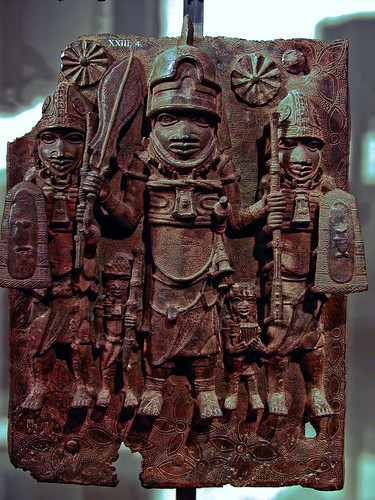
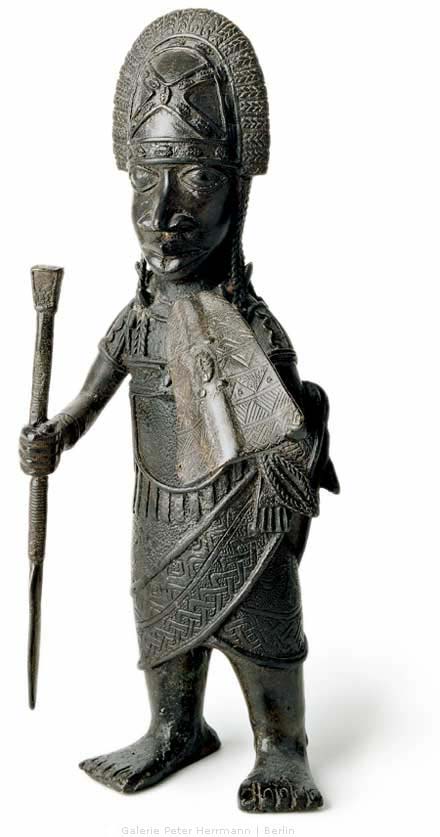
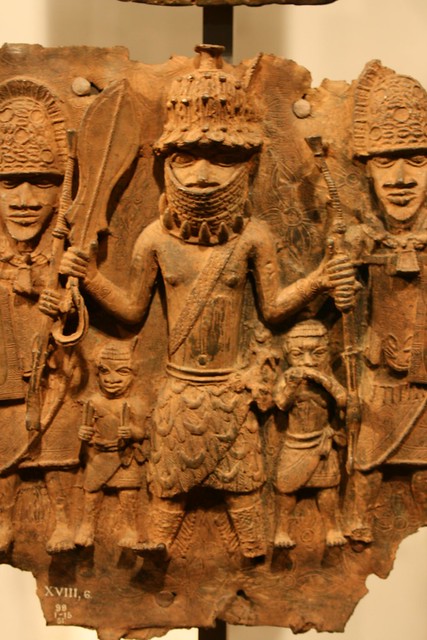
Booshman, from the books I've read and the images I've seen, I didn't get the impression that they did insert iron under there. I actually got the impression that it was either/or. Either the soldier wore the armor from the leather of thick skinned animals like hippos or elephants over a cloth tunic OR he wore chain mail outright, with no animal hide/leather armor, A book that I read way back stated that hippopotamus hide or elephant hide were used for the armor plates and crocodile hide was used for some of the headgear. Given the appearance of the armor in the plaques, I think the statement about it being elephant or hippopotamus hide is entirely accurate. However, I would have preferred if they had stated explicitly that they got this information from the Benin palace or other elders in Benin, rather than just stating it on their own (Western art historians) authority, without reference to their source. Honestly this specific question is one that you would need a real expert on the culture to really resolve decisively. I say this because there are many specific detailed things about Benin that weren't published for a long time, and then, when they were published, it was by "non-professional" or "non-academic" or so-called amateur historians, but from just a cursory reading of their first few words you could tell immediately that they had a really deep knowledge of the traditions of Benin and probably knew more than even the professional historians about certain things. So someone (old) who had deep knowledge of military traditions in the old days might be able to resolve the question decisively. Let me give an example of what I mean. A year ago I stumbled on an online book in pdf format which contains the field notes of an Austrian anthropologist, Siegfried F. Nadel, who studied the Nupe kingdom in the early 1930s and produced an influential study of the Nupe called A Black Byzantium: the Kingdom of Nupe in Nigeria. I haven't read his book (and probably never will, honestly) and I've read very little of his field notes, but I searched the file to see if it mentioned anything about Nupe warriors. The reason is because I had seen two images of the so called "Tsoede bronzes" or "Jebba bronzes" that are associated with both the Nupes and Igalas and I wanted to see if I could find out more about what the military attire of other Nigerian groups was besides Benin. This was at a time when I had seen basically no other military attire besides that of Benin and one of the groups they defeated in their plaques. There's a kind of huge "lack of context" of what warfare between the powerful feudal states looked like in Nigeria from around 1300-1700 etc. because only a little bit of the artwork of other groups besides Benin explicitly shows warriors, so I wanted to get an idea of what Nupe and/or Igala soldiers dressed like. One of Nadel's field notes says: "2/4/6 At Kusodu's house we see a man dressed up in the way the old Nupe horse-warriors used to - complete with chain-mail (sulke), spear (tanci) and leather shield, made of skin of [[Nadel's page no.s 14-17 inclusive are missing , ]]" S.F. NADEL: the field diaries of an anthropologist in Nigeria 1935-36, p. 115 http://www.rogerblench.info/Anthropology%20data/Text/Nadel/Nadel%20composite.pdf Now what is clear from the above is that 1) the Nupe warriors made such frequent use of chain-mail that they had an indigenous name for it 2) there existed warriors from a traditional kingdom in North central Nigeria that used chain-mail Since the Nupes and Igala kingdoms were closely linked (the Igala kingdom was allied with them, but also sort of ruling over them in a way) and the Igala had numerous trade interactions with Benin and an earlier ancient political connection to Benin, the Nupes (who probably got it from someone else) are one possible source for chain mail. Now for Benin, what one would need is someone going around in the 1930s asking people about how the armor was designed, arranged, what the words were for each piece of the armor and what materials exactly were incorporated in the armor, and of course, did they have a word for chainmail armor? Did they make it a practice to keep iron plates under the armor? Of course, we probably don't have that kind of information. There is a lot of written and unwritten information about Benin though, so maybe all of that is known, but not easily accessible or well known. But I'll say what I think about the armor based on what I've seen. My take is this: 1. You said they wore metal helmets, but I think this was only in a minority of cases, as most of the helmets seem to clearly not be metal but rather leathers made of crocodile or elephant or other animal hides, OR what seems to be agate stone beads fashioned into a certain helmet shape. Or they wear (probably red) hats of various designs and shapes that are not for protection, but just for style among the commanders. If you look through most of the images I posted in this thread, that becomes quite clear. The people on the left and right of the central figure in this plaque are one exception: https://farm4.static.flickr.com/3183/2589064432_f6655275f8.jpg And this figure is an exception: https://www.galerie-herrmann.com/arts/art3/Ife_Benin/36_Krieger_380J/Benin_380Y_gr.jpg And the figures on the left and right in this plaque are wearing brass or iron helmets: [img]http://feastbowl.files./2010/10/nigeria-plaque.jpg?w=378&h=500[/img] And I'm sure that there are some other exceptions as well, but I think that in general, their helmets were made of materials other than iron or brass. For example, the central figure in this plaque: https://img714.imageshack.us/img714/1039/2ndcapturefromthebookth.jpg is very clearly wearing a crocodile hide helmet. 2. Benin soldiers probably would have preferred flexible clothing, generally, given the kind of terrain they were going to be fighting in. So padding pieces of metal onto formerly flexible material might never have been seen as ideal. Especially if the padded hide and cloth armor could already stop arrows, spears, etc. Much of the real fighting all over the world was really done with bows/crossbows and spears prior to the development of the gun, despite the glorification of the sword in military cultures including Benin. Some groups made heavy use of battle axes or throwing axes, admittedly, but overall even in those military cultures where the sword was glorified (such as feudal Japan), spears/lances and arrows were still of primary importance for the initial fighting, before close quarters combat started. 3. Not all of the warriors would have worn upper body armor. There are many brass plaques that clearly show individuals with spears or with bows or non-ceremonial swords that are not protected in their upper body armor at all. However when you see soldiers with ceremonial swords in addition to or instead of actual fighting weapons, those individuals are very frequently wearing full armor and occasionally brass bells or other ornaments for spiritual protection in battle, while more plain looking individuals, frequently lacking ceremonial swords and ornaments, are wearing little or no upper body clothing. This suggests (to me, but others might disagree) that it was the higher ranks or more important soldiers that wore elaborate armor, while the lowest ranks were more exposed. Admittedly, there are also plaques showing individuals that are clearly not "leaders" or "central" figures also wearing complete armor, so it probably may not be as simply as high rank = more armor, lower rank = little armor. An example is this image https://farm2.static.flickr.com/1024/973040803_151dfab573_z.jpg where the central, more important figure (the Iyase) has no upper body armor and the side figures do. However, I think that it is the case that this is depicting a war ceremony, rather than recollecting a battle scene: https://www.nairaland.com/nigeria/topic-582176.160.html#msg7956094 I have seen armed figures that do not seemed to be involved in any ceremony that lack armor, but I am not sure whether those aren't just messengers. Nevertheless, I still think the lowest ranks wore little body armor. 4. a) The degree of the effectiveness of the armor cannot be easily gauged today, because we don't have any full armor to look at and study to see exactly how it was made, it seems, and the Benin military system has long been nonexistent. However, we can draw some conclusions from what we know. What we can see from some of the images where the soldiers are wearing full armor is that their armor is layered - with a tunic under leather breastplates and sometimes with one other layer of some other material over part of the leather breastplates. What that other material is over the material is not all that clear. Take this image for example: https://upload.wikimedia.org/wikipedia/commons/9/9a/Benin_kingdom_Louvre_A97-4-1.jpg Take a look at their upper body. There is clearly a (probably red colored) tunic like this Benin tunic: https://img714.imageshack.us/img714/5528/20707410074849204171623.jpg under the leather plate. Then there is the main leather armor. Then there is another material over the leather plate, around the pectoral area that is probably used to fasten together the tunic and the leather more securely. What that material is isn't all that obvious, but it could just be more leather. Here are some other examples of the layering what I'm referring to: https://upload.wikimedia.org/wikipedia/commons/thumb/4/42/Benin_Bronzes%2C_Horniman_Museum.jpg/399px-Benin_Bronzes%2C_Horniman_Museum.jpg ^^^^ In this plaque in particular, it's obvious that the armor is quite thick. https://images.easyart.com/i/prints/lg/2/1/212289.jpg ^^^^^ This plaque also makes it clear that the armor was thick. Here are some images from books: https://img560.imageshack.us/img560/759/sbookonbeninart.jpg https://img840.imageshack.us/img840/759/sbookonbeninart.jpg ^^^ These two images are from Felix von Luschan's book Die Altertümer von Benin (The Antiquities of Benin), 1919. The following three images are from Antique works of art from Benin by Pitt Rivers https://img193.imageshack.us/img193/6706/capturefigures6and7from.jpg https://img502.imageshack.us/img502/2973/capturefigures16and17fr.jpg https://img23.imageshack.us/img23/6361/capturefigure254fromthe.jpg It's clear that when they did use the armor, it was often well layered. b) It also should be noted, to avoid any possible confusion, that elephant or hippopotamus hide is quite different from "standard" ordinary leather from cattle. For example "There's a thick layer of fat under the skin which, besides the thickness of the skin itself, obstruct more serious injuries during fights. When dried, the hippo hide is so tough that it was once used for sharpening of diamonds and natives used it to cover their shields." http://eng.hrosi.org/?id=info_index Here's another link about hippopotamus skin: books.google.com/books?id=p0xvDQq7hZ8C&pg=PA20 One very telling aspect of the sheer toughness of hippopotamus skin is the myth about the skin being bulletproof. Of course the answer is no, but the reason for the myth that hippo hide, crocodile hide, etc. is bullet proof precisely because of how tough the hide is. Take a cursory look at the results from one search: http://www.google.com/search?q=hippo+skin+bulletproof&ie=utf-8&oe=utf-8&aq=t&rls=org.mozilla:en-US:official&client=firefox-a Some links (like this one, immediately below) give the impression that a hippo's skin can be bulletproof: http://www.painfulbite.com/the_hippopotamus.php But once again, that's false. The the reason there is even any confusion or curiosity about whether it actually is bulletproof is because the skin is so particularly thick and tough when dried. Elephant hide armor was also very tough. For example, a Chinese writer from the 12th century, describing the armor of one of the southern Chinese groups, called their elephant hide armor as "solid as iron": books.google.com/books?id=TH0LAAAAYAAJ&pg=PA192 books.google.com/books?id=TH0LAAAAYAAJ&pg=PA193 So this was quite tough material. And crocodile hide? Same thing. "The inspiration for protective clothing is for example crocodile skin, which is able to deflect spears, arrows, knifes and sometimes even bullets. The reason of the high strength of crocodile skin is not only the thickness but collagen protein's fibres. The collagen fibres are the reinforcement parts of skin scales." http://ustachewicz..com/2011/02/skin-inspiration.html As for pangolin skin, those are keratin scales, and would undoubtedly offer some serious protection if layered well, although probably not as much as hippo, elephant, etc. hide. Here's an example of 19th century Indian pangolin skin armor: http://en.wikipedia.org/wiki/File:Coat_of_Pangolin_scales.JPG ^^^^^ You'll note under the caption that it says that this is the only example of this kind of armor, but of course that's not true. Here are a few other pictures of leather and non-leather scale armors from different military cultures: http://en.wikipedia.org/wiki/Scale_armour Elephant hide armor was also known to the Mongols as you can see from note #1 on p. 193 of that book link (books.google.com/books?id=TH0LAAAAYAAJ&pg=PA193), which mentions the elephant hide armor of a Mongol prince in 1573. However the Mongols probably primarily did use buffalo leather or hides of similar animals as it states on p. 190 and p. 180 (http://books.google.com/books?id=TH0LAAAAYAAJ&pg=PA180) of that same book (but they wrapped them in many layers, making them quite strong for defense). In one of the links I posted above, you can see where Marco Polo described these leather armors as being very strong. Also elephant hide was used by warriors in India and other parts of Asia. And crocodile hide armor was used by the Egyptians. So the effectiveness of these kinds of armors was well appreciated by several cultures that were also very capable of creating metal plates and using it in armor if they were so inclined. You can do some more searching on the toughness of elephant and hippopotamus hide and confirm what I'm pointing out by yourself with other sources, though. c) Given the toughness of hippopotamus and/or elephant hide, Benin soldiers might not have felt the need to bother with brass or iron plates, even though they definitely had the technology to do that if they needed. As we already know, the castings were almost all brass, they had swords of iron, and some of the castings of trophy heads or other heads had iron inlaid into the eyes. So making a simple iron or brass plate and connecting it securely to their other armor would not have been a problem or somehow beyond their grasp. But with headgear often made from the thickest toughest part of the crocodile, and very tough elephant and hippo hide armor protecting their upper bodies, they probably felt quite secure already without weighing themselves down with inflexible metals. It may not be entirely obvious from looking at the plaques that they're wearing tough armor and that's because when we think of leather armor, we're used to seeing European leather armor made from cow skin which offers comparatively little protection (I read somewhere that it was basically useless against virtually any sharp weapon), and which we know already to be relatively weak. The Mongols (the most successful military empire in history), the Chinese, and several other groups across Asia made very good use of boiled/dried hides as armor. We know for a fact, for example, that in the case of the Mongols, when they were actually able to engage the Japanese in one battle (in Japan), they trounced the Japanese in battle. The only obstacle was of course, the storms and typhoons that kept destroying their ships and drowning their troops, preventing them from engaging in a full scale invasion of Japan (this happened multiple times - the Japanese called it the "kami kaze" ("divine wind"  because it saved them from the Mongols). This is a very telling fact because the Mongol armor was almost entirely leather based, while the most elite soldiers of the Japanese (the samurai) used those metal plates of lamellar armor in addition to some leather, in their best armor, which we might be misled into assuming would give them a huge advantage. because it saved them from the Mongols). This is a very telling fact because the Mongol armor was almost entirely leather based, while the most elite soldiers of the Japanese (the samurai) used those metal plates of lamellar armor in addition to some leather, in their best armor, which we might be misled into assuming would give them a huge advantage. And of course, the Mongols (who once again, used primarily leather based armor and very little metal), repeatedly defeated the Chinese, who also opted for iron plates on their soldier's armor (although, as p. 181-190 of that book link above shows, at various time even they often preferred hide armor, especially rhinoceros hide armor, although they had extensive iron working technology). I don't really mean to get too off topic by bringing up the Mongols, Chinese and Japanese, but I just wanted to use them as an example to dispel any inaccurate perceptions which might exist about the relative strength of certain types of armors. As p. 180 and some other pages of that book I gave a link to (Chinese clay figures: Prolegomena on the history of defensive armor, Part 1 by Berthold Laufer) make very very clear, impartial observers over multiple centuries repeatedly noted that hard, layered leathers of certain animals were a very strong defensive material against all kinds of weapons when used appropriately. I wrote all of the above, because (and I apologize if I'm reading too much into this), I honestly got the impression from the way your question was worded that you perceived the animal hide (hippo, elephant, crocodile), used by the soldiers as being akin to ordinary leather from cattle and that was why you may have assumed they might have needed to wear iron plates underneath. I only mean to point out that there is a HUGE difference between wearing one or two layers of ordinary cow leather and wearing the thickest part of the dried hide of a hippo, crocodile or elephant fashioned into a breastplate. If that wasn't the perception that led you to ask that question, then I apologize for seeing that in your question, but if that was something that had been bothering you (the actual strength of the armor), then I hope what I posted above resolved the question to some extent. Admittedly, it is always be good to have a last line of defense, so maybe Benin's soldiers might have thought of that and indeed put metal plates under the leather breastplates, regardless of how strong their outer armor was, but like I said, we probably won't know, since the people who would have known all about that are probably no longer alive. 5. Now the issue of chain-mail that I brought up earlier. Mail is of course, quite strong in terms of defense against slashing, and it's difficult to slash through good chain mail armor, but, against blunt hits (like from a war hammer or mace for example), it's not useful at all. However, the ability of good chainmail to so strongly withstand slashes is obviously the source for at least one Benin tradition. There is very clear reference to one famous suit of chain mail in Benin tradition. Oba Ozolua the Conqueror wore what is remembered in Benin tradition as his impenetrable "iron cloak". There are a whole lot of published sources that state this long established piece of tradition. This is one detail about the battle armor of one of the warrior kings that has been published by "professional" or "academic" historians. The impenetrable "iron cloak" or "iron coat" is obviously a reference to strong chain mail. This is something that could have been obtained from either the North (Northern Nigeria, especially the kingdom of Bornu, if a trade link existed; some of their cavalry are known for a fact to have worn chain mail, from direct observation from visitors) or the Portuguese, or (and this is much less likely, in my opinion, considering the already established Benin style of armor) it could have been an indigenous product. In Benin's history Oba Ozolua was betrayed by his most trusted general, Laisolobi, because the soldiers were exhausted and tired of conquest but the Oba would not turn back. In the traditional account, Laisolobi was able to kill Ozolua because the Oba had taken off his iron armor at that point. Whether Ozolua was actually defeated by opposing warriors (in Esan) or betrayed by his most trusted general is not entirely clear, but the legend of the cloak is an obvious reference to chain mail. Here are some mentions of Ozolua's "iron cloak" http://books.google.com/books?ei=0GuKToagGsi2twfpvKisAw&ct=result&id=NgfqAAAAMAAJ&dq=ozolua+iron&q=+iron+coat#search_anchor http://www.google.com/search?hl=en&client=firefox-a&hs=9AG&rls=org.mozilla%3Aen-US%3Aofficial&biw=1173&bih=622&tbm=bks&q=ozolua+iron&oq=ozolua+iron&aq=f&aqi=&aql=&gs_sm=e&gs_upl=10856l11387l0l11565l5l5l0l4l0l0l60l60l1l1l0 ^^^ However, you can see from the second to last search result from the second link, that in the book The Art of power, the power of art: studies in Benin iconography, the author mentions that in the 50s, R.E. Bradbury recorded a Benin tradition about Oba Ozolua's iron coat being an indigenous product, made by a blacksmith named Odia, in contradiction to my hypothesis (which I still stand by) about it being obtained through northern trade connections. (There are also some mentions of it in one or two of the art books on Benin that I list below in #6) This could be a depiction of Oba Ozolua (seen with the distinctive box shaped hat), or it could just be a depiction of a certain war commander: https://img207.imageshack.us/img207/759/sbookonbeninart.jpg The image is from Felix von Luschan's Die Altertümer von Benin (The Antiquities of Benin), 1919. 6. Benin artists depicted what was chain mail on multiple brass plaques. The material depicted is almost always on a warrior figure that could be an army commander or it is on what is possibly a warrior king (Ewuare, Ozolua, Orhogbua, etc. - the Obas that took part in actual military expeditions before that practice stopped after Oba Ehengbuda's death), which makes it extremely likely that the material has a military function. Furthermore, the material looks very distinct from the depictions of coral or agate beads - they just have a different depiction, which suggests that they are not beads at all. And, as previously stated, there are multiple depictions of armed warrior figures with these outfits, and a coral or agate bead shirt is completely useless to a war captain or high ranking soldier as far as defense. There is an image of a plaque in a book I checked out that I no longer have with me, which has a caption that also states that the material depicted on the figures in the plaque is chain mail, and claims that this is the consensus among scholars about those outfits on plaques. I might scan and upload the image if I can get the book again. I had a lot of similar books checked out at the same time and it was slightly over a year ago (and some of them, I checked out even earlier, so it would be especially difficult to recall those ones) so I would need to look through all of them again and narrow it down to the exact one that had the picture and the caption about it being identified as chain mail, so unfortunately I can't give the exact name of the book at this time, but I know that it's in at least one of these books: Paula Girshick Ben-Amos - The Art of Benin, Kate Ezra - Royal Art of Benin: The Perls Collection in the Metropolitan Collection, Metropolitan Museum of Art, New York Armand Duchateau - Benin: royal art of Africa from the Museum für Völkerkunde, Vienna Nigel Barley - The art of Benin Marie-Therese Brincard (editor) - The power of bronze: royal sculpture from the Kingdom of Benin Phillip J.C. Dark - An Introduction to Benin Art and Technology Phillip Dark - Benin Art, photographs by W. and B. Forman Stefan Eisenhofer, Franýois Neyt and Fritz Falk- Ife Akan und Benin: West African art from 2000 years Barbara Plakensteiner (Editor), O.J. Eboreime (Foreword) - Benin: Kings and Rituals: Court Arts from Nigeria The three books I put in bold - especially the ones edited by Ezra and Plakensteiner - are the most likely to contain the image and caption that I mentioned, as those are the ones with the most (and the best, in my opinion) pictures. 7. Here are a few images of what I'm talking about in #6 as far as multiple depictions of chain mail: https://www.deviantart.com/download/144824292/A_Bite_Of_Benin_Brass_by_aegiandyad.jpg ^^^ The middle figure is dressed militarily, and what he is wearing are not depicted the same way beads are usually depicted. Furthermore, he could not just be wearing a plain gown of clothing as an actual warrior. https://img191.imageshack.us/img191/3148/beninkriegerc5.jpg ^^^^ Note that he's wearing the armor in the exact same style (almost down to the feet), and that he is posing in a very battle ready position, so it makes sense that he would be dressed militarily. The figure is from here: http://www.zeller.de/de/katalog/auktion-89-junijuli-06/auktionsartikel/benin-krieger/ Furthermore, the length and shape of these outfits is consistent with the appearance of chain mail tunics in other cultures (European, Arabic, etc.). In most of the Benin brass plaques, male figures are not wearing clothing which has the form of a dress, which is how chain mail tunics look. 8. In summary this is basically my view of the armor used: a)primarily thick, tough hides layered into armor b) occasional use of chain mail that they sourced from their northern neighbors (Nupe & Igala?) or from the Portuguese or other Europeans. But despite what I have stated above, there is one intriguing image that might support your idea about wearing iron under the leathers. I came across this image on a German art auction website which is auctioning some (looted, mostly) African art: http://www.zeller.de/de/katalog/auktion-89-junijuli-06/auktionsartikel/benin-reliefplatte-1/ This is a plaque showing a ceremonial gathering involving an important warrior figure on the right - probably a warrior king - dressed in pangolin shirt and holding a ceremonial sword and a spear. To his left, are two horsemen with Igala or Nupe markings (scarification) on the sides of their mouths, like those on the Benin cross bearing messenger figures and on several other Benin figures (such as the bronze horseman) but what appear to be Benin outfits and with the hair braids seen on several of the (Edo) figures on Benin plaques. This site allows you to click on the image to get a larger view. If you look at the larger image, and look closely at the helmets on the two (probably Igala) figures on the left, you can see that they have what appears to be a metallic helmet under the (crocodile?) leather covering. From this metallic helmet you can see a chin strap which both figures are wearing and you can also see that there is something at the top of their helmets which looks metallic. I think these might be Igala figures from the period after Benin defeated and held some influence over Idah (early 16th century), but prior to the period where the Jukuns invaded (17th century) Idah and briefly held sway over Idah. You can see very clearly from the depictions of their helmets, that there is a double layering thing going on there. Like I said earlier, I don't think Benin's soldiers did any double layering of metal and leather just from the images I've seen and I think they were probably quite confident with armors without metals. But this image makes it clear that there's a possibility that other groups (such as Igalas) may have had such practices of combining iron and leather in a manner similar to that in the helmets. |
| Culture › Re: Best Musicians !(friendly Rivalry) by PhysicsQED(m): 10:04am On Oct 05, 2011 |
Another classic Miriam Makeba - Pata Pata [flash=480,390] https://www.youtube.com/watch?v=Zq5S5sH1Ikk&feature=related[/flash] |
| Culture › Re: Best Musicians !(friendly Rivalry) by PhysicsQED(m): 10:01am On Oct 05, 2011 |
[flash=480,390] https://www.youtube.com/watch?v=XoHWjG6LUsA&ob=av2e[/flash] I guess this is technically British music actually. . . |
| Culture › Re: Best Musicians !(friendly Rivalry) by PhysicsQED(m): 9:59am On Oct 05, 2011 |
[flash=480,390] https://www.youtube.com/watch?v=FiOcVWQY2bc&feature=related[/flash] |
| Culture › Re: Best Musicians !(friendly Rivalry) by PhysicsQED(m): 9:56am On Oct 05, 2011 |
[flash=480,390] https://www.youtube.com/watch?v=PuJ1NALgZ8s[/flash] |


 wtf is wrong wit u microphallus son of a turd.





1 2 3 4 5 6 7 8 ... 123 124 125 126 127 128 129 130 131 (of 154 pages)