Great . The Gold Coast became Ghana after independence. Then Rhodesia ( South, East, West, North whatever) became Zimbabwe. In Chad, Fort Lamy ( the capital) became Ndjamena. The cultural shift should continue. Countries like Sierra Leone, Cote d'Ivoire, Cameroon etc. should also change their names.
Make no mistake Panafrican is not a Muslim. He is a 100% Conservative Catholic who is happy a patriot like General Buhari took over from crooked Jonathan. The latter is a sell - out European union stooge who spent his term in office conniving with foreign powers to loot African countries instead of fighting corruption in Nigeria.
The upcoming presidential election in Nigeria will be about who has a proven record when it comes to fighting corruption, nailing down the bad guys and moving things forward. The only one who is better qualified as of now is general Buhari.He is the only sheriff in town. That is why those who just hate him should go back do their homework because they are missing the point.
We first need a good army. An army that will good enough to thwart British and French plots against us. Just remember the British are somewhat behind most of the major wars in Europe and the World. : the 100 - year war ( which actually lasted 116 years), the 7 - year war, the 1sr, 2nd, 3r , 4th etc. coalition wars against the French revolution and the French empire, WW1, WW2 Just to name a few . We better watch them.
This NYT Op-ed can well be a true Fake News engineered by gay extremists to spray rumors, mutual suspicion, distrust and confusion in the Trump administration on purpose to bring this president down.
Trump will win on that and the senator will be seen as a Washington swamp keeper the U.S. president was talking about during the 2016 campaign. Lost battle over a non issue.
One of the biggest crimes of the 21st century. 1.2 billion mentally sick people and potential HIV vectors Let's just pray God spares the rest of us when he decides to close the chapter of this insane world.
We better watch them if we don't want to be caught off guard again like we were after the Berlin conference in 1884-885
WORLD MACRON WANTS TO CREATE A EUROPEAN ARMY—BUT FIRST HE'S REVIVING FRENCH MILITARY MIGHT BY DAVID BRENNAN ON 8/29/18 AT 10:10 AM
French President Emmanuel Macron has long wished for greater European military cooperation. This week, he continued the drive, suggesting the bloc can no longer rely on American military support to protect members against outside threats.
In a speech to relaunch his political agenda Monday, the president explained, “It is up to us to guarantee European security” and said he would “launch an exhaustive review” of security relations with “all Europe's partners, which includes Russia.”
After decades of underinvestment, Macron is spearheading a push to revamp France’s military, returning it to its historical position as one of the most well-funded and potent forces in the world. With Europe facing an emboldened Russia and the Western allies battling Islamist threats across Africa and the Middle East, France needs its bite back.
Greedy Boers and British created all this mess in the first place when they started slaughtering Black people and taking rich lands by force. How can someone plunder people's lands then later complain when they claim their property ?
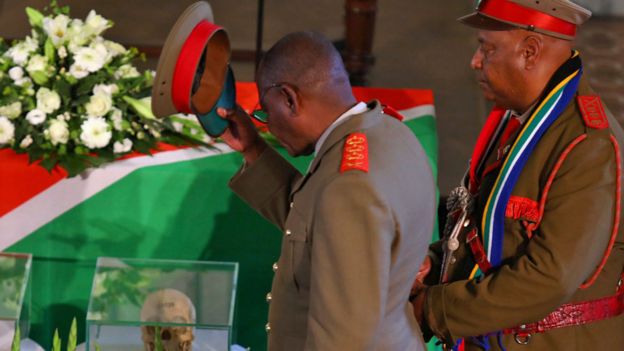
A Namibian government delegation received the skulls at a church service in the capital, Berlin.
The bones had been sent to Germany for now-discredited research to prove the racial superiority of white Europeans.
Tens of thousands of Herero and Nama people were murdered in response to an anti-colonial uprising.
Why was an extermination order issued?
The genocide began in 1904 after a Herero and Nama rebellion in response to the German expropriation of their land and cattle
The head of the military administration in what was then known as German South West Africa, Lothar von Trotha, issued an extermination order in October 1904.
The Herero and Nama were forced into the desert and any who were found trying to return to their land were either killed or put into concentration camps.
There is no agreed figure of how many died but some estimates have put it as high as 100,000. It is thought that 75% of the Herero population and half of the Nama population died.
The skulls of some of the victims were sent to Germany where racial anthropologists studied them as part of an attempt to justify a theory about the superiority of Europeans.
There are thought to be hundreds of Namibian skulls in Germany and on Wednesday more than 25 remains were handed back.
Skulls from Germany's other African colonies, including modern day Cameroon, Tanzania, Rwanda and Togo, were also used in the discredited studies.
BeijinDossier: Which military background? I guess the Oxford product like Ojukwu were not in the same military? Was Buhari ever qualified to be in the military, because he never even had ordinary school certificate? Buhari is not supposed to be in circulation of normal people because it takes even an alien to understand his spoken English language. Buhari is a disaster and an embarrassment that should have been avoided in 2015.
He was democratically elected in a country of almost 200 million inhabitants. If you cannot understand that message then good luck to you in politics.
LordVarys: Please use the sharing tools found via the share button at the top or side of articles. Copying articles to share with others is a breach of FT.com T&Cs and Copyright Policy. Email licensing@ft.com to buy additional rights. Subscribers may share up to 10 or 20 articles per month using the gift article service. More information can be found at https://www.ft.com/tour. https://www.ft.com/content/2795662c-a8aa-11e8-94bd-cba20d67390c
Donald Trump will welcome Kenya’s Uhuru Kenyatta to the White House on Monday for what will be only the second one-on-one meeting the US president has held with an African leader since he took office last year.
The first meeting, with Nigeria’s ailing 75-year-old Muhammadu Buhari in April, ended with the US president telling aides he never wanted to meet someone so lifeless again, according to three people familiar with the matter.
Advocates of closer US-Africa ties hope his encounter with the younger, more urbane Mr Kenyatta, 56, will breathe fresh life into a relationship with a region that Washington is seen to have neglected as other countries, notably China, develop ever-closer trade and investment ties with the continent.
Under Emmanuel Macron, France is also trying to reset its relationship with its former colonies in Africa and deepen commercial ties with bigger economies in the Anglo sphere, such as Nigeria and South Africa.
“Trump likes chemistry,” said a person in touch both with senior US administration officials and the Kenya delegation preparing for Monday’s meeting. “Africa has never been high on his radar but if the big guy likes you he’ll find a way to make things work.”
Fake News. President Trump was very impressed by the inspiring personality, the dignity and respect president Buhari displayed.
You referred to general Buhari as "Nigeria's ailing 75-year-old". Sufficient enough to know where you stand.
Keep in mind the general is well and he will be reelected for a 2nd term. Jonathan Goodluck will be invited and be given a seat in the very first row , so he can watch the ceremony from a close distance as a FORMER president.
Looks like the revolution is going to swallow its own children. Classical outcome when two strongmen are in control.
Rifts at the Top Rattle Zimbabwe After Mugabe Aug. 22, 2018, at 8:48 a.m. BBC
BY JOE BROCK
HARARE (Reuters) - As Zimbabwe braced for opposition protests after this month's disputed election, a heated argument broke out in the offices of President Emmerson Mnangagwa over who was in charge of national security, two people with direct knowledge of the meeting said.
At one point, Vice President Constantino Chiwenga reminded Mnangagwa that it was he who had installed the president in power after last year's coup against Robert Mugabe.
Details obtained by Reuters about the post-election rift between Mnangagwa and Chiwenga paint the clearest picture yet of a power struggle that could define Zimbabwe's future.
As a result, Western governments and big business fear Zimbabwe may not fulfil its economic potential, putting at risk billions of dollars in aid and foreign investment.
Zimbabweans had hoped that the election on July 30 would turn a page following decades of turmoil under Mugabe.
That optimism evaporated in the days that followed a military crackdown on demonstrators, when the Zimbabwe Election Commission (ZEC) was alleged by the opposition to have rigged the vote, and police and soldiers were accused of abusing opposition supporters.
Mnangagwa, the 75-year-old Mugabe ally who replaced his old friend, was declared the winner by the ZEC on Aug. 2, but the leader of the opposition Movement for Democratic Change (MDC), Nelson Chamisa, 40, is challenging the result in the constitutional court this week.
Analysts say the court is unlikely to overturn the result.
Presidential spokesman George Charamba said there were no divisions between Chiwenga and Mnangagwa, echoing the united front the two have maintained publicly.
"The overbearing reality of harmony within the Presidency will not change because of wishful scenario-building," Charamba said in an emailed response to questions. "One gets a sense some interests feel threatened by the combination in the Presidency."
TENSIONS MOUNT
After a more peaceful build-up to the election compared with the violence of the Mugabe years, nervousness grew when the ZEC delayed releasing the presidential result.
When it eventually became clear that the ZEC was about to announce Mnangagwa had won, Chamisa claimed victory on July 31 and accused ZEC chairwoman Priscilla Chigumba of collaborating with ZANU-PF, the ruling party, to steal the election. Chigumba has defended her independence.
As tension mounted that day, Mnangagwa, Chiwenga, and defense forces chief Philip Sibanda held crisis talks in the presidency offices in Harare, according to the two sources, one from the military and another from ZANU-PF. Several other senior officials were present, they said.
Chiwenga, 61, said that since he held the defense portfolio he should manage security at opposition demonstrations expected the following day, the sources said.
Mnangagwa and Sibanda wanted any protests to be handled by the police.
"Chiwenga was unhappy. He said the election had been badly managed and stability needed to be restored. It got heated," said the military source.
"Chiwenga said no one should forget who got rid of Mugabe."
Charamba, who speaks for the president and vice-president, declined to comment further. Chiwenga did not answer a call to his phone. An army spokesman did not immediately respond to a request for comment.
A day after the meeting, as riot police tried to disperse protesters in Harare, military armored vehicles unexpectedly rolled onto the streets. Soldiers fired live rounds and beat opposition supporters. Six were killed.
Since then human rights groups have reported more than 150 incidents of alleged abuses by security forces against opposition supporters, including illegal detention, assault, looting and rape. Many in the MDC have fled. (...) "This internal struggle may paralyze any reform process and Zimbabwe will continue to lurch from crisis to crisis."
Many analysts and diplomats in Harare believe Chiwenga's ultimate ambition in removing Mugabe was to take his seat but he handed power to Mnangagwa to give the military intervention the veil of legitimacy.
"Chiwenga should not be underestimated. He will dig in," said Alex Magaisa, a London-based political analyst.
"If Mnangagwa survives the court challenge, I still do not expect him to finish his term. I expect Chiwenga to take over before the next election."
The acrimony between the Mnangagwa and Chiwenga factions has intensified due to the failure to achieve the smooth election Mnangagwa promised, security sources say.
"They are operating parallel governments," Magaisa said.
The split between Chiwenga and Mnangagwa is making it difficult for investors, who say they don't know who to talk to. Many deals have fallen apart. (..)
The ructions have also dismayed Zimbabweans who took to the streets to embrace soldiers during the coup last year.
"We should have known these generals would end up being the real ones in control," said Tonde, a Harare street trader.
"They swapped camouflage for suits and ties but they are the same men deep down."
Jkay187: Look at this fcvucktard still don't see the bigger issue at play here by right wing white supremist. Trump has no say or right in SA land issue this is about us not the USA. Anyway South Africans don't trade that much with US anymore and they aren't even the biggest investors in SA. WE are going East Bleep the west.
You should also learn to stop worshiping your white mans ass*s
We all know who is behind that lobbying. They are trying to immigrate " en masse " ( in droves) to America, that is why they are demonizing Black South Africans. The only thing they are not telling Trump is why are Black so angry at them, what did they do. They tried such a propaganda on purpose to immigrate to Australia but the Australians turned them back. They cannot immigrate to Canada because Canada can't stand such a group of racist people. They can't go to Western Europe because Europeans are tired and sick of scumbag race supramacists. Their only hope is to bring Trump on their side. They will fail when things start pouring out in the media about the ugly untold story of the apartheid regime.
Back from a ten - working day vacation in U.K. General Buhari promised to jail more thieves. With no doubt the Nigerian president is one of the few if not the only sitting African president whose priority is to rid his country of corruption.A lot of African presidents do not even mention that issue in their daily speeches and we know why, a witch is always reluctant to expose another witch.
Kofi Anan backed a foreign army ( the French army) in the massacre of thousands of unarmed civilians by French soldiers in November 2004 at the Hotel Ivoire in Abidjan, CI. People were protesting against France's support to Muslim rebels who attacked the country on September 2, 2002. Thanks to France and Koffi Anan, Ouattara the rebel leader is president today in Cote d'Ivoire
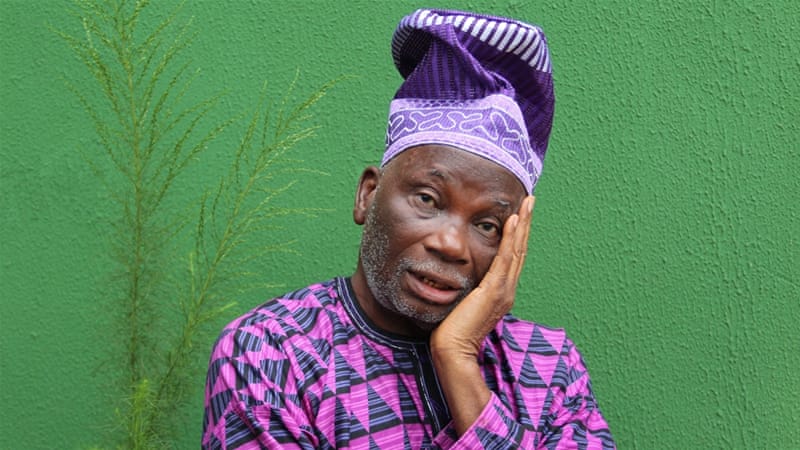
I remember the day … I designed the Nigerian flag In 1959, a year before Nigeria's independence, a 23-year-old student helped colour the country's identity.
A 23-year-old Ibadan-born student gave the new country its national flag.
Michael Taiwo Akinkunmi was studying engineering at Norwood Technical College in London when he saw a newspaper advert calling on people to enter a competition to design the Nigerian flag.
He mailed his submission to Lagos a short time later, and in October of the following year received a letter inviting him to the London office of the Commissioner for Nigeria in the United Kingdom, where he was told that his green and white design had been selected. He had won 100 pounds ($281 in 1959) as well as a place in Nigeria's history books.
It was October 1959, exactly a year before Nigeria's independence.
Akinkunmi is now a retired civil servant who resides in one of the poorer areas of Ibadan, in a green and white house that can only be reached on foot. Separated from his wife for about two decades, his only live-in companion is his 28-year-old son.
He does not have a phone and last owned a car in the early 1990s. But he enjoys walking through the neighbourhood and further afield to visit two friends from his school days. These excursions add colour to his days.
The furthest he recently travelled was a visit to Abuja in 2014, where he received a national honour from then-president Goodluck Jonathan. He was also given a lifetime's salary of a presidential special assistant - around 800,000 naira (roughly $4,000) is now paid into his account every month. Akinkunmi is effusive as he remembers that day, but he cannot recall what Jonathan said to him.
"Seventy-five," Akinkunmi says when asked about his age, but after his son corrects him, he agrees, "I'm 79." His son insists his memory is fine.
Yet Akinkunmi gives the wrong name for the college he attended in London, doesn't remember why he underwent surgery within days of winning the competition and cannot give a single detail about what he was doing on October 1, 1960, when Nigeria raised its national flag for the first time.
"Well, I was just pleased," he says about his feelings on that day.
Sunday Olawale Olaniran was an undergraduate at the University of Ibadan when he got to know Akinkunmi , or as he later dubbed him the "hero without honour".
"When I met him in 2006, he would never say anything negative," Olaniran remembers. "He would say 'God bless Nigeria,' or 'Nigeria is moving forward and will keep moving forward.' Even when you could see around him that he was not well taken care of."
At the time, Olaniran was compiling a pamphlet on Nigeria's history. It was during his research for that history that he learned who the designer of the Nigerian flag was and decided to track him down.
"People said he was dead, that I should forget about looking for him and just write about the flag," he says. But Olaniran kept searching until he found him in Ibadan. Akinkunmi was living alone, left to the care of his neighbours. On the first day they met, Olaniran says the older man was incoherent and kept talking to himself. His state drove Olaniran to tears. "So I got in touch with a journalist and we went back two days before Independence Day," he says. "Even the journalist couldn't believe the man was still alive."
The resulting story was published in the national The Sun newspaper on October 1, 2006, and Olaniran says it was only after it appeared that most Nigerians became aware of Akinkunmi 's condition. Akinkunmi was a pensioner when Olaniran found him, but his pension payments were so irregular that he could not even depend on them to feed himself. "Some Nigerians went to him and donated foodstuff, clothes," Olaniran says.
Then, in 2008, Olaniran was contacted through his blog by a representative of the Nigerian edition of Who Wants to be a Millionaire, asking to be put in touch with Akinkunmi . For his appearance on a special edition of the TV show, Akinkunmi was given a cheque for two million naira (around $10,000). This was the money his son says was used to complete the green and white building they now live in.
OPINION/FRANCE Torpedoing Africa, and then complaining about 'migration' European countries are still shaping the lives of millions of Africans, determining both their present and future.
Lorenzo Kamel by Lorenzo Kamel 4 hours ago , Saturday August 18, 2018
Out of the 67 coups in 26 African countries in the last 50 years, 61 percent took place in former French colonies. Fifty percent of the monetary reserves of 14 African countries are still today under full French control: none of them has any control over its macroeconomic and monetary policy. France makes billions of euros from Africa annually under the form of "reserves", and lend part of the same money to its owners on market rates.
These few numbers hide one major truth: many European countries, France first and foremost, are still today shaping the lives of millions of Africans - three quarters of whom live on less than two dollars a day - determining both their present and future. They take the best out of Africa, while largely ignoring, or complaining about, much of the rest (noteworthy: Muslims represent about eight percent of the total French population and yet, between 40 percent and 70 percent of the population of France's prisons are estimated to be Muslims, mainly originate from African countries).
How are the European Union (EU) and many European citizens responding to this reality? They tend to focus on the "final rings of the chain" (including NGOs, "hotspots", or how to "divert irregular migration", meaning that they focus on "the migration crisis plaguing Europe" without addressing some of the main structural conditions behind these phenomena.
Post-colonial "possessions" A number of agreements signed in recent years by the EU in different parts of Africa have been largely detrimental for local populations, not least because they have exposed weak economies to unfair competition, adopted "divide and conquer" tactics when negotiating with African countries, and reduced trade between African nations.
OPINION Africa is not poor, we are stealing its wealth Nick Dearden by Nick Dearden On top of this, these agreements are often signed by countries that are still heavily dependent on external powers. A case in point is represented by the accord - the covers goods and development cooperation - reached by the EU and the Economic Community of West African States (ECOWAS) on February 24, 2014.
Almost all countries that are part of both ECOWAS and UEMOA (West African Economic and Monetary Union) - including Benin, Burkina Faso, Ivory Coast, Guinea, Guinea-Bissau, Mali, Niger, and Senegal - are still today de facto "post-colonial possessions".
The Central Bank of each of these African countries is in fact compelled to maintain at least 50 percent (it was 65 percent until 2005) of its foreign exchange reserves in an "operations account" controlled by the French Treasury. Moreover, each Central Bank is required to maintain a foreign exchange cover of at least of 20 percent of its liabilities.
It should also be mentioned that still today - despite the efforts made by ECOWAS to create a new common currency (ECO) for West African states - the CFA Francs, which are in reality two different currencies both guaranteed by the French Treasury, are the official currencies in 14 West and Central African countries.
CFA Francs, contrary to the dollar or euro, cannot be converted into any other currency. This means that all these countries are excluded from the international foreign exchange market (FOREX), the largest and most liquid market for options of any kind in the world.
It could be claimed that the countries that operate with these currencies might freely leave the arrangement at any time. In truth, dozens of African leaders, from Silvanus Olympio in Togo to Muammar Gaddafi in Libya, have tried in recent decades to replace these tools of monetary and financial control with a new common African currency. Almost all of them - with the possible exception of Malian President Modibo Keïta (1915-77) - have been killed or overthrown the very moment in which their attempts were close to succeeding.
Tackling structural interests For many centuries, Europe contributed to intercontinental migration more than any other continent. On the other hand, migrants from other continents rarely chose Europe as a destination.
Much is changed during the 20th century, and yet, still in 1990, migrants from West Africa, where many of the current migratory waves directed to Europe stem from, represented only the 0.005 percent of the annual population growth in Europe, which at the time was 0.184 percent.
The upsurge of net migration from Africa from the late 1990s, and more specifically the upswing of migratory traffic across Sahara from West to North Africa, is the result of an unprecedented "perfect storm", meaning the (never so) well organised exploitation of Africa - mainly at the hands of single European countries and companies, with the connivance of corrupted local leaderships - the increasing destabilisation of the entire region (to which European weapons are also contributing much), and the epochal challenges posed by the combination of climate change and demographic growth (according to the United Nations, more than half of global population growth between 2015 and 2050 is expected to occur in Africa).
Instead of tackling these epochal challenges and acknowledging that 87 percent of world refugees are hosted in low and middle-income countries, a number of European politicians and millions of average citizens have chosen the "easiest path": they are invoking a Europe-wide alliance against "mass immigration", or, more precisely, quoting Italy's Interior Minister Matteo Salvini, "a League of the Leagues of Europe, bringing together all the free and sovereign movements that want to defend their people and their borders".
"Europe", in truth, is not defending itself, but "attacking". It is doing so in a more sophisticated way than in the past, while receiving only limited "side effects". In this sense, concerns about "migrations" cannot but generate a positive outcome for European countries and citizens: in the medium-long term, they will be compelled to reconsider their attitudes and policies. And this process starts with broadening awareness on these issues.
Indeed, complaining about "migrants" - not dissimilarly from focusing on NGOs, or on the "financial" cost of the "migration crisis" for European countries - is a self-assuring shortcut that speaks at the gut of millions of disillusioned European citizens. Challenging and tackling the structural interests of (mainly) European businessmen, companies and governments - like Africans are doing through initiatives like the "West Africa leaks" - would be much riskier: this is why it won't easily happen.
Fostering local agency The "West Africa leaks" investigation, published by the International Consortium of Investigative Journalists (ICIJ) last May 22, has confirmed that real change will ultimately come from African citizens themselves. The end of the exploitation of their countries passes, in fact, primarily through their structured and organised efforts.
Through the analysis of 27.5 million leaked documents, the "West Africa leaks" shed further light on how government officials, arms merchants and corporations have syphoned off millions of dollars from some of the poorest West African states through offshore tax havens. The latter is, to a large extent, linked to European and American companies and businessmen.
The result of the investigation, the largest-ever collaboration of journalists from West Africa, is particularly meaningful if considering that the region (West Africa) accounts for more than one-third of the about $50bn that leave Africa each year illegally.
There is still much to inquire about the role played in these processes by some of Africa's most powerful politicians and business leaders, although the OPL 245 case in Nigeria, from where one in every five Africans is from, might be considered as a poster child for understanding how the system works, and how it should be tackled.
Let the brainwashed slaves think they are more secure when Africans don't make it or when African immigrants are kicked out of America. Let them feel secure among Mexicans , Arabs , Asians etc. The day those they feel secure with start hanging on trees again or gunning them down like deers , with everyone around them cheering the "best shooter" they will get the message. It would be too late though.
Allassane ouattara the usurper and illegal immigrant bastard from Haute volta. ( now Burkina Faso) lost. the confidence of his French masters , reason why they ordered him to release all political prisoners.
There are new guests at the ruined palace where Emperor Jean-Bédel Bokassa once held court. During his rule over the Central African Republic in the 1970s, Bokassa used a year’s worth of development aid to stage an extravagant coronation, and he personally oversaw the torture of prisoners. He fed some to his pet crocodiles and lions.But the French government that helped install Bokassa in 1966 ousted him in 1979, deploying paratroopers to prevent any countercoup.
Now, four decades later, it is Russian soldiers who mill around this crumbling estate in Berengo—and the shifting power dynamic is raising concerns in the West. President Vladimir Putin is pushing into Africa, forging new partnerships and rekindling Cold War–era alliances.
“There will be a battle for Africa,” says Evgeny Korendyasov, head of Russian-African studies at the Russian Academy of Sciences, “and it will grow.”Russia’s economy is in long-term decline, and its reach has diminished since the Soviet era. So the Kremlin is using diplomatic, economic and military tools to prospect for political influence and new markets in Africa—signing multibillion-dollar arms deals, bidding for big construction projects, boosting space communications, exploiting hydrocarbon reserves and launching publicized military interventions, alongside more clandestine operations.
“The Russians want to implant themselves in the Central African Republic so they have an axis of influence through Sudan in the north and southwards into Angola,” says a senior United Nations security official in Bangui, CAR’s capital, who requested anonymity as he wasn’t authorized to speak with the media. “The French are hated as the old colonial power. American troops have left. https://www.newsweek.com/2018/08/17/russia-putin-africa-kremlin-central-republic-devastated-power-dynamic-1061066.html
 Foreign Affairs › Re: South Africa To Be Renamed Azania by panafrican(m): 1:46pm On Sep 15, 2018*. Modified: 10:25pm On Sep 15, 2018


 , meaning that they focus on "the migration crisis plaguing Europe" without addressing some of the main structural conditions behind these phenomena.