Rafidi's Posts
Nairaland Forum › Rafidi's Profile › Rafidi's Posts
1 2 3 4 5 6 7 8 9 10 11 12 13 14 15 (of 19 pages)
 Islam › Re: Ex-Sunni: 'Why I Became Shia'; Inspirational Stories by Rafidi: 8:57pm On Apr 04, 2013 Islam › Re: Ex-Sunni: 'Why I Became Shia'; Inspirational Stories by Rafidi: 8:57pm On Apr 04, 2013 |
BetaThings: I wanted to hear the true Shia position, but you defaulted into abuse.suit yourself! if you truly want to know the "Shia position" as you claim (while at the same time presenting false ideas and allegations against the Shia,and insisting on them),as Imam Ali (as) rightly put it: "there is enough light for those who want to see". SALAM. |
| Islam › Re: Ex-Sunni: 'Why I Became Shia'; Inspirational Stories by Rafidi: 10:29pm On Apr 01, 2013*. Modified: 10:45pm On Apr 01, 2013 |
^ You are not after the truth.you are after arguing. you criticized those (companions) who assassinated Usthman and then said you don't "judge", because the Shia do just as you did (to criticize bad deeds),by opposing the bad deeds of a number of companions.Shia do not believe "almost all" companions apostatized. then,you replied that a Sunni scholar who said Prophet Khidr (as) controls the world,believes Prophet Khidr (as) controls the world by Allah's permission.that is true and fine.but why don't you apply the same thing that if the Shia believe Imam Mahdi (ajtfs) or the Prophet Muhammad (s) controls the world it is also and only by Allah's permission? you see the double standard? when it comes to examining what Sunnis say,you prove to be smart and in touch with reality.but when it comes to what the Shia say,you turn yourself blind and twist what the Shia say.you've still gone to bring propaganda videos,and decided to reply earlier posts of Zhul-Fiqar at a stage you saw you couldn't continue in a logical fashion with me. you can talk to yourself.it wont make any difference.you have made blindness your choice.tread in it. SALAM. |
| Islam › Re: Ex-Sunni: 'Why I Became Shia'; Inspirational Stories by Rafidi: 8:56pm On Mar 31, 2013 |
BetaThings: I have found out. Those assassins were unjust and concocted lies against Uthman.Wow! How dare you criticize sahaba and Aisha,the "mother of the believers"!!! Are you now "Shia"? Those assasins were also companions,and Sunnis do not criticize any sahaba and call them "unjust" and "liars".Sunnis don't "interfere in what happened among companions".Sunnis love them all-the good and the bad!!! In fact Sunnis don't reveal what is recorded in their books about the companions who took part in the assasination of Usthman.common if you're Sunni then cover your eyes,seal your lips and turn a deaf ear  Interesting anthology  Sunnis actually insist that Uthman married Ali's daughter. Some Shias claim that Ali was forced to agree to the marriageI know that of Umar;not Usthman.is this another one? Or you didn't like the correction that Sunnis claim it was Umar (not Usthman) who "married" a "daughter" of Imam Ali (as). Are we comparing the in-laws of Fir'awn to Ali or the Prophet (SAW)?I'm comparing Usthman to Fir'awn. Sunnis call Usthman "dhul-nurayn",meaning "the possessor of two lights",because he allegedly married two "daughters" of the Prophet (s).in that case,Sunnis should call Fir'awn "dhul-nur" or "possessor of one light",because Fir'awn was married to one of the four best women of creation,Asiyah (as). Sunni historians say that they are biological daughters of the Prophet (SAW)Imam Ali (as) was assasinated by the man he personally brought up and took care of like a son in his house.so can we say the killer of Imam Ali (as) was not an "evil man" because if he was Imam Ali (as) wouldn't have had him in his house? Take into consideration Imam Ali (as) knew his killer before he was struck,and the Prophet (s) had told him also that his killer would be in the deepest pit of hell fire. Are you defaulting to advice, debate or polemics?Its a suggestion out of the imagination that would go down well with Sunnis. |
| Islam › Re: Salafee Imam Visits Church by Rafidi: 3:18pm On Mar 31, 2013*. Modified: 3:43pm On Mar 31, 2013 |
[quote author=Soulja-boi]As salaam alaykum, I believe we should stop using the word Salafist and Salafism . These two terms have been used to depict Muslims in bad light. We should rather adopt the terms; Salafee - This is a person who adheres to the teaching of Islaam in the light on the Sunnah of the Prophet صلى الله عليه وسلم and the teaching of the pious predecessors. Salafiyyah - This is the creed of the Salafee. Also, we should know that the present situation of things have called for the use of these terms. We may argue that "we are Muslims, because that is what Allaah called us"; no one is disputing that, but due to the different ideologies springing up on a daily basics, we need to distinguish ourselves from the crowd. The Prophet صلى الله عليه وسلم was reported to have said in a lengthy Hadeeth " ..... my Ummah would split in to 73 sects, but ONLY 1 would be saved. They are those who are upon what I am upon and those alongside with me, and those who are with the Jama'ah " Those who were alongside the Prophet صلى الله عليه وسلم are our Salafs {predecessor} in the religion, and they should be followed because they had a better understanding of the Religion. Over the years, different sects have risen and have rubbished the image of our beloved Predecessor; saying they had disbelieved in the very thing they shed their blood in propagating. They conned different lies to discredit them and as a result called the Word of Allaah {Al-Qur'an} lies. Yet they call themselves Muslims just as we do too. All these fact have led to the reinforcement of the word Salafee. May Allaah ease our affairs and rectify our deeds[/quote]You obviously lack education. Salafee,salafi,salafiyah,salafist,salafism and wahhabi and wahhabism refer to the same thing. Sunnite,sunni,sunnism,ahlus-sunnah wal jama'ah refer to the same thing. Shia,Shi'ite,shi'ism,Ja'fari,Ja'fariyyah,Imamiyyah,ithna-ashariyyah,refer to the same thing. |
| Islam › Sayyeda Zeinab: The 7th Century Heroine Of Karbala by Rafidi(op): 10:53pm On Mar 29, 2013 |
Sayyeda Zeinab: the 7th Century Heroine of Karbala Protected by her own…. by Franklin Lamb March 19, 2013 https://d3e11nsse60sj1.cloudfront.net/wp-content/uploads/2013/03/Lady_zaynab_mosque.jpg Sayyeda Zeinab Shrine, DAMASCUS — It is well known in this region that powerful foreign and domestic forces in nearly every country, but particularly Iraq, Syria, and Lebanon, are increasingly acting, for purely political purposes, to ignite a bloody internecine conflict within Islam. Indeed, the March 17 attacks targeting four Sunni sheiks in Beirut that led to immediate road blockings in Beirut, Sidon, and the Bekaa Valley is a reminder of the vulnerability of Lebanon’s own delicate sectarian balance to potential chaos. The seemingly rapid escalation of Shia-Sunni sectarian strife pulsating back and forth across Syria and in and out of Iraq and Lebanon appear to some analysts to be unstoppable. This week, the UN Security Council expressed alarm that rising sectarian violence threatened a return to civil war in Lebanon. The sect targeted for destruction is mainly, but not exclusively, Shia Muslims, and a potential conflagration among a few Muslim sects is smoldering from Yemen to Libya to Pakistan and in more than a dozen countries. Places of worship are being attacked with the hope of creating flight and destruction among so-called kuffar (infidels) and other alleged “enemies of Allah.” As the violence continues in parts of Syria, it is not always clear who exactly is behind, for example, the thefts of antiquities from museums and shops, the carting off of medical equipment from hospitals, the widespread stripping of certain factories in places like Aleppo and moving their assets to Turkey, apparently with little if any objection from Ankara, and the damaging of mainly Christian and Shia places of worship. But there is little doubt that Islamist extremists, are behind many of these crimes. Against this backdrop of targeting religious institutions and shrines of minority sects in Syria, it is little wonder that following serious attacks on the Sayedda Zeinab Shrine near the village of Zoa south of Damascus, one as recently as last month, that Shia Muslims and others across the world are deeply concerned about its safety. Three recent attacks on the resting place of Zeinab bint Ali, the granddaughter of the Prophet Mohammad (pbuh) has also led to speculation that certain elements may launch a ‘false flag’ attack to ignite conflict between Sunni and Shia. Al-Qaeda affiliated groups such as Jabhat al Nursa and Al Qaeda in Iraq (AQI) have pledged to defeat Lebanon’s Hezbollah in the name of Allah. Tens of thousands of Shia pilgrims and others from around the world visit this Damascus suburb every year, most to pray at the Sayyeda Zeinab shrine. It was also one of the reasons why I wanted to go there. But trying to get to Sayyeda Zeinab has not been easy these past few months. In fact this observer’s new lucky number may be five. Because that is the number of times I thought I had a deal with a driver to take me from central Damascus to the Zeinab shrine. But each time, shortly before our scheduled departure, the driver invariably called to tell me his car broke down or he had to attend a family event or that the road had been hit by a mortar and was impassable, or he could not find any benzene. Taxis are understandably a bit spooked in Damascus these days and as with the road to the airport there are sometimes snipers peering around and an occasional IED or two. Fortunately some fellows from Lebanon who are among those guarding the shrine sent me a message that it was ok to come and I trusted their judgment. Finally I found a driver and he took me to Fao without problems. However, he was unwilling to wait for me while I visited the Shrine and he abruptly split, even before I had a change to pay him, leaving me to find another way to return to Damascus. As this observer exited the Shrine, having performed absolution type prayers for myself and friends in Lebanon and Syria who specifically asked me to, I was approached by a middle-aged woman who turned out to be from Homs. She had lost her home and her neighborhood was emptied by shelling, so she had come to the village of Fao, which she thought would be safe. But as she told me later she wanted also to be near Zeinab bint Ali, the 7th Century Heroine of Karbala, during these uncertain times. One resident who lives near the Sayedda Zeinab told this observers that during the most recent attack on the shrine, the bomber detonated an explosives-packed van that he drove into a parking lot about 50 meters from the shrine. The blast shattered the shrine’s windows, knocked down chandelier ceiling fans, and cracked some of its mosaic walls. He added that militiamen at Sayyeda Zeinab were motivated partly by the desire to prevent a repeat of the wholesale sectarian violence that followed the 2006 attack on the Iraq’s Shiite Imam al-Askari Mosque, blamed on Al-Qaeda, which cost thousands of lives, both Sunni and Shia. The story of Zeinab at Karbala, and her subsequent life, like the passion play of Karbala itself, is history that one never tires of hearing. I had read about both but when this obviously devout woman who told me her name was Miriam, approached me, assuming I guess, that I was a tourist unfamiliar with this holy place, which was true. I was pleased to sit with her, to be quiet, and to listen. Miriam summarized the Battle of Karbala in October 680, in present day Iraq, and how it is commemorated during Ashoura (October tenth) by millions across religious divides because of its universal message of resistance to oppression, relentless pursuit of justice and even sacrificing one’s life for the good of the community. The actual battle pitted a grandson of Prophet Muhammad (pbuh), Hussein bin Ali, one of two of Zeinab’s brother killed that day, against the caliph of the time in the first of a series of succession crises that shaped the unfortunate historic split between Sunni and Shia Muslims. I was amazed that like me and others from various countries and cultures who I have crossed paths with over the past few years in this region, and who were also raised in a Christian tradition, that my new friend Miriam viewed the 7th century suffering of Hussein Ibn Ali and those who were martyred at Karbala as in some ways similar to the crucifixion of Jesus Christ at Calvary 700 years earlier. We each lit up at the realization that the other exactly understood this connection and the historic resistance ethos that Karbala and Calvary have meant for mankind and the current relevance of both working together for humanity as pillars of the Resistance. But Miriam shed even more light for this admittedly dim observer by mentioning another woman, in some ways much like Zeinab, who was from Europe. As a group of chadored Iranian women gathered around us, with a Farsi interpreter relating Miriam’s words, our group shared a common and rapt spirituality. Miriam told us that during this month of recognizing women’s accomplishments, she was reminded of the similarity between Zeinab bint Ali and La Pucelle d’Orléans, known as Jeanne d’Arc, who was falsely accused of heresy and burned alive at the stake for resisting the English occupation of her country. Miriam explained many parallels between the “two sisters of Resistance”, as she called them, even quoting from memory the historic speech of Zeinab in Damascus to Yazid, the killer of her family, including her bothers Hussein and Abbas and their dozens of followers and relatives at Karbala in present day Iraq. On the 11th Muharram, 61 AH, after the battle of Karbala, the caravan of the captives, including Zeinab, were marched through the city of Kufa and Sham. For one year they stayed captives in Damascus prison. Zainab encouraged resistance among her fellow prisoners and fearlessly faced Yazid and recited to him the wrongs he had done. Her address to Yazid ends with a black-clad Zeinab addressing Yazid. “You will not succeed in erasing our memory,” she says. Miriam explained that Zeinab bint Ali, like La Pucelle d’Orelans, was devout, frugal, and unstintingly generous to the poor, homeless, and parentless. Both communicated with Allah and were fierce defenders of justice, the cause for which they both willingly sacrificed themselves. Through her good works, Zeinab helped her community to know the principles and practices of Islam. Concerning Joan, the uncrowned King Charles VII sent her to the siege of Orleans as part of a relief mission. She gained prominence when she overcame the dismissive attitude of veteran commanders and lifted the siege in just nine days. Several additional swift victories against overwhelming odds led to Charles VII’s coronation at Reims and hastened the departure of the British. Despite her achievements, Joan was accused of heresy. Joan’s trial record demonstrates her remarkable intellect, Miriam explained. The transcript’s most famous exchange is an exercise in subtlety. “Asked if she knew she was in God’s grace, the illiterate farm girl answered: ‘If I am not, May God put me there; and if I am, may God so keep me.’” The question of course was a prosecutorial trap carefully set for Joan. Church doctrine held that no one could be certain of being in God’s grace. If Joan had answered yes, then she would have convicted herself of heresy. As the still preserved trial transcript proves, Joan’s trial was a fraud from beginning to end, and she insisted, even when threatened with torture and facing death by fire, that she was guided by God to liberate her country from occupation. Miriam told us that “one of the legacies of the sisters Zeinab bint Ali and Joan d’Arc is that every woman should realize that she can always make a positive difference for mankind. She can always reach for and achieve the better. Those men alone cannot win independence and prosperity, neither can the women. Together, and under the banner of resistance at Karbala and Calvary and following the examples of Zeinab and Joan d’Arc they can achieve to justice and defeat occupation and hegemony.” One Lebanese druze pilgrim explained to this observer that Sayedda Zeinab represents all women and all who seek justice in the face of tyranny and that the Sayyeda is “everywoman”, meaning that Zeinab does not belong just to the Shia or Muslims but to all people of goodwill. Zeinab bint Ali continues to rest in peace at the sacred shrine at Foa village southwest of Damascus—her final community. Repairs at Sayedda Zeinab have been made, and the beauty and tranquility of the holy site has been fully restored. No doubt to the relief of untold millions, the Heroine of Karbala is being protected by her own–Muslims from different sects as well as Christians like Miriam among others—for they, and all who are part of the culture of resistance to injustice, are truly among Zeinab’s own. It is right that we should protect her for Zeinab bint Ali, like Karbala, belongs to all of us. As I was trying to figure out how to get back to Damascus and we said good-bye, Miriam told me she was Christian. She understood me perfectly and gave me a warm knowing smile when I gestured toward the glorious Sayyeda Zeinab resting place, and opined that it seems likely that spiritually, we are both Shia-Christian and Christian-Shia. http://www.foreignpolicyjournal.com/2013/03/19/sayyeda-zeinab-the-7th-century-heroine-of-karbala/ |
| Islam › Re: Ex-Sunni: 'Why I Became Shia'; Inspirational Stories by Rafidi: 8:48pm On Mar 29, 2013*. Modified: 9:05pm On Mar 29, 2013 |
BetaThings: Could his assassins have been lying.find out. Tell me about what Aisha instigated1.) Ibn Qutayba in his book Al-Imama wa al-Siyasa records: Abdullah bin Muslim (ibn Qutayba) from Ibn Abi Maryam and Ibn Ufair – from Ibn Uon – from Mukhol bin Ibrahim and Abu Hamza al-Thumali – from Ali bin al-Hussain who said: ‘… then Ubaid said to her: ‘The first one to incite the people against him was you, and you used to say, ‘kill this Nathal because he has become dissolute.’’’ 2.) Ibn Atheer in ‘Al-Nahayah’, Volume 5 page 80 stated: The hadith “kill Nathal, may Allah kill Nathal” refers to Uthman. That happened from her when she got angry and went to Makka. 3.) In Tabaqat al Kubra of Ibn Sa'ad, Volume 3 page 82 we read the testimony of famous Tabayee namely Masrooq which has also been quoted by the Abu Sulaiman and has declared the tradition as authentic: “Musrooq said to Aisha, Uthman died because of you, you wrote to people and incited them against him”. 4.) Imam ‘Ali (as) wrote a letter to Aisha in which He (as) had openly questioned Aisha’s motives, as recorded in Seerat al Halabiyah (Urdu), Volume 2 part 2 page 437: “You have acted in opposition to Allah (swt) and his Rasul (s) by leaving your home, you have made demands for those things that you have no right. You claim to wish to reform the Ummah, tell me, what role do women have in reforming the Ummah and participating in battles? You claim that you wish to avenge Uthman ‘s murder despite the fact that he is a man from Banu Ummayya and you are a woman from Banu Taym. If we look in to the matter it was only yesterday that you had said ‘Kill Nathal May Allah (swt) kill him because he has become a kaafir”. Seerat al Halabiyah (Urdu), Volume 2 part 2 page 437, translation by Deobandi scholar Maulana Muhammad Aslam Qasmi 5.) According to Umar bin Shabbah – Abul Hassan al-Madaini – Suhaym, the mawla of Wabrah Al-Tamimi- Ubayd bin Amr al-Qurashi: Aisha had left Madina while Uthman was being besieged. A man [just in from Madina] called Akhdar came up to her in Makka, so she asked: “What are the people doing?” “Uthman has killed the Egyptians” he replied. “We belong to Allah and to Him we return” exclaimed Aisha. “Does he kill people who come seeking justice and denouncing injustice? By Allah! We don’t approve of such a thing”. Presently another man came. “What are the people doing?” she asked. “Uthman has been killed by the Egyptians” he replied. Akhdar amazed. She then alleged that the killed was the killer. History of Tabari [English translation] Volume 16 page 39 Ibn Shabbah: Dahabi said: ‘Thiqah’ (Al-Kashif, v2 p63), Ibn Hajar said: ‘Seduq’ (Taqrib al-Tahdib, v1 p719). Abu al-Hassan al-Medaini: Dahabi said: ‘Seduq’ (Tarikh al-Islam, v16 p289), Imam Yahya ibn Mueen said: ‘Thiqah Thiqah Thiqah’ (Mizan al-Etidal, v3 p153), Tabari said: ‘Seduq’ (Lisan al-Mizan, v4 p253). Suhaim muwla Wabra: Imam Abu Hatim mentioned him and didn’t record any negative remakrs about him (Al-Jarh wa al-Tadil, v4 p304). Ubaid bin Amr: A Sahabi (Al-Isaba, v4 p345). I believe that Sunnis say that Uthman was married to Ali's daughter. Do Shias contest this? If they do, then who is the father of the woman in question? And did he marry that wife after taking the Prophet (PBUH) daughters or before?Sunnis claim it was an elderly Umar who "married" a very young "daughter" of Imam Ali (as);not Usthman. anyways,Fir'awn (the tyrant who Allah drowned and condemned) was married to Asiyah (as) who is one of the four best women of creation.so no point.Usthman was married to two women,who the historians differ on whether the women were biological daughters of the Prophet (s),or daughters of Sayyida Khadijah (as) from her previous marriage,or daughters of her sister,Hala. May be you can make or invent another claim and give it to Usthman,that he too married a daughter of Imam Ali (as). |
| Islam › Re: Ex-Sunni: 'Why I Became Shia'; Inspirational Stories by Rafidi: 8:42pm On Mar 28, 2013 |
BetaThings: First time I am seeing a Shia who does not want to debate!its not like I don't want to debate.but these are topics that have been debated,discussed,analyzed,and argued many times.and you're among those who have been engaged.debate should be a mean and not an end.if debate doesn't give the desirable outcome,then perhaps advice should be used in its place. But Uthman was also involved in the usurpation of the caliphate from Ali. Why do you single out Abu Bakr and Umar in that la'anat you composed?Usthman was not involved in the scheming that took place in Saqifa Banu Saeda (based on what I know).he didn't plot for the usurpation.he is equally a usurper (later on) and a tyrant as his predecessors.but initially Usthman (to my knowledge) didn't plot for Saqifa Banu Saeda.also,the main fault many point out in Usthman is nepotism and corruption.he largely favored his relatives.that is one of the reasons those among the sahaba who plotted his assassination (aside from Aisha's instigation/incitement) pointed out. |
| Islam › Re: Ex-Sunni: 'Why I Became Shia'; Inspirational Stories by Rafidi: 10:32pm On Mar 27, 2013 |
BetaThings: So what did they do?i'm not really in the mood to argue over Abu Bakr and Umar again-too many threads already covering their roles.but if my anser would be good for you,then i'd reply.i'd do so by stating the points,and its left for you to research on the points. 1.) disrespecting the Prophet (s) -e.g. raising their voice when talking to the Prophet (s) (and addressing the Prophet Muhammad (s) by his name).Quran is a witness to this as a verse was revealed to checkmate the situation. 2.) disobeying the Prophet (s) - e.g. the pledge of al-Ridwan,and refusing to joing the army under Usama Ibn Zaid (ra). 3.) Insulting the Prophet (s) - event of pen and paper. 4.) attempted assassination of the Prophet(s) in Aqaba 5.) the coup of Saqifa Banu Saeeda 6.) the usurpation of the caliphate from Imam Ali (as) 7.) the confiscation of Fadak from Sayyida Fatima (as) 8.) the attack on Sayyida Fatima's (as) house. 9.) threatening the sahaba who stood by Imam Ali (as) and took shelter in Sayyida Fatima's (as) house with death for refusing to pay allegiance to Abu Bakr. 10.) the killing of Banu Yerboa,by Khalid Ibn Walid who was sent by Abu Bakr.the male members of the clan were massacred while the females taken captives,even though they testified to be muslims.the clan had refused to pay zakat because they did not recognize abu bakr's rule.abu bakr ordered Khalid to attack them and considered them "apostates",when they were not! 11.) the killing of Malik Ibn Nuweira (ra) by Khalid Ibn Walid (abu bakr's commander) and the ra-ping of his wife.Khalid did not face Islamic punishment or justice because of abu bakr's influence. 12.) abu bakr imposed umar unilaterally as caliph,which killed the sunni excuse of "shura".this same caliphate ended up in the hands of yazid,who ordered for the beheading of Imam Hussain (as),the Prophet's (s) grandson,and the tragedy of Karbala. ofcourse Sunnis have explanations and explanations and explanations and excuses for each.but please spare me the argument.i'm not interested.i only replied to your question. |
| Islam › Re: Ex-Sunni: 'Why I Became Shia'; Inspirational Stories by Rafidi: 10:44pm On Mar 25, 2013*. Modified: 11:09pm On Mar 25, 2013 |
BetaThings: Yes. We should be merciful to the deadtake it as a Quranic principle and a sunnah of Allah (swt),la'nat which is insufficiently translated into English as "curse" and very different from "insult",is permissible on unbelievers,idolaters,hypocrites,tyrants and oppressors.in the Quran Allah (swt),the angels and prophets do la'nat.this is a Quranic teaching.doing la'nat upon an enemy of Islam (for instance) is a way of doing bara'ah (spiritual disassociation) from that person.you are simply telling Allah (swt) you are innocent from the evil deeds of that person.it means you do not feel pleased and you do not agree with what he did,and Allah (swt) will deal with that person.this is the principle here when you mention abu bakr,umar and Aisha.and if you ask me about that mushrik in the video who is fooling himself that he is Shia,he too deserves la'nat.may Allah's la'nat be upon him for his shirk,and may Allah's la'nat be upon for deceiving people and trying to paint the Shia for what we are not.anyone who commits shirk does not represent Shia Islam.he is not practicing Shia Islam.its that simple. however,what I disagree with is trying to ridicule the suffering of the human being,even if I send la'nat on him.i don't think that is humane. Here are Shias rejoicing and declaring that Aisha (RA)will go to hellthese are followers of Sheikh Yassir al-Habib.i don't know of Shia who celebrate on the day Umar was killed or Aisha died,even though to me as a Shia I disassociate myself in the sight of Allah (swt) from the bad deeds those two people did.Sheikh Yasser al-Habib is extreme (just as there are also extremist Sunnis) and his aggressive approach has caused unease even among us Shia.may be you can check his videos on youtube to see what I am saying.he is not diplomatic.he brings his proof from Sunni books and present them to you,and then hammer his point in a very blunt and inconsiderate way. I see. So you are making takfir of this person contrary to the "dire warnings" of Zhul-Fiqar? You are saying he is not a muslim!!!what I said and what Zhul-Fiqar said are not different.we both disassociated ourselves from that person and consider him neither a Shia nor a Muslim at all.here is what Zhul-Fiqar said: "any Shia who refers to any Imam as "god" or worships any human being or object has disbelieved in Allah (swt).he becomes a non-muslim and therefore cannot claim to be Shia.our Aqeedah,and the most fundamental Aqeedah is Tawheed". Zhul-Fiqar's warning came to you for using in a bid to tarnish our image as Muslims,what does not represent us as Muslims.he was simply pointing out there are also "bad eggs" among the Sunnis. in my view both of you are doing a dis-service to the image of Muslims.if a non-muslim sees the video where a Sunni sheikh was permitting Sunnis to eat dogs and rats,the non-muslim wouldn't care if that sheikh is sunni or shia.he would surely attack Islam.i believe both of you know what Shia and Sunnis believe.so maintain your exchanges based on what represents the two groups and not on what either side rejects,and one party would want to use as advantage to capitalize against the other party in debate.that is not fair.refrain from propaganda youtube videos which are available from both sides to attack the other side. BTWI don't even know who that person is.as far as I know he is a nobody in the Shia Muslim world.he is just a poet like there are millions.he was not an alim of any sort.i cannot claim no one in Pakistan among the Shia ulama did not denounce him.those who commented said he was carried away by emotions.but obviously from what I saw in the video,he wasn't carried away by emotions.even in his illness he still expressed those views.so he was astray and in misguidance and kufr.regardless,his views do not represent us Shia as one of the two branches of Islam. I did not make the video. Personally I don't believe in making statements mocking the dead, only Shias exercise that liberty and justify it!may Allah's la'nat be upon him.we don't "mock" the dead.as I explained earlier sending la'nat is not mocking and doesn't amount to ridicule or insult. Shis's curse on Abu Bakr and Umar (RAA). So-called "Du'aa Sanamay Quraish" (imprecation against the two idols of the Quraish)yes we do for understandable reasons.you can agree with us or disagree with us as to why we send la'nat on them and disassociate ourselves from what they did.but you cannot accuse us of ridiculing or insulting them because Islamically that is haram and should not be done.and I have explained the principle of la'nat as a Quranic teaching different from "insult" or "ridicule".sending la'nat (insufficiently translated as "curse" ) doesn't mean mocking the dead. |
| Islam › Re: Ex-Sunni: 'Why I Became Shia'; Inspirational Stories by Rafidi: 11:04pm On Mar 24, 2013 |
@BetaThing your Sunni propaganda video is un-Islamic.how can anyone make fun of the sick and dead? it reminds me of those Christian missionaries who tried to prey on Sheikh Ahmed Deedat's sick condition to convert him into Christianity.and when Sheikh Deedat passed away they were clamoring that he was "punished" for speaking against Christianity.i believe Islam teaches us to be merciful and kind.not vengeful,wicked and outrageous even to those we differ to either in aqeedah or point of views.and by the way i am not saying this because I am Shia Muslim or because I regard that man a fellow "Shia".i don't believe he is Shia or Muslim.he is on his own. and this is for you: https://www.youtube.com/watch?v=PmIaW9VzGTE |
| Islam › Re: Tbaba,please Explain This Hadith by Rafidi: 5:10pm On Mar 24, 2013 |
[quote author=♚ƒԐLis-c∆tus]Wow.......profound words of wisdom........[/quote]indeed! but in the wrong place.Maclatunji (also tbaba) is not after the "substance" (truth) he preaches about.his "wise words" are just back up for an escape route to give tbaba cover. |
| Islam › Re: Which Muslim Artiste Do You Love Listening To Their Nasheeds by Rafidi: 5:03pm On Mar 24, 2013 |
| Islam › Re: Matyrdom Of Lady Fatima,daughter Of The Prophet Muhammad (sa) by Rafidi: 2:09pm On Mar 24, 2013 |
WITH A HEART FULL OF SORROW AND REGRET, I EXTEND MY SINCERE AND HEARTFELT CONDOLENCE TO THE IMAM OF THIS AGE, IMAM MAHDI (a.j.t.f.s), ON THIS VERY DAY WHICH MARKS THE BLESSED AND PAINFUL MARTYRDOM OF THE LEADER OF ALL WOMEN OF THE WORLDS,AND THE CHIEF LADY OF THE WOMEN OF PARADISE, FATIMAH (a.s),THE BELOVED DAUGHTER OF OUR MASTER MUHAMMAD (s) BY THE HAND OF THE TYRANTS WHO USURPED HER RIGHT & MALTREATED HER AFTER HER FATHER'S DEMISE. THIS CONDOLENCE GOES SECONDLY TO ALL OUR FAITHFUL LEADERS & LASTLY TO ALL MUSLIMS AND EVERYONE WHO SUPPORTS THE OPPRESSED AND IS A LOVER OF THE AHLUL-BAYT (as). MAY THE CURSE OF ALLAH BEFALL ANYONE WHO HAD A HAND IN HER DEATH AND ALL THOSE WHO TREAD THEIR PATH TILL THE LAST DAY. AMEEN YA RABBAL-ALAMEEN. 1 Like |
| Islam › Re: Questions For The Sunni/salafi And Shia by Rafidi: 5:23pm On Mar 21, 2013 |
[quote author=♚ƒԐLis-c∆tus]I don't know about people reporting, but I think it would be better for those who have opposing views to post what they think. A number of people have already read this thread and hiding it will only strengthen their opinion that the Shias are correct. Besides,it could happen that another person that has points to counter what LagosShia wrote will see this thread and give his/her own opinion/corrections about the issues he raised.[/quote]you have said it all. I believe the likes of tbaba,BetaThing,Vedaxcool,are not the only Sunnis here.may be some other Sunni would have better knowledgeable to join the thread and challenge what have been put forth by LagosShia. I cant believe we are now voting or appealing for a thread not to be hidden.what's wrong with us Muslims? why can't we have the courage to accept the truth? this is how Allah (jj) described us in the Quran: Holy Quran 3:110 "You are the best of the nations raised up for (the benefit of) men; you enjoin what is right and forbid the wrong and believe in Allah;..." is hiding this thread in accord with the above verse? is that enjoining good? where is the courage to enjoin good and forbid evil by concealing information? |
| Islam › Re: Questions For The Sunni/salafi And Shia by Rafidi: 5:17pm On Mar 21, 2013 |
deols: This thread will have to go or what do you all think?the thread should stay. perhaps many don't know the importance of these discussions.i encourage everyone who viewed this thread or contributed in it to watch the below video.a Sunni caller called to ask: what is the problem/difference if consider consider Imam Ali (as) as their fourth caliph,or the Shia believe he was the first caliph/imam? as in,he meant to say that this was in the past.how does it bother or concern us today? find out the strong and powerful answer of truth given by Ayatollah Sayyid Kamal al-Haidary: https://www.youtube.com/watch?v=nnqPKWC_j-8 |
| Islam › Re: Questions For The Sunni/salafi And Shia by Rafidi: 1:20am On Mar 21, 2013 |
BetaThings: Looking at your posts, one would be fooled into thinking that you represent a sect that is peaceful and truthfulIbn Qayyim studied under Ibn Taymiyyah.the same line of thinking.that is the point.so if Ibn Taymiyyah weakens the "hadith of the city of knowledge",his student would do likewise.this has to do with grading.tbaba presented Ibn Qayyim to back up Ibn Taymiyyah's view.it does not hold because more prominent scholars have confirmed the authenticity of that hadith. the other hadith I quoted,was recorded by Ibn Qayyim.it has nothing to do with grading.no inconsistency.if you're too slow to think,please let your master continue in the thread.we are not interested in baby thinkers.look at the inconsistencies of your sunni scholars.obviously the likes of ibn taymiyyah has their agenda,an Umayyad one. |
| Islam › Re: Questions For The Sunni/salafi And Shia by Rafidi: 11:42pm On Mar 20, 2013 |
tbaba1234: Yahya Bin Ma'eendhahabi,Albani,Ibn Jawzi and others are similar to who? Ibn Taymiyyah!!! perhaps you should state the dates these salafists scholars were born and died,compared to the ones who have graded the hadith as "sahih" and "hasan". abeg,go rest.you're using confusion and the contradiction between Sunni scholars (prominent one VS salafist ones) to convince us you're on the "right path".shiooooooooooooooorrrrrrrrrrrrr!!!  |
| Islam › Re: Questions For The Sunni/salafi And Shia by Rafidi: 11:37pm On Mar 20, 2013 |
tbaba1234: 1. "I am the city of knowledge and Ali is its gate"."I am the city of knowledge and Ali is its gate".the Prophet (sa) never said this city has many gates.that is your speculation/imagination.he said "Ali is its gate",meaning there is "one gate". tbaba1234: ^ I can provide a far longer list that consider it daeef (weak)... Like i said, even if you take the middle ground and say it is hasan, the meaning is sound, you guys need to put the brakes on because you overthink everything that has to do with Ali. This is the kind of extremism that unfortunately has infected you guys.so we have prominent Sunni scholars of hadith like al-Tabari and Ibn Hajar al-Asqalani (who are highly regarded even by salafists among sunnis) declaring the hadith as "sahih" and "hasan",and you come here to tell us that you have a "longer list" of those who deem it "weak" (like ofcourse Ibn Taymiyyah does),then isn't this evidence that you Sunnis are confused? how can you decide which view to hold on to? and you tell me this is a "saved/guided" sect? |
| Islam › Re: Questions For The Sunni/salafi And Shia by Rafidi: 9:09pm On Mar 20, 2013 |
tbaba1234: You saw it too, abi and That is just the tip of the ice berg, if people actually knew the beliefs of the shia, you will not come near them with a long pole.don't you read in Sunni hadith attributed to the Prophet (sa) the following exaggeration (ghuluw) concocted to extol Umar: "had there being a prophet in my ummah after me,it would have being Umar". you have Sunnis extolling Umar to a station he was the farthest from.and Mr.tbaba wants to use a pole against us,because of believing in what the Prophet (sa) and Allah (jj) commanded about the 12 holy Imams (as).don't you think people should run away from Sunnism,especially based on how Umar used to behave towards the Prophet (sa)? is this a man you elevate to the level of prophethood,and believe he possessed the qualities of prophethood,and was simply not a prophet because there is no prophet after Prophet Muhammad (sa)? oh,Sunnis fear Allah and be just!!! do not allow prejudice to overcome you,and develop a rejectionist attitude whenever the word "Shia" is mentioned.examine the message,not the messenger.you're the ones raising someone like Umar to the level of prophethood,while we only consider our 12 holy Imams (as) based on what Allah (jj) and the Prophet (sa) said about them. 1 Like |
| Islam › Re: A Timeline Of Sectarian Terrorism Against Shia Muslims by Rafidi: 9:04pm On Mar 19, 2013 |
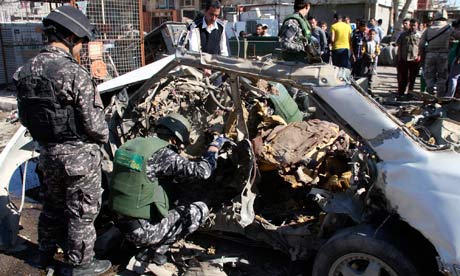
Iraq rocked by wave of explosions Dozens killed and scores more injured as Sunni extremists target Shia civilians in series of blasts across Baghdad https://static.guim.co.uk/sys-images/Guardian/About/General/2013/3/19/1363683943527/Iraq-blasts-in-Sadr-City-008.jpg The remains of a car bomb in Baghdad's Sadr City, part of a series of blasts that rocked Baghdad on the 10th anniversary of the US-led war of 2003. Photograph: STRINGER/IRAQ/REUTERS Baghdad was convulsed by a deadly wave of explosions as terrorists detonated up to nine explosions in the course of a few hours on Tuesday morning on the 10th anniversary of the US-led invasion. Early reports suggested that at least 34 people were killed and dozens more wounded as car bombs hit Shia areas, including a mosque and a restaurant across the city. At the ministry of the interior in central Baghdad, the Guardian heard one explosion in the distance, followed by a rising plume of smoke. Helicopters could be seen hovering above the scene. An hour later, in another part of the city, a second blast was audible and another column of smoke a half a mile or so away, this time from an attack in Karrada,. The first bombing took place near a small restaurant in Baghdad's Mashtal neighbourhood, killing four people and wounding 15 at 8am. Minutes later, two day labourers were killed and eight were wounded when a roadside bomb targeted where they gather each day in an area of New Baghdad. One eyewitness to the first bombing, who had just arrived at work at 8am, told the Guardian: "It was a huge explosion at the junction close to where my office was, close to a restaurant. I heard the bomb go off in an area which is crowded at this time of day." A policeman who gave his name only as Ahmed, who was on duty near the scene of another of the explosions, told the Guardian. "It was about 300 metres from me, near where I was on duty in Karrada. It was a car bomb parked by the road close to a place where minibuses park." The attacks on the 10th anniversary of the first air strikes of the Iraq war, on 19 March 2003, which targeted the Dora Farms where it was thought Saddam Hussein was visiting, have underlined the still bitter sectarian tensions in Iraq. Ten years ago on Tuesday also marked President George W Bush's announcement in the US of the start of the invasion, with troops crossing the border with Kuwait in force the following day. Tuesday morning's blasts hit largely Shia areas where people were gathering for work or start the day, including small restaurants and bus stops in the Iraqi capital. At least six attacks occurred within an hour. Although the anniversary of the fall of Saddam is marked by the government, the day of the invasion is generally ignored by Iraqis, many of whom regard it as the beginning of an occupation that prompted the "sectarian war", which pitted Sunni against Shia for five years of brutal bloodletting. While there was no immediate claim of responsibility, the attacks bore the hallmarks of al-Qaida in Iraq. While violence in Iraq has receded in recent years since 2008, tensions have been rising again fanned by Sunni protests over equal rights and human rights abuses in northern and western provinces, in particular in Fallujah. Analysts have blamed the slow response of the Shia-dominated Iraqi government to the protests for a resurgence in al-Qaida in Iraq, which, some claim, has boosted the number of new terror recruits. In the sprawling Shia suburb of Sadr City, a sticky bomb placed under a minibus killed three commuters and wounded seven people, while another car bomb exploded in a commercial street in the same Shia area, killing two and wounding 11. In the north-eastern suburbs of Baghdad, four people were killed and 11 others wounded after a car bomb went off near a small restaurant in Hussainiyah neighbourhood. In Zafarniyah, two car bombs exploded near a police station, killing five people, including a policeman and wounding 27, said police. In northern Baghdad, a car bomb went off near a bus stop, killing three people and wounding 13. In the city centre, a car bomb exploded near a restaurant close to the well-protected green zone, killing six people, including two soldiers and wounding more than 15. In Shulla, a car bomb exploded near an outdoor market, killing five people and wounding 21. In response to the wave of attacks, the prime minister, Nouri al Maliki, announced he was delaying the holding of provincial elections – due in April – in Anbar and Nineveh provinces that have been at the heart of a three-month-long Sunni uprising that has partly driven recent tensions in Iraq. http://m.guardian.co.uk/world/2013/mar/19/iraq-rocked-wave-explosions |
| Islam › Re: Ahlussunnah Wal Jamaa'ah by Rafidi: 5:39pm On Mar 17, 2013 |
abulbanaat: @vedaxcool, may Allaah reward u best. But why was my reply hidden and his venom allowed? Whoever has done that has been unfair. Well I will go and open another thread.ouch! you now sound frustrated.but i'd offer a piece of advice.it is not a good idea to keep opening threads and abandoning them,or running away from them. |
| Islam › Re: Progress Of Iran Under An Islamic Regime (shariah) by Rafidi: 5:00pm On Mar 17, 2013 |
Iran launches indigenous Jamaran 2 destroyer in Caspian Sea [img]http://previous.presstv.ir/photo/20130317/fathi20130317103310987.jpg[/img] Iran’s indigenous destroyer Jamaran (file photo) Sun Mar 17, 2013 10:41AM GMT Iran launches the indigenously-manufactured Jamaran 2 destroyer in the Caspian Sea near the northern port city of Bandar Anzali in the presence of President Mahmoud Ahmadinejad. Jamaran 2, a Wave-class warship, has been designed and built by the experts at Iran’s Defense Ministry and has state-of-the-art navigation equipment and complex defensive systems. The production line of the advanced indigenous destroyer was inaugurated in Bandar Anzali six years ago with the aim of protecting Iran’s 20-percent share of the Caspian Sea. The 1420-ton destroyer is powered by a 20000-horsepower engine with a speed of 30 knots and has the capability to carry helicopters, different surface-to-surface and surface-to-air missiles, advanced artilleries and torpedo system. It is also equipped with electronic war system. The Jamaran 2 destroyer is a symbol of the Islamic Republic’s capability and strength and conveys the message of peace and friendship to the Caspian Sea states. Iranian Defense Minister Brigadier General Ahmad Vahidi and Chief of Staff of Iran's Armed Forces Major General Hassan Firouzabadi also attended the ceremony to launch the warship. Jamaran 2 will officially join the fleet of Iran’s Navy within the next 6 months after the completion of final tests. In recent years, Iran has made great achievements in its defense sector and attained self-sufficiency in producing essential military equipment and systems. Tehran has repeatedly assured other countries that its military might poses no threat to other states, insisting that the Islamic Republic’s defense doctrine is entirely based on deterrence. SF/MA http://www.presstv.ir/detail/2013/03/17/294010/iran-launches-jamaran-2-destroyer/ |
| Islam › Re: Sayings And Teachings Of The Ahlul-Bayt (as) by Rafidi: 11:37pm On Mar 16, 2013 |
The Prophet Muhammad (s) said: “Mentioning Ali (A.S) is a form of worship, and looking upon him is a form of worship.” Mustadrak Al-Sahihain of Al-Hakim Al-Nisabori, 3/123; Kenz Al-Omal, 6/156; Al-Tabarani; Ibn Al-Maghazeli, 240, 278; Al-Khawarizmi, 62 |
| Islam › Re: Which Muslim Artiste Do You Love Listening To Their Nasheeds by Rafidi: 11:30pm On Mar 16, 2013 |
| Islam › Re: Which Muslim Artiste Do You Love Listening To Their Nasheeds by Rafidi: 11:20pm On Mar 16, 2013 |
| Islam › Re: Which Muslim Artiste Do You Love Listening To Their Nasheeds by Rafidi: 11:16pm On Mar 16, 2013 |
| Islam › Re: Which Muslim Artiste Do You Love Listening To Their Nasheeds by Rafidi: 10:58pm On Mar 16, 2013 |