Litmus's Posts
Nairaland Forum › Litmus's Profile › Litmus's Posts
1 2 3 4 5 6 7 8 ... 127 128 129 130 131 132 133 134 135 (of 361 pages)
 Foreign Affairs › Re: Battle Field Discussion (picture/video) Of African Military . by Litmus: 11:02pm On Jul 18, 2021 Foreign Affairs › Re: Battle Field Discussion (picture/video) Of African Military . by Litmus: 11:02pm On Jul 18, 2021 |
Pakistan-Afghanistan border fence, a step in the right direction The border barrier will decrease the number of cross-border attacks, but more needs to be done to secure the region. https://www.youtube.com/watch?v=ByUF9YBxk8Q Pakistan is about to reach a new milestone in its fight against terrorism. The fence barrier it is building on the Durand Line, the 2,640km (1,640-mile) land border between Afghanistan and Pakistan that passes through rugged mountains, densely forested valleys and narrow rock passages, is nearing completion. Islamabad started fencing its porous border with Afghanistan in March 2017, after facing a spate of deadly attacks from Afghanistan-based Pakistani militant groups in the previous year. Despite a slow-performing economy, disruption caused by the COVID-19 pandemic and a volatile security environment, the work on the border continued mostly uninterrupted in the last four years. So far, 85 percent of the border has been fenced, and the remaining work is expected to be completed by April 2021. The border barrier consists of two sets of chain-link fences, separated by a 2-metre (6-foot) space filled with concertina wire coils. The double-fence, which is 3.6 metres high (11 feet) on the Pakistani side and 4 metres high (13 feet) on the Afghan side, is fitted with surveillance cameras and infrared detectors. Moreover, nearly 1,000 forts are also being constructed along the border to increase security. Cross-border movement will only be allowed through 16 formally designated crossing points after the completion of the project, which is expected to cost more than $500m in total. For the last two decades, the regions surrounding the Durand Line have been used by armed groups, such as the Haqqani Network, al-Qaeda and the Tehreek-e-Taliban Pakistan (TTP), to conduct attacks both in Pakistan and Afghanistan. Kabul has long accused Pakistan of providing sanctuary to the Afghan Taliban. Islamabad, on the other hand, has raised similar concerns about TTP’s presence in Afghanistan. Indeed, both Pakistan and Afghanistan have repeatedly found prominent criminals they are seeking to capture and eliminate in each other’s backyards in recent years. In 2016, for example, Taliban chief Mullah Akhtar Manor was killed by a US drone attack in Pakistan’s Balochistan region. Two years later, in 2018, TTP leader Mullah Fazhlullah was killed by another US drone attack in Afghanistan’s Kunar province. Pakistan says its border barrier will extensively increase security in restive border areas and put to rest the tensions it experienced with its neighbour over cross-border militant attacks. Critics of the project, however, argue that while the fence will likely deter Afghanistan-based anti-Pakistan militants from conducting cross-border attacks, the Afghan Taliban will continue to cross the border at will, with a wink and a nod from Pakistan. Pakistan is also hoping that the border barrier will prevent any future turmoil in Afghanistan from spilling into its territory. Indeed, if Afghanistan once again descends into chaos in the coming years, the wall will help curtail the refugee influx from Afghanistan into Pakistan. In 1989, when Russia withdrew from Afghanistan, the ensuing civil war resulted in the migration of millions of Afghan refugees into Pakistan. Further, the fence will help curb the cross-border smuggling of narcotics and weapons that helps sustain terror groups in the region. According to the UN Office on Drugs and Crime, Afghanistan is the source of 80 to 90 percent of the world’s opium supply. About 45 percent of Afghan opium, which is used in the production of heroin, is trafficked through Pakistan to the Middle East, Africa and Europe. Pakistan’s reasons for embarking on this massive fencing project, however, are not only increasing border security and preventing smuggling. The fence will also help Pakistan politically by cementing the Durand Line as the permanent border between the sovereign territories of Afghanistan and Pakistan. Afghanistan disputes the border drawn by British colonial officials, with the agreement of then-Afghan leader Amir Abdul Rehman, in 1893. It argues that the border is a “colonial imposition” that divides the ancestral homelands of Pashtun tribes between two countries, and claims sovereignty over the Pashtun territories on the Pakistani side of the border that comprise the former Federally Administered Tribal Areas (FATA) and parts of North West Frontier Province. Kabul also argues that the agreement between British officials and Rehman had a 100-year time limit, which expired in 1993. Pakistan, on the other hand, considers the border it inherited from the British after its independence as legal and final. And it hopes that its ambitious border barrier project will put the dispute over the Durand Line to rest for good. Even before its completion, the border barrier provided Pakistan with visible benefits. Since 2007, Pakistan has carried out numerous kinetic operations, including Zarb-e-Azb and Radd-ul- Fasaad, to root out terror groups from the former FATA. However, the de-facto open border between Afghanistan and Pakistan undermined the security gains made through these operations. It allowed militants to avoid capture by escaping into Afghanistan. These militants, after recovering and regrouping within Afghanistan, later launched new attacks on Pakistan. But since Pakistan’s fencing project began, these same militants started to find it a lot harder to move between the two countries and evade the Pakistani government’s efforts to prevent their attacks. The number of cross-border terror attacks from Afghanistan has fallen from 82 in 2019 to just 11 in 2020. The fencing of the border, however, has also presented Pakistan with new challenges. The fence adversely affected the daily lives of families who have relatives on both sides of the border. Similarly, it harmed subsistence farmers whose lands straddle the border. The situation has already compelled several farmers to sell their lands at throwaway prices. Traders who made a living by exporting food items and other goods from Pakistan into Afghanistan and vice versa have also been affected as they now need to acquire visas to cross the border and pay customs fees for the produce they bring over. Pakistan is already working to mitigate the negative impact the border barrier had on the lives of civilians living in the area. It has reached an agreement with Afghanistan to establish joint trade markets along the border and discussions are ongoing about exactly where these markets should be established and what items should be traded within them. It is also planning to financially compensate the farmers who have lands on both sides of the border. For the families living across the Pakistan-Afghanistan border, Islamabad will issue long-term passes. The fencing of the Pak-Afghan border is a necessary step towards curbing militancy in the border areas and bringing stability to the former FATA. But on its own, it will not solve the region’s myriad problems. The border barrier will undoubtedly provide a tactical respite for Pakistan and reduce the number of cross-border attacks. But until sustainable peace is achieved in Afghanistan, and the grievances of the Pashtun tribes living near the border are resolved, no barrier will successfully bring peace, stability and long term security to the region. Ref: https://www.aljazeera.com/opinions/2021/2/25/the-pak-afghan-border-fence-is-a-step-in-the-right-direction 2 Likes |
| Science/Technology › Jeff Bezos's Blue Origin First Human Flight Pre-launch Briefing by Litmus(op): 6:03pm On Jul 18, 2021 |
| Science/Technology › Nuclear Starship Update! by Litmus(op): 5:50pm On Jul 18, 2021 |
| Travel › Re: Train Goes Off The Railway In Ikeja, Lagos (Photos) by Litmus: 12:33pm On Jul 17, 2021 |
nograv:Ok, my mistake, I thought this thread was about train derailment in Nigeria and how train derailment happens nowhere in the world except Nigeria and that consequently Nigeria is a Joke, shit hole and the rest of it. Also while I support the idea of fencing off railway lines ( in fact I go further by suggesting we not only fence off as much railway line as possible we landscape too) it isn't true that all train lines are fenced off in the UK or US. |
| Travel › Re: Train Goes Off The Railway In Ikeja, Lagos (Photos) by Litmus: 12:47am On Jul 17, 2021 |
https://s.abcnews.com/images/US/GTY_amtrak_crash_2002_washington_jef_160929_16x9_992.jpg Amtrak train 3 traveling from Chicago to Washington, D.C., |
| Travel › Re: Train Goes Off The Railway In Ikeja, Lagos (Photos) by Litmus: 12:43am On Jul 17, 2021 |
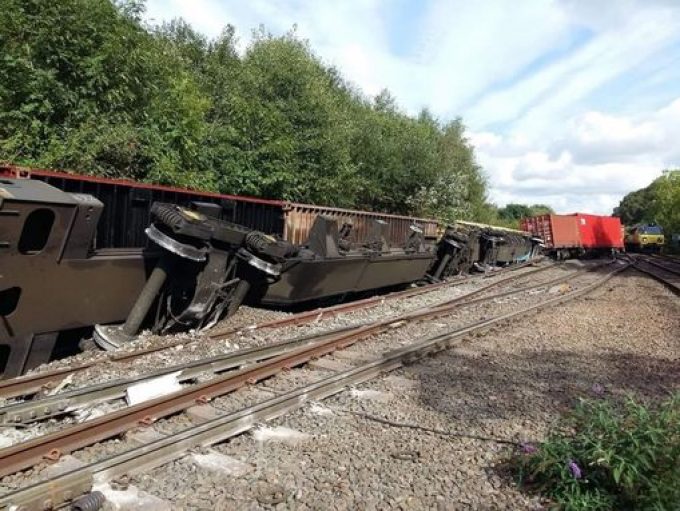
https://www.kentonline.co.uk/_media/img/750x0/57NSKMIBWD7N6NHL2IML.jpg Southeastern train travelling between Chilham and Wye derails after hitting cattle  |
| Travel › Re: Train Goes Off The Railway In Ikeja, Lagos (Photos) by Litmus: 12:37am On Jul 17, 2021 |
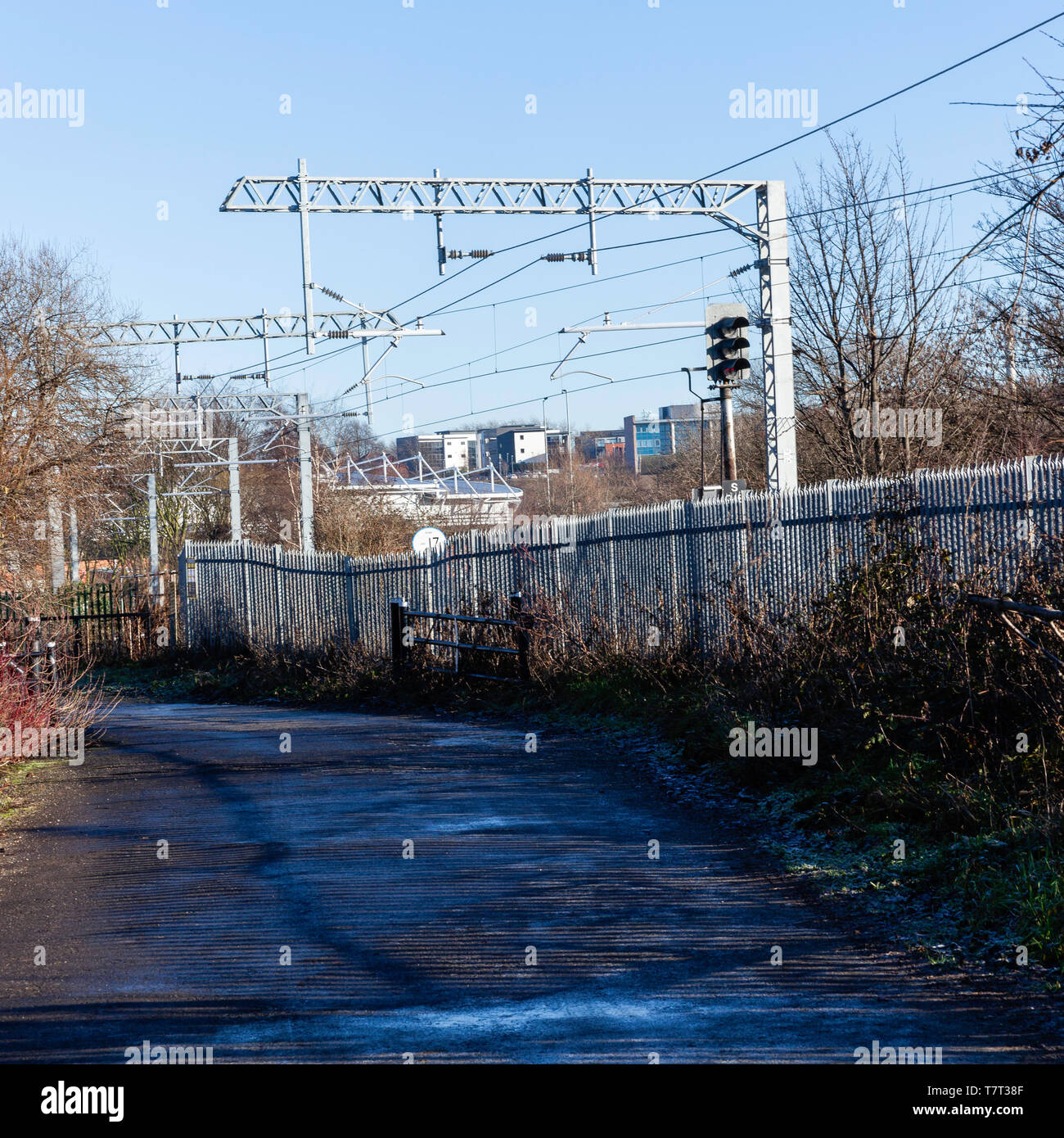
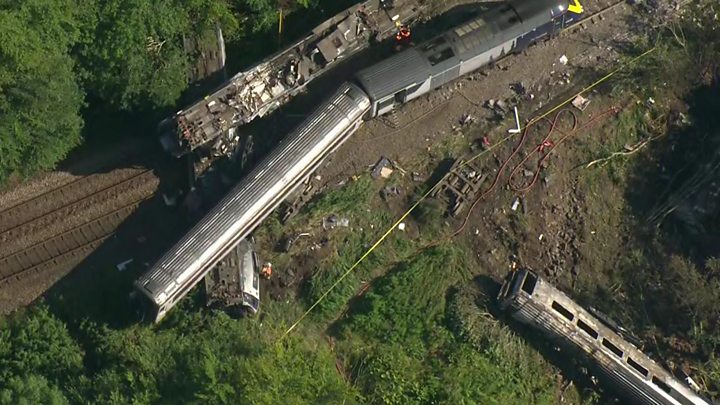
nograv:https://ichef.bbci.co.uk/images/ic/720x405/p08ngtjt.jpg Where did this take place? https://theloadstar.com/wp-content/uploads/GBRf-rail-derailment-Coventry-Live-1-680x0-c-default.jpg and this one? |
| Business › Re: Dangote Refinery: Bailing Out The Unbailable - Investment Or Bailout? by Litmus: 12:00am On Jul 17, 2021 |
As long as Dangote works with Indians he's bleeped |
| Car Talk › Tesla FSD9 Lombard Street Challenge Drive Test by Litmus(op): 11:04pm On Jul 14, 2021 |
https://www.youtube.com/watch?v=r5Sjf6z881o Older FSD, 9 months ago Lombard Street challenge drive https://www.youtube.com/watch?v=3ltLwRPz6p4 Latest FSD, 2 Days ago Lombard Street challenge drive |
| Science/Technology › AI Designs Quantum Physics Experiments Beyond What Any Human Has Conceived by Litmus(op): 10:29pm On Jul 14, 2021 |
Originally built to speed up calculations, a machine-learning system is now making shocking progress at the frontiers of experimental quantum physics https://cdn.mos.cms.futurecdn.net/aBSs4o7eAJupCvRQGcvgET-320-80.jpg Quantum physicist Mario Krenn remembers sitting in a café in Vienna in early 2016, poring over computer printouts, trying to make sense of what MELVIN had found. MELVIN was a machine-learning algorithm Krenn had built, a kind of artificial intelligence. Its job was to mix and match the building blocks of standard quantum experiments and find solutions to new problems. And it did find many interesting ones. But there was one that made no sense. “The first thing I thought was, ‘My program has a bug, because the solution cannot exist,’” Krenn says. MELVIN had seemingly solved the problem of creating highly complex entangled states involving multiple photons (entangled states being those that once made Albert Einstein invoke the specter of “spooky action at a distance”). Krenn, Anton Zeilinger of the University of Vienna and their colleagues had not explicitly provided MELVIN the rules needed to generate such complex states, yet it had found a way. Eventually, he realized that the algorithm had rediscovered a type of experimental arrangement that had been devised in the early 1990s. But those experiments had been much simpler. MELVIN had cracked a far more complex puzzle. “When we understood what was going on, we were immediately able to generalize [the solution],” says Krenn, who is now at the University of Toronto. Since then, other teams have started performing the experiments identified by MELVIN, allowing them to test the conceptual underpinnings of quantum mechanics in new ways. Meanwhile Krenn, working with colleagues in Toronto, has refined their machine-learning algorithms. Their latest effort, an AI called THESEUS, has upped the ante: it is orders of magnitude faster than MELVIN, and humans can readily parse its output. While it would take Krenn and his colleagues days or even weeks to understand MELVIN’s meanderings, they can almost immediately figure out what THESEUS is saying. “It is amazing work,” says theoretical quantum physicist Renato Renner of the Institute for Theoretical Physics at the Swiss Federal Institute of Technology Zurich, who reviewed a 2020 study about THESEUS but was not directly involved in these efforts. Krenn stumbled on this entire research program somewhat by accident when he and his colleagues were trying to figure out how to experimentally create quantum states of photons entangled in a very particular manner: When two photons interact, they become entangled, and both can only be mathematically described using a single shared quantum state. If you measure the state of one photon, the measurement instantly fixes the state of the other even if the two are kilometers apart (hence Einstein’s derisive comments on entanglement being “spooky”). In 1989 three physicists—Daniel Greenberger, the late Michael Horne and Zeilinger—described an entangled state that came to be known as “GHZ” (after their initials). It involved four photons, each of which could be in a quantum superposition of, say, two states, 0 and 1 (a quantum state called a qubit). In their paper, the GHZ state involved entangling four qubits such that the entire system was in a two-dimensional quantum superposition of states 0000 and 1111. If you measured one of the photons and found it in state 0, the superposition would collapse, and the other photons would also be in state 0. The same went for state 1. In the late 1990s Zeilinger and his colleagues experimentally observed GHZ states using three qubits for the first time. Krenn and his colleagues were aiming for GHZ states of higher dimensions. They wanted to work with three photons, where each photon had a dimensionality of three, meaning it could be in a superposition of three states: 0, 1 and 2. This quantum state is called a qutrit. The entanglement the team was after was a three-dimensional GHZ state that was a superposition of states 000, 111 and 222. Such states are important ingredients for secure quantum communications and faster quantum computing. In late 2013 the researchers spent weeks designing experiments on blackboards and doing the calculations to see if their setups could generate the required quantum states. But each time they failed. “I thought, ‘This is absolutely insane. Why can’t we come up with a setup?’” says Krenn says. To speed up the process, Krenn first wrote a computer program that took an experimental setup and calculated the output. Then he upgraded the program to allow it to incorporate in its calculations the same building blocks that experimenters use to create and manipulate photons on an optical bench: lasers, nonlinear crystals, beam splitters, phase shifters, holograms, and the like. The program searched through a large space of configurations by randomly mixing and matching the building blocks, performed the calculations and spat out the result. MELVIN was born. “Within a few hours, the program found a solution that we scientists—three experimentalists and one theorist—could not come up with for months,” Krenn says. “That was a crazy day. I could not believe that it happened.” Then he gave MELVIN more smarts. Anytime it found a setup that did something useful, MELVIN added that setup to its toolbox. “The algorithm remembers that and tries to reuse it for more complex solutions,” Krenn says. It was this more evolved MELVIN that left Krenn scratching his head in a Viennese café. He had set it running with an experimental toolbox that contained two crystals, each capable of generating a pair of photons entangled in three dimensions. Krenn’s naive expectation was that MELVIN would find configurations that combined these pairs of photons to create entangled states of at most nine dimensions. But “it actually found one solution, an extremely rare case, that has much higher entanglement than the rest of the states,” Krenn says. Eventually, he figured out that MELVIN had used a technique that multiple teams had developed nearly three decades ago. In 1991 one method was designed by Xin Yu Zou, Li Jun Wang and Leonard Mandel, all then at the University of Rochester. And in 1994 Zeilinger, then at the University of Innsbruck in Austria, and his colleagues came up with another. Conceptually, these experiments attempted something similar, but the configuration that Zeilinger and his colleagues devised is simpler to understand. It starts with one crystal that generates a pair of photons (A and B). The paths of these photons go right through another crystal, which can also generate two photons (C and D). The paths of photon A from the first crystal and of photon C from the second overlap exactly and lead to the same detector. If that detector clicks, it is impossible to tell whether the photon originated from the first or the second crystal. The same goes for photons B and D. Read the rest here: https://www.scientificamerican.com/article/ai-designs-quantum-physics-experiments-beyond-what-any-human-has-conceived/ |
| Science/Technology › NASSA Set To Attack An Asteroid In October 2022 To Change Its Trajectory by Litmus(op): 7:56pm On Jul 14, 2021 |
| Politics › Re: "Self-determination, Not A Crime": Sowore To Lead #freennamdikanu Protest August by Litmus: 4:28pm On Jul 14, 2021 |
Thought he was in jail awaiting trial for contravening bail and lately for incitement to violence and killings of law enforcement officers evident in historic Social Media platform records. Aren’t there many in Nigeria calling for self determination e.g in MOSOB not in jail? |
| Politics › Re: DSS Accuses Israeli Filmmakers Of Supporting IPOB, Detains Them In Cells by Litmus: 1:26pm On Jul 14, 2021*. Modified: 2:07pm On Jul 14, 2021 |
SeeThisLoser:You’re very arrogant (setting aside coonish and brainwashed) with this your Israel and West must come destroy Nigeria stitch. Are you even black let alone Nigerian? Nigeria will always be the Just one wronged because Nigeria never leaves her affairs to go bother other Nations. Nigeria didn’t send no Nigerian journalist to go interview, photograph, nor document no Hamas in no West bank, risking Israel’s ire. 1 Like |
| Politics › Re: Hausa Residents Cry Out As Rivers Govt Demolishes Shanties by Litmus: 12:51pm On Jul 14, 2021 |
History of Sentiments as weapon against development in Nigeria: demolition of illegal shanty towns = War against the poor; forget Tax, tax is universally demonised as war against the poor; traffic law enforcement including confiscation of motorbikes and cars = war against hardworking youth! And now demolition of illegal structure or relocation of markets = war against ethnic groups!  Media does not help, why adjective-ise this as “Houser” residents instead of just Residents? 1 Like |
| Foreign Affairs › Re: South African Man Loots Love Machine During Zuma Protest by Litmus: 10:35am On Jul 14, 2021 |
If the pic isn’t fake, or some sort of misrepresentation, then the guy might have taken that thing out of a sense of humour. Perhaps something he and people around him will have a good laugh over, to lighten the miserable situation they find themselves in, at this juncture of inner city South Africa life. This does not however justify the looting of hard working people’s businesses. |
| Travel › Re: Construction Linking Bonny Island By Road (Photos) by Litmus: 6:10pm On Jul 13, 2021 |
The money Nigeria overall seems to spend on road constructing i.e. on rehabilitating, repairing, building new in additions to fly-overs may have provided Nigeria with the more enduring railway infrastructure. Railway circuit needn’t be vast. |
| Science/Technology › Re: Richard Branson Virgin Galactic Safely Back Ushering New Space Era by Litmus(op): 2:40pm On Jul 13, 2021*. Modified: 10:10am On Jul 14, 2021 |
Soulsymbol99:I don’t know what they all got against Jeff – the entire neo space exploration fan base as well as the leading figures such as Elon, Branson etc. In my experience, when a sizable USA fan base are against a leading figure, that figure often has done or said something favourable to black people or is a liberal… |
| Politics › Re: Men In Military Uniforms Shooting At Ladipo Market by Litmus: 2:33pm On Jul 13, 2021 |
Instead of making conclusions such as 'its the Army', 'its Terrorists', 'it's attack against Igbo traders', 'oh what a country', 'it has began', etc, etc wouldn’t we be better informed when some of these attackers are caught? Then all are able to find out more about them? If we are unable to apprehend any of these people and so arnt able to get a closer look at them, we should not loose track of the fact that our says are nothing but opinions and speculation not Facts! 1 Like |
| Politics › Re: 'Information Blackout' Against Media Bills: Newspapers, NUJ, NGE, NPAN Protest by Litmus: 10:36am On Jul 13, 2021*. Modified: 11:07am On Jul 13, 2021 |
lexy2014:The entire world acknowledges that with wider interment reach enabling grassroots access to information and disseminating of same, false information as prank or weapon ,deliberate or inadvertent ,is problematic. Majority of Nigerians acknowledge this development. Fake news, outright lies is fact in Nigeria media space and particularly rampant. Fearing the government in power will exploit concerns not to enact measures sanitising it but instead to stifle dissenting public, civil society and political opposition voices is a different argument. Fake news in Nigeria Media space is objective fact . Government exploitation of calls to sanities the media is an important argument but one we cannot afford to allow neutralise need for measures against our media decent into madness if not abject farce. Since opposition parties will forever distrust any media regulation by the party in government we would be forever moribund. In multi-party dispensations’ even Independent Media Regulators are suspects. This impasse needs to be broken. |
| Science/Technology › LIVE: Super Heavy Booster 3 Cryogenic Proof Testing by Litmus(op): 11:14pm On Jul 12, 2021 |
| Politics › Re: 'Information Blackout' Against Media Bills: Newspapers, NUJ, NGE, NPAN Protest by Litmus: 10:18pm On Jul 12, 2021*. Modified: 10:37pm On Jul 12, 2021 |
Bloggers lied about my EFCC arrest ― Comedian Pankeeroy Fake news' driving ethno-religious crisis in Nigeriahttps://www.france24.com/en/20190414-nigeria-buhari-fake-news-azikwe-islam-muslim-christianity Whats the truth on Amatukun, Kanu, Esn, Buhari, Police, Soldiers, The War, Bokoharam, Sepratist, Black Magic, Vloggers, Where’s the truth on anything written by Nigerians online ? Images of protesting Nigerian separatists have been shared multiple times on Facebook alongside claims that they show a rally at the White House on July 2, 2021. The posts surfaced days after the arrest of Nnamdi Kanu, the leader of the Indigenous People of Biafra (IPOB) group, which supports the secession of the south-east of Nigeria. But the claim is false. AFP Fact Check traced the photos, which are video screenshots, to a Biafran demonstration in Vatican City in 2019. A video viewed tens of thousands of times on Facebook is being shared alongside claims that it shows supporters of the Indigenous People of Biafra (IPOB) movement protesting the arrest of their leader Nnamdi Kanu in June 2021. This is false; AFP Fact Check found that the footage has been on the internet since 2015 and is unrelated to Kanu’s latest arrest. |
| Politics › Re: 'Information Blackout' Against Media Bills: Newspapers, NUJ, NGE, NPAN Protest by Litmus: 9:51pm On Jul 12, 2021*. Modified: 10:16pm On Jul 12, 2021 |
lexy2014:You're funny. What about the Leki massacre for starters ? Nigeria's popular ThisDay newspaper recently published a story headlined: "Drama as US Embassy Denies Bishop Oyedepo Visa". Back in 2014, when the Ebola virus hit Lagos State, the city’s healthcare team had to contend with the spread of misinformation regarding its prevention and treatment. A piece of fake news claiming Ebola could be prevented by drinking and bathing with salt water went viral. According to Symplur, a company that tracks health misinformation on Twitter, Nigerians began using the words “Ebola,” “salt,” “water” and “drinking” together in tweets from 2014 on August 4. Four days later, two persons were reported dead in Jos, the capital city of Plateau State. They had consumed an excessive amount of saltwater. In June 2018, images of a baby’s bloodied corpse, a man’s cracked skull and bodies in mass graves quickly spread across Facebook feeds in Nigeria, Africa’s most populous nation. Fake news is not new to Nigeria. In the 2015 elections, for example, a 55-minute documentary full of falsehoods entitled “The Real Buhari” aired on television before doing the rounds on social media. In 2017, Biafra separatists attempting to disrupt the Anambra governorship vote claimed the army was injecting school students with monkey pox to depopulate the South East, leading some schools to close and parents to withdraw their children in panic. Bloggers peddled lies about how our sister died, say brothers of late Nneka Odili |
| Crime › Re: I Didn’t Kill Usifo Ataga- Chidinma Denies Killing Super TV CEO by Litmus: 9:47pm On Jul 12, 2021 |
stinflame:Thanks for informing that guy, I wanted to reply but his margin of ignorance was so great, the thing weak me. Over three hundred from the Troll House liked his post so it was important to challenge him, in the process educating those that might have been persuaded. Nigeria legal system is weak but his understanding of the law and how it works is unrelated to why or how. 1 Like |
| Politics › Re: 'Information Blackout' Against Media Bills: Newspapers, NUJ, NGE, NPAN Protest by Litmus: 6:57pm On Jul 12, 2021 |
lexy2014:This question is like me asking you who is telling the truth. |
| Sports › Re: Ranking Every Nigerian Who Chose To Play For England's Three Lions by Litmus: 4:03pm On Jul 12, 2021 |
Dagger111:This last point does not apply to Nigeria but very true for the rest of Africa especially East Africa. Nigerians do turn to god but they are likelier to turn against government than ask international donors for help. The rest of Nigeria except the North have grown to hate cows. |
| Politics › Re: 'Information Blackout' Against Media Bills: Newspapers, NUJ, NGE, NPAN Protest by Litmus: 2:38pm On Jul 12, 2021 |
Media Bill is necessary since Nigeria’s information space is bloated with lies. And Nigeria News Papers anti-anti media bill stance isn’t convincing when scrutinised. This is why: before the information revolution, when Nigerians relied on newspaper stands, Nigerians were pretty critical of their broadsheets and tabloids, labelling them either Godfathers of political party mouth pieces. Indeed, Al jazeera, CNN, BBC and other Western media organisations have many times dismissed Nigeria News Papers as Political Party mouth pieces, crushing my boasts that Nigeria is home to some of the developing world’s most vibrant free press spaces. How or when the tabloids morphed into Free Press deserving of backing in their stance against politically motivated censorship, is eyebrow rising. We are all rightly weary of censorships but existential threat posed to Nigeria by unregulated media – either by the media or government – I believe warrants it. The Bill is to me as if an emergency measure to safe guard the State. Someone on Niraland or perhaps I saw this on one of the Nigeria Televised news Youtube pages, made the point worth reiterating and that was, ‘finally, we need a Nation (existing) in which to debate or fight for improved freedoms. |
| Sports › Re: Italy vs England: Euro 2020 Final (3 - 2) On Penalties On 11th July 2021 by Litmus: 9:41pm On Jul 11, 2021 |
Says Italy 1 vs England 2 on twitter on google 1, 1... |
| Foreign Affairs › Re: Battle Field Discussion (picture/video) Of African Military . by Litmus: 8:15pm On Jul 11, 2021 |
AskiaHarem:When others research "in-depth" for themselves the text books evidence will be there for them to decide this, not you or me. Ultimately you or i did not go out on the field, researched for years, made discoveries and published our findings. We are shamefully relying on white people's work and as is evident in what you read and what I read, how they differ, they can twist information to fit thire political agenda or peddle contradictory evidence because they are unsure and still benefit from book sales. Besides of this, common sense should tell us migration flows from greatest numbers to lowest. Igbo number approximately 30/40 million in present day Nigeria. Where the are now in Nigeria is almost certainly their original homeland. 1 Like |
| Science/Technology › Richard Branson Virgin Galactic Safely Back Ushering New Space Era by Litmus(op): 7:56pm On Jul 11, 2021 |
SPACEPORT AMERICA, New Mexico — Richard Branson completed a daring, barnstorming flight to edge of space Sunday, rocketing through the atmosphere in the spaceplane he’d been yearning to ride for nearly 20 years. The suborbital trip gave the British billionaire, his three crewmates and two pilots a glimpse of the Earth from more than 50 miles up and a few minutes of weightlessness before the vehicle they were traveling in, SpaceShipTwo Unity, glided back to Earth and a landing on the runway at Virgin Galactic’s facility here in the New Mexico desert. https://www.youtube.com/watch?v=RTpWYWIfP7Y https://www.washingtonpost.com/technology/2021/07/11/richard-branson-virgin-galactic-live-updates/ |
| Science/Technology › Tesla Vision FSD 9 Released! Analysis: How Does It Look, And How Is It Working ? by Litmus(op): 1:14pm On Jul 11, 2021 |
| Foreign Affairs › Re: Battle Field Discussion (picture/video) Of African Military . by Litmus: 1:03pm On Jul 11, 2021*. Modified: 1:26pm On Jul 11, 2021 |
AskiaHarem:The Migration start-point was centred in the east of Nigeria encompassing the part of Cameroon near Nigeria. I read this in numerous books taking their sources from competent researchers in the field. For some reason, the start point of this migration has been steadily shifted to Cameroon in contemporary literature. I personally believe that this shifting of the start point of the great migration from what is now Nigeria ending in South Africa to from Cameroon to South Africa owes more to political tinkering, perhaps some of these bogus Afrocentric Kemet, Nemet, Queen and Kings type works etc, than any new findings in the fields. The problem is that Nigerians don’t seem to take these things seriously because Nigerians are ignorant of how important they are to National grounding. 1 Like |
| Foreign Affairs › Re: Battle Field Discussion (picture/video) Of African Military . by Litmus: 9:58pm On Jul 10, 2021 |
AskiaHarem:Bantu are originally from Nigeria, actually. The start point of the migration to South Africa is located in Nigeria and some parts of the area of Cameroon near Nigeria. As a youngster I had tons of Anthropological literature that stated this. But I guess politically motivated books (and Black scholars doing bogus research) of recent are revising history. |


 The delusions of some Africans I swear.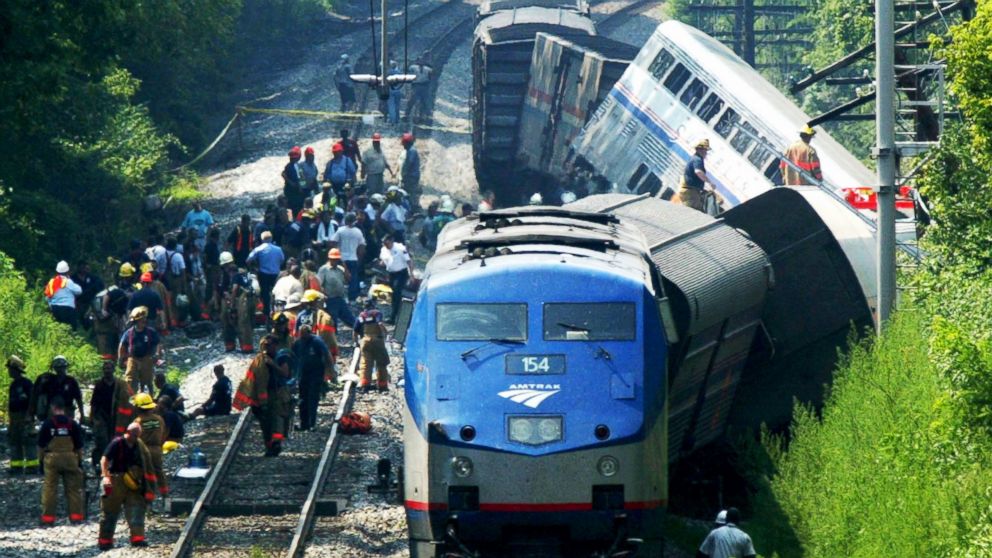



1 2 3 4 5 6 7 8 ... 127 128 129 130 131 132 133 134 135 (of 361 pages)