PhysicsMHD's Posts
Nairaland Forum › PhysicsMHD's Profile › PhysicsMHD's Posts
1 2 3 4 5 6 7 8 ... 32 33 34 35 36 37 38 39 40 (of 67 pages)
 Culture › Re: Edo Colonized Yorubaland Not Vice Versa. by PhysicsMHD(m): 12:22am On Mar 13, 2011 Culture › Re: Edo Colonized Yorubaland Not Vice Versa. by PhysicsMHD(m): 12:22am On Mar 13, 2011 |
[quote author=tpiah! link=topic=392592.msg7893768#msg7893768 date=1299877590]assuming you're familiar with bini culture [doubtful, no offence], compare the name ekaladerhan to any bini name you know. do you even see any similarities? does it sound like any past or present bini name?[/quote]1. "Assuming your familiar with Bini culture"? What would being familiar with the whole of Benin culture have to do with knowing Bini names? Anybody could find out Bini names just by buying books on Benin names, such as Ja Belo-Osagie's book, which has literally 1000+ names in it and explanations of their meaning. 2. Your statement "no offence" is disingenuous at worst, and your mention of my "unfamiliarity" is irrelevant (see #1) at best, If you want to say something come out and say it, and don't make irrelevant (to the discussion) comments about me. I already gave away much of my background in several posts across several threads in this forum: Americanized, science geek, history lover, and currently a college student. As a college student with access to many books on African history, art, etc. through one of the largest and best university libraries in America, and with access to history journal articles through my university's subscription to numerous journals, I took advantage of these resources and found out more about my people's history than I might have been able to do at some later time. I never claimed to be thoroughly enmeshed in Edo culture as I left Benin at an early age and (for now) only visit Benin during summer and winter breaks. I only started reading about any African history in my late teens after taking an interest in my grandfather after a story about him from my father and I never claimed to be an authority on Edo culture. In fact, in that thread "Benin art and architecture" that I started, I was specifically relying on amazonia, as someone with in-depth knowledge of the culture that goes beyond books, to inform me about other symbols used by priests, as I had no idea about such things. When you can find anywhere where I stated that I was a fountainhead of knowledge with regard to all things relating to Edo culture, let me know. 3. You clearly don't know anything about Benin names. The "Eka/Ekha" part of Benin names is extremely common (Ekhaguere, Ekhator, etc.) and the "Erha" part is quite common (Erhabo, Erhauyi, Erhahon, etc.). Ekaladerhan is extremely Benin sounding. 4. Why don't you ask Jacob Egharevba's family, why it was that when Jacob Egharevba wrote the name down in 1934, the Benin people he talked with told him some (but not all) stuff about Ekaladerhan and why they didn't bring up another supposedly more "Bini-sounding" name? Your whole purpose was to imply that the name was recently made up, but you didn't even bother to find out either a) when the name was first written down or b) what Benin names really sound like. 1 Like 1 Share |
| Politics › Re: Book On History Of Nigeria? by PhysicsMHD(m): 7:37pm On Mar 11, 2011 |
I strongly recommend Colonialism and Violence in Nigeria by Toyin Falola. It covers the period of the conquest and colonization of Nigeria and mentions the resistance and protests that are often not touched upon. Unfortunately, it does leave some things out, and it is too general and not specific enough in some areas. Overall though, it's an extremely informative book. http://www.amazon.com/Colonialism-Violence-Nigeria-Toyin-Falola/dp/0253221196 |
| Politics › Re: Urgent Answers Needed by PhysicsMHD(m): 5:45pm On Mar 11, 2011 |
How on earth are Yoruba descended from Itsekiri? |
| Culture › Re: Has Nigeria Ever Produced A True Genius In Any Field? by PhysicsMHD(m): 5:34pm On Mar 11, 2011 |
AjanleKoko:Achebe has been widely lauded and recognized, and is even referred to as the "father of modern African literature" by many non-Nigerian sources. I also think having your books be required reading in so many high schools and colleges outside of Nigeria is definitely making an impact on the international/world level. For the record, several European writers that are less deserving of the Nobel than Achebe have won it. I think Achebe's "problem" (I don't think there's an actual problem, but I'm looking at this from the possible perspective of the Nobel committee) was actually stamina. Mario Vargas Llosa and William Golding, for example, wrote many other novels besides their few most celebrated ones, providing a more grandiose and accomplished looking "literary resume". By contrast, Achebe seems to have stopped earlier or produced a shorter body of fiction than several other novelists who have won the Nobel. 1 Like |
| Culture › Re: Edo Colonized Yorubaland Not Vice Versa. by PhysicsMHD(m): 5:19pm On Mar 11, 2011 |
[quote author=X-factoria link=topic=392592.msg7891378#msg7891378 date=1299851369]True, that is what we were told but between you and I, that story is incredible. This is the kind of story that the Oba of Benin (Solomon Akenzua - Omo N'Oba Erediauwa) exploited in an intelligent attempt to distort history.[/quote]Oba Erediauwa isn't the source of the Ekaladerhan -> Oduduwa story. Just for the record. |
| Culture › Re: Edo Colonized Yorubaland Not Vice Versa. by PhysicsMHD(m): 5:18pm On Mar 11, 2011 |
[quote author=X-factoria link=topic=392592.msg7891338#msg7891338 date=1299850924]You seem to be approaching this whole thing with a mindset that lots of stuff are made up. How is the Igbo angle able to support your argument? What if archaeological findings suggest the Orun Oba Ado is the earliest of Ife acheaology?? How does that invalidate the Ooni of Ife's story that the heads of Benin Obas were buried there?? For all you know, that site could have been used for some rituals of some sort before the heads of the Obas were being buried there? What does archaeology say about the findings there? Did they find human fossils dating as old as 6th century (Please relay the archaeological facts comprehensively. I may not have the time to go through your suggested literatures)? Doesn't the fact that the site is close to the Opa Oranmiyan suggest to you that it could have a Benin story like Ooni relayed in his story? You need to do more to dispprove the Ooni's claim. Then, be careful how you accept carbon datings as facts, they can be misleading![/quote]1. My point about the Igbo angle is that the name of the archaeological site was exploited to make up a story. What if I claimed that Igbo Obameri is a reference to the forest (Igbo) king (Oba) Eri (the famed ancestor of the Nri kings) and that that was why it was named in his honor by his sons who later fanned out to found or dominate other kingdoms? There are a number of other important Yoruba sites I could concoct an Igbo myth for if I were so inclined. 2. My point was that Orun Oba Ado being a sacred spot designated specifically as the "spiritual domain of the Benin kings" actually leans more towards supporting Oba Erediauwa's version of the story given its extreme primacy. There are three phases of Ife from an archaeological standpoint, if you've ever read any of the literature on it: the pre-classical, classical, and post classical phases. "The Classical period has been the focus of most archaeological investigations in Ile–Ife. The period was characterized by the florescence of the production of naturalistic terracotta brass/bronze sculptures, extensive construction of potsherd pavements, and the construction of walls that delineated the urban space of Ile–Ife among others (Eyo, 1974a; Garlake, 1974, 1977; Ozanne, 1969; Willett, 1967a). The post-Classic period refers to the period after the sixteenth century when the production of naturalistic terracotta and bronze sculptures of the elite and royal patrons, and the construction of potsherd pavements, subsided. There are indications that the ceramic attributes of the pre-Classic contexts are different from those of the Classic and post-Classic periods in Ile–Ife. The preliminary archaeological study at Orun Oba Ado site, for example, revealed pre-Classic occupation levels dated to the sixth–ninth centuries, and the ceramics from these levels are markedly different from the ones that were evident in post–ninth century sites in Ile–Ife (Willett, 1973, p. 130). The morphological and decorative attributes of ceramics that were established during the tenth and eleventh centuries at Ita Yemoo continued during the twelfth–fifteenth centuries in Woye Asiri and Obalara, and lasted until the sixteenth–eighteenth centuries in Lafogido and Odo–Ogbe sites (Ogundiran, 2000, p. 362; Willett, 1973, pp. 126– 127). In other words, there was continuity in the ceramic forms and decoration attributes at Ife from the early stage of the Classic to the post-Classic period." - ' Filling a Gap in the Ife–Benin Interaction Field (Thirteenth–Sixteenth Centuries AD): Excavations in Iloyi Settlement, Ijesaland,' by Akinwumi O. Ogundiran Clearly, for the oldest important site in Ife to (later) be designated the spiritual domain of the Benin kings actually suggests an unusual reverence for that place by Ife and an unusual importance of that kingdom to Ife that all the other city-states that claim an Ife connection do not have. My point about Opa Oranmiyan, is that the granite monolith was placed near the Orun Oba Ado (spiritual domain of the Benin kings) site, which precedes it by many centuries. I would have imagined that things were the other way around - a sacred place for Oranmiyan, and the Benin site placed next to it - if I were a partisan of the Ooni of Ife's story. And no, no human remains were found: http://books.google.com/books?id=_ZoPAQAAMAAJ&q=orun+oba+ado+human++6th+century&dq=orun+oba+ado+human++6th+century&hl=en&ei=fkp6TfqcMsWgtweh1ry6BQ&sa=X&oi=book_result&ct=result&resnum=2&ved=0CCwQ6AEwAQ Who says you cannot do all these on a corpse without its head?? Is there a part of these rituals that specifically spells how the head of the King is treated such that it invalidates the Ooni's claim of the head being sent to Ife?? Unfortunately, none of those buried with the King will return alive to come tell if they saw him without his head or not.This is my problem with your whole approach. The account, instead of just saying the "king is buried in the ground, a feast is held, and the new king is installed," decides to tell us in detail, with some degree of pity, what type of structure he's buried in, who goes into the well with him, what is placed over the well, how the king's dead body is monitored over multiple days, and yet you assert that these people in the grave are standing around a headless body or that the head is removed prior to this, but the European writer who is disapproving of and pitying the whole practice neglects to mention that extraordinary and even more pitiable fact! Then you continue to promulgate a fable with regard to head burying but then accuse others of ingeniously distorting history! Astounding. The Ooni cannot cook that story if it didn't happen.Did I say the Ooni made up the story? The Ooni didn't even write the speech he gave when Oba Erediauwa visited him in 1982. Instead, a history professor, Saburi Biobaku, prepared his speech for him. And you think the Ooni is sharp enough to make up the story? That's not even relevant anyway. In my part of Yorubaland, the King's head and limbs are severed from him when he dies and they are used for rituals and buried in certain locations of the town. There is another kind of rituals on the main body that is buried within the palace. I am privileged to know this because I have royal blood (my grandfather actually told me). The Ooni may be right and you do not have sufficient facts to prove otherwise.1. In some parts of Yorubaland, the king ate the heart of his predecessor on the throne. This is well accepted by professional historians (Biobaku, Bradbury, others). Yet this was never a Benin practice. So asserting that Yoruba post-mortem mutilation of kings implies Benin post-mortem mutilation of kings is a silly approach to take. 2. The Ooni may be right? This isn't about whether there was post-mortem mutilation of prominent individuals in Yorubaland. That is actually already established and known, without reference to your "privileged" information. 3. The burden of proof of the claim actually lies on the Ooni and however many archaeologists he can sponsor, not me. Like I said before, the great Frank Willett already performed six excavations at Orun Oba Ado and found nothing relating to Benin. 4. I actually responded to your other statements, but it was originally blocked by the spam blocker. It has reappeared now though. My responses are on page 5 of this thread: https://www.nairaland.com/nigeria/topic-392592.128.html#msg7880175 1 Like 1 Share |
| Politics › Re: Urgent Answers Needed by PhysicsMHD(m): 1:04am On Mar 11, 2011 |
A banished prince at a port city near Benin who defeated the soldiers sent to bring him back to Benin. |
| Politics › Re: Gaddafi Warns About Influx Of Millions Of Blacks Including Nigerians To Europe by PhysicsMHD(m): 1:03am On Mar 11, 2011 |
^^^^ Powerful stuff. One of the hardest comebacks I've seen on this forum. |
| Politics › Re: Urgent Answers Needed by PhysicsMHD(m): 12:58am On Mar 11, 2011 |
^^^ lol, dance barefoot?  But by that same reasoning, respects should be paid to where Ekaladerhan originated from. |
| Culture › Re: Photos Of The Wonderful People Of Melanesia by PhysicsMHD(m): 11:44pm On Mar 10, 2011 |
Interesting. |
| Politics › Re: Urgent Answers Needed by PhysicsMHD(m): 11:33pm On Mar 10, 2011 |
[quote author=Kilode?! link=topic=619687.msg7887747#msg7887747 date=1299795769]Bini boy, It is also a Yoruba word for King/Lord/Ruler.  BTW, When are y'all Binis going to start a cumpolsory annual pilgrimage to Ife? Oduduwa-Ekaladerhan will be proud you now.  IMO, Subjects should always respect the wishes of their lord and princes, Ekaladerhan chose Ife. It is time Ile-Ibinu people stopped getting angry and give Yorubas the respect they deserve  I will demand an Idobale from the next Biniman I meet. . .[/quote]@ the bolded, I was pointing out that it was an Edo word, so he couldn't make that argument that the Olu title indicated the Itsekiri king's Yorubaness. As for Ife, you do know that the site in Ife that the Ooni of Ife is claiming Benin kings were buried in is the oldest single archaeological site in Ife? So the sacred place "Orun Oba Ado" if it is indeed the "heaven of the Benin kings" is the oldest spot/sacred spot in Ife. Why bother with the pilgrimage after that? |
| Culture › Re: Benin Art And Architecture by PhysicsMHD(m): 11:25pm On Mar 10, 2011 |
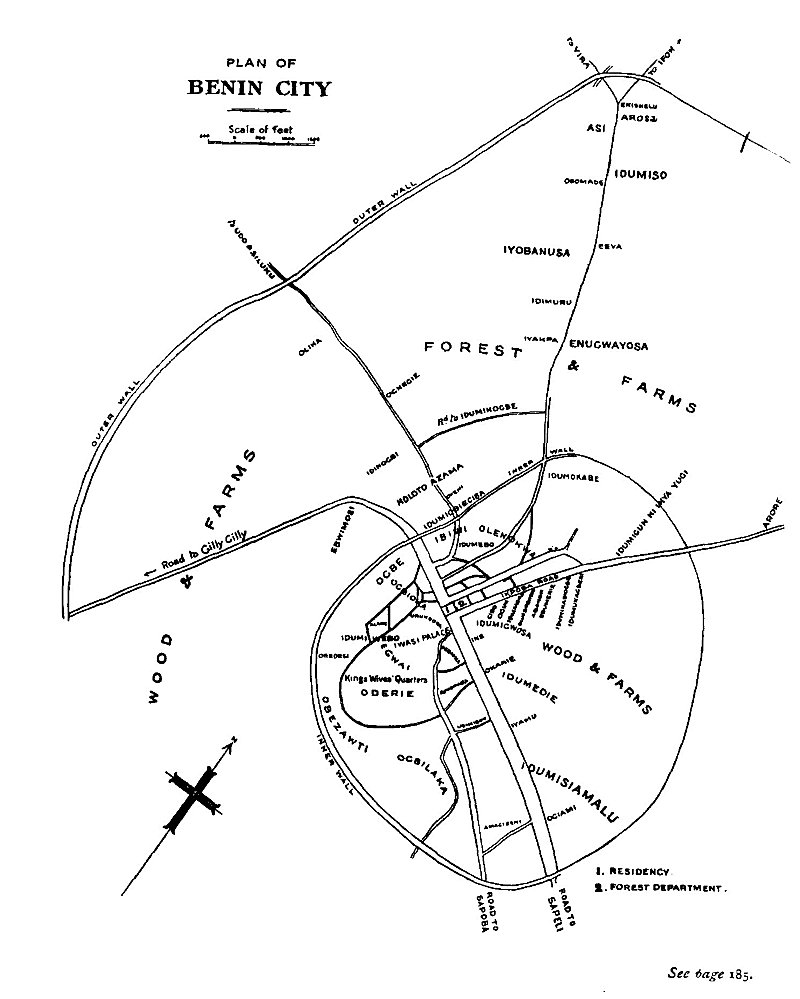
"By a house, I mean the abode of a family [1] living under its head, and not merely the dwelling place of an individual. This house (Pl. XVI) is built on the same lines, though on a smaller scale than a chief's palace. Passing along a road (ODÉ) one comes to a fence on one side of it, and this outer fence they call OGBOLI. Passing through an entrance there is, at a given distance, a second fence called EGODOLI, and then a third called EKUNUGOLI before coming to the house. The front wall of this house is called EBOWI, the side walls IGIEKA, and the back wall IYEKOWA. The space between the enclosing wall and the house in front is called AGUDULI, while those on the sides and back are made into a garden called EGUN. The house is divided into three sections, the centre part being the husband's quarters, looking towards the road to the left the wives' quarters ODERIE (Pl. XVb), and to the right the young men's quarters YEKOGBE. The doorway is called EKU, while the passages are called OBIOVIO. The rooms are ranged in both these latter quarters on the inner sides of the outer walls of the house and the outer sides of the walls of the husband's quarter, and are mere lean-to sheds. [1. The family is called EGRE, and is composed of ERA, father, OMIWU, the sons of the father, EYE, INYHEYHI, SAPAMAREGUDI, EGABIONA and the next our generations, none of whom may intermarry.] The centre part or husbands' quarters of an ideal Bini house is divided into four rooms. 1. IKUNU OGULI or ALERA, father's room, where there is an altar to the memory of the occupant's father. 2. IKUNU KADICI or ALWIYE, mother's room. 3. IKUNU AROHUMU, the reigning son's room, or the head's grove or temple. The entrance passage to this room is called ONURU, and facing you as you enter is the side of the altar AROWEBO (bead grove or altar).[1] There is an entrance to the wives' quarter from this. The roofs of these rooms incline towards the centre, which is an open square, and is upheld by a pillar (EHAWI) in each corner of the square. The floor of this square is about twelve inches or more below the level of the floor running round it, and this basin is called EGUDU. On the side opposite the altar is a raised platform of mud serving as a sofa or bed which is called UKBO. On the left hand side, just after entering the third room, are two closed-in rooms which you enter through small openings in the wall, one being the wife's room UGUGA, and the other the husband's room, OGWA. The fourth room is a spare quarter called ODUOWA, and in a garden on the outside of the back wall of the ODUOWA is a general or medicine altar called OGUSHUN. They call the roof EROHUMOWA, and it is made of the leaves (EBE) of a reed-like plant with a large leaf called EMWAME. The ridge pole goes by the name OKPO, the rafter EREDOMI, while the opening or funnel down which the rain flows into the EGUDU is called the OBOTO." - R.E. Dennett, At the Back of the Black Man's Mind, 1906 https://img849.imageshack.us/img849/2679/capturebinihouse.png |
| Culture › Re: Benin Art And Architecture by PhysicsMHD(m): 11:20pm On Mar 10, 2011*. Modified: 3:13am On May 05, 2012 |
"Under these OGIES are many villages ruled over by headmen equivalent to the KONGOZOVO in the Kongo. These. headmen have a number of families under them, each of which have land given to them for planting. There may be waste land in a province or a kingdom, but that is not to, say that it is no man's land for it belongs either to the OGIE, or the OBA. There were three other roads (Pl. XIV) leading from the OBA'S Compound to places within the outer wall, ODUHUMIDUMU to the east, where the OBA "played," and ODOKORAW to the residence of the OBA's eldest son, and ODIEKOGBA to the country at the back of the palace. The OBA'S Compound became the centre of a very large city surrounded by two great ditches and the thrown-up earth forming walls on either side of them. It takes one more than half an hour's hard walking to march from the inner wall or ditch on one side of the city to the same on the other side. And from the inner to the outer wall the distance varies from 1,000 to 3,600 paces. The main roads are those leading from the Oba's Compound to Siluka, Yira and Ifon, Geduma, Sapoba, Sapeli, and Gilly Gilly. In the olden days when the Sapoba and Gilly Gilly roads were unbroken approaches to and only bordered on one side by the palace wall and on the other by IMARAN'S house they must have had a very grand and beautiful appearance. A hundred paces broad, these green glades were lined by trees, growing on the raised sweeping of years on either side.' It was the duty of certain towns to come in to Benin City yearly and clean and sweep these glorious entrances to the palace. 1. The OBA'S Compound was roughly divided into three quarters. The OBA's quarter EGWAI. The wives' quarter ODERIE, and the Eunuchs' quarter called after the first great Eunuch URUKPOTA.2 [1. The poorer people who could not afford to bury their dead in houses threw their bodies on to this road, so that with-these and the bodies of people sacrificed it really had an awful appearance. 2 They say that OVERAMI did not castrate people to act as Eunuchs, but that any child who had the misfortune to be born without, or by an accident to lose these parts, was brought by his parents to the king. It is possible that this is in part the truth, but what about those holes in the wall of a town not far from Benin City, through which they say the victim's head was thrust while this operation was carried out.] Then there were eleven other divisions into which the City was divided and the names of these parts are those of the great chiefs who first founded them. 2. The beadmen's quarter (OBADAGBONYI) known as IDUMI WEBO. These people under NWAGWE appear to have partly lived close to the King in his Compound and partly to the N.W. of it. 3. Then to the South, behind the wall of the ODERIE was the quarter called OGBEZAWTI. 4. From here to where OBASEKI has his house was called OGBE. 5. Round about where ARASI has his house was called OGBIOKA (OBA'S son's quarter). 6. And where OBAYAGBON has his house was named the IDUMU IBIWI. 7. And where IHALIKA lives was called IDUM'EBO. 8. Then from the UDO or SILUKU road to the IKPOBA or GEDUMA road is named after OLENOKWA. 9. And from the IKPOBA road to the SAPOBA road the name is IDUMGWOSA as far as the house of PUSH PUSH. 10. From the latter's house along the Sapoba road is still called IDUMEDIE. 11. From there to the ditch, near the Sapeli road is called IDUMSIAMALU. 12. From the Sapeli road to OGBEZAWTI is called OGBILAKA. In the OBA'S Compound there was also a quarter called IDUMWUKI, where certain people observed the changes of the moon." - R.E. Dennett, At the Back of the Black Man's Mind, 1906 [My own note: Idumwun-Iwoki is what is meant by "IDUMWUKI", and Unwangue is what is meant by "NWAGWE." There are many other misspellings and other errors from Dennett, but his information remains interesting and often valuable regardless.] |
| Culture › Re: Benin Art And Architecture by PhysicsMHD(m): 11:18pm On Mar 10, 2011 |
| Politics › Re: "if They Rig, We'll Kill Them There-adams Oshiomole by PhysicsMHD(m): 11:15pm On Mar 10, 2011 |
Why is Oshiomhole making a fool of himself like this? If they rig in Edo state, who will kill them? A 5 foot tall governor? Ill-thought out statement. |
| Culture › Re: Edo Colonized Yorubaland Not Vice Versa. by PhysicsMHD(m): 11:01pm On Mar 10, 2011 |
Who refers to the Ooni of Ife as primus inter pares? The Alaafin of Oyo? The other stories around Oduduwa suggest a foreign interloper figure, and they suggest an actual human being. |
| Politics › Re: Urgent Answers Needed by PhysicsMHD(m): 10:55pm On Mar 10, 2011 |
[quote author=U de vex? link=topic=619687.msg7881908#msg7881908 date=1299732175]It would be the same as a Bini man claiming Urhobo people are Edo, because the languages are related. Urhobo is Edoid, but not Edo, just as Itsekiri is Yoruboid, but not Yoruba.[/quote]Basically. |
| Politics › Re: Nigerian Oil Smugglers Storm Ghana by PhysicsMHD(m): 10:53pm On Mar 10, 2011 |
Show and prove. |
| Politics › Re: Urgent Answers Needed by PhysicsMHD(m): 10:51pm On Mar 10, 2011 |
seanet02:For the record, Olu is an Edo word for a king/lord/ruler. The first Olu of the Itsekiri Warri kingdom was a Benin prince. Also, Edos previously used to call the Ooni of Ife (Ife was called Uhe by Edos) the Oluhe. The Olu in the title of the king of Warri does not mean "god". |
| Politics › Re: Urgent Answers Needed by PhysicsMHD(m): 10:47pm On Mar 10, 2011 |
[quote author=Ramnon.2 link=topic=619687.msg7881870#msg7881870 date=1299730893]Is he a black person or a white Portuguese who colonized itsekiris?[/quote]Black father, Portuguese mother. |
| Politics › Re: Cote D'ivoire - Gbagbo Gives Southern Nigerians A Mischievous Idea by PhysicsMHD(m): 10:44pm On Mar 10, 2011 |
@ OP, this is not a "mischievous" idea, it's a wrong idea. Or did you not read the part where two premature babies died? |
| Culture › Re: Edo Colonized Yorubaland Not Vice Versa. by PhysicsMHD(m): 1:06am On Mar 10, 2011 |
Don't seem to be able to repost it without a spam ban. I'll find another way to post it then. |
| Politics › Re: Patience Jonathan In Another Grammatical Mishap by PhysicsMHD(m): 12:41am On Mar 10, 2011 |
There is such a thing as "ethnic nationality" but she really wasn't clear. |
| Politics › Re: Urgent Answers Needed by PhysicsMHD(m): 11:24pm On Mar 09, 2011 |
? |
| Culture › Re: Edo Colonized Yorubaland Not Vice Versa. by PhysicsMHD(m): 10:58pm On Mar 09, 2011 |
Well, my response does not seem to be reappearing, but I'll post it later in a modified and separated form tomorrow. |
| Culture › Re: Edo Colonized Yorubaland Not Vice Versa. by PhysicsMHD(m): 8:47pm On Mar 09, 2011 |
[quote author=X-factoria link=topic=392592.msg7877902#msg7877902 date=1299675575]Thanks PhysicsMHD. I have resolved the ban issue. Let me quickly point out a misconception here. You keep getting things mixed up about Ooni's statement featured in this link: https://www.nairaland.com/nigeria/topic-392592.64.html#msg7726462 "Since Oranmiyan dynasty started in Benin, all the heads of the Obas of Benin on demise were buried in Ife in a sacred place called “Orun-Oba-Ado†up to the year 1900. 4. Records in the archives made it clear that since 1191AD, the Ooni of Ife had to be informed, and clearance must be given by him on the new Oba of Benin to be installed up to 1916" Ooni mentioned that only the head of the Obas were buried in Ife. It is possible that the bodies were buried in Benin with slaves like you suggested in your previous posts. Ooni may not be wrong here except you can proof that the Oba's heads were buried with them in the graves in Benin. I feel strongly that very soon either you or me will sponsor an archeological research to unravel the truth about this. Certainly, it has to be so one day.[/quote]Let me point out some misconceptions 1. The Orun Oba Ado head claim was completely made up. It was ingenious, I admit, because Ado is definitely a Yoruba word for Benin (Edo). Unfortunately, it is simply not grounded in facts. Igbo, for example, apart from being a word for forest or bush, is coincidentally the word for an ethnic group or nation that happens to be not too far from the Yoruba and also from the same language family. With the trend that the Ooni of Ife has advocated with regard to Orun Oba Ado, I wonder if he or his descendants will later start complaining if Igbo scholars at some later time exploit the abundance of the word Igbo (forest, bush, etc.) in ancient Yoruba sites, including Ife (Igbo Obameri, for an example of an Ife site) to start claiming that they (Igbos) laid these foundations in ancient times? See how distortion can backfire? 2. Egharevba introduced the claim that Eweka I ordered that upon his death his remains should be taken to Ife and that this was repeated in every third reign after him. There was never any reference to a head. The after death decapitation is precisely the abomination that makes the claim even sillier. Orun Oba Ado, which supposedly means the spiritual domain of the Oba of Benin, is among the earliest – actually, the earliest – significant archaeological site in Ife, with radiocarbon dates going back to the 6th century AD, from one of Frank Willett’s numerous archaeological excavations in Ife (see 1968. Radiocarbon Dates, WAAN, IX, 73. and 1969. New Radiocarbon Dates for Ife, WAAN, XI, both by Frank Willett. Or, see Archaeology in Nigeria(1969) by Thurstan Shaw if you can’t access those articles.) The only comparable significant archaeological features of Ife are the ancient walls also dated to the 6th century. So 6th century Ife had earthen walls/ramparts and an important foundational site that was already or was to become the "spiritual domain" of Benin (whether on the initiative of Benin or Ife, doesn't really matter to me)? So if you actually believe that Orun Oba Ado – the supposed spiritual domain of the Oba of Benin or the "the heaven of the kings of Benin"– which is at the heart of Ife near the Ife palace itself (by this I mean that is occupies a much more central location relative to the archaeological remains of Ife and the walls/ramparts of Ife, as contrasted with Ita Yemoo, for example, which is on the periphery) and is conspicuously close to Opa Oranmiyan, is tied to Benin, surely you can see the implications of this. Backfire #2. Once again, distortion bites the hand that feeds it . 3. You don’t seem to have grasped what a real burial of a king of Benin was like in olden times so let me give it to you in full detail and I hope you can use your immense knowledge of Ifa to divine the point at which the head is taken and enlighten the rest of us: "Among others, there is in the kingdom of Benin an ancient custom, observed to the present day, that when the king dies, the people all assemble in a large field, in the centre of which is a very deep well, wider at the bottom than at the mouth. They cast the body of the dead king into this well, and all his friends and servants gather round, and those who are judged to have been most dear to and favoured by the king (this includes not a few, as all are anxious for the honour) voluntarily go down and keep him company. When they have done so, the people place a great stone over the mouth of the well, and remain by it day and night. On the second day a few deputies remove the stone, and ask those below what they know, and if any of them have already gone to serve the king; and the reply is, No. On the third day the same question is asked, and someone then replies that so-and-so, mentioning a name, has been the first to go, and so-and-so the second. It is considered highly praiseworthy to be the first, and he is spoken of with the greatest admiration by all the people, and considered happy and blessed. After four or five days all these unfortunate people die. When this is apparent to those above, since none reply to their questions, they inform their new king; who causes a great fire to be lit near the well, where numerous animals are roasted. These are given to the people to eat, and he with great ceremony is declared to be the true king, and takes the oath to govern well." - From the account of a 'Voyage from Lisbona to the island of San Thomé south of the Equator, described by a Portuguese pilot, and sent to his magnificence Count Rimondo della Torre, gentleman of Verona, and translated from the Portuguese into Italian', published in Giovanni Battista Ramusio (1550), and retranslated by Blake (1942), i, pp. 150-1. The account was written in about the year 1540, according to Blake, and 'the author may have been one of the scores of Portuguese pilots who at this time were familiar with the navigation from Lisbon to the island of São Thomé'. - From the book Nigerian Perspectives (2nd ed.) by Thomas Hodgkin 4. “No human remains or artifacts of Benin culture were found in six burials excavated at Arun-Oba-Ado” The source for this conclusion being Frank Willett’s article in the book The African Iron Age, P. L. SHINNIE, (ed.) Guy, nothing was made up. I have been consistent in my statements. The Ifa came with Oranmiyan to Ife. If you are able to pursue research in Odu-Ifa (the verses of the literary corpus of the Ifa Oracle. There are 256 chapters of it), it will address your ignorance and show clearly what I'm talking about.I’m well aware of the Odu Ifa. That’s precisely my point. You claimed that Oranmiyan came with the Ifa oracle to Benin (you said Ife in this post that I’m quoting, but it’s clear that that’s a mistake from our preceding discussions, and that you actually meant Benin). Let’s see: “The great Oracle of the Yoruba country is Ifa. He is represented chiefly by 16 palm nuts each having from four to 10 or more eyelets on them. Behind each one of these representative nuts are 16 subordinate Divinities. Each one of the whole lot is termed an Odu -which means a chief, a head. This makes the number of Odu altogether 256. Besides these, there are 16 other Odus connected with each of the 256, and this makes the whole number of Odus 4,096. Some increase this large number still by an addition of 16 more to each of the last number of Odus, but the 16 principal ones are those more frequently in requisition. There is a series of traditional stories, each of which is called a road, a pathway, or a course, and is connected with some particular Odu. Each Odu is supposed to have 1,680 of these stories connected with it, and these, together with those of the other Odus, every one aspiring to the office of "A Babalawo," who is a divining or sacrificing priest, is expected to commit to memory, though scarcely has any one been found to perform the feat. Many learn by heart a very, considerable number, rather an appreciable number connected with the principal Odus. Upon the appearance of an Wit on the divining or consulting bowl, the "Babalawo," thinks of some of the stories attached to it, and from any of them that appears to him to suit the case upon which he is consulted, he delivers his Oracular response, and prescribes the sacrifice that would be accepted.” –Richard Edward Dennett, At the Back of the Black Man's Mind, 1906 And yet out of hundreds of deities the only ones which are known in Benin are the handful that could easily have been transmitted at later times due to Benin being part of the same larger sociocultural and religious community as the Yorubas. Your claim is ridiculous beyond belief. Your two stories that bordered on the Benin Origin of the Olokun (the first in which a hunter met with Olokun in the woods and the second in which a prodigal boy - Omobe climbed a palm tree) can in no way support an assertion that the Olokun you described in your post was the same Olokun (god of the Sea) as known to the Yorubas.Their depiction in art is the same, their names are the same, their powers and functions are the same, and you’re asserting that they are coincidental twins of different origins when the different origin points are right next to one another? Unbelievable. Olokun is Olokun my friend, there is no doppelganger Olokun. Please learn more about this deity since you’ve implied that you’re an expert on Yoruba religion. FYI, the Olokun does not reside on land. It resides in water or so we learnt in Yoruba mythology. So, how could it have been met by people who stayed far-away and who had no direct contact with the sea? Those far-away beaquethed the worship of that Sea god to the people closer to the sea? Your story could have made more sense if you had mentioned that the Benin people (in fact, the ruling families of Lagos) who settled in Lagos pre-colonial days had gone back to Benin to introduce the Olokun deity. That would sound more credible because I know the Olokun worshippers abound among the original indigenes of Lagos in areas like Epe and Ibeju-Lekki (all close to the sea).1. With regard to Olokun as a word, yeah that was a mistake on my part to assume the etymology could only have been one way. I’m aware that the compounding of words results in (sometimes, but not always) dropping middle letters and condensing the word as my own name first name is actually a testament to that. I’m aware of the “Asunki” phenomenon and it’s actually extremely common in Edo, but my perception was that they dropped the long “o” and kept only one (Olokun, rather than “Olo-Okun”) because owner of the sea is what Olokun is frequently called. Olu-Okun as Olokun makes sense though, so it could easily be that in Edo or Yoruba as well as Olo + Okun. My point still stands, however. 2. Did I claim Olokun resided on land? How are you not getting this? I don’t think you understand who Olokun is. Olokun is paramount over all waters. Saying that Benin had no direct contact with the sea is ill-thought out, because Olokun and sea symbolism in Benin art is enormous so your assertion that they needed to be near the sea at all times is already rubbished by reality. The Edo certainly had contact with water. Ughoton was a port, for example. You also completely failed to explain the unique Edo reverence of and religious laws with regard to large bodies of water when you implied that they were an inland people. Also, did you forget that a Benin prince founded the Itsekiri kingdom of Warri that was right by the coast and frequently directly at the sea? As for your statement about Lagos, it’s completely ludicrous. Lagos was of no significance before the 15th century, so I would be absolutely foolish to claim Binis established Olokun in Awori land (Lagos) and then transplanted it back to Ife and Benin when Olokun related art already appears in art from before the 15th century. 3. Owa-Obokun is now related to Olokun? When there isn’t a single reference to their association in the vast and enormous corpus of literature on Yoruba history and religion? More made up claims. I’ll only point out that Ekaladerhan and his actions at Ughoton necessarily precedes one of the very youngest sons of Oduduwa, regardless of whether Ekalderhan and Oduduwa are claimed to be the same person or not. 4. With regard to Ijebu, Olokun related art motifs do not appear in Ijebu bronzes or art before the 17th century, at which time Ijebu is said to have been under Benin dominion by Dapper and other European writers of that time. Subsequently, it appears frequently in Ijebu art. I wonder why? Then there are the Ikales, a Yoruba subgroup found in Ogun and Ondo state that are held by various writers, including numerous Ikales themselves, to have migrated from Benin towards the Ogun and Ondo areas, but there is no record of movements from the Ogun and Ondo areas to Benin. Furthermore, I would suggest you read or reread Saburi Biobaku’s Sources of Yoruba History with regard to his observations on Ijebu and Benin to understand how your suggestion of an Olokun-from-the-Ijebu area idea only strengthens the idea of Olokun originating from Benin. |
| Politics › Re: Gaddafi Warns About Influx Of Millions Of Blacks Including Nigerians To Europe by PhysicsMHD(m): 4:01am On Mar 09, 2011 |
[quote author=Ileke-IdI link=topic=618590.msg7875209#msg7875209 date=1299634827]Oh really? But you responded with specific details (Ghanaian women) to back up your rebuttal. So really, it wasnt a joke to you. But it's okay, take it as you wish. My point still stand that African men, esp our political leaders, are nothing but imbecilic hamsters running on wheels, back and forth on the same backwardness. mtcheww. Look at a continent controlled by men and dominated by men. . . . look at it! Beautiful continent enriched with riches, yet dominated in every aspect by greedy, selfish, vile, evil speci[b]men[/b]s. Yea, that was a joke. Yeah right. rollz eyes[/quote]Specific details? There are clearly Akan traditional leaders in that picture and I said that they were there to avoid being beaten by their wives and you think that's not a joke? Yeah all the bad stuff in Africa is done by men. And? Are you gonna start a lesbian colony? |
| Culture › Re: Edo Colonized Yorubaland Not Vice Versa. by PhysicsMHD(m): 3:44am On Mar 09, 2011 |
What could be proved to convince the other side on either group's part? The first written history of the Yoruba was by a man who was deliberately trying to distort their own history to elevate the Alaafin of Oyo above the Ooni of Ife, when that was unnecessary. Later he wrote that Oranmiyan was on his way to topple Mecca but was blocked by a lot of black ants. So you can't tell me that the earliest accounts are infallible. Of course nothing is going to be proved on a tribal issue, but I'm not the one that resurrected this thread. I just couldn't let fabrications slide and I wanted to point out that Oba Erediauwa is at least on the side of logic, even if he's wrong, and he's not "condemning" Egharevba by pointing out just some of several of his errors. |
| Culture › Re: Edo Colonized Yorubaland Not Vice Versa. by PhysicsMHD(m): 3:34am On Mar 09, 2011 |
[quote author=tpiah! link=topic=392592.msg7875315#msg7875315 date=1299637755]can you post links or quote that.[/quote]The Ooni of Ife's statement is enough. https://www.nairaland.com/nigeria/topic-392592.64.html#msg7726462 |
| Culture › Re: Edo Colonized Yorubaland Not Vice Versa. by PhysicsMHD(m): 3:27am On Mar 09, 2011 |
[quote author=tpiah! link=topic=392592.msg7875288#msg7875288 date=1299637276]everybody wants to reinvent the wheel.[/quote]So you feel I should have just the claims stand? People were claiming that Yoruba was the official language of the Benin palace. If the shoe was on the other foot, I doubt you'd be saying this. |
| Culture › Re: Edo Colonized Yorubaland Not Vice Versa. by PhysicsMHD(m): 3:06am On Mar 09, 2011 |
I just went through X-factoria's lasts posts by clicking on his profile and I saw the post that got banned as spam (because he quoted all of my post that had several links and was long). Let's see. [quote author=X-factoria]Nobody, not even me can assert that Oduduwa introduced all Yoruba deities. There are over 400 of them and some like Oya, Osun, Sango (the god of thunder and former Alaafin of Oyo) were introduced much later as you pointed out. However, I insist that the Ifa Oracle had been in Benin since Oranmiyan time. You do not have to agree. Go and study "Odu-Ifa" to get knowledge of this. It has wise sayings of Oranmiyan's activities in Benin.[/quote]So basically you just made it up despite it not making the least bit of sense and then assert and insist that it's true? And then mock the credibility of other people who have taken the time to think about whether the history insisted by others is true? [quote author=X-factoria]These are conflicting stories of the origin of the Olokun. The Olokun as you described it above could be different from the Yoruba's Olokun (God of the Sea). The Olokun as worshipped by Yorubas is a water spirit in the Sea or the Ocean. Even the word Olu (god) and Okun (Sea) tells the full story of where it could have originated from. I seriously doubt the veracity of these stories attributing the origin of the Olokun to Benin judging its distance from the sea although I do not know the story on the origin of the Olokun.[/quote]More made up claims. The Benin Olokun is absolutely the god of the sea and not something different. Please stop attempting your own fake etymology and stop making stuff up. Olokun has the same meaning in Edo and in Yoruba (these are related languages) and it is Olo (owner) Okun (sea) contracted into Olokun (owner of the sea). I see you didn't even bother to read my links which discussed this. There is no such thing as "Olukun". There is no reason to just keep making stuff up. Yes there is a Yoruba story about the origin of Olokun and there is a Benin story and I never said that either one was authoritative; rather, I said that there is no evidence that Olokun originated from outside of Benin, yet it is prominent in certain parts of Yorubaland, so your religious argument holds no weight. I find your claim about Benin and the sea even more ludicrous than your false etymology. If you had bothered to learn more about Benin before joining this debate you would have known that the Edo believed that they were forbidden to cross water because of their belief in Olokun. They believed the sea separated the world of the living from the world of the dead (the spirit world). No surprise then that they relied upon Itsekiri and Ijaw for much of their maritime trade with Europeans. This means all Edo, not just those actually in the city of Benin. Ughoton later became a port for Benin trade with Europeans so claiming that Benin city had to be next to the coast to worship the sea god is ludicrous. The city of Benin never moved towards the sea at any period, yet the number of Benin bronzes from Benin city depicting sea motifs and Olokun motifs is enormous. Olokun is the god of all water and the Edo reverence for seas, rivers, and all large waters was quite real. Furthermore, if you think Olokun came from Yorubaland, name the important ancient city in Yorubaland that was next to the sea that it came from. Here's a hint before you begin your search - you won't find one. I know Ife isn't near the sea and is even further from the sea than Benin. You'll have to try real hard with what you can concoct on this one. Secondly, you cannot premise your acceptance of the two stories on the worship of the Olokun originating from Benin on the fact that it is widely worshipped there. I will give you a good example. The Eyo masquerade that is widely/popularly worshipped in Lagos originated from Iperu-Remo in Ogun State. The family that worship the masquerade in Iperu-Remo came to marry in Lagos sometime in the 19th century and the Eyo came with them and that is the family that later popularized it in Lagos. Today, the Eyo masquerade is the face of Lagos cultural heritage. You cannot ascribe origin to a particular place based on popularity there.I absolutely did not base my argument that the origin of Olokun was Benin on the fact that it is widely worshiped there. Rather I pointed out that it is extremely developed and detailed and central among the gods there unlike in Yorubaland where it seems peripheral (minor) and simple, as though it were an addition or appendage, rather than foundational. In the same manner, Shango, Orunmila, and other Yoruba gods are extremely developed and detailed and very central in parts of Yorubaland but not so in Benin. Your example of the Eyo masquerade actually supports the idea that Olokun was brought from Benin into Yorubaland (Ife) as much as it suggests the possibility of Olokun not originating in Benin, so that example doesn't prove anything. Like I said, my argument was never about Ekaladerhan of Ughoton definitely bringing Olokun to Ife, it was just about your unfounded claim that when Yoruba deities must have been brought to Benin and your unsupportable assertion about Yoruba influence on Benin proving something about Oduduwa. [quote author=X-factoria]The second story on the Olokun and the John Mason story dating the origin to sometime in 12th century AD, could add up to mean that the Ogun deity predates the Olokun and had been present in Benin before the 12th century since Omobe - the prodigal boy, wrestled with it. So how did the Ogun find its way from Ife to Benin at that time and the Ifa Oracle only came to Benin several centuries later (17th century according to you)? You may wish to know that the Ifa Oracle and the Ogun deities are the most popular of all Yoruba deities from time immemorial and the most likely to be primarily exported to any other tribe or people.[/quote]How are you not getting this? Ifa, in whole, never came to Benin. Did you not read that google books link I posted? Benin adopted deities gradually. The overwhelming majority of Ifa deities were unknown to Benin, so how can any reasonable person claim Ifa was transplanted to Benin by Oranmiyan? At best you could suggest Ogun or one other deity like Shango was brought by Oranmiyan, but even that would be a completely unprovable assertion. And for the record, there is no date associated with Ogun, I just said it was most likely to be Yoruba in origin for geographical reasons. If one story implies that Ogun has long been in Benin and another story doesn't either one could be true, but that's not important for my general argument. I also find it interesting that you're now seeing implied pre-Oranmiyan contact between Ife and Benin in the story, because it's convenient for your hypothesis (a from Ife to Benin hypothesis of Ogun being transplanted) but immediately saw pre-Oranmiyan contact in which Olokun is transplanted to Ife from Benin as doubtful. For the record, even if Ogun was transplanted to Benin in pre-Oranmiyan times from Ife, it wouldn't somehow disqualify Olokun from being transferred to Ife by Ekaladerhan, so as I said it's not relevant to the general argument against your religious claim. [quote author=X-factoria]Lastly, I found one thing constant in all your submissions. You easily qoute whatever the Europeans write about Benin that you find favourbale and utterly disreagrd ones that do not recognize the Ekaladerhan story (most especially) in which case you will readily posit that the story was false and inaccurate. Aren't you also quilty of what you accused Egharevba of doing?[/quote]Are you serious? You think I easily quote whatever I find favorable? Me, that quoted a European account that said that Benin people threw themselves into graves to die with their king, is quoting whatever I find favorable? I quote things with a purpose - to point out that the whole story is not being told. If you can find many European or American authors that just repeat Egharevba's first story and disregard the Ekaladerhan story how does that affect the validity of my arguments or the distortions, fabrications or the logical gaps I want to point out? I pointed out that Willett's and Fagg's ideas on Benin art were often false because with regard to some things they just started conjecturing based on Egharevba's work and their conjectures were contradicted by facts. I pointed out that Robert Bradbury's writings on the burial place of Benin kings being Ife was contradicted by facts and by Egharevba himself. I pointed out that the "Yoruba palace language" story told to Bradbury, apart from being contradicted by European explorers, simply has no merit and no source from the palace itself. I pointed out that Michael Crowder's claim on Yoruba tribal marks being drawn onto the face of an Oba of Benin during coronation and then washed away was a complete fabrication and that the man had never even seen a coronation at the time that he wrote it nor was there any source for the claim. And you're saying that I'm just "disregarding" these European writers because they don't agree with my view? I'm debunking them and their claims. There's an enormous difference. I don't recall Egharevba debunking the Ekaladerhan story. I just said that he didn't incorporate all accounts. Other people accused him of distorting Benin history in 1945, so I don't need to be the one to accuse him of disregarding or distorting. Rather, every story should have been told, and preferably by somebody without his series of biases. This is not about Jacob Egharevba personally, because I definitely respect the man, it's what people are trying to turn his apparent errors into - their source of personal aggrandizement. Imagine someone asserting that the Oba of Benin was decapitated after death and then buried in Ife and then repeating this as though it were fact without bothering to check the sources for the claim and comparing it with other evidence and then telling you that you're a dishonest falsifier when you point out that it's a distortion. 1 Like 1 Share |


1 2 3 4 5 6 7 8 ... 32 33 34 35 36 37 38 39 40 (of 67 pages)