PhysicsMHD's Posts
Nairaland Forum › PhysicsMHD's Profile › PhysicsMHD's Posts
1 2 3 4 5 6 7 8 ... 35 36 37 38 39 40 41 42 43 (of 67 pages)
 Politics › Re: Abacha's Son Is Cpc's Kano Governorship Candidate. by PhysicsMHD(m): 12:02am On Mar 06, 2011 Politics › Re: Abacha's Son Is Cpc's Kano Governorship Candidate. by PhysicsMHD(m): 12:02am On Mar 06, 2011 |
[quote author=*Cougar* link=topic=617248.msg7852449#msg7852449 date=1299355577]george bush senior ruled after killing millions in iraq in 91. his son(george junior) continued where his father left off in 2004 and nigerians didn't complain. mohammed abacha is a nigerian and he's entitled to contest for the governor of his state. his father's issues should not be mixed with his own mandate.[/quote]What are you talking about? Do you know anything about the Gulf War? "The Persian Gulf War (August 2, 1990 – February 28, 1991), commonly referred to as simply the Gulf War, was a war waged by a U.N.-authorized coalition force from thirty-four nations led by the United States, against Iraq. This war has also been referred to (by the former Iraqi leader Saddam Hussein) as the Mother of All Battles,[12] and is commonly, though mistakenly, known as Operation Desert Storm for the operational name of the military response[13] (See section 12.1 Operational Names below), the First Gulf War, Gulf War I, or the Iraq War,[14][15][16] before the term became identified with the 2003-2010 Iraq War. The invasion of Kuwait by Iraqi troops that began 2 August 1990 was met with international condemnation, and brought immediate economic sanctions against Iraq by members of the UN Security Council. U.S. President George H. W. Bush deployed American forces to Saudi Arabia, and urged other countries to send their own forces to the scene. An array of nations joined the Coalition. The great majority of the military forces in the coalition were from the United States, with Saudi Arabia, the United Kingdom and Egypt as leading contributors, in that order. Around US$36 billion of the US$60 billion cost was paid by Saudi Arabia.[17]" http://en.wikipedia.org/wiki/Gulf_War Also, why would Nigerians be complaining publicly about what the U.S. was or was not doing in Iraq? Is Nigeria tied up or really involved in Middle Eastern affairs? My point about the Abacha connection continuing is that Buhari had strong, close connections to Sani Abacha so it's absolutely no surprise that he's fine with allowing the man's son to have a prominent position in the CPC. More on Mohammed Abacha: "According to post-Abacha governmental sources, some $3[5] or $4 billion USD in foreign assets have been traced to Abacha, his family and their representatives, $2.1 billion of which the Nigerian government tentatively came to an agreement with the Abacha family to return, with the quid pro quo being that the Abachas would be allowed to keep the rest of the money. Although this proposal caused a massive outcry at the time for seeming to reward the theft of public funds, it was subsequently rejected by the late dictator's son, [size=13pt]Mohammed Abacha, who continues to maintain that all the assets in question were legitimately acquired[/size].[16][17] In 2002, Abacha's family agreed to return $1.2 billion that was taken from the central bank.[18]" http://en.wikipedia.org/wiki/Sani_Abacha The source for the part I enlarged is: Easterly, William. (2002) The Elusive Quest for Growth, MIT Press. p. 245 |
| Nairaland General › Re: Buzugee/Nairaland, So I Want To Talk About Living Abroad by PhysicsMHD(m): 10:16pm On Mar 05, 2011 |
I have no beef either. It's just jokes.  - PhysicsMHD, the Nairaland school bully. |
| Politics › Re: Efcc Confiscates Lucky Igbinedion’s Assets by PhysicsMHD(m): 10:15pm On Mar 05, 2011 |
I don't understand how the EFCC could confiscate the London home. Somebody please enlighten me. I'm ignorant in this area. As for the rest, kudos to the EFCC for doing something without a political motivation. This should probably have happened earlier though. |
| Nairaland General › Re: Buzugee/Nairaland, So I Want To Talk About Living Abroad by PhysicsMHD(m): 10:11pm On Mar 05, 2011 |
Katsumoto:lol @ this. Isale started it actually. Go back and re-read the thread. All I made was a simple statement at first. [quote author=isale_gan2 link=topic=590933.msg7852719#msg7852719 date=1299358855]My esteem for you drops a point each time you post and run.  [/quote]Who's running? [/quote]Who's running? I'm glad you're keeping a point by point tally of your esteem for me. I wish I could say the same for you. |
| Family › Re: Over 2000 Men Get Beaten Up By Their Wives In Ghana by PhysicsMHD(m): 10:02pm On Mar 05, 2011 |
Jakumo: In a typical Ghanaian marriage, the wife is built like a Hippopotamus while the husband has the stature of an emaciated mouse. Don't ask me why that weight advantage always goes to the woman in Ghanaian marriages, but that is the way it is. Maybe Ghanaian men like to be able to hide behind ONE of their wife's thighs whenever debt collectors come visiting.https://www.nairaland.com/nigeria/topic-80784.0.html#msg1781307 Not that I agree with the above (I don't even know about Ghanaian marriages) but I thought it sufficiently hilarious that it was worth quoting here. |
| Nairaland General › Re: Buzugee/Nairaland, So I Want To Talk About Living Abroad by PhysicsMHD(m): 9:47pm On Mar 05, 2011 |
I see I've left some permanent wounds in somebody's psyche. Good.  |
| Culture › Re: Edo Colonized Yorubaland Not Vice Versa. by PhysicsMHD(m): 9:40pm On Mar 05, 2011 |
fstranger3:The truth is that people were trying to tell Benin their history without taking in all accounts. And when the "Yoruba tribal marks drawn and then washed off an Oba of Benin during coronation" lie got published in a supposedly authoritative history of Nigeria by a British historian, you have to wonder about the validity and objectivity of such history. |
| Culture › Re: Edo Colonized Yorubaland Not Vice Versa. by PhysicsMHD(m): 9:33pm On Mar 05, 2011 |
How do you know history wasn't already changed? The issue is that the first version of history proffered as authoritative was neither logical nor was it promoted by people who were unbiased towards certain quarters. And please don't tell me that common symbols of mud fish, ram's heads, etc. in art are evidence of exchange in artworks because those animals are prominent all over Nigeria and are found in different Nigerian art for that reason. Mudfish can be found in Nok art, rams in Ikenga, etc. The overwhelming majority of Ife and Benin bronzes, apart from those that seem religious, do not have similar themes and motifs. For example the cross motif so important in Benin bronzes is absent in Ife work. However, if people in Benin could make Ife style art as late as 1880, when Ife's prominence was nonexistent, it doesn't follow that the reason that Benin artists ever made Ife style art was because the story the Ooni of Ife asserted was true. My real question is how you conclude that cultural exchange from Ife to Benin in art supports the view of the Ooni of Ife and his partisans. Let's see: “By and large, since evidence of an Ife stylistic influence has yet to be convincingly demonstrated, a new and independent chronology is needed for Benin art, and this should be structured on internal evidence, rather than on an assumed continuum of Ife naturalism” - Babatunde Lawal, THE PRESENT STATE OF ART HISTORICAL RESEARCH IN NIGERIA: PROBLEMS AND POSSIBILITIES, Journal of African History, XVIII, 2 (1977), pp. 193-2I6 “As for the Ife-Benin succession in bronze casting, recent analysis of mould- and core-stuff does not seem to support the tradition.” - from Sources of Yoruba History (1973), p. 163, edited by Saburi Biobaku You said it was all about the slave trade in a topic about Ife and Benin, not about West Africa and Portugal. Bizarre. |
| Politics › Re: Abacha's Son Is Cpc's Kano Governorship Candidate. by PhysicsMHD(m): 9:02pm On Mar 05, 2011 |
And the Abacha connection continues. . .  |
| Politics › Re: I Want To Marry Kobjunkie by PhysicsMHD(m): 8:51pm On Mar 05, 2011 |
fstranger3: fstranger3:Let me help you out son: http://www.wikihow.com/Avoid-Looking-Desperate "#2 Don't try too hard. If you look like you are doing a lot to get them to notice you, you will seem desperate. #3 Don't stalk him/her, it's a bit creepy. It will make them think you are strange and desperate. #4 If that person clearly doesn't like you, then turn your attention to someone else" "Warnings: * If the person is interested he/she will show it, looking desperate won't help your case and will make you look sad!" |
| Politics › Re: I Want To Marry Kobjunkie by PhysicsMHD(m): 8:34pm On Mar 05, 2011 |
Odunnu:  |
| Politics › Re: Is This For Real? by PhysicsMHD(m): 8:14pm On Mar 05, 2011 |
"What type of sh1t is that, fraudulence, what's the cause of it" - Nature |
| Culture › Re: Edo Colonized Yorubaland Not Vice Versa. by PhysicsMHD(m): 7:43pm On Mar 05, 2011 |
1. Nobody is denying influence from Ife to Benin, but which particular artworks are you talking about? The vast majority of Benin and Ife artwork are quite different in even their material composition, not to talk of artistic style. If you mean the depiction of Ife characteristics in figures in Benin bronzes, that's to be expected since they were linked. Nobody is saying there was no link. The question is whether Benin initiated the link with Ife even before Oranmiyan. 2. The Portuguese never made contact with Ife. There are several pre-Portuguese Benin bronzes. 3. With regard to Oduduwa, "On the story that the Benin people went to Ife to ask for a king, Akenzua asked, “How can a group of people you do not know before just come to you and demand for a king and you[b] will just give your eldest son to them[/b] – to go to the land you don’t know to be their king? Simple reasoning will tell you that it is not true." (Prince Edun Akenzua). That's part of what the issue of Oduduwa is about. The claim that Oranmiyan just agreed to go and Oduduwa agreed to send him when there was no prior link with Benin arouses skepticism. 4. What does the slave trade have to do with anything? You do know that Ife had little or nothing to do with the slave trade and Benin had little to do with the slave trade? 5. Who did Oduduwa send to the Ijaw? 6. My main point was that you can't rely on Jacob Egharevba as the Ooni of Ife and his partisans have been doing for their argument. 7. Does the cultural exchange from Hausa to Nigerian Fulani imply that the relationship between Hausas and Nigerian Fulanis is like what the Ooni of Ife thinks the relationship between Ife and Benin was? 1 Like |
| Politics › Re: Stampede Kills 5 As Gov Akpabio Shares #15m Bribe!can This Affect His Election? by PhysicsMHD(m): 3:18am On Mar 05, 2011 |
I thought Akpabio was supposed to be one of the better governors in Nigeria.  |
| Culture › Re: Benin Art And Architecture by PhysicsMHD(m): 2:31am On Mar 05, 2011 |
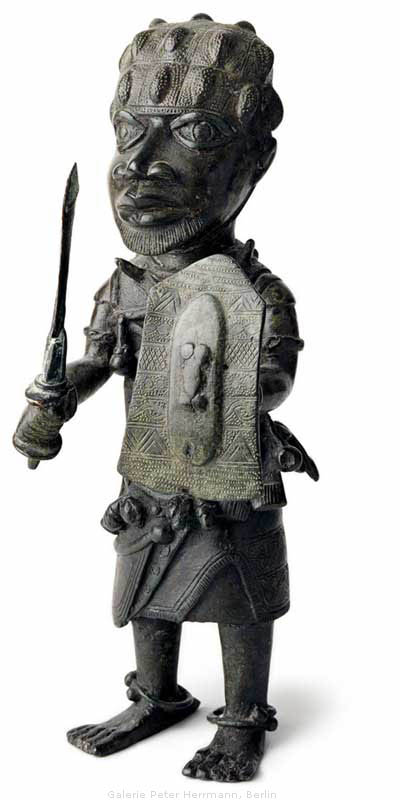
https://www.galerie-herrmann.com/arts/art3/Ife_Benin/35_Krieger_Krokohut/Krieger_120J_gr.jpg Warrior Benin, Nigeria about 1880 32 cm A plaque in the Museum of Ethnology in Leipzig features a very similar figure emerging victorious from a war scene. The two warriors wear the same crocodile-skin headdress and chin-beard, both uncommon f or objects from Benin. In the Viennese Catalogue, Christine Seige suggests that both warriors represent Oba Esigie (1504-1550), but this thesis does not seem very logical given that no other depiction of Esigie features a beard or this unusual headdress. Cp.: Barbara PLANKENSTEINER (Hg.): Benin. Könige und Rituale. Höfische Kunst aus Nigeria, Wien 2007, S. 457. |
| Culture › Re: Benin Art And Architecture by PhysicsMHD(m): 2:28am On Mar 05, 2011 |
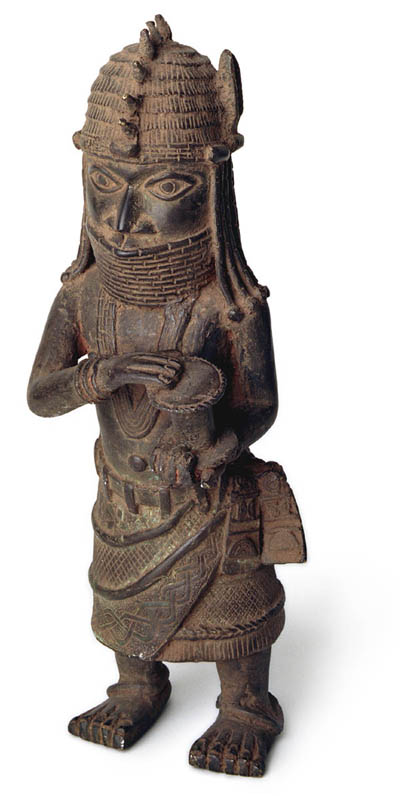
https://www.galerie-herrmann.com/arts/art3/Ife_Benin/41_Statue_Gorodose/Notabler_Goro_gr.jpg Prominent Figure with Kola Nut Box Benin, Nigeria 18th/19th century Bronze 34 cm Various features mark this dignitary as belonging to Benin's court society: he wears the coral feathered headdress and coral collar of high-ranking figures, as well as a wrap-around skirt and additional coral jewellery. In his hands, he carries a box containing precious kola nuts, gifts so valuable that special boxes were made specifically to hold them. These highly-valued nuts were brought to altars as signs of devotement. |
| Culture › Re: Benin Art And Architecture by PhysicsMHD(m): 1:19am On Mar 05, 2011 |
Thanks for the link. The Yoruba Aroko does not seem to be written communication though, so unless amazonia can provide evidence of this binary communication system, I'll have to conclude that the Edo did not have real writing. As for the Chinese, it's true that oracles are how their writing started. It's unfortunate that Benin did not make the leap to real writing. It would have been an enormous transformation. I think they were just averse to writing. Certain palace officials and the king of Benin had knowledge of Portuguese at various times through Benin's history and Oba Esigie even sent an ambassador (an Olokun priest) to Portugal. Oba Esigie (a Christian) also built three churches, so there must have been at least one Bible somewhere in Benin at some point. Yet Benin never even adopted the Latin script, not to talk of developing their own writing. |
| Culture › Re: Edo Colonized Yorubaland Not Vice Versa. by PhysicsMHD(m): 1:05am On Mar 05, 2011*. Modified: 2:18pm On Mar 29, 2012 |
A few points: 1. Please read http://www.edo-nation.net/edoghimioya1.htm with regard to the Ooni of Ife and the Western region, and with regard to the many biases of Egharevba to get a good idea of what some of the problems are with accepting the version of the Ooni of Ife. 2. Also, it should be noted that Michael Crowder, who worked extremely closely with J.F.Ade-Ajayi , another Yoruba historian, was directly responsible for concocting the fabrication that Yoruba tribal marks were drawn on to the Oba of Benin's face during coronation and then wiped away. This story, with no evidence of originating from Benin, was promulgated by a British historian (Crowder) who just so happened to be affiliated with Obafemi Awolowo University (then known as University of Ife) and just so happened to have close ties to Ade-Ajayi. The story was later published as though it were actually true in a later edition of Crowder's The Story of Nigeria (1978) despite the fact that Crowder never witnessed the videotaped 1979 coronation of Oba Erediauwa or the earlier 1933 coronation of Oba Akenzua II (Crowder wasn't even born in 1933). The significance of that is that there is already evidence of a British historian with close ties to Yoruba historians trying to distort Benin history. 3. I've addressed the head burying fable. It's simply not true. In fact, according to Egharevba's original claim, every third Oba's remains after Eweka I was buried in Ife on order of Oba Eweka I before his death and Oba Eweka I's remains were taken to Ife as well for burial. However, even by the list of Obas given by Egharevba himself, Oba Esigie died around 1547 according to Egharevba's estimate, and he was exactly one of the Obas who was was one of every third Obas after Eweka I. Yet I provided a quote from circa 1540, from a European explorer (Ramusio), which describes what happened when an Oba died - many people were buried with him, and this was already the ancient custom there. So much for the decapitation. A combination of Egharevba's own claims and written documentation already rules out his own made up story. Also I posted a link to an article (that google books link) in an earlier post which addresses this claim. It's also curious that in the first English edition of A Short History of Benin, and the Edo language version that preceded it, he claimed that Oba Eweka I was buried in Usama, in Benin, and made no mention of Eweka I or any other Obas being buried in Ife but asserted the Ife burial idea in the second edition of the book. 4. Jacob Egharevba never said explicitly that Oduduwa was ethnically Yoruba. In the first edition he merely said that Oduduwa was the forefather of the Yoruba kings and sent his son from Ife to Benin. Nobody is actually arguing with that, it's about who Oduduwa was and where he was from. In the second edition (1953), Egharevba said the Binis journeyed from Egypt, stopped at Ife, and founded Benin. This had earlier been stated in a colonial intelligence report (Intelligence Report on Benin City (1938)) in which he had been involved. He also repeated this in The Origin of Benin (1954).The implications of this statement by Egharevba are quite clear. A whole group of Bini “Egyptians “ just settled in and then left another city/kingdom and left no traces or influence? Of course not. It's implicit in his statement that although Benin as a prominent city came after Ife's prominence (although both cities are of similar antiquity), the Binis did something at Ife during its early days or the Binis in ancient times initiated the link with Ife that they would use at the end of the Ogiso dynasty. This was in the 50s, long before any complaints about the version recently advocated by Erediauwa. It's quite different from the version recently advocated by Oba Erediauwa but the implications are similar. The main thing to realize though, is that Egharevba in his histories was never describing anything like what the current Ooni of Ife and some other people are claiming with regard to an ethnically Yoruba origin for the present dynasty. It was Egharevba, after all, that stated that Oduduwa was not Yoruba in 1975. 5. The claim that Egharevba or the older historians didn't introduce convenient manipulations into their interpretations of history is simply not true. They took some stories, ignored others, and molded what they accepted into coherent histories with a little bit of ingenious theorizing. With regard to art, for example, Egharevba claimed that bronze casting was introduced to Benin in the 14th century from Ife. However, not only was a bronze bracelet dating from the 13th century found at Benin by Graham Connah, other Benin bronzes were found that have been dated to be over 900 and 950 years old by thermoluminescence, making them as old as any known Ife bronzes (which are often ascribed dates of 12th-15th century, but some are actually from even later than that). See http://www.galerie-herrmann.com/arts/art3/Ife_Benin/index_eng.htm#top for more. William Fagg's and Frank Willett's ideas about the origins and dates of various pieces of Benin art do not stand up to scrutiny - and they based most of their claims on Egharevba's writings. To make matters worse, few of the Ife bronzes and terracottas are adequately dated by actual analysis as most are just assigned dates on the assumption that they are older than most of the Benin bronzes. For example, see http://www.galerie-herrmann.com/arts/art3/Ife_Benin/08_Kopf_gr_m/e_Benin_450J.htm about Egharevba's false claim on the date that the headdress with “earflap” like projections was first used by an Oba. He stated that this style of crown was introduced by Oba Osemwede in the early 19th century and this was accepted uncritically by Frank Willett and then repeated in multiple other books on Benin or its art. However, it is clearly depicted on a 16th century memorial head of an Oba. Additionally, the bronze dwarfs were usually held by art historians like William Fagg and Frank Willett who relied upon Egharevba's writings to be from around the 14th-15th century based on their supposed “Ife-like” realism and the idea that Benin art started off as being like that of Ife after bronze casting was transplanted there in the 14th century and then Benin bronze casting departed from Ife bronze casting gradually over time. In reality, the bronze dwarfs are much older, and date from around the 1000-1100s A.D. Egharevba's assertion about the introduction of brass ("bronze"  casting from Ife in his second (but not first) edition of A Short History of Benin has long been a point of contention. casting from Ife in his second (but not first) edition of A Short History of Benin has long been a point of contention.6. The claim that stories collected earlier, during the colonial era, were necessarily more factual than any later versions, doesn't make much sense from a historical standpoint. In the study of history, it's often the later books, interpretations, scholarship, etc., that are accepted as most plausible, well-researched, and sensible over the earliest theories, historical writings, and conjectures. A good example is Herodotus, the “father of history” who, writing from a limited perspective and with limited knowledge of the many cultures and groups he wanted to describe, wrote many things about different groups that simply were not true. Modern scholarship approaches his writings with a healthy dose of skepticism. 7. The reason that I claimed that the version of history advocated by Oba Erediauwa may have been suppressed due to the socio-cultural atmosphere of the time, in which a part Yoruba, part Bini historian in the person of Egharevba may have been trying to solidify the links between Benin and Yorubas to the fullest extent and trying to make the Edos more closely “tied” to their neighbors by ignoring the other version of the Ekaladerhan story in his first version is that when Richard Burton visited Benin in 1863, he was informed that Benin had bequeathed “civilization” on the Yorubas in earlier times. This may or may not actually be true but what is clear is that they certainly had a certain view of things in 1863 yet it was never really reflected in Egharevba's first version from the 1930s, which shows that he had already not succeeded in incorporating all Benin histories in his accounts. The 1863 view, the story contained in Egharevba's second version from 1938 and the 1950s, and the 1970s version that Oba Erediauwa recently advocated in 2000 all link up into one more coherent picture of things in which Benin initiates the link with Ife before Oranmiyan. I think the weight of evidence, not only from a logical standpoint, but from the murkiness of the current Ooni of Ife's view of who Oduduwa actually was (actually descended from heaven? An Arab from Mecca? ) makes me lean towards accepting the Ekaladerhan as Oduduwa version.8. Aspects of Yoruba religion, such as the Orunmila deity, are held to have been introduced to Benin in the 17th century, so claiming that Yoruba influence on Benin was due to Oranmiyan, who didn't even stay in Benin and has always been held by both sides to have been frustrated out of Benin or to be frustrated with integrating into Benin (either one, makes little difference) and then to have gone and founded Oyo after this frustration, is pure fabrication and quite dishonest an approach to take. 9. The version advocated by Prince Edun Akenzua in the 1970s was never contradicted or denied by his father (Oba Akenzua II) while Oba Akenzua II was alive or by Egharevba, although both Egharevba and Oba Akenzua II, who were friends, were alive at that time. 1 Like 1 Share |
| Politics › Re: George Orwell Must Have Been Thinking About Nigeria When He Wrote Animal Farm! by PhysicsMHD(m): 11:37pm On Mar 04, 2011 |
Weird comparisons and mismatches, no time to go through and debunk it all. |
| Culture › Re: Benin Art And Architecture by PhysicsMHD(m): 8:51am On Mar 04, 2011 |
https://www.prm.ox.ac.uk/sitephotos/factsheetimgs/1991_13_17.jpg Ada, ceremonial sword, sheathed in coral beadwork. Aside from a sword like this one, the Oba would also have owned ceremonial garments – a headdress, fly whisk, and jewellery, all of coral beadwork. Benin https://www.prm.ox.ac.uk/sitephotos/factsheetimgs/1965_9_1B.jpg Pendant mask representing a leopard’s head, Benin, |
| Culture › Re: Benin Art And Architecture by PhysicsMHD(m): 8:48am On Mar 04, 2011 |
amazonia:Please provide more information on this. This is the first I'm hearing about this. The only written symbols of the Edo that I'm familiar with are the Olokun symbols, which are strictly religious and not for daily communication. |
| Culture › Re: Benin Art And Architecture by PhysicsMHD(m): 8:45am On Mar 04, 2011 |
ezeagu:Edos didn't have writing to the best of my knowledge. However, they certainly did have means of sending messages: "Objects and rituals, rank jewels and ornaments Numerous objects were used during events held at court. During audiences and ceremonies, gifts were presented in finely-crafted recipients. The traditional cola nuts were offered in richly sculpted ivory and wooden recipients. The court would send its messages in leather or brass boxes called ekpokin, inside which were placed objects with a symbolic meaning. Costumes, ornaments and jewels were attributes which helped to distinguish each of the many court dignitaries. A number of these costumes, including very fine and often little-known items, notably in ivory, bronze, brass, agate and coral, can be found in European museum collections." http://www.quaibranly.fr/uploads/media/DP_BENIN_21082007_-_ENGLISH_corrige.pdf Here's an image showing an example of one of these individuals: https://www.prm.ox.ac.uk/sitephotos/factsheetimgs/1991_13_8.jpg "Cast brass plaque of three men. The figure in the middle is carrying a leather or bark box called an ekpokin used for ceremonial presentations. The warriors on either side of him are wearing collars of leopards’ teeth around their necks. Leopards’ teeth were believed to give the warriors spiritual protection in battle. Benin, 1991.13.8" http://www.prm.ox.ac.uk/benin.html |
| Politics › Re: Lagos Ohanaeze Lists Conditions For Fashola’s Endorsement by PhysicsMHD(m): 8:35am On Mar 04, 2011 |
I think you guys have been going in circles basically. That usually happens when a glorious leader of men, women, souls, nature, and even small woodland creatures - such as myself - leaves the commoners to their low-brow discussions. |
| Politics › Re: Lagos Ohanaeze Lists Conditions For Fashola’s Endorsement by PhysicsMHD(m): 8:27am On Mar 04, 2011 |
[quote author=onye_ngbu link=topic=614770.msg7843269#msg7843269 date=1299223520]You tried to but your efforts werent sufficient.[/quote]What did the great PhysicsMHD miss or fail to do? |
| Politics › Re: Lagos Ohanaeze Lists Conditions For Fashola’s Endorsement by PhysicsMHD(m): 8:23am On Mar 04, 2011 |
How is this thread still going? I thought the great PhysicsMHD cleared things up already. |
| Celebrities › Re: Mirror Boy London Premiere… Pictures by PhysicsMHD(m): 8:16am On Mar 04, 2011 |
[quote author=Missy ★ B link=topic=614084.msg7836220#msg7836220 date=1299144144]Kai! This PhysicsMHD I've been admiring for the past 10 years is here paying Tjsiiikiiii a compliment whereas he hasn't even noticed me  Tjskii, I'm so going to invite Firearm here. You're in HOT SOUP!  [/quote] 10 years? [/quote] 10 years? I had no idea. Well I've noticed you now but if you want a real compliment put up a real pic. |
| Politics › Re: Engineer Launches Rocket In Kaduna by PhysicsMHD(m): 3:32am On Mar 03, 2011 |
They'll certainly need to do more than 1%. It is very good that the government is moving in that direction though, I have to admit. Previous governments certainly never even thought about it. |
| Celebrities › Re: Mirror Boy London Premiere… Pictures by PhysicsMHD(m): 3:29am On Mar 03, 2011 |
tjskii looks better than all those women at the premiere. |
| Politics › Re: Engineer Launches Rocket In Kaduna by PhysicsMHD(m): 3:08am On Mar 03, 2011 |
Beaf:I didn't say funding could go to random members of the public. I wasn't clear, so let me make it clearer. You have an engineering department at a top Nigerian university. The engineering profs there write articles. The articles get published. They go to conferences and present papers. They plan the curricula, they review articles, they lecture, they guzzle coffee, they do academic stuff, etc. etc., but they could also receive funding from the government to research specific areas (they could get large grants) that the government thought were worthy of focus. Why do I suggest that this wider academic community is who the government should include, rather than just those engineers who have applied to and gotten jobs at government research institutes? Because in general, those guys at top universities in a country tend to be unusually bright. This is done in the U.S. with regard to certain areas, such as nuclear energy research. |
| Politics › Re: Lagos Ohanaeze Lists Conditions For Fashola’s Endorsement by PhysicsMHD(m): 1:43am On Mar 03, 2011 |
[quote author=EzeUche_ link=topic=614770.msg7834500#msg7834500 date=1299112045]You are right, I am not familiar with Binis' liberalism. My main focus is East of the River Niger. However, I am interested in the well-being of my people wherever they reside. Currently, I don't even see Benin City as a destination or even worth fighting over. No offense. I think all groups should have a major city to call their own or should I say a capital city. Igbos have Enugu, Bini have Benin City, Hausa have Kano and Yorubas should have Ibadan. Lagos and Abuja are fair game. And yes I feel a people should ethnic representation based on their numbers. It is simple logic that if your people are found in an area in large numbers, they should have some sort of representation. We are not taking control of a city. We just want representation![/quote]How is Lagos fair game? That's the claim I don't get. This place does have a history. It's not Abuja. And why do you get to determine what city each group should have? Who says the Yorubas want or wanted Ibadan as their "capital"? Do you not even know about the historical tensions between the Oyo/Ibadan Yorubas and the other Yorubas? Concerning what's worth "fighting over." Benin is not something that could be "fought over" now or in the future, so how you, as an outsider, consider it, is not even relevant. Nobody who knows anything about the city and the way it's set up would ever suggest that the Bini would have to "fight" over control of the city from outsiders. And Lagos, Calabar, Kano, etc. none of these cities could be "fought over". That should be obvious, but you're being deliberately disingenuous here. Anyways, you're the one that brought up Benin, not me. As for ethnic representation based on their numbers, it's the exact opposite of the "One Nigeria" cosmopolitanism you were claiming people were embracing. The day we all start thinking like that, we'll ensure that in the future we'll always sideline a competent Ogoni, Berom, or Idoma person running for government to make way for incompetent Hausas, Yorubas, and Igbos based on Hausas, Yorubas, and Igbos being found in Nigeria in larger numbers. Ethnic representation based on numbers is simply not reconcilable with the cosmopolitan spirit that makes people reside in large numbers in places where they aren't originally from, and with that spirit that lets them be treated fairly and kindly by the indigenous groups there. If you want to compete with other groups for areas that they thought were theirs, just come out and say so. Otherwise the degree of political influence the indigenous group lets the new group have is strictly up to members of that group, not dependent on how many people the new group can get into the place. |
| Politics › Re: Lagos Ohanaeze Lists Conditions For Fashola’s Endorsement by PhysicsMHD(m): 1:22am On Mar 03, 2011 |
[quote author=EzeUche_ link=topic=614770.msg7834412#msg7834412 date=1299110990]And as you know, Igbos are native to Edo state as well. If you say they aren't, I shall call you a liar. Yet, we Igbos do not claim all of Edo state. We know our boundaries clearly. Simply mentioning that there are a lot of Igbos in Benin City, but we wouldn't dare claim ownership. We are not even claiming ownership of Lagos. We just want political representation. I would ask the same for Benin City if there were a lot of Igbos living in that town as well. No taxation without representation as the Americans would say. Well I am sorry that you have to worry about your culture eroding due to the dominant cultures of other groups. That is why population matters in that world, but your people can still remain distinct if you all cherish your heritage and history. And I never even mentioned Sapele. Frankly, I would not make such a statement, because I do not know much about Sapele to be honest. I don't even know how many Igbos are in that city. Therefore, I think you have me confused with somebody.[/quote]Did I say Igbos were not native to Edo state? As for claiming "all of Edo state," Igbos in Edo state cannot claim more than a few villages that could easily be transferred to Delta state once the Igbos there stop seeing themselves as Edo. There's a difference between being native to Edo state and being from Benin city, by the way. As for claiming political representation in Benin city, that's not something I even have to address because Chike Ekwuyasi, who was from Ogwashi-Uku, was elected in 1951 on the Otu-Edo platform to represent Benin. So you obviously don't have a good grasp of Binis' liberalism. The problem is when people start using that carefree, open-minded liberalism to advance an ethnic agenda. There's simply no reason why Igbos coming all the way from Imo or Enugu should have more of a political voice in Benin city than Owan or Etsako or some other non-Benin group just because Igbos, with a whole population of 25+ million east of the Niger to draw on, are able to populate the city faster and to a greater extent than those other non-Bini groups. If Benin city is to become a truly cosmopolitan city instead of the Bini city that it has been for over a thousand years, then you absolutely cannot claim that Igbos should get ethnically based political representation based on their numbers. That's the basic argument you still haven't addressed. You can't claim cosmopolitanism with one hand, but then reach for benefits for specific ethnic groups with the other hand. My mistake about the Sapele thing. That was another poster then. |




1 2 3 4 5 6 7 8 ... 35 36 37 38 39 40 41 42 43 (of 67 pages)