PhysicsMHD's Posts
Nairaland Forum › PhysicsMHD's Profile › PhysicsMHD's Posts
1 2 3 4 5 6 7 8 ... 36 37 38 39 40 41 42 43 44 (of 67 pages)
 Politics › Re: Engineer Launches Rocket In Kaduna by PhysicsMHD(m): 1:11am On Mar 03, 2011 Politics › Re: Engineer Launches Rocket In Kaduna by PhysicsMHD(m): 1:11am On Mar 03, 2011 |
If it did use some "zany" technology, but didn't have a significant impact on Nigeria and Nigerians after all the money was spent to incorporate/develop/utilize that technology, I would be against the government directly funding it through government agencies and parastatals instead of something like an open competition from all actual and potential researchers in Nigeria. Nigeria has manufacturing engineers right? Engineering profs with Ph.Ds (or even just master's) in mechanical engineering with a focus on manufacturing, right? So who's to say that the particular govt individuals at those agencies are the people to come up with that revolutionary use of some "zany" technology (like some new method of nanoassembly) that could make revolutionary improvements to brick making, rather than the rest of the academic community of Nigeria? The same thing applies to the time management system with regard to electrical engineers, computer scientists, etc. |
| Politics › Re: Lagos Ohanaeze Lists Conditions For Fashola’s Endorsement by PhysicsMHD(m): 1:01am On Mar 03, 2011 |
[quote author=EzeUche_ link=topic=614770.msg7834289#msg7834289 date=1299109559]PhysicsMHD is only saying that because he fears that can happen to Benin City. He already know there are Igbos are in Benin City in quite large numbers who consider themselves Benin Boys like the rest of them. That is why I can understand PhysicsMHD point of view, but he has to understand that we Igbos would never claim Benin City, which was built by the hands of the Bini people. Lagos on the other hand was built by different groups of people and each group who has added to the success of Lagos should be able to benefit from it politically.[/quote]Actually, in case you haven't been following Nairaland, I recently had to argue against two Yorubas who were convinced that Yorubas made up something like 10% of Edo state! Why did they think this? Because even with all the historical links and cultural similarities between Edos and Yorubas, they used those Edos who lean even more to the Yoruba side culturally than is usual for Edo state to start claiming ownership of 10% of Edo state. That's a starting point for future claiming. As for Benin, my problem is with the erosion of distinct, unique identities being subsumed into one mix with the influx of foreign populations. I don't like the Hausanization of Nigerian clothing - I would have preferred if my own people wore variants of the kinds of clothing seen in Benin art or which we had been weaving since before the 13th century - but not because I don't like the Hausas/Fulanis or their clothing. I actually like several aspects of their culture and like their clothing a lot, but I don't want to give up what my own people had that was unique. As for claiming Benin city, if I recall, weren't you the one on here bragging about how Igbos were supposedly 50% of Sapele at one point? I could be wrong about it being you that said so, but somebody definitely was bragging about that. What's the difference, really? Anyway, you didn't dispute my overall point. |
| Politics › Re: Engineer Launches Rocket In Kaduna by PhysicsMHD(m): 12:49am On Mar 03, 2011 |
Beaf:I don't think you really understood my complaint. I'm not concerned with how many patents Nigerian government employees are able to rack up. I'm interested in significant results and outcomes for money spent. For every invention, there is an end effect or result. The end results of any time management system and any brick making machine are adequately covered by existing technology. Thus any progress in these areas which is not revolutionary, will be relatively insignificant, after all that money is spent. Therefore it makes sense to fund more worthwhile projects, rather than remake existing technology. This is just about optimization. |
| Politics › Re: Lagos Ohanaeze Lists Conditions For Fashola’s Endorsement by PhysicsMHD(m): 12:37am On Mar 03, 2011 |
I'm not following the logic here. Why should an ethnic group argue for specific political rights and spoils of political victory to be awarded to fellow members of that ethnic group, if the argument for them being able to do it in a city not usually inhabited by their ethnic group is that they are fellow Nigerians and just as Nigerian as anybody else, and therefore have rights to every city in Nigeria? I don't see how people aren't seeing the conflict between pursuing a solely ethnic agenda and then claiming that doing so is justified based on nationalist ("One Nigeria"  principles. principles.What I mean is, if I come from some small obscure Middle Belt tribe and move to Lagos, my kids will be just as Lagosian as the Igbos that have been there for ages, so if we are going to take an ethnically neutral approach to politics, then my kids, if they want to run for office in Lagos someday, should not have to appease or appeal to both the Yoruba and the (future) Igbo bigwigs and politicians and movers and shakers and their interests, just because those ethnic groups constitute the largest part of Lagos state. Rather, my kids should appeal to Nigerians to get a political position (deputy governor, commissioner, minister of this or that, governor, etc.) based on merit. But if you start this trend of giving political positions based on the ethnic composition of the state, you create a situation where a brilliant Middle Belter (my hypothetical descendent, if I were a Middle Belter) could actually be sidelined to appease ethnic agendas. The Yorubas, Igbos, and then the Hausas, would first have to be appeased in their specific ethnic representation and development agendas in the city before this brilliant, affable Middle Belter could get a word in about improving his beloved home city of Lagos. If you're going to make Lagos a "no-man's land" it has to be done fully and honestly. Anything else is just an ethnic agenda badly packaged as cosmopolitanism and nationalism. |
| Politics › Re: Jonathan Visit: Four Pdp Supporters Kill In Auto Crash by PhysicsMHD(m): 12:23am On Mar 03, 2011 |
Tragic. Maybe the driver was drunk. |
| Politics › Re: Engineer Launches Rocket In Kaduna by PhysicsMHD(m): 12:21am On Mar 03, 2011 |
Beaf:Time management system? I know Nigerians have problems with time management, but I think we should fix that through discipline, not using money that could used on better things. As for brick making machines, do they really need to go and fund research to develop new brick making machines? It seems like reinventing the wheel for no purpose other than to say that you reinvented the wheel. http://www.motherearthnews.com/Modern-Homesteading/1977-09-01/Manual-Brickmaking-Machine.aspx http://www.google.com/images?q=brick+making+machine&oe=utf-8&rls=org.mozilla:en-US:official&client=firefox-a&um=1&ie=UTF-8&source=univ&sa=X&ei=2s9uTafLCdHTgQed6aky&ved=0CE0QsAQ&biw=1680&bih=857 https://www.youtube.com/watch?v=VxFtela_lXo https://www.youtube.com/watch?v=jQm3bkNaj3I http://www.globalsources.com/manufacturers/Brick-Making-Machine.html http://www.rictec.com.sg/brick/ etc. etc. . . . |
| Politics › Re: Engineer Launches Rocket In Kaduna by PhysicsMHD(m): 12:13am On Mar 03, 2011 |
texazzpete: He said he was able to invent the solid-fuel rocket with support from friends  http://dailytrust.dailytrust.com/index.php?option=com_content&view=article&id=13159:engineer-launches-rocket-in-kaduna&catid=1:news&Itemid=2 (edit: Then again, maybe he did actually originate his own design and engine; though definitely not a whole new invention, it could be something partially original) |
| Politics › Re: How MALCOLM X Made America Livable For Nigerians by PhysicsMHD(m): 12:08am On Mar 03, 2011 |
[quote author=Ileke-IdI link=topic=614838.msg7834112#msg7834112 date=1299107199]Hello, exaggeration! But yes, it's like Nigerians are being targeted  (minus wife-killing and drug dealing cases)[/quote]Oh, I get what you mean now. Yeah, some Nigerians definitely need to move to safer areas. (minus wife-killing and drug dealing cases)[/quote]Oh, I get what you mean now. Yeah, some Nigerians definitely need to move to safer areas. |
| Politics › Re: How MALCOLM X Made America Livable For Nigerians by PhysicsMHD(m): 12:01am On Mar 03, 2011 |
[quote author=Ileke-IdI link=topic=614838.msg7834043#msg7834043 date=1299106490]Yes very livable. . . .that's why you have Nigerians dying from unnatural causes every other week (Not including wife-killing cases tho)[/quote]Nigerians are dying from unnatural causes in America every other week? |
| Politics › Re: Engineer Launches Rocket In Kaduna by PhysicsMHD(m): 11:59pm On Mar 02, 2011 |
Kobojunkie:For the first time ever I'm going to have to completely cosign Kobojunkie. It's even ironic that the Minister of Science and Technology, Prof. Mohammed Abubakar, happens to be a Northerner, and all this ambition and scientific potential is rotting in the North while he approves government funded projects to develop time management systems and brick making machines. |
| Education › Re: Ramano: You Ask Why University Of Ilorin Was Rated First 1st In Nigeria. by PhysicsMHD(m): 11:40pm On Mar 02, 2011 |
SEFAGO:I wouldn't know. I just assumed that since he's clearly a physician or going to be a physician and seems to have been at Princeton after Rutgers that they do indeed study medicine at Princeton. I could be wrong. |
| Education › Re: Ramano: You Ask Why University Of Ilorin Was Rated First 1st In Nigeria. by PhysicsMHD(m): 11:38pm On Mar 02, 2011 |
fstranger3:Wikipedia's page on Princeton. The pic there matches up with one that you posted. And of course, the Harold and Kumar hint. http://en.wikipedia.org/wiki/File:ArchewayLantern.JPG http://en.wikipedia.org/wiki/Princeton_University "Many campus buildings have Neo-gothic archways and lanterns. Seen here is Blair Arch, the largest and most famous archway on campus." Also, I think SEFAGO said that you were at Princeton at some point. |
| Education › Re: Ramano: You Ask Why University Of Ilorin Was Rated First 1st In Nigeria. by PhysicsMHD(m): 11:33pm On Mar 02, 2011 |
fstranger3:Princeton, of course. What are you studying again (what specialization in medicine) ? |
| Education › Re: Ramano: You Ask Why University Of Ilorin Was Rated First 1st In Nigeria. by PhysicsMHD(m): 11:31pm On Mar 02, 2011 |
fstranger3:You previously mentioned Rutgers on here a few times, so I just wikipedia'd it, assuming there would be a few pics of its most well known or important buildings. |
| Politics › Re: How MALCOLM X Made America Livable For Nigerians by PhysicsMHD(m): 11:29pm On Mar 02, 2011 |
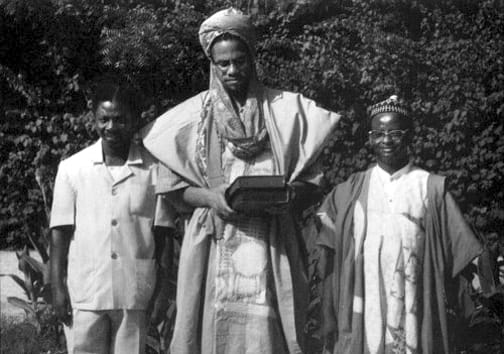
You'll like this: https://www.sfbayview.com/wp-content/uploads/malcolm-x-in-africa-1964.jpg "Omowale Malcolm X visits Nigeria in 1964 - there he was given the name Omowale by the Yoruba people meanining, the child has returned home" http://www.skyscrapercity.com/showthread.php?t=1305999&page=2 2 Likes |
| Education › Re: Ramano: You Ask Why University Of Ilorin Was Rated First 1st In Nigeria. by PhysicsMHD(m): 11:07pm On Mar 02, 2011 |
fstranger3:Rutgers. http://en.wikipedia.org/wiki/File:Old_Queens_Rutgers.jpg "Winter at Old Queens, the oldest building at Rutgers University in New Brunswick, New Jersey, built between 1808–1825. Old Queens currently houses much of the Rutgers University administration." |
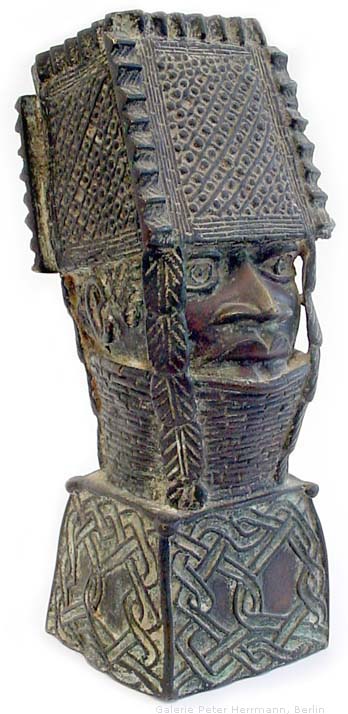
| Culture › Re: Benin Art And Architecture by PhysicsMHD(m): 11:01pm On Mar 02, 2011 |
I've only seen this box-shaped hat in one other Benin bronze. An interesting departure from the regular styles. |
| Education › Re: Ramano: You Ask Why University Of Ilorin Was Rated First 1st In Nigeria. by PhysicsMHD(m): 10:57pm On Mar 02, 2011 |
[img]https://www.nairaland.com/attachments/401598_OAU-Edu_jpgfaa588ebb3fc88e639319fc01f8e521d[/img] www.nairaland.com/attachments/401580_AJSLT_OAU_jpga139af3ec2fdb4e337a2f00b6828dfc1 Who's responsible for the architecture? It's kind of strange. |
| Education › Re: Ramano: You Ask Why University Of Ilorin Was Rated First 1st In Nigeria. by PhysicsMHD(m): 10:55pm On Mar 02, 2011 |
fstranger3:Oh. I can see that now with the pictures he's added. |
| Education › Re: Ramano: You Ask Why University Of Ilorin Was Rated First 1st In Nigeria. by PhysicsMHD(m): 10:40pm On Mar 02, 2011 |
^^^^ lol, you better get better pictures, because the ones from becomrich are making Illorin look better than OAU |
| Politics › Re: Engineer Launches Rocket In Kaduna by PhysicsMHD(m): 10:36pm On Mar 02, 2011 |
Good that he's interested in science and arguing for its promotion in Nigeria, but I need to know the scale of the rocket before I'm impressed. |
| Politics › Re: Lagos Ohanaeze Lists Conditions For Fashola’s Endorsement by PhysicsMHD(m): 10:27pm On Mar 02, 2011 |
[quote author=EzeUche_ link=topic=614770.msg7833417#msg7833417 date=1299100774]I can't believe I am reading that some foolish posters would say that Lagos did not need the support of the British. The main reason that Lagos is considered an economic powerhouse is due to the British focus on that city. If the British did not arrive in that town, it would be still considered swampland. Only a few cities in Nigeria had the necessary means of growing into commercial centers in Nigeria without British involvement and that would have been Benin City, Onitsha, Kano and Ibadan. Cities like Port Harcourt, Lagos, Warri even Sapele at one time thrived due to British interest.[/quote]http://books.google.com/books?id=JPJmCcZyxmYC&printsec=frontcover&dq=nigeria+cities+falola&source=bl&ots=WYONGYyyGk&sig=QdFzDkHUCPwkPIAKXqNkUbcdqgs&hl=en&ei=MrVuTeWNEs2Ttwemj8SIDw&sa=X&oi=book_result&ct=result&resnum=2&ved=0CB0Q6AEwAQ#v=onepage&q=five%20thousand&f=false (edited) |
| Politics › Re: Lagos Ohanaeze Lists Conditions For Fashola’s Endorsement by PhysicsMHD(m): 9:51pm On Mar 02, 2011 |
[quote author=~Bluetooth link=topic=614770.msg7833246#msg7833246 date=1299098985]Even without the british,lagos would still have been what it is today ![/quote]  Nonsense. |
| Politics › Re: Lagos Ohanaeze Lists Conditions For Fashola’s Endorsement by PhysicsMHD(m): 9:08pm On Mar 02, 2011 |
[quote author=EzeUche_ link=topic=614770.msg7832697#msg7832697 date=1299093599]It doesn't have to make sense. All we know is that there were groups who fought to keep Nigeria one, so now it is time for them to suffer the consequences. To keep Nigeria one is the task that must be done. [/quote]That's kind of my point. The "consequences" don't really make sense. I can see a made up city like Abuja belonging to no one, but Port Harcourt, Calabar, Lagos, etc. all have native populations. [quote author=onye_ngbu link=topic=614770.msg7832747#msg7832747 date=1299094017]It doesnt make sense at all in Nigeria. But the true shape of things is that it is just the truth. Any portion of Lagos land you purchase legally belongs to you, where ever you might have come from. No one is going to send you parking from there simply because he/she believes its his land. Any time it happens, it will simply lead to anarchy at the end of which things will still stay the way it is right now. Thats why I still maintain that Lagos or any other big city is no ones land. Even in onitsha town, onitsha indigenes have control over the land.[/quote]The Scots can never not own Edinburgh just because they're in the UK, so saying a union means that a city belongs to no one is just an assault upon history. How does Onitsha belong to everyone? I suspect that the real reason for this deliberate obliviousness is that the shoe is not on the other foot - i.e. other Nigerians are not rushing in significant numbers to Enugu, Onitsha, and other major cities in the SE and demanding political influence. |
| Politics › Re: Are The Best Leaders In Nigeria Likely Found In The North? by PhysicsMHD(m): 8:23pm On Mar 02, 2011 |
# 3 and #5 should be removed from your list immediately. For #3 refer to the wikileaks revelations on Yar'Adua and his smuggler friend. Also the crisis of government that resulted from his refusal to resign and transfer power to the VP is not a good example of leadership. For #5 refer to the bungled voter registration saga that is still ongoing. He could be honest, but certainly not among the "best" leaders in Nigeria. As for #2, that's debatable. He was previously Obasanjo's attack dog. He also said he would not investigate those who were funding him as a candidate (that he doesn't care where the money comes from). As for # 4, he worked for Sani Abacha as head of the PTF and appointed one of his relatives to an important position in that organization. Also he used the PTF money to disproportionately develop roads in the North as against the South. So you basically only have one person, Sanusi Lamido Sanusi, left for the North. |
| Politics › Re: Lagos Ohanaeze Lists Conditions For Fashola’s Endorsement by PhysicsMHD(m): 8:14pm On Mar 02, 2011 |
Claiming that every mega city is no man's land makes no sense to me. Then again, One Nigeria makes no sense. |
| Culture › Re: Benin Art And Architecture by PhysicsMHD(m): 6:48pm On Mar 02, 2011 |
https://www.galerie-herrmann.com/arts/art3/Ife_Benin/13_Kopf_Ahnekpo/General_Ahnekpo_gr.jpg Memorial Head of General Ekeghugu Ahnekpo: This head was made in memory of a distinguished person from Ife or Benin, known as "General Ekeghugu Ahnekpo." It is the last of the memorial heads that stood in the Obaseki shrine and can be dated to the year 1884. A 2007 TL analysis indicated an age of 100 years (plus or minus 30%), confirming an estimate made in 1989. Stylistically, this head follows the model of representations of Esigie's warrior father, Oba Ozolua the Conqueror (1481-1504), a legendary figure well-known for his impenetrable iron cloak, which included a rectangular headdress like the one seen here. The facial characteristics of this head, however, are more closely related to the later, more realistic period of casting; furthermore, the head is smaller than most 16 th-century heads. |
| Culture › Re: Benin Art And Architecture by PhysicsMHD(m): 6:47pm On Mar 02, 2011 |
[img]http://72.5.117.144/fif%3Dfpx/c/CR8238-d1.fpx%26obj%3Diip,1.0%26wid%3D400%26cvt%3Djpeg[/img] |
| Culture › Re: Benin Art And Architecture by PhysicsMHD(m): 6:46pm On Mar 02, 2011 |
https://www.barakatgallery.com/Auction/ItemImgs/ACFB4.gif This powerful brass head is a representation of a queen mother (iyoba) from the Nigerian kingdom of Benin. The style of this piece is one of the earliest recorded for the Benin polity. The first major stylistic convention for such pieces was a very high, pointed headdress fitted closely around the head. The faces were typically naturalistic, and rather finely rendered. The current piece, while certainly created in this image, is likely to be made somewhat later, probably in the 19th century. The neck is tall and slender with a ringed base, running up to a rounded jawline and a slim yet robust face. The lips are sensitive yet thick, with a deft handling of the flesh of the cheeks that implies that the woman depicted as of a certain age. The nose is trilobate, with a strong central stem and distinct, rounded nostrils. The eyes have definite rims, a characteristic most clearly seen in 18th century pieces, and pupils that were once inlaid with iron. The forehead is decorated with six vertical pellets, a number which is usually reserved for the oba himself (iyobas usually had eight pellets). The high, forward pointing headdress is typical of the early period, being rendered in a gridwork relief pattern. The vast majority of Benin’s artworks are designed to honour the achievements and/or memory of the Obas, the divine rulers of the Benin polities. Until the late 19th century, the Benin centres were a ruling power in Nigeria, dominating trade routes and amassing enormous wealth as the military and economic leaders of their ancient empire. This changed with the appearance of the British forces, which coveted the wealth of the royal palaces and found a series of excuses to mount a punitive expedition against the Oba’s forces in 1897. It was only at this point, the moment of its’ destruction, that the true achievements of the Benin polities became apparent to western scholars. The palaces were a sprawling series of compounds, comprising accommodation, workshops and public buildings. As it grew, the buildings pertaining to previous Obas were either partially refurbished or left in favour of newer constructions; this led to a long history of royal rule written in sculptural works that rank among the finest that African cultures have ever produced. The technology of bronze and copper smelting, ironworking and sculpting in a range of materials that particularly included ivory was extremely refined and effective; indeed, smelting, forging and cire perdue (lost wax) metalworking methods exceeded any seen in Europe until the 19th century. Brass or bronze Oba heads were made to honour the memory of a deceased king. Typically, the son of the dead king – the new Oba – would pay tribute to his father by erecting an altar in his memory. These altars, low platforms of mud that were arrayed around the perimeter of the royal courtyards, were decorated with these heads, and with various artefacts alluding to the Oba’s achievements in life. In traditional Benin society, the queen mother (Iyoba) is also commemorated in this way, following an edict laid down by Oba Esigie in the early 16th century. The first wife of the Oba to give birth to a live male son receives this title, for in a divine kingship system she is as important as Mary is to Christians, or Amina to Muslims. Iyoba heads can be differentiated from those of Obas by the forward-pointing “chickens beak” hairstyle which forms a shape known as the “ede Iyoba”. The typological systematics of these heads are endlessly argued over. In brief, there are two major types: the thin-walled and delicate type that is usually deemed to be earlier, and the more powerfully-built, geometrical and heavier type with a mouth-high cylindrical beaded collar that is associated with Oba head grades 4-5 of Dark’s monumental typology (? 18th century). This piece has the style of the early, tall-headdress type, but with detailing more reminiscent of later periods. It is probably a reiterative work by an enterprising sculptor in the last century of Benin’s independence. This outstanding piece is in excellent condition with no flaws and no restoration, and would take pride of place in any good collection. - (FZ.246 (LSO)) |
| Culture › Re: Benin Art And Architecture by PhysicsMHD(m): 6:42pm On Mar 02, 2011 |
https://www.artdaily.org/imagenes/2010/12/21/Masterpiece-2.jpg Ivory pendant mask, Edo people, Kingdom of Benin, Nigeria. Estimate: £3,500,000-4,500,000. Photo: Sotheby's. LONDON.- On 17th February 2011, Sotheby’s will sell a rare, newly re-discovered, 16th century ivory pendant mask depicting the head of the Queen mother from the Edo peoples, Kingdom of Benin in Nigeria along with five other rare works from Benin collected at the same time. Only four other historical ivory pendant masks with related iconography of this age and quality are known – all of which are housed in major museums around the world1. All of the ivory masks are widely recognized for the quality of their craftsmanship, for the enormous scale of Benin’s artistic achievement and for their importance in the field of African art. Produced for the Oba (or King) of Benin, these ivory pendant masks are testament to the Kingdom of Benin’s golden age when the kingdom flourished economically, politically and artistically. The masks rank among the most iconic works of art to have been created in Africa. The mask to be sold at Sotheby’s in February is estimated at £3.5-4.5* million. It had been on public view in 1947 as part of a loan exhibition at the Berkeley Galleries in London entitled ‘Ancient Benin’, and then again in 1951 in ‘Traditional Sculpture from the Colonies’ at the Arts Gallery of the Imperial Institute in London. The mask and the five other Benin objects will be sold by the descendants of Lieutenant Colonel Sir Henry Lionel Gallwey (in 1913 he changed his name to Galway) who was appointed deputy commissioner and vice-consul in the newly established Oil Rivers Protectorate (later the Niger Coast Protectorate) in 1891. He remained in Nigeria until 1902 and participated in the British Government’s “Punitive Expedition” of 1897 against Benin City. The faces of the five known pendant masks have been interpreted widely by scholars of Benin art as that of Idia, the first Queen Mother of Benin. The mother of the Oba Esigie (c. 1504 – 1550), Idia was granted the title of Iyoba (Queen Mother) by Esigie in recognition of her help and counsel during his military campaigns. Idia remains a celebrated figure in Benin, known as the ‘only woman who went to war’. The masks were created at least in part as objects of veneration. The worn and honey-coloured surface of the offered mask attests to years of rubbing with palm oil, and surface as well as the style of carving is most similar to the example in The Seattle Art Museum. The mask comes to auction together with: a highly important carved tusk made with a group of other similarly carved tusks for the altar of an Oba who lived in the 18th century. The imagery presented depicts emblems of power and strength which are related to the life of the Oba himself. The iconography is specific, and can be seen repeated across many arts forms in Benin, including the well-documented bronze plaques. The collection also includes two richly carved ivory armlets which incorporate many of the panoply of motifs used by the artists of the Igbesanmwan, the Royal Guild of ivory carvers. As with most ivory carvings, these were more than likely made for an Oba, as he would have had complete control over the production of works of art made from precious ivory. Also in the collection is a rare bronze armlet, cast with Portuguese figures in an openwork motif. The earliest appearance of the Portuguese in plaques and free-standing figures and bracelets in the 16th and 17th century was undoubtedly calculated by the Benin to add considerable prestige to the Oba and his courts demonstrating that his power extended beyond the confines of his own people. Finally, the collection includes a very rare bronze sculpture of a type historically identified as tusk stands. The twisted and hollowed form of this stand suggests it served the same function as the more familiar bronze commemorative heads, as a stand for a carved ivory tusk on an altar created to honour a former ruler. *Estimates do not include buyer’s premium |
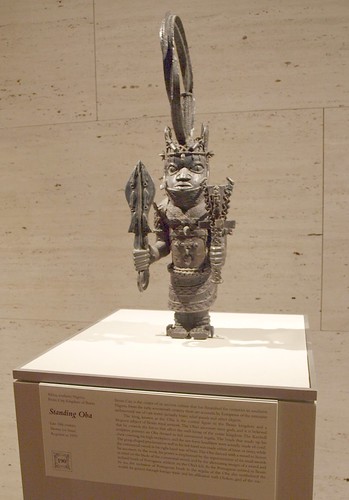
| Culture › Re: Benin Art And Architecture by PhysicsMHD(m): 6:40pm On Mar 02, 2011 |
https://farm4.static.flickr.com/3638/3522499570_2895ccd511.jpg African Standing Oba late 18th century Africa, Southern Nigeria, Benin City, Kingdom of Benin Bronze (or brass) 22-5/8 x 7-1/8 x 7-3/4 in. (57.4 x 18.1 x 19.7 cm) AP 1970.04 Kimbell Art Museum in Fort Worth. Standing Oba Africa, Southern Nigeria, Benin City, Kingdom of Benin Benin City is the center of an ancient culture that has flourished for centuries in southern Nigeria. From the early seventeenth century there are accounts by Europeans of the extensive architectural use of cast metal (actually brass) relief panels and other objects. The king, known as the Oba, is the central figure in the Benin kingdom and a frequent subject of Benin royal artwork. The Oba’s ancestors were gods, and it is believed that he controls the forces that affect the well-being of the entire kingdom. The Kimbell sculpture portrays an Oba dressed in full ceremonial regalia. The beads that made up his chest covering, his high neckpiece, and the net-form headdress were actually made of coral. The gong-shaped proclamation staff in his left hand was made either of brass or ivory, while the ceremonial sword in his right hand was of brass. The Oba danced with a sword to honor his ancestors. In this work, his power is emphasized by the representation of six small swords in relief on the blade of the ceremonial sword, and by the alternating images of a sword and stylized heads of Portuguese soldiers on the Oba’s kilt. As the Portuguese arrived in Benin by sea, the inclusion of Portuguese heads in the regalia of the Oba also symbolized the wealth he gained through foreign trade and his affiliation with Olokun, god of the sea. |
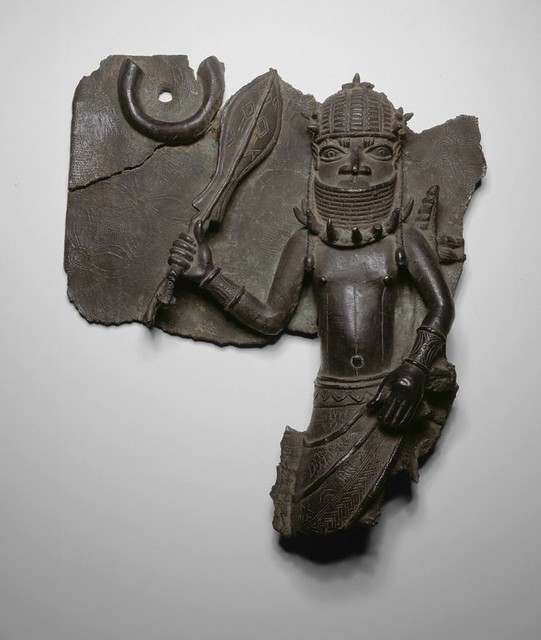
| Culture › Re: Benin Art And Architecture by PhysicsMHD(m): 6:37pm On Mar 02, 2011 |
https://farm4.static.flickr.com/3498/3755640483_7473281f5b_z.jpg?zz=1 Nigeria - Edo Plaque of War Chief (Art Institute of Chicago) Nigeria Edo peoples, Court of Benin 16th/17th century Brass, 13 3/8 x 11 3/8 x 1 7/8 in. Ivory, brass and coral have long been highly valued in the Benin kingdom (established about 1300). At one time all such materials were owned by the oba, or king, who distributed them to chiefs, title holders, and other important individuals. The warrior in this brass plaque, one of many from the magnificent royal palace complex in Benin City that was destroyed by fire in 1897, wears a coral-studded cap and high coral-beaded collar, indications of his high rank. The raised horseshoe shape in the upper left corner represents a copper or brass ring, called a manilla. They were manufactured in Europe and were used as a form of currency and a source of brass for Benin royal casting. |





1 2 3 4 5 6 7 8 ... 36 37 38 39 40 41 42 43 44 (of 67 pages)