PhysicsQED's Posts
Nairaland Forum › PhysicsQED's Profile › PhysicsQED's Posts
1 2 3 4 5 6 7 8 ... 120 121 122 123 124 125 126 127 128 (of 154 pages)
 Culture › Re: Yoruba, Igbo And Acculturation (or Multiculture) by PhysicsQED(m): 5:27am On Nov 27, 2011 Culture › Re: Yoruba, Igbo And Acculturation (or Multiculture) by PhysicsQED(m): 5:27am On Nov 27, 2011 |
BlackLibya:lol, research? I didn't do any research. I already believed that you and him were one and the same weeks ago because of your nearly identical writing style and because I thought it was impossible for two people to have the exact same ignorant and simplistic approach to places they didn't know about, but I guess you guys are just different ignoramuses. The reason I injected Benin into a conversation about Yoruba, is because I am more familiar with Benin than with Yoruba. You can find different sources online that say the ancestors of the Yoruba founded Benin, but it appears the more correct that the Edo people were in fact the founders. With that said, the Edo and Yoruba people share similiar ancestry.Actually you're not familiar with anything, or else you wouldn't interject Benin, whose traditional attire is completely unconnected to this discussion into this conversation under the moronic premise that Yorubas wear Benin traditional attire or that their traditional attire is one and the same. I don't need to look online for answers about origins or ancestry. And the question of founding or whatever is irrelevant to the facts written down in precolonial times or the pictures taken in colonial times or now showing traditional attire. This is not some sort of mystery that needs unraveling through random online articles. Whether or not they wore the same clothing or not would be an example of cultural diffusion. This happens. Egypt and Nubia were not the same kingdom, yet they shared many things in common with how they buried their dead and etc. It's called cultural exchange.There isn't a question of "whether they wore the same clothing or not" because there is quite literally nothing to suggest that they did so the issue of cultural diffusion or cultural exchange does not come up. 3rd, the book I cited above was written by an Igbo man, whose father was NOT A CHRISTIAN. So there.lol, so what if it was written by an Igbo man? I didn't ask about any book written by one person from one place in Igboland or comment on it. My point is that Benin traditional clothing isn't relevant here so it was dumb to bring it up. The rest of your crap has been addressed by other posters here, so I'm not going to bother responding further. |
| Politics › Re: Ojukwu (Dim Chukwuemeka Odimegwu) Is Dead by PhysicsQED(m): 5:02am On Nov 27, 2011 |
R.I.P. |
| Culture › Re: The Conquest of Nigeria: What Went Wrong? by PhysicsQED(m): 5:01am On Nov 27, 2011 |
ezeagu:My mistake on that, it was indeed the West African Frontier Force. The Ndebele are a smaller group driven out by the Zulu, they have a different language and culture. That would be like Ibibio being Igbo.It appears that there are two groups of people called "Ndebele". The group I referred to are not the "real" Ndebele, but a group of "Zulus" called the Matabele, and from what I've read, they are indeed basically Zulus. "THE ORIGIN OF THE MATABELE. During the period of suspense which is so hateful to eager spirits on both sides, we may, with advantage, take a glance at the central figure of this strange drama. Lobengula, the son of Moselekatse, as he used to be called in all the earlier missionary books from which we gain our first information of this region, or Umziligazi, as later and more correct information has led us to describe him, is a Zulu. His father more than sixty years since revolted against Tchaka, the founder of the Zulu kingdom. Leaving Natal, where Tchaka brooked no rival, he settled at first in the Transvaal, but being pressed by the advancing Boers he crossed the Limpopo and settled in Matabeleland. There, in the heart of sub-tropical Africa, in a pleasant and well-watered land abounding in great game and free from the tetzi fly, he established a Matabele counterpart to the original Zulu kingdom. The Matabele are as much Zulus as the Americans are English. They are practically identical in race, in manners, in language, and in their social and military organization. Lobengula is but a more remote Cetewayo. He himself objects to be culled a Matabele, always asserting that he and his men are Zulus. The analogy between the split in the English speaking race and the two branches of the Zulu kingdom is closer than would at first sight appear. The Zulus of Zululand have kept their blood purer than the emigrants who trecked westward under Moselekatse. The men who formed the impi which destroyed the British army at Isandhluana, and who were subsequently broken up at Ulundi, were men of purer blood than the men who are gathering on the Matalele frontier to-day. Lobengula's impi are only partially made up of the pure-blooded Zulu and very largely of other native races. Many of them have been captured as boys in the predatory raids of the Matabele, and been taught as the Turkish Janissaries to have no other country than that of their victors and no other religion but war." books.google.com/books?id=qBcyIMmrE20C&pg=PA555 I should have indicated that I was referring to the so called "Northern" Ndebele who are the Matabele (Zulus). |
| Culture › Re: The Conquest of Nigeria: What Went Wrong? by PhysicsQED(m): 9:37am On Nov 25, 2011 |
I read parts of the book The Fall of Nigeria by Obaro Ikime when I checked it out 2 years ago from a library and from the parts that I read, the main issue was definitely the difference in the power of arms used by the different sides. Brain triumphs over brawn every time. Of course the irony here is that the British invented neither guns (although they managed to improve on them) nor rockets, so maybe another lesson there is that extensive trade, diplomacy and adventurousness triumphs over isolation and complacency. 2 Likes |
| Culture › Re: Igbo Kids Are The Most Respectful In Nigeria, What Do U Think? by PhysicsQED(m): 9:13am On Nov 25, 2011 |
For a second there, I though that this was the actual poster "Mai Suya" (https://www.nairaland.com/nigeria?action=profile;u=263367), but I see now that it's a completely different individual with a similar name (or sense of humor). @ topic, I don't really understand the example you gave in the opening post. Are you talking about children greeting strangers or about people they know or see everyday? I find it hard to imagine that the kids in any of the groups you mentioned could get away with not greeting their elders if they knew these elders, so perhaps you should be more specific. . . |
| Culture › Re: The Conquest of Nigeria: What Went Wrong? by PhysicsQED(m): 8:11am On Nov 25, 2011 |
Who wrote this article? There are a few inaccuracies. 1895 is when Nembe was defeated after the 'Brass Revolt' or 'Akassa War'. It does not necessarily mean that is when "Ijawland" was defeated and annexed. Niger Coast Protectorate troops (Hausas, basically) were used against the Aro, not British soldiers. The Ekumeku uprisings were separate events (1898, 1902, 1904, 1909, 1911, etc.) that broke out at different times. The British did not invade the Oyo empire nor the states that succeeded it. The British did invade and fight the Ijebu kingdom however. Also, the Benin kingdom was not really in "steady decline" from 1700 onwards and the decline was not due to fighting against external groups. There was a civil war from around that time but the kingdom had recovered and was doing well by the 1780s as attested to by written documents from James Field Stanfield (an Irish abolitionist who visited Ughoton) and also by Pierre Labarthe, although the kingdom was no longer in its golden period. The next period of decline was in the 1850s. Another internal conflict happened around this time and the kingdom was in decline and it was a little after this time that external groups chipped away at the exterior parts of the kingdom. The kingdom was definitely still in decline by the 1880s and of course by 1897 it was far from its glory period. Even though I understand how it happened, it still baffles me to wonder how a few hundred people were able to conquer millions. Maybe it's just the fact that these empires were in decline. I'm sure in their golden days they woulve been able to ward off any European attacks.How many millions? What was the population of Nigeria in 1900? The 1952-3 census showed that Nigeria's population was around 30 million:books.google.com/books?id=3FHvvW1TclIC&pg=PA154 By 1963, it was 47 million. I think that around 1900 it was much less than 30 million and this is among hundreds of different groups, so individual states and kingdoms would have been of limited size. It is true that most of these places were all in decline when invaded, but I do not think any of these places had an army of sufficient size out of the population of their individual states that could have put up a really amazing resistance anyway. It might be more accurate to say that a thousands of people (not hundreds) were able to conquer millions, but it's more or less the same thing. It's happened before in history. Think of the Mongols conquering China or the conquistadors conquering the Aztecs (even fewer people were used here, if I recall correctly). The important thing is who has the superior military force and tactics. Those places that had to face maxims (machine guns, basically) and rocket artillery never really had a chance. The main reason for this simple conquest was the use of the maxim (developed in 1884) in these invasions. If they had invaded before the maxim was developed, the resistance would have been quite different. For example, when one reads the descriptions of the conquest of Benin by some of those actually involved, it becomes (annoyingly) clear that the whole thing was really about the maxim. http://en.wikipedia.org/wiki/Maxim_Guns Note the part about 50 soldiers fighting off 5,000 Ndebele (Zulu) warriors in a battle. Also, http://en.wikipedia.org/wiki/First_Matabele_War One reason the 1879 Anglo-Zulu conflict looks like such a great resistance (in comparison to the Matabele invasion or other invasions in Africa) by the Zulu is because they didn't have to face even a single maxim machine gun in 1879. That's one thing that some people miss when they fall for the myth of Zulu military preeminence among African groups. When the Ndebele (who are basically a group of Zulus) were invaded with maxim guns, the result was similar to the simpler invasions in other parts of Africa. |
| Culture › Re: Yoruba, Igbo And Acculturation (or Multiculture) by PhysicsQED(m): 12:48am On Nov 25, 2011 |
It's almost painful to read this thread. I've seen few other threads in nairaland with so many erroneous statements. I said I would leave this board alone for some weeks, but upon seeing this train wreck of a thread I just have to make a few comments. @ everyone, I would advise you not to take this "BlackLibya" character too seriously. He originally posted on this forum under the name "Knoowell" and his first act on this board was to proclaim the following: https://www.nairaland.com/nigeria/topic-755008.0.html#msg9106160 If you scroll down you'll see where I responded to some of his assumptions. His next post was in this thread: https://www.nairaland.com/nigeria?topic=128391.msg9105757#msg9105757 Where he went on to make similar huge assumptions and make historical assertions without any backing. I think he retired his original name out of embarrassment over his initial posts, but if anyone compares the diction used, the tone, and the same kind of simplistic reasoning, unfounded assumptions and lack of basic knowledge it's glaringly obvious that it's the same poster. He is neither Bini nor Yoruba, but he is American and he seems to not know very much about Nigeria at all. Why he feels the need to inject Benin into a completely unrelated discussion (this discussion) is unclear to me. Why he feels the need to comment on the pre-colonial history of a country he's read virtually nothing about is also unclear. @ BlackLibya/Knoowell, there are books and published articles which deal with the subject of pre-colonial Nigeria. One good source is the book Nigerian Perspectives by T. Hodgkin. It's about 400 pages long and contains numerous excerpts of descriptions of visits by foreigners to all parts of Nigeria. Anyone interested can track down the longer works it cites independent of the book, but the book gives a pretty good picture of many different places in Nigeria in pre-colonial times. If you actually think only Benin people were wearing traditional clothes or that the clothes worn by Benin and Yorubas were the same, you're very ill-informed because there is lots of written evidence against this. |
| Politics › Re: Chinua Achebe Is Ignorant Of The Situation In Nigeria - GEJ by PhysicsQED(m): 9:59pm On Nov 13, 2011 |
GEJ and Abati don't know what they're talking about and their decision to complain about the rejection of the award is what is really regrettable. And how they reached the conclusion that Achebe's supposedly "regrettable" decision was due to "misinformation" or a lack of information is beyond me. They should just accept that he knows whats going on there but things aren't up to his standards, yet. Also, they've managed to drastically reduce the worth of these awards by giving them to people who don't really fit the profile. |
| Culture › Re: BBC's Documentary On The 'Bronze Cast Head Of The Ife King' by PhysicsQED(m): 9:44pm On Nov 13, 2011 |
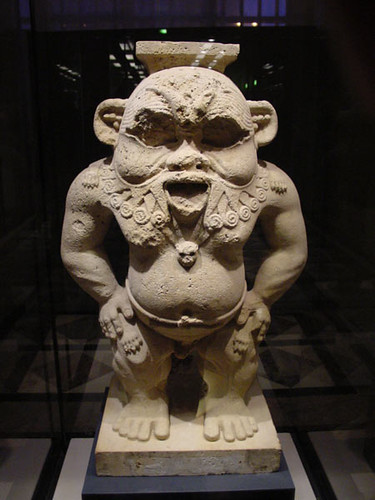
@ Terra Cotta. I was able to access and read most of the chapter (except for 4 pages) and it was very interesting and I liked the spirit of his analysis, but I think that certain images say much more about the possible connections of Egyptian religion with certain areas of West Africa than all the words in that book chapter possibly could: https://wwwdelivery.superstock.com/Image/1443/Thumb/1443-868.jpg https://wwwdelivery.superstock.com/WI/223/1443/PreviewComp/SuperStock_1443-868.jpg Statue of the Cortier Bes 664-610 BCE Egyptian Art Limestone Museu Calouste Gulbenkian, Lisbon, Portugal http://www.superstock.com/stock-photos-images/1443-868 https://cache2.asset-cache.net/xc/122222405.jpg?v=1&c=IWSAsset&k=2&d=77BFBA49EF878921E86F5CE8BE5D78FB90159980959DEFA07F3AEE19DB582870B1351F5B0DB00D28 Egyptian civilization, Middle Kingdom, Dynasty XXII. Basalt statue of seated visir Hori. Height 96 cm. From Karnak, Temple of Amun, Courtyard of the Cachette. (Photo By DEA / S. VANNINI/De Agostini/Getty Images) http://www.gettyimages.com/detail/122222405 https://img.artknowledgenews.com/files2009a/Tada_Seated_Figure.jpg https://www.imamuseum.org/sites/default/files/attachments/08%20seated%20figure%20detail.jpg Tada, Seated figure, Late 13th-14th century C.E. Fundación Marcelino Botín/Museum for African Art. © National Commission for Museums and Monuments, Nigeria. http://www.imamuseum.org/art/exhibitions/ife/image-gallery @ lakal, Interesting to find out that Obatala was the patron of the disabled/deformed. I guess that is why that terracotta was identified as a representation of Obatala. I did not come across this comparison in the Ancient Egypt in Africa book that TerraCotta posted. A long time ago I stumbled upon a thread making a comparison of the two figures on the egyptsearch/egyptsearch reloaded forum, but I didn't stop and think about it too seriously then because some of the (Egypt obsessed) posters on that site tend to post conjectural/conspiracy theory like information on that site in addition to posting very rarely mentioned and interesting legitimate information. When I saw the figure of the Nok terracotta (that I keep mentioning, but have yet to post  ) and its crystal clear connection to Egypt, and then saw four different images of Nok terracotta wearing outfits similar to that of the Oonis, then I started to remember this comparison and the probable link. ) and its crystal clear connection to Egypt, and then saw four different images of Nok terracotta wearing outfits similar to that of the Oonis, then I started to remember this comparison and the probable link.I came across yet another reference to Bes being a foreign deity that was introduced to Egypt on one of the website links I posted above: 'Bes was a family genius, who with Theuris, protected the house. His popularity was enormous, mostly in the New Reign. He was represented by a bearded dwarf with a dangling tongue, with crooked legs and a long dangling tail, he was a grotesque figure. He defended the house from the evil spirits, besides keeping away the dangers from men., with Theuris he protected the women in labour from any painful aspect of the delivery. He was also the protector of sleep, and in fact he was often represented on beds to prevent the evil geniuses to appear in dreams. He was god of dancing and of joyful events and he was also often represented while he was playing a drum. He presided over personal hygiene and his image is carved on many objects used for this purpose. It seems his origin was foreign. He was the “Guardian of the door”, in the mystery initiations, his name in fact means “to begin, to introduce”. ' http://www.egyptancient.net/godsbes.htm I suspect that both the websites that mention that he was probably a foreign deity to Egypt are drawing upon the work of some old and obscure Egyptologist or on some general work on Egyptian religion (rather than making merely making their own guesses), but don't care to give references or citations for their information. |
| Computers › Re: I Helped Steve Jobs Create The Mac — Bill Gates by PhysicsQED(m): 9:11pm On Nov 13, 2011 |
samyng:Maybe Jobs developed selective amnesia right before his death. |
| Culture › Re: BBC's Documentary On The 'Bronze Cast Head Of The Ife King' by PhysicsQED(m): 7:30pm On Nov 13, 2011 |
@ TerraCotta, as I said before, I will reply your earlier posts some days from now when I have much more time, and I'll also post the Nok/Egypt similarity and some other relevant Nok pictures some days from now as well, but for now I'll just post the Ife terracotta that I referred to. I might as well mention now that the Nok-Egyptian similarity on the piece that I called "incontrovertible evidence" was not pointed out by me, but by the authors of that book, who placed the Egyptian figure and the Nok figure side by side on p. 24 of that book (although they did not call it "incontrovertible evidence" like I did, but merely noted that the Egyptian and the Nok figure were "strikingly similar"  . It is not merely a superficial similarity, and it is not at all about the style of the art, but rather the specific pose and form of the figure, which may have some sort of religious significance. I also did not say that the Nok culture was really Egyptian or that they originated from Egypt (and I also noted that there is no evidence that they were literate). I merely said that there was a link. . It is not merely a superficial similarity, and it is not at all about the style of the art, but rather the specific pose and form of the figure, which may have some sort of religious significance. I also did not say that the Nok culture was really Egyptian or that they originated from Egypt (and I also noted that there is no evidence that they were literate). I merely said that there was a link.This is the Ife terracotta which was said (in an art book on Ife) to be either a representation of Obatala or of a diseased man: [img]http://hum.lss.wisc.edu/hjdrewal/Ife3.jpg[/img] This is one depiction of Bes in Egyptian art: https://farm1.static.flickr.com/28/53086299_83e40aa788.jpg You can see some of the many other depictions of Bes from a simple google images search of "Egyptian Bes": http://www.google.com/search?um=1&hl=en&client=firefox-a&rls=org.mozilla%3Aen-US%3Aofficial&biw=1173&bih=648&tbm=isch&sa=1&q=egyptian+bes&btnG=Search&oq=egyptian+bes&aq=f&aqi=&aql=&gs_sm=s&gs_upl=0l0l0l639223l0l0l0l0l0l0l0l0ll0l0 I came across one blog which makes the following claim: "Ugly and never shown in profile this dwarf-like god looks very un-Egyptian, and indeed it is suspected that he was imported from somewhere else, maybe other parts of Africa. Still, as a protector of homes and childbirth, Bes was quite popular although no temples were dedicated to him. He also acted as god of war and music. This high relief of Bes (also spelt: Bisu or Bez) is at the entrance to the Dendera temple of Hathor (near Luxor) http://www.travelphoto.net/a-photo-a-day/wordpress/2008/01/25/egyptian-god-bes-at-dendera/ But I do not see the source for their claim that "it is suspected that he was imported from somewhere else" nor who it is that suspects this. I am not claiming that these are necessarily the same figure, but they seem very similar in some respects: open mouth with tongue showing (as if shouting something or cursing someone - although admittedly, most of the other Bes figures do not have their mouths open), puffy cheeks, wide head, short and wide nose, sunken in eyes, skull hanging beneath their head, and a short/low forehead. Here's some more of Egypt's Bes: https://www.hypnotiqueolmecpunch.org/Bes%20Olmec%20Egyptian%20Diety.jpg http://www.egyptancient.net/godsbes.htm These could possibly be different and unrelated, but I do suspect a connection (religious) of some sort between the two pieces of art. |
| Computers › Re: I Helped Steve Jobs Create The Mac — Bill Gates by PhysicsQED(m): 7:08pm On Nov 13, 2011 |
Jobs was really two-faced: Walter Mossberg and Kara Swisher interview Steve Jobs and Bill Gates at 'D5: All Things Digital' conference in Carlsbad, California, in 2007. Quotes made during the time of the photograph. Kara: "What you think each has contributed to the computer and technology industry, starting with you, Steve, for Bill, and vice versa." Steve: "Bill built the first software company in the industry and I think he built the first software company before anybody really in our industry knew what a software company was, except for these guys. And that was huge. That was really huge. And the business model that they ended up pursuing turned out to be the one that worked really well, you know, for the industry. I think the biggest thing was, Bill was really focused on software before almost anybody else had a clue that it was really the software." Walt: "Bill, how about the contribution of Steve and Apple?" Bill: "Well, first, I want to clarify: I’m not Fake Steve Jobs. [Peals of laughter.] What Steve’s done is quite phenomenal, and if you look back to 1977, that Apple II computer, the idea that it would be a mass-market machine, you know, the bet that was made there by Apple uniquely—there were other people with products, but the idea that this could be an incredible empowering phenomenon, Apple pursued that dream. Then one of the most fun things we did was the Macintosh and that was so risky. People may not remember that Apple really bet the company. Lisa hadn’t done that well, and some people were saying that general approach wasn’t good, but the team that Steve built even within the company to pursue that, even some days it felt a little ahead of its time—I don’t know if you remember that Twiggy disk drive and…" http://en.wikipedia.org/wiki/File:Steve_Jobs_and_Bill_Gates_%28522695099%29.jpg Inked_Nerd:Look at the part that I put in bold from the joint interview above, and note the use of "we" there. Bill Gates took his share of the credit in a less direct and less confrontational way back in 2007. Now he's just saying it more explicitly because Jobs went out of his way to insult him. |
| Computers › Re: I Helped Steve Jobs Create The Mac — Bill Gates by PhysicsQED(m): 7:02pm On Nov 13, 2011 |
1. Wow. Steve Jobs sounded like a real jackass there. I'm stunned at how two-faced he was because there is a picture of Gates and Jobs smiling at each other and talking together at a conference. This is pure jealousy and it was really low of him to try and portray the philanthropy as a mere consequence of (allegedly) having no ability to innovate or make any contributions to technology after getting his money. Can any mature person honestly say that if they had Bill Gates' amount of money, they wouldn't engage in serious philanthropy of some sort? 2. Steve Jobs had over 300 patents and of course, was the brains behind the original Mac, so it's no surprise that he would consider himself a great inventor compared to Gates. But Bill Gates has 54 patents (with other co-inventors), so I'm not sure that it's completely accurate to claim that he "never invented anything." Maybe Jobs would have just claimed that he and the other people awarded those patents just ripped people off for those though. . . Here's a list of Gates' patents: http://www.freepatentsonline.com/result.html?p=1&edit_alert=&srch=xprtsrch&query_txt=IN%2F%22gates+william+h%22%0D%0AIC%2F%22redmond%22&uspat=on&usapp=on&date_range=all&stemming=on&sort=relevance&search=Search And it seems that Bill Gates was filing patent applications even as late as 2009 on a variety of different things: http://blogs.discovermagazine.com/80beats/2009/07/16/bill-gates-patents-a-device-aimed-at-halting-hurricanes/ http://www.informationweek.com/news/global-cio/legal/218500495 http://www.geekwire.com/2011/microsoft-bill-gates-patent-virtual-entertainment-belt http://articles.businessinsider.com/2009-04-09/tech/30058880_1_organ-donation-patent-application-electric-cars http://www.tomshardware.com/news/bill-gates-car-engine,7517.html So if I understand this correctly, Bill Gates is co-patenting devices to weaken the effect of hurricanes, virtual entertainment gadgets, and electromagnetic engines as late as 2009, but Gates is uncreative, unimaginative, and unable to contribute to modern technology any more? Anyway, kudos to Gates for telling the truth. |
| Politics › Re: Nigerian Civil War Dictionary: Nicknames, Slogans, Operational Names Etc by PhysicsQED(m): 11:11am On Nov 13, 2011 |
@ Relax101 Giwa in edo state is from two places Among the Northern Edo it is from Nupe influence/domination, although the possibility exists of a Yoruba connection. Nupes became islamicized by Fulani influence around the 19th century and then engaged in jihadist expansion near the end of the 19th century, penetrating into northern Edo state. There are Nupes and Hausas that are now indigenous to a few parts of Edo north because of the invasion. There is also the Igarra, an Igbiroid group in Edo north. Among the Binis it is from Edo-Yorubas that returned from the former exterior provinces of Benin: http://www.edofolks.com/html/pub103.htm http://www.edo-nation.net/edoakure.htm I know a few Giwa-Osagies and one Belo-Osagie and they are not descended from slaves (although, slaves may have eventually taken the name of the family that they were serving, so it's not impossible) and they would probably change their name and drop the "Giwa" or "Belo" "Bello" etc., if they thought it would be misinterpreted as indicating anything other than Yoruba Muslim ancestry (in addition to Edo ancestry). You can find some information on the Oloke family of Benin here (although the information about "Spanish-speaking Roman Catholic Missionaries" being sent by the Portuguese is inaccurate) and read about their Yoruba connection: http://olokefamily.org/?page_id=2# Note that there are Ojo-Osagies as well. Even on the facebook page for the Oloke family (which has Giwa-Osagies and Belo-Osagies), the creator of the page is one Femi Ojo-Osagie. Among the Binis, these kind prefixed names are usually from a Yoruba connection, not any Hausa origin. Neither Hausas nor Nupes are indigenous to Anioma or Bini areas. |
| Culture › Re: BBC's Documentary On The 'Bronze Cast Head Of The Ife King' by PhysicsQED(m): 7:38pm On Nov 12, 2011 |
@ Negro_Ntns, no I am not a prince. Where did you hear that?When exotik called me "ovbioba" that was just a compliment, not meant literally, if that's what you're referring to. |
| Culture › Re: BBC's Documentary On The 'Bronze Cast Head Of The Ife King' by PhysicsQED(m): 4:57pm On Nov 12, 2011 |
TerraCotta:I don't know about Negro_Ntns, but I can't access chapter 6 of that book through Google's preview. I suggest that you type up and quote short paragraphs or relevant parts of that chapter or just summarize the main arguments of that author in that chapter. Also, I suggest typing your long responses off the internet and then copying them to the reply box if you aren't already doing that. I've also lost long responses to threads that I didn't type up first in word or wordpad and had to remember and try to rewrite what I meant to post. Also, what's your opinion on the similarities between the Ife terracotta said to depict Obatala (the terracotta of the supposedly "diseased" short bald man with a skull on a necklace around his neck) and the ancient Egyptian artwork depicting Bes? I'd be interested in knowing what your perspective on that is in your next response to me. |
| Culture › Re: BBC's Documentary On The 'Bronze Cast Head Of The Ife King' by PhysicsQED(m): 4:29pm On Nov 12, 2011 |
@ Terra Cotta, your comments are interesting and your approach to this history and the various theories out there is a refreshing departure from what is sometimes the norm here. You said that you would "add more later". However, I see some serious errors or problems in what you've already written so I would have to ask that you delay your next comments that are addressed to me so that I can adequately respond to what you've written previously, since I am a bit busy with school and cannot as frequently reply thoroughly to posts that merit a serious analysis. Furthermore, I still intend to answer the interesting comments posted by Negro_ntns, tpia, and emmatok as well. If by "add more later" you were just addressing everyone else on the thread about adding more relevant general information about the art and the history associated with it, then of course, don't mind me, and please do continue to inform others about what you know. |
| Culture › Re: BBC's Documentary On The 'Bronze Cast Head Of The Ife King' by PhysicsQED(m): 2:39pm On Nov 11, 2011 |
I recently checked out the book The Nok Culture: Art In Nigeria 2,500 Years Ago, edited by Gert Chesi and Gerhard Merzeder, and there seems to be at least one piece of incontrovertible evidence there (p. 24, for anyone who can check out the book from a library) linking Nok with Egypt via one of the terracotta and the pose it's making. There are possibly two or three other figures which show a clear similarity with Egyptian art, such as a sphinx like figure and a bird-human creature (a possible reference to Thoth?). There are also several terracotta which show quite clearly that the outfit and style of dress of the Oonis (or whoever those figures depicted in full or half body form in the Ife bronzes are) is probably derived from that of the rulers or certain dignitaries of Nok. I would speculate that this culture (Nok) provided the ruling class for Ife up until a new figure emerged on the scene in or around the 12th century and supplanted an earlier dynasty. Some of the Nok terracotta seem to show what looks like a possible priest's breastplate, but with a different configuration than that of the Hebrews. It is not particularly surprising to see Egyptian-like motifs in some of the art, since I've honestly never even thought (looking at the art objectively) that the individuals of the Nok culture art looked anything other than "Near Eastern" or "Mesopotamian" in character, form, appearance, style, etc. although they are definitely black. They may have indeed been from Sudan, Egypt, (or further away still). Of course, what weakens this argument greatly is that evidence has not yet been uncovered which shows that they (the Nok people) were literate, so perhaps they were an indigenous culture that was influenced to some degree by outsiders from the near east. I will reply some of the other interesting statements in this thread (emmatok, amor4ce, tpia, TerraCotta, Ufeolorun, Negro_Ntns) somewhat later. I have some serious academic obligations right now that I can't really curtail in order to adequately reply the longer posts, or the posts that merit longer responses. There were some other images that I wanted to scan and upload for another thread, and I'll probably scan and upload the Nok images that I'm talking about at the same time and then post them here later so others can see what I mean by what I said immediately above. |
| Culture › Re: BBC's Documentary On The 'Bronze Cast Head Of The Ife King' by PhysicsQED(m): 8:56am On Nov 11, 2011 |
Negro_Ntns: Physics, if you were not a Bini man I'd be upset with you for the blasphemy on Akenzua. No Prince of an Empire need modesty to attain his birthright. Names are attributes of the person. Akin means Braveheart. It is reserved for men of calvary - warriors and heroes. Kings were also warriors and led their men to war. So you will also find princes bearing Akin, in addition to Ade - crownhead. If you say Aken in Bini does not mean braveheart, then I dispute the meaning you gave to it, knowing that it is most unbefitting of an attribute to give to a son whose birthright to prosperity is ordained by noble blood. You want a crown prince to be bold and brave, not modest and aspiring to prosperity. Negro_Ntns:@ Negro_Ntns, it's important to consider things in context. Akenzua was almost not the Oba of Benin and he had to "play the fool" before he could obtain his birthright. It was not just granted to him because he was a prince or had noble blood. Oba Akenzua the first had to overcome his brother Ozuere, and his brother's powerful supporter, the Iyase of that time (Iyase n'Ode). At that time the Iyase was still the top military commander (as other Iyases had been in the past). Oba Ewuakpe had already established the principle of primogeniture (the first son takes the throne) as a more firm rule (it wasn't necessarily adhered to before), so the fact that Akenzua would succeed his father Oba Ewuakpe was a done deal, but the Iyase a) had a strong dislike of the (then prince) Akenzua because of a personal insult or dispute between the two (from Egharevba's account) and/or b) was related to Ozuere's mother (from R.E. Bradbury's summary of Ezomo Omoruyi's account in the 1950s), so the Iyase and some other leaders schemed to place Ozuere on the throne. After Ozuere usurped the throne and ruled briefly, Akenzua was later able to force both of them out of Benin with the assistance of the future Ezomo, Ehenua, and was able to take his righful place on the throne. Although hostilities and fighting still continued between Akenzua and the Iyase's faction for a significant time afterward, Akenzua and the Ezomo finally triumphed later. The above is a brief summary of what has been written about this situation in that book (Art, Innovation, and Politics in Eighteenth-Century Benin), and from R.E. Bradbury's account of the situation that he obtained from Ezomo Omoruyi (a descendent of Ehenua) in the early 1950s (one can check R.E. Bradbury's article "Ezomo's ikegobo and the Benin cult of the hand" for details) Additionally, there is some independent written confirmation of a Benin civil war and the eventual triumph of the Oba by different written sources from 1700 to 1721. Now as for the name itself, that interpretation of the name given there certainly does not originate from me and definitely not from the author of that book (Paula Ben-Amos), Paula Ben-Amos interviewed people in Benin city starting from 1966 to the 1980s, and she got that information from Chief Ihama in Benin: "Upon assuming the throne, the elder son took the title name of Akenzua. According to Chief Ihama of Igun Eronmwon (pc1981), the name is a shortened version of an Edo phrase: a kon ze uwa, one has to appear modest (play dumb) before attaining prosperity. This theme is related to the notion that the Oba must suffer, must appear lowly before attaining the throne which is drawn from the paradigmatic story about the sufferings of the great warrior and master of occult powers, Oba Ewuare." - Art, Innovation, and Politics in Eighteenth-Century Benin (pc = personal communication) I definitely don't claim to know more than he does, so I'm not particularly inclined to go with a different etymology. If I were to attempt a different etymology however it would be "a" (one (in the sense of a pronoun referring to a person, not the number 1)) + "ke" ("to be suitable"/"it is suitable that"/"ought to" (there are other meanings for ke ("from,", "near", etc.) other than "it is suitable that"/"it ought to be that", but this is the meaning I would use)) + "n" (this has other uses, but it can be used to introduce the subjunctive mood (for something which has not happened, but which one wishes or desires to happen, i.e. what ought to happen), which is what it will mean here) + "ze" (choose, select, take, etc.) + "uwa" (prosperity). So it would be A-ke-n-ze-uwa "One (a) ought to (ke-n-) choose (ze) prosperity (uwa)". While this etymology is not impossible and I might like it a little better, I would definitely defer to the Ihama's knowledge and his interpretation on this. But even if I did accept that Aken meant brave instead of the reference to pretending to appear as if he accepted being outmaneuvered by his brother and the Iyase (playing dumb or playing the fool) before ousting them and becoming king, I still don't see how "Aken" (brave) + ze (choose, select) + uwa (prosperity) has anything to do with the Egyptian name Akhenaten ("living spirit of Aten" . Of course, maybe you believe Akhenaten means "braveheart Aten" or "brave Aten", but I doubt that this is really tenable and Egyptologists and linguists would probably debunk that interpretation pretty easily if they came across it.I don't deny that the ruling classes of places in Nigeria could possibly have come from Egypt or the Canaanites/Phoenicians and that there seem to be a few links here and there, but I think you should just accept that neither Yoruba nor other "East Kwa"/"Volta-Niger" languages (like Edo, Igbo, Igala, etc.) are really fundamentally Afroasiatic or Proto-semitic even if they might have a few words here or there from those areas. Unless you have some groundbreaking new linguistic study to unveil, I think we should desist from trying to see Egypt or the Middle East in every name and word we come across. |
| Culture › Re: BBC's Documentary On The 'Bronze Cast Head Of The Ife King' by PhysicsQED(m): 6:41am On Nov 11, 2011 |
Interesting comments above. I'll reply the longer comments and statements somewhat later because I need to look at a few sources for those, but for now I"ll just reply the simplest statements. |
| Culture › Re: Pictures Of OBI Of Onitsha Doing Ofala Ceremony by PhysicsQED(m): 6:02am On Nov 11, 2011 |
@ Ezeagu The oldest depiction of a fly whisk in Nigeria is a Nok terracotta. There is an image of this terracotta on p. 71 of the book The Nok Culture: Art In Nigeria 2,500 Years Ago, edited by Gert Chesi and Gerhard Merzeder. The caption on the figure is: "Standing male figure with fly-whisk H. 99 cm, 100 BC +/- 400 years TL 02301104 Private collection" And indeed the figure is holding a large fly whisk in his left hand and holding it over his shoulder. Flies have always been a problem, apparently. |
| Culture › Re: Pictures Of OBI Of Onitsha Doing Ofala Ceremony by PhysicsQED(m): 7:06pm On Nov 08, 2011 |
NRI PRIEST:But you have yet to explain what's so scary about these festivals. Is it the killing of cows in some of them? I hope not, because the Benin people do not have a Benin title that is the equivalent of "Ogbuefi" (cow-killer). So what is it about these festivals that was scary and what did they look like. Also who was involved? Ordinary people on the street, or people in traditional Benin clothing? Ogboni members, if they do have some sort of parade in Benin city, are not part of Edo culture. That is a separate issue altogether. The other Benin festivals are well known. Therefore, it should not be a problem to at least describe one aspect of what you saw and why you considered it scary. I have yet to see a Benin festival that is actually "scary" in appearance and that's why I want to know what it is exactly that you're referring to. And for goodness sake, please don't just say "it was full of voodoo" because that's garbage to me. As far as I'm concerned the very foundation of the Christian relgion - the Old Testament - is stuffed full of "voodoo", rituals and magic. Secondly, I am still waiting for you to prove to me that Eze Nri sacrificed his son fo some yam festival as your side-kick ChinenyeN puts it.I do not know what you are waiting for. It would cost you very little effort to find out for yourself whether or not the story is authentic. Concerning the sacrifice of the Eze Nri's son, this is a known tradition, whether you know of it or not. There are many publications originating from Igbo scholars which mention this tradition, so you don't have to take my word for it and can take issue with those authors if you have a problem with it. But I found the statement from the Eze Nri himself in his speech that I mentioned earlier so you can at least take his word for it: "In keeping with the custom and tradition of total obedience to God(Chukwu), Eze Nri sacrificed his first son and a yam spouted from the grave and grew. Eze Nri was then directed by God to use the yam to feed Ndigbo. This was ritualized as Ifejioku(god of yam), and one of the Nri myths of origin. Eze Nri, in obedience to this directive, will today give out yam seedlings to Ndigbo to go and plant and feed their families and kindreds." - Eze Obidiegwu Onyesoh (MFR) http://nwosureport.blog.com/2010/12/04/address-from-ikpo-eze-nri/ |
| Culture › Re: The Itsekiris. by PhysicsQED(m): 6:32pm On Nov 08, 2011*. Modified: 9:45am On Aug 18, 2013 |
We should be cautious of some stories we read on NL: "NOMENCLATURE The Itsekiri call themselves Itsekiri or iwere, and the Yoruba and Edo use the same names; the Urhobo call them irhobo, a term sometimes said to mean "those who float on the water"; the Ijaw call them selemo. In the English literature they are known as Warri or Jekri, though in the 19th century they were often referred to as Benin, since contact with them was first made on the banks of the Benin River. Warri and Itsekiri have been spelt in many different though recognizable ways by European writers, e.g., Oere, Ouere, Awerri, Owerri; Jekri, Jakri." - The Benin Kingdom and the Edo-speaking peoples of South-Western Nigeria by R.E. Bradbury together with a section on The Itsekiri by P.C. Lloyd, London, International African Institute, 1957. |
| Culture › Re: The Itsekiris. by PhysicsQED(m): 6:26pm On Nov 08, 2011 |
. |
| Culture › Re: Benin Art And Architecture by PhysicsQED(m): 8:53pm On Nov 07, 2011 |
Booshman:I really have to apologize for the delay. I've been very busy with tests and preparing for the physics GRE, so I did not type up the quotes I found about Benin in books. I'm sorry but I might have to delay that even longer, since I have a lot on my plate right now. If you want to know more about Benin daily life, then you probably don't need to read Egharevba's book (A Short History of Benin), because that is really about the monarchy's wars, disputes, etc. and not about daily life. I still recommend it for providing some background (if you can find it) though. If you want to know more about Benin culture besides that of the monarchy, I would recommend R. E. Bradbury's two books on Benin: The Benin Kingdom and the Edo speaking peoples of South-Western Nigeria, 1957 Benin Studies (edited by Peter Morton-Williams, and published after Bradbury's death), 1973 There is way too much information in there for me to attempt to summarize so I strongly suggest going to a large library somewhere to read parts of these books (the parts relating to day to day activities and customs that you're interested in) yourself to get a fuller and more accurate picture of things. Also, for the best overall book on Benin published so far, I recommend the book Benin, Kings and Rituals: Court Arts from Nigeria [/i]edited by Barbara Plankensteiner. The book is large physically and is about 530 pages long. This is the kind of book I would recommend buying (although the book is expensive). It contains a very large number of images (hundreds), many of which are absolutely stunning (and many of which I have yet to post in this thread) and a surprisingly huge amount of text explaining every image, and giving a ton of insight into the culture, history and traditions of the Benin kingdom (the book relies on a lot of earlier published work by many scholars). There are really too many images in there for me to scan and upload, and the detailed accompanying text and explanation for many of the images is too long to type, so I recommend checking the book out or buying it if you really want to know more about what the art is meant to represent. It also has a photo of chain mail (now in a museum) taken from Benin which I will scan, upload and post later on if I get time, along with photographs of cannon (also in a museum) taken from Benin. There is also a page or two speculating on the art depicting messengers with flat rectangular objects and the book suggests the people holding these objects may be literate Edo court officials, though it refers to European written languages (Portuguese, in particular). I have no doubt that the c. 1700 and the 1897 events probably prevented any documents written by Edo people, whether in Portuguese or any other system of writing, from surviving to the present. In addition, it explains some of the different outfits and attire, such as the beads around the legs and wrists that I was speculating about before. The ankle ornaments are called iviawe or eguen (apparently introduced by the Ogiso Ere), and there was a mention of them next to a picture of one of the plaques in the book. Although virtually everything in there is derived from another source, that book is definitely the best overall [i]synthesis of images, traditions, and other information relating to ancient Benin that has been published in any language. If you need info on Benin, I would strongly recommend going to a university library or a large public library in a major city, and getting a copy of that book. It would be more helpful as reference material than this thread, in my opinion. Here's a link to the book: http://www.amazon.com/Benin-Kings-Rituals-Court-Nigeria/dp/9053496262 |
| Culture › Re: Pictures Of OBI Of Onitsha Doing Ofala Ceremony by PhysicsQED(m): 7:54pm On Nov 07, 2011 |
@ Nri Priest Ogboni is not Benin, for the record. It is Yoruba. It was originally a Yoruba society of councilors/distinguished elders who kept the king's power in check in a Yoruba kingdom. The ROF (Reformed Ogboni Fraternity) did become popular in Benin during the colonial era, but a political party, Otu Edo, which was formed to oppose Ogbonism, was also popular. As for Ogboni being "demonic", I don't see how that is the case considering that their activity did not and does not center around "demons". What is "demonic" is subjective, anyway. For example, the Nri tradition in which the first Eze Nri sacrifices his son to God (Chukwu) for a good agricultural harvest may be seen as "demonic" by certain religions, but if you look a bit deeper you'll usually find that those other religions have their own flaws. If the first Eze Nri thought he was doing as God commanded, then what occurred should not really be called "demonic". Similarly, if the Ogboni used to sacrifice a criminal or an animal to their God or gods, it is not really demonic if it was not done with the intent of worshiping demons. |
| Culture › Re: Benin Art And Architecture by PhysicsQED(m): 7:32pm On Nov 07, 2011 |
ezeagu:Apparently the British did not originally intend to destroy Benin. They wanted to exile the king, install a puppet, and loot the place a bit: "The whole of the English merchants represented on the river have petitioned the government for aid to enable them to keep their factories (trading posts) open, and last but not least, the revenues of this Protectorate are suffering , I am certain that there is only one remedy. That is to depose the King of Benin , I am convinced that pacific measures are now quite useless, and that the time has now come to remove the obstruction , I do not anticipate any serious resistance from the people of the country - there is every reason to believe that they would be glad to get rid of their King - but in order to obviate any danger, I wish to take up sufficient armed force , I would add that I have reason to hope that sufficient ivory may be found in the King's house to pay the expenses incurred in removing the King from his stool." ["J.R. Phillips to Foreign Office. Advising the deposition of the Benin King." 17 Nov. 1896. Dispatches to Foreign Office from Consul-General, Catalogue of the Correspondence and Papers of the Niger Coast Protectorate, 268 3/3/3, p. 240. National Archives of Nigeria Enugu.]' But I am certain that the end result would have been the same (fighting and then eventual destruction), since fighting would have commenced anyway after the attempt to remove the king and the British would have burned the capital the same way they burned other African cities (like Kumasi) after their invasions. Anyway, in 1897, Benin was in a period of decline, due to changes in trade in the region, so I don't think the development and inevitable modernization would have been that rapid. |
| Culture › Re: BBC's Documentary On The 'Bronze Cast Head Of The Ife King' by PhysicsQED(m): 7:18pm On Nov 07, 2011 |
alj_harem:Was there such bronze casting in Ketu, Sabe or Popo? Let's try and be objective here. This "bronze" casting thing was a Nigerian phenomenon, not a Yoruba phenomenon. Except for Egharevba's decision in his later edition of his famous book to claim that somebody named "Iguegha" was from Ife, I do not think this claim would have been continuously repeated. Anyway, names like "Oghene" ("Hooguanee"/"Ogane" and "Iguegha", if interpreted in a straightforward manner in relation to Ife, seem to imply something that may be better left unsaid so as not to derail this thread. |
| Politics › Re: Group Wants Igbanke Included In The Proposed Anioma State by PhysicsQED(m): 1:18am On Oct 20, 2011 |
LMAO The return of the Ogbuefi of lies indeed! You didn't disappoint with your essay. You really piled it on there and I've already spotted several errors just glancing through that epistle you wrote. Well, I have a test Friday morning, so expect a full response on Friday afternoon! However, when I do post my counter "essay" I'm going to do it in that Delta Igbo Bendel Igbo thread, because you had some other false claims there that I [b]still [/b]intend to correct. I was waiting for you to return, but since you're here now, it's all good. I'll respond in that thread and post the link in this thread just in case you miss it. |


 ? Well,if isnt,prove it to me!!



1 2 3 4 5 6 7 8 ... 120 121 122 123 124 125 126 127 128 (of 154 pages)