PhysicsQED's Posts
Nairaland Forum › PhysicsQED's Profile › PhysicsQED's Posts
1 2 3 4 5 6 7 8 ... 119 120 121 122 123 124 125 126 127 (of 154 pages)
 Politics › Re: Lagos Monarchs Get N46m Car Gift From Fashola by PhysicsQED(m): 12:19pm On Dec 08, 2011 Politics › Re: Lagos Monarchs Get N46m Car Gift From Fashola by PhysicsQED(m): 12:19pm On Dec 08, 2011 |
Akanbi_edu:Yeah, I see that now. I assumed there was only one Oba of one Ketu, but it seems that there are at least two Obas of two different Ketus, and they are both called Alaketu. A little confusing. http://www.nigeriancompass.com/index.php?view=article&catid=319%3Asaturday&id=4321%3Awar-brews-in-ketu-ikosi-over-land-monarchs-stool&tmpl=component&print=1&layout=default&page=&option=com_content&Itemid=661 http://234next.com/csp/cms/sites/Next/News/5566345-147/yoruba_in_benin_republic_seek_recognition.csp http://books.google.com/books?id=BIdITHIAEs0C&pg=PA373 |
| Politics › Re: Lagos Monarchs Get N46m Car Gift From Fashola by PhysicsQED(m): 11:32am On Dec 08, 2011 |
Are these other Ketus named after the Ketu in Benin Republic or is it just a general word for a group or a popular city name? |
| Politics › Re: Lagos Monarchs Get N46m Car Gift From Fashola by PhysicsQED(m): 11:30am On Dec 08, 2011 |
aloy/emeka:So there are multiple places called Ketu. Sorry about that. I guess the mistake is on my part, not that of the newspaper or the government. |
| Politics › Re: Lagos Monarchs Get N46m Car Gift From Fashola by PhysicsQED(m): 11:29am On Dec 08, 2011 |
Or is this is the "Ketu" they are referring to: http://allafrica.com/stories/201009220340.html Because this "Ketu" community is not in Lagos, apparently. Somebody clear this up for me. I thought the "Oba of Ketu" lived in Benin Republic. |
| Politics › Re: Lagos Monarchs Get N46m Car Gift From Fashola by PhysicsQED(m): 11:23am On Dec 08, 2011 |
aloy/emeka:It's not. Is there more than one Ketu? |
| Culture › Re: The Acculturuation Bewteen Midwestern And Eastern Nigerian Cultures. by PhysicsQED(m): 11:20am On Dec 08, 2011 |
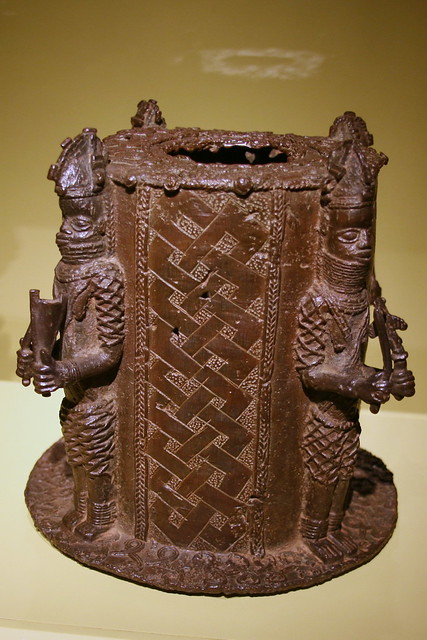
ezeagu:Yeah, beads in general were for the nobility. https://farm4.staticflickr.com/3159/2923614618_258e166969_z.jpg?zz=1 http://africa.si.edu/collections/view/objects/asitem/People$00402369/0?t:state:flow=dc2054ae-ee55-4620-95cd-f476c68ef042 "Date: 18th-19th century Maker: Benin kingdom court style Edo peoples Dimensions: H x W: 24.4 x 23.5 cm (9 5/8 x 9 1/4 in.) Medium: Copper alloy Credit Line: Gift of Joseph H. Hirshhorn to the Smithsonian Institution in 1966 Geography: Nigeria This object possibly supported an ivory tusk on an altar. The depiction of four female figures holding gongs suggests an association with an iyoba, or queen mother. Two figures strike bird gongs, which symbolize the infallibility of the oba." |
| Politics › Re: Lagos Monarchs Get N46m Car Gift From Fashola by PhysicsQED(m): 11:05am On Dec 08, 2011 |
Can someone explain who the "Oba of Ketu" is and what his connection to Lagos is? If that is really referring to the Alaketu, then I think the article is either inaccurate, or somebody in the Lagos state government made a huge mistake. Ketu is not in Nigeria. |
| Culture › Re: The Acculturuation Bewteen Midwestern And Eastern Nigerian Cultures. by PhysicsQED(m): 3:33am On Dec 06, 2011 |
oduasolja:So a wrapper is a traditional "whiteman" (Western European) style of dressing now? Do you realize how dumb you sound? At the very most, if looking for outside influence, one might be inclined to look towards the Sudan or Egypt for a similar dress style to that of people who wore wrappers, but not to Europe or to white people in general. |
| Culture › Re: The Acculturuation Bewteen Midwestern And Eastern Nigerian Cultures. by PhysicsQED(m): 3:25am On Dec 06, 2011 |
Multiple groups of women from different ethnic groups wore beads, but they had their own different styles. Nowadays, the Bini style is not exclusive to Bini women. |
| Politics › Re: Group Wants Igbanke Included In The Proposed Anioma State by PhysicsQED(m): 12:17pm On Dec 01, 2011 |
I said that my late grandfather saved one man. I did not mention my father earlier. Also, that post of mine immediately above was a lighthearted observation and not a real jab or insult.  It is a little amusing though how fired up you got over one cheeky observation. I thought you would detect the "mischievous" humor in the post, since everyone, including you, should be able to appreciate simple irony. It is a little amusing though how fired up you got over one cheeky observation. I thought you would detect the "mischievous" humor in the post, since everyone, including you, should be able to appreciate simple irony.Something I came across a year ago (the site is no longer up), where the interviewer, Isesele Ezekiel, was told directly about the relationship between Usen and Benin: "The Olu-Awure has a very cordial relationship with the Benin monarch, even till tomorrow we are still saying that Usen and Benin are one." - HRH Oluogbe II, the Olu-Awure of Usen, April 2010 So how about this: I'll consider spending a little of my time asking around about Chief Igbe's background when you decide to use up any of your time finding out from someone directly associated with the royal house of Usen whether what you claimed (about Ondo, Usen, and the Elawure) is actually true or whether or not you're distorting what another man said and putting words into his mouth. However, I think we both have much better uses of our time and that you probably shouldn't bother since I already have the answer. As for Isidore Okpewho and his claims, Peter Ekeh (an Urhobo man, who also criticized Egharevba) dealt with his claims and criticized his glaring bias in his 2000 article "Contesting the History of Benin Kingdom" (Research in African Literatures, Volume 31, Issue 3, 2000.) The article is reproduced here on an Edo website: http://ihuanedo.ning.com/profiles/blogs/contesting-the-history-of-benin-kingdom Once again, have a nice life.  |
| Politics › Re: Group Wants Igbanke Included In The Proposed Anioma State by PhysicsQED(m): 5:17am On Dec 01, 2011 |
Ogbuefi 1: Ogbuefi 1:Na wa o. . . |
| Politics › Re: Group Wants Igbanke Included In The Proposed Anioma State by PhysicsQED(m): 7:14am On Nov 30, 2011 |
Clap for yourself. You've managed to end with more lies and also with more distortions of what I posted, even in your final remark. It's really not worth responding in detail anymore. Goodbye and have a nice life. |
| Culture › Re: Benin Art And Architecture by PhysicsQED(m): 9:14am On Nov 29, 2011 |
lol, I went back and checked that "THE IMPERIAL ARCHITECTURE OF GREAT BENIN" facebook page that I mentioned many pages ago near the opening of this thread, and I see that the admin of that facebook page has posted a lot images that I posted on this thread in his facebook page (although he has also posted lots of independent information) and even quoted some of my individual personal comments directly (although without attribution). I guess we're learning from one another through our posts. |
| Politics › Re: Group Wants Igbanke Included In The Proposed Anioma State by PhysicsQED(m): 10:20am On Nov 28, 2011 |
Ogbuefi 1:I decided to just let this thread die since I was just arguing with a tribalist and someone with reading deficiencies. I have no idea why you resurrected it just to post this stuff about what you had "planned" with your "cache of materials" since it was obvious I had moved on. If did not respond the Friday that I said I would, and not even the next Friday after that, I wonder why you were even planning anything when I had left the thread to die out. Anyway, you got a lot of stuff wrong - everything from assuming that kaolin (sometimes actually called "white gold" and used in a legion of products) was not worth much, to assuming that Attahiru (who[i] explicitly[/i] pleaded with the British that he not be bothered because he was "simply running away" after the first battle of Burmi (in which the people of Burmi defended him and their town from the British) - and this has already been proven (anyone can check p.181 of the 1964 edition of Concerning Brave Captains: Being a History of the British Occupation of Kano and Sokoto and of the Last Stand of the Fulani Forces by D.J.M. Muffett for proof )) died fighting as a martyr. This is a myth perpetuated by idiots. He actually died seeking protection in Burmi/Bormi while fleeing east after fleeing Sokoto (where he should have died if he were so interested in martyrdom), while the Oba of Benin only left after they fired rockets at the palace (it would serve no purpose to stick around for no reason when rockets are raining down) upon entering the city, and when he returned, he turned himself in for a trial where he was specifically meant to be hanged (there is indisputable evidence of this from the British soldiers themselves, and they even took a picture of where they meant to hang him), until he was found innocent of actually ordering any attack on any British (the British trespassers) at the trial. Really, if the Oba had ran to the Esan (who were invaded in the Ishan Expedition, which was later) begging for protection, then there might have been some similarity between him and caliph Attahiru, who ran almost as far as Borno (and his son, Mai Wurno, continued running and left to the Sudan) seeking protection in Burmi under Musa (the ruler of Burmi). The Oba had the guts to show up to trial and face whatever "punishment" the British decided upon, rather than to desperately seek protection elsewhere, yet the caliph you compared him with pleaded that he be allowed to keep traveling to the east and was the only Nigerian monarch to specifically plead with the British that he be allowed to continue to "run away". Nearly everything you wrote in this discussion has been junk to me. Everything from you misunderstanding what I said about Ekpon and why I even mentioned what Idemudia wrote, to the crap about the Ubulu Uku conflict and the nonsense about Adesuwa being the Oba's daughter (as if the Oba's daughters left the palace section of the city!) rather than the Ezomo's daughter (as if the Anioma know better than Benin whose daughter she actually was; anyway, even Isidore Okpewho, in his book (Once upon a Kingdom) blames the Ezomo for starting the conflict over Adesuwa, and that is because he, like some other Anioma, still don't seem to understand what his relationship was with her and why he was so indignant, even over 200 years later), to the stuff about Bradbury and Egharevba (you foolishly assumed that Bradbury's 1957 book was his main or only publication, ignoring the many other things he wrote that relied on Egharevba and his personal praise of Egharevba), to your idiotic comparisons of the fewer troops and fewer guns (and no rocket artillery) used against Ubulu Uku to those used against Benin, to stupidly assuming that every historical figure in Benin tradition could be traced to one of the families (people living now can be traced to the families, not that every single historical figure in the past could be traced to one of the families), to even thinking I claimed a murdered man (the alleged man named "Edo"  who gives his life for someone else had living descendants (and assuming that the other individuals I named could not have had any living descendants, without even knowing much about who they were), to your ignorance about the enormous difference between the 1921 census and the other censuses, to the unfounded assumption that Bini artists would even depict old peoples' features (wrinkles and other signs of aging) in their art (they never did for aesthetic reasons; the 1997 article "Prestige and the Gentleman: Benin's Ideal Man" discusses this. Not even a single depiction of any Oba or Iyoba looks aged, nor does anyone else. . .), to claiming that I actually posted an image of a 18th century trophy head (I only posted a head with a caption that made reference to a different head kept in the British museum that was considered 18th century), to claiming that Oba Eresoyen's wealth was derived from Agbor (actually, the wealth was from trade with the Dutch and British during that time and there are written documents to very strongly back that up; anyone can check "Art, Politics, and Innovation in Eighteenth Century Benin" by Paula Ben-Amos or Benin and the Europeans by Alan Ryder for more specifics about the ivory trade during that time. There are real, independently written documents which confirm this tradition, not stories alone), and many other things. who gives his life for someone else had living descendants (and assuming that the other individuals I named could not have had any living descendants, without even knowing much about who they were), to your ignorance about the enormous difference between the 1921 census and the other censuses, to the unfounded assumption that Bini artists would even depict old peoples' features (wrinkles and other signs of aging) in their art (they never did for aesthetic reasons; the 1997 article "Prestige and the Gentleman: Benin's Ideal Man" discusses this. Not even a single depiction of any Oba or Iyoba looks aged, nor does anyone else. . .), to claiming that I actually posted an image of a 18th century trophy head (I only posted a head with a caption that made reference to a different head kept in the British museum that was considered 18th century), to claiming that Oba Eresoyen's wealth was derived from Agbor (actually, the wealth was from trade with the Dutch and British during that time and there are written documents to very strongly back that up; anyone can check "Art, Politics, and Innovation in Eighteenth Century Benin" by Paula Ben-Amos or Benin and the Europeans by Alan Ryder for more specifics about the ivory trade during that time. There are real, independently written documents which confirm this tradition, not stories alone), and many other things.And even the "cannibalism" claim is just another misinterpretation from you. Your "friend" came in there and explained how a group was "cursed" over something and I countered back that I didn't believe in that stuff but if any group was cursed, it was not exclusive to just one group. The belief that Europeans ate people was not just found among some of the Igbo but was widespread in some other parts of Nigeria. The Nupes for example, had the same belief, as evidenced by a written document describing a visit to the Nupe capital in the 1800s. Selling people while thinking that they're going to be eaten is pretty screwed up thinking, but it doesn't mean a whole ethnic group is cursed and I made no claim about any Nigerian group being cursed or being cannibals. This "point" of yours was just more evidence of a reading deficiency. You were even so reading impaired that you thought I claimed that I learned about Inyelen from that umuanioma website. I said to him (Relax101) that I learned about it from an argument I was involved in earlier this year on this very forum (not from some other website, but from a discussion/debate on this forum), which the person asking had already read, and when I gave him the information, he still asked for a source, even though I had already told him exactly where I got the information from. When he asked for a source, I gave him a traceable, quotable source that he could use, since I don't consider anonymous internet postings by myself or anyone else to be a real source. Overall, when I saw that specific complaint from you, I realized I was arguing with a mindless robot who was just grasping for points to argue about, even when they don't make sense. You were even dumb enough to interpret me calling professors with the title "Dr" as though it were an insult of some sort from me, which shows complete and total ignorance not merely of conventions in academia but also a lack of common sense about these things. At that point, it was just time to ignore you, not to mention the fabrications about names like Alilehan (which you attempted to interpret using a language they don't speak) and the fabrication about the Binis being unable to engage in bush warfare (the 1897 descriptions of fighting by the British explicitly refute this), the fabrication about reading about Naiwu Osahon's article about who could be given a title in a newspaper, and many other lies. Then there was the Gelegele thing. How can anybody be so dumb that they assume that simply because a place is now heavily populated with one group, that that group always owned and occupied that land? The USA alone is a relatively easy counterexample. The truth is that the Ijaws have no historical claim to Gelegele and you were a fool to even suggest that they did. When Royal Navy soldiers under Captain O' Callaghan burnt down Gelegele on February 10th, 1897, these Ijaw people were nowhere to be seen. It was always known as a Bini place and indeed it was specifically identified as the first Bini village encountered in 1897 by the British who were very well aware of the difference between Ijaws and Binis and who even made a point to note that Ijaws in what is now Delta state that they had come across before they reached Benin territory were friendly to the invasion. So much for Gelegele being Ijaw. Prior to 1897 there was nothing like Gelegele as Ijawland, but migrants are now creating fictitious traditional rulers there. It was also a bit annoying to see someone who can barely handle basic English make references to the role of physics in science. I don't know why you would sit there and try to tell me about the place and role of a science that you know next to nothing about. It's bizarre and annoying at the same time, like when you were trying to tell me how different scientists should be ranked or trying to tell me about what Maduemezia's achievements were when you don't even know what any of his research means and couldn't explain even one thing about it. I don't know why anybody would be dumb enough to rely on Nigerian newspapers for information about the standing or achievements of physicists anyway. I came across claims in a Nigerian newspaper about Dr. Ekhaguere (http://tribune.com.ng/sun/reminiscences/947-i-slept-a-lot-during-prep-cos-i-was-too-playful-gos-ekhaguere-professor-of-mathematicsmacarthur-grant-liaison-officer) calling him a genius, but I knew enough not to accept it as true (the standard for considering someone a genius in math or physics is quite high and that article, like other Nigerian newspapers, was not written by anybody who knows enough about physics or mathematics to accurately assess these sort of things). You know basically nothing about a whole science but made it a point to tell somebody who knows that science how accomplished a scientist in that field was or was not. You went out of your way to try to rubbish and dismiss G.O. Aiwerioba's achievement in being the first president of the Nigerian Society of Engineers because he did not earn a Ph.D by 1958 when he was president of that society or anytime afterward, but then went on to brag about Mr. Maduka (who you incorrectly presented as a doctorate holder; probably out of ignorance, not deliberate deception) being president at one point of that very same society. There was no way I would engage in another extended comparison of achievers after your refusal to admit to that contradiction. For every Awele Maduemezia, I could bring up an Emmanuel Emovon (who was president of the Nigerian Academy of Science before Maduemezia, and held more important posts, such as Minister of Science and Technology), and for every Professor Emmanuel Edozien, I could bring up a Professor Milton Iyoha, and for every figure in technology I had another name I could bring up (Kingsley Idehen, John Aisien, Ken Woghiren, etc.) and so on and so on, but you would label people who are much more accomplished than yourself "misfits" because they are of a particular ethnic group, so I decided that this was yet another reason to ignore you and move on. Why would I continue to humor you when people much smarter and more accomplished than you are just going to be labeled "misfits" for no reason? But the physics thing was more annoying than all the previous stuff. I didn't sit there and tell you the role of biology or history or whatever it is you studied, anyway. I know very well that you couldn't even explain one significant concept from any branch of physics (without using some search engine) even if it were relatively basic like an eigenstate, coherent state, degeneracy, or a four-vector. Please, let's not pretend that you realized that physics is the foundation of the sciences because you actually know anything about physics or have a real understanding of its connections to the other sciences - that would seem ridiculous to both of us and neither of us could really believe it. You realized physics is the foundation of the sciences because that's what smarter people said, so you ran with it without having the curiosity to find out for yourself what all that is really about. And really if you were "no longer interested in this thread", then why bother to resurrect it over a month later just to declare your non-interest and claim (to who?) what you had planned to do? I wrote my response, and then decided to forget about it and let you have the last word, because it wasn't worth my time to engage you further, but you still felt you had to announce what you had "planned" to do, utilizing your "cache" of materials, on the thread even after I had deliberately let you come out looking like all of the crap you spewed could actually stand up to scrutiny. . @ Relax101, I'm not going to say where I study simply because there are too many shady characters on this forum that might try to look me up in a directory or track down and find other information about me and then start using my information for God knows what . We've already seen a few 419 characters exposed on this forum, so I have no doubt that others are lurking and reading the forum. I'm a physics major and I'm interested in AMO (atomic, molecular, and optical) physics for grad school, though I also have some other areas I'm looking at. @ Wesley, many Fridays passed by, and I even posted on other threads in between that Oct. 20th post of mine and today as you can see from my post history in my profile and my posts in the Culture section. Sorry if you wanted to see a real response, but I was ignoring this thread and had moved on. Ogbuefi said he was not going to post beyond this year, so I assumed that with no response from me by the end of this year, he would just ignore the thread, move on, feel like the "victor" (he finds it very "gratifying" when people give "positive remarks" on what he writes on anonymous internet forums, after all) and this stuff would die out, but he had to come back with one more comment about his disinterest and what he had "planned" with his "cache of materials", which I found annoying and silly. If he was no longer posting, he should have just said that and left, without all that unnecessary self promotion and claims about what he had planned. My full response was detailed, but there's no point in posting it now because it would drag out a discussion that both me and Ogbuefi now find boring. Much of what he wrote is crap to me, but picking it apart piece by piece is too boring to bother with. I could refute much of what he posts in detail, but it would just drag things out longer. Should I really be debating invented claims about a woman being murdered for alleged "witchcraft" and other similar stuff? I don't think so. I remember that you mentioned that you are from Aboh in a thread in the culture section, but I don't know much about Aboh tradition and don't claim to, so if you were hoping that I would counter anything that Ogbuefi said with regard to Aboh, I'm sorry to disappoint you there. If he says that this is what Aboh tradition holds, I have no reason to believe that he's not telling the truth as it was told to him. I question his numerous other inventions and fabrications, but I have no reason to believe that on this particular issue he is saying anything other than what he learned from Aboh people about their tradition. If one of the things you were wondering about was the statement about Eze chime and Egharevba in Ogbuefi's response, the truth is that the figure known as Eze chime, while he clearly existed, does not seem to have been known to the Edo speakers, or perhaps was not notable enough to the Binis in comparison to the more well known figures of that era (to them) such as Arhuarhan, Esigie, and queen Idia. As a result, he is entirely unknown to Edo traditions and even the place that Ogbuefi claimed he was from (Udo) had no knowledge or mention of him when they were asked about the events of that era by Patrick Darling. The ironic thing here is that the scholar that he mentioned (Patrick Darling) carried out extensive archaeological work on Udo (and other areas) and recorded its traditions about that specific Esigie-Idia era (in a 1984 book on the earthworks in Edo and Esan areas, he notes the traditions he recorded at specific places in the back of the book and in other parts of the book), some of which mention Arhuarhan and Esigie, but no figure matching the name or historical profile of Eze chime or Ikhime was noted. This is especially surprising because their tradition actually differs somewhat in a significant aspect with the "official" or "standard" Edo history authored by Egharevba about Benin, so they are not just agreeing with Benin tradition or with what Egharevba wrote - they actually disagree with it on a crucial matter, such as whether or not Benin once payed Udo tribute before Benin eventually triumphed over them. Egharevba was definitely not infallible, but he also definitely did not have some sort of grand scheme designed to "protect the image of the monarchy" as alleged above, and no objective person can read his descriptions of Obas Ezoti, Ewuare, Ewuakpe, Ohen, etc. in his book and think he wrote that book with the intention of protecting the image of the monarchy. If he had such an agenda, the book would have to have been completely different. Both Benin and Udo tradition, which don't actually agree exactly, have no recollection of any Ikhime/Eze chime/chima figure, but we know that he existed from extensive mention of him in Anioma tradition and he was even mentioned in colonial intelligence reports. With regard to Egharevba, no Edo historian, when writing a history of Benin, was under any obligation to go to Anioma for information, just as no Anioma historian when writing a history of any Anioma place, was under any obligation to go Benin for information, even though references were sometimes made by some historians to the other group (Anioma areas or Benin areas) in their works, so I have difficulty faulting Egharevba for not knowing about a figure that nobody in Benin or any other Edo speaking area knew about. It might have been better for both groups if efforts had been made to collate the traditions from both sides that reference each other, but that would have been a difficult and extremely time consuming thing to do. Since Aboh tradition links them to Eze Chime's group, then I am not going to dispute their tradition in any way. Perhaps you have a different perspective on Aboh's link to Benin, though. |
| Culture › Re: BBC's Documentary On The 'Bronze Cast Head Of The Ife King' by PhysicsQED(m): 12:03am On Nov 28, 2011 |
Negro_Ntns:It was not my intent to dismiss the oral traditions that may have influenced Samuel Johnson's statement about origins. It is just difficult to accept that the story he gives in the opening of his book is not just a modified "Kisra legend". Concerning objectivity, I posted what I did about the Kisra legend and its link to Johnson's work because I thought that on this particular issue, my comment would be taken as objective criticism, not as part of the contentious Ife-Benin discussion, since the question (origin of Yorubas) does not relate to me directly. I'm not going to sit here, and as a non-Yoruba, tell you what Yoruba origins are. That wasn't my purpose in posting what I did. I was just pointing out that when one has read about the Kisra legends, one should view Bello's comments and Johnson's comments in a different light and not view them as pure traditions. |
| Culture › Re: The Art And Architecture Of Yorubaland! by PhysicsQED(m): 11:31pm On Nov 27, 2011 |
Malstrom:I think he insinuated it. If he's not rehashing the Frobenius theory, then why is he claiming that direct contact between the Mediterranean and Yoruba land occured? Anyway, if I recall correctly, some scholars have stated that Ife had trading connections with parts of Northern Africa via parts of Northern Nigeria (I think I read that in Graham Connah's book African Civilizations: an archaeological perspective). Now since parts of North Africa had contact and trade with the Mediterranean, it's not hard to see, if we accept the premise of an Ife-Northern Africa connection, how an indirect contact of some sort could have occurred between Western Nigeria and the Mediterranean, but to assert direct contact with no evidence seems really implausible and like a rehashing of Frobenius's work. |
| Culture › Re: The Art And Architecture Of Yorubaland! by PhysicsQED(m): 11:18pm On Nov 27, 2011 |
Unsupported fringe theories can go both ways. If Dr. Campbell wants to conjecture about the Cretans founding settlements in Western Nigeria with no evidence, others can equally assert that West Africans founded Minoan Crete!! http://www.cwo.com/~lucumi/crete.html http://clyde.winters.tripod.com/chapter6.html http://www.amazon.com/Minoan-Linear-Scripts-Niger-Context/dp/1872596150 http://www.amazon.com/African-Origins-Classical-Civilisation/dp/1434350800 http://www.amazon.com/Who-were-Minoans-African-Answer/dp/1425920071/ref=pd_bxgy_b_text_b You, as a Yoruba, have no more reason to accept a Mediterranean/Minoan/Atlantis ---> Ife story than they (Cretans) have a reason to accept that some proto-"Niger-Congo" group founded Minoan Crete thousands of years ago. I don't know why you guys are really buying this stuff. It's just speculation, really and neither side has any truly convincing evidence. There is no reason to believe that Professor Joseph Campbell knew more about Crete than Professor Graham Campbell-Dunn, so Professor Campbell's completely unsupported brief remark definitely does not hold more weight than Campbell-Dunn's three whole published books merely because he was famous. 1 Like |
| Culture › Re: The Art And Architecture Of Yorubaland! by PhysicsQED(m): 10:43pm On Nov 27, 2011 |
Negro_Ntns:And do you think any artifact linking Crete to any part of Western Nigeria has actually been found or will be found? This sounds a bit like he's rehashing Frobenius's Mediterranean Ife theory. He was careful not to state his sources, but I suspect that Frobenius is his source. 1 Like |
| Culture › Re: BBC's Documentary On The 'Bronze Cast Head Of The Ife King' by PhysicsQED(m): 10:35pm On Nov 27, 2011 |
Negro_Ntns:Wait a minute. What exactly do you mean here? There are white Europeans such as Leo Frobenius (in the 1900s) and Dierk Lange (today) who have argued for a Mediterranean (Frobenius) or Near Eastern origin or Middle Eastern origin (Dierk Lange) of the ruling class of the Yorubas and there are numerous Yoruba scholars today who would argue otherwise (although I think Saburi Biobaku felt that the Yorubas came from a place near Egypt or Sudan, and of course the king of the Ijebu also believes his people are from the Sudan). I side with those scholars who opine that Yorubas aren't from the Mediterranean or Middle East - many of whom are Yoruba - for reasons of logic. This is not about the racial background of the authors. My objection to this Mecca story specifically is that I have not seen where the story is actually an authentic origin story from Yorubas who have not been influenced by a religion (Islam) with a Middle Eastern bias. I did not really argue strongly against an Egyptian or Sudan area origin for the ruling class, but you have to understand that this story of a Middle Eastern origin and the specific form of the story promoted by Bello and later by Johnson very strongly recalls the various "Kisra legends" that were applied to Northern and North-central Nigerian groups. If you read up just a little bit on the Kisra legends, and then read the opening part of Samuel Johnson's book where he gives an account of origins from Mecca, the similarity in the basic outline of the stories is just glaring. You are yet to respond to my earlier question. Who was the authentic source from which white man got the story that you claim is credible?Which story are you talking about? 1 Like |
| Culture › Re: BBC's Documentary On The 'Bronze Cast Head Of The Ife King' by PhysicsQED(m): 1:22pm On Nov 27, 2011 |
Ufeolorun:lol @ that film. Sounds ridiculous. Well everybody has their own version of history. I'm not a historian either, just curious and interested in pre-colonial Nigeria (and Africa). I don't think they (the people who would know Edo tradition) even know for sure that their soldiers beheaded a king and not a war captain or commander, but maybe they are getting that from Egharevba, since he made similar statements (about beheading) when talking about wars to the east of Benin. |
| Culture › Re: BBC's Documentary On The 'Bronze Cast Head Of The Ife King' by PhysicsQED(m): 11:25am On Nov 27, 2011 |
Negro_Ntns: Here is a very good figure to show that Yoruba was a powerful civilization in AfroAsia. Compare to Biblical customs instructing High Priests to dress in exact same manner as shown in this figure.Some of the images on the Andrea Jemolo site are indeed mislabeled, but that applies to multiple pieces, not just this piece. There is an actual archer figure (wearing cornrows and with a quiver of arrows) that is associated with/related to this crowned figure and with peculiar scarification on his face. Can you explain to me why you think this specific individual in the Nupe bronze is Yoruba? Also, can you explain to me what that collar around his neck is for or means in Yoruba culture? Also, can you explain to me why you think a (king?) with a circular crest of a horned (like a "devil" god or figure on his crown is a priest? What do you think he was a priest of? |
| Culture › Re: BBC's Documentary On The 'Bronze Cast Head Of The Ife King' by PhysicsQED(m): 11:03am On Nov 27, 2011 |
@ Negro_Ntns It is very doubtful if the "Lamurudu"/Nimrod/"Oduduwa"/Mecca story given by Sultan Bello and then in a different form by Samuel Johnson has any historical validity at all and the misinterpretation of Sultan Bello's statement as an actual authoritative statement by a scholar that had carried out research into origins seems to have had a seriously distorting effect on your view of history. I think you've been taken for a bit of a ride there merely because of Sultan Bello's apparent confidence (as is clear from his diction in his statement) when he applied a well known Northern Nigerian myth/legend to a group he didn't know about or understand (the Oyos). Sultan Bello grafted the "Kisra Legend" that was popular among Northern Nigerians onto the Oyo Yorubas in order to explain how they came to be in Northwest central Nigeria because, despite all his learning and scholarship, he didn't really know much about them and couldn't explain how they came to be in northwest central Nigeria, near his own empire. As a result of his immersion in Middle Eastern (Arabic and Muslim, specifically) learning, he had a bias towards that part of the world which made him attempt to explain the origin of a nearby group (the Yorubas at Katunga/Oyo Ile were more or less in the northwest central part of Nigeria, of course) from the Middle East. The articles "The Kisra Legend and the Distortion of Historical Tradition" (1975) by Phillips Stevens Jr., "Oral Tradition in Changing Political Contexts: The Kisra Legend in Northern Borgu" (1998) by Olayemi Akinwumi, "The Kisra Legend as Oral History" (1980) by Marjorie Helen Stewart, and "The Kisra legend" (1950) by A.B. Matthews, would probably put Sultan Bello's claim in better perspective. I have only read the first three of these articles, but from the preview for the fourth, I can tell that it's about the same general thing as the first three. Anybody who reads some of these articles and then reads Sultan Bello's claim would immediately understand that Sultan Bello's story about Oyo Yorubas basically was a graft of a popular myth onto an unknown group. I should also clarify that the Kisra legend is not really related specifically to Yorubas nor was that story (the Kisra legend) even exclusively applied to them. The real home of the myth seems to be in explaining the origin of Borgu kingdoms, but it seems to have been applied to several other Northern and North-central groups whose origin couldn't be explained by Muslim Northern Nigerians with a Middle Eastern bias, and of course Bello applied it to the Yorubas, resulting in its appearance in Yoruba history by Samuel Johnson's speculation about it. However, with the advent of Islam among the Yorubas even more natural confusion may have arisen about the possible validity of the application of such a legend to Yorubas, so even Yorubas back then and now, independently of Sultan Bello's claim, might have opted for a Middle Eastern origin despite the near impossibility of this actually being the case. I'm only posting this to point out that an authentic "Oduduwa from Mecca" story doesn't really seem to exist among non-Muslim Yorubas. What seems to exist is 1) Sultan Bello's grafting of the Kisra legend onto Oyo Yorubas and 2) the possible adoption of a Middle Eastern origin by some Muslim Yorubas Concerning the Obatala/Bes link, from what I can tell, that deity probably was introduced to Egypt from somewhere else in Africa as it is dissimilar in appearance from virtually every other Egyptian deity. Also, I did not suggest that the Yorubas or anyone else under discussion here actually originated from Egypt or the Sudan. I was merely talking about ancient religious links between important centers of different cultures in ancient times and the possibility that the ruling class of certain places could have come from Sudan or Egypt. Also, I don't think Yoruba or any other group has to be linked to Egypt, the Sudan or Western Asia to be considered "a powerful civilization" in ancient times. 1 Like |
| Culture › Re: BBC's Documentary On The 'Bronze Cast Head Of The Ife King' by PhysicsQED(m): 10:47am On Nov 27, 2011*. Modified: 3:01am On Aug 30, 2012 |
Negro_Ntns: Quantun physics is just beginning to arrive on conclusions that mystics have known for ages but which science back then denied as invalid conjectures.Such as?  Can you give specifics on what you think is "mystical" in quantum mechanics? Can you give specifics on what you think is "mystical" in quantum mechanics?To forestall any references you might make here to issues associated with the interpretation of quantum mechanics, it should be noted that these problems are legitimate scientific (or if you like, 'philosophical') problems of interpretation, and it is not necessary to bring up terms like "mysticism" or "mystic knowledge" when discussing them. |
| Culture › Re: BBC's Documentary On The 'Bronze Cast Head Of The Ife King' by PhysicsQED(m): 10:06am On Nov 27, 2011 |
Ufeolorun: Spanner in the puzzle?Can you actually name these "Benin historian[b]s[/b]"? Do you mean people in real life or writers in newspapers and on the internet that are repeating Egharevba's work? If it's any consolation, some Yoruba writers in books and articles also occasionally repeat Egharevba's work. This is all from Jacob Egharevba's efforts when he collected traditions in the early 20th century. Basically all of it. Now who was Jacob Egharevba? Jacob Egharevba was born in Idanre, schooled in Akure, had friends and mentors that were Yoruba (such as A.K. Ajisafe, the Yoruba author who wrote Laws and Customs of the Benin People (1945)), spoke Yoruba (in addition to Edo and English), and his mother was the granddaughter of an Ibadan chief (according to Egharevba Family, a short pamphlet about his family that he published in 1967, as stated in the article "The Scholarship of Jacob Egharevba of Benin" (1994) by Uyilawa Usuanlele and Toyin Falola). Incidentally, he was also a Reformed Ogboni Fraternity member and an Action Group supporter. This particular argument against Egharevba from some Yorubas with regard to Benin and Eastern Yoruba land is a little ironic to me when viewed in the context of his background. Was he really out to stick it to the Ondos and other groups? What would be his particular motivation for that? He was Bini, but I suspect from his background that he did not have any particular bias against eastern Yoruba land. Even some Yorubas will dispute some of his claims, but some writers, some of which are Yoruba, will cite him heavily at the same time that some Yoruba writers are criticizing Binis for disputing some of what he wrote. People should not have such a strong issue with criticism of his work, just as the first work on the History of the Yorubas by Samuel Johnson has not remained beyond reproach among scholars. Interestingly enough, the thread was derailed entirely by my criticism of a particular alteration of Egharevba's which was sourced from Percy Talbot's great ethnographic work in the 1920s, and which is relied upon continuously, as though it was strongly supported by facts. Obviously, I respect his work and his efforts, but he cannot have gotten everything right. |
| Culture › Re: Benin Art And Architecture by PhysicsQED(m): 9:09am On Nov 27, 2011 |
I might as well re-post this quote: "Legroing tells us : " The city of Benin is situated in a plain surrounded by deep ditches. Vestiges of an old earthen wall are to be seen ; the wall could hardly have been built of any other material as we did not see a single stone in the whole journey up. The houses for the most part are covered with latanier leaves, and those of the king with large shingles. In front of the king's houses there were two thick clumps of high trees, and these appeared to us to be the only trees planted by the hand of man (Labarthe, p. 175)." From Landolphe we learn that a " ditch more than 20 feet wide and as deep surrounds the town, and the soil taken out is made on the city side into a talus, on which a thorny hedge has been planted so thick, that not even an animal can get through. The height of this talus deprives one of a view of the houses at a distance, and one does not see them until entering the town, the gates of which are very far apart " (II., 48). " The streets are very broad ; in the middle there is turf on which the kids and sheep feed ; about thirty feet from the houses there is a level road, covered with sand for the inhabitants to walk on " [ibid, II., 50). He also mentions several spacious courts surrounded by earthen walls about sixteen feet high. Along the inside of the walls there ran a gallery fifteen feet wide, thatched with natanier. The thatching is done by overlapping the leaves which not being pulled apart, fall one on top of another to a thickness of eighteen inches. This roof is supported by large pieces of timber cut into the shape of pillars. They are set up about eighteen feet apart, and carry stout horizontal planks on which abut the sloping joists which carry the roof, which was an ingenious piece of work " (ibid, I., 111-112). Of the apartments of the king's wives he says the walls are twenty feet high and five feet thick, solidly built of earth [ibid, I., 335)." - H. Ling Roth, Great Benin (kids = goats, just in case anyone is confused by that part) |
| Culture › Re: Benin Art And Architecture by PhysicsQED(m): 8:38am On Nov 27, 2011*. Modified: 2:17am On Jul 25, 2012 |
This is the excerpt, including the footnotes, from pp. 156-159 of the book Nigerian Perspectives by Thomas Hodgkin, which contains a description (from a 1602 book by Peter de Marees) of seventeenth century Benin by a Dutchman whose initials are given as 'D.R' (probably Dierick Ruiters): 'D.R.' - The Dutch in Benin 1 "The Citie of Benin The towne seemeth to be very great, when you enter into it, you goe into a great broad street, not paved, which seemeth to be seven or eight times broader than the Warmoes street in Amsterdam; which goeth right out, and never crooketh, and where I was lodged with Mattheus Cornelison, it was at least a quarter of an houres going from the gate, and yet I could not see to the end of the street, but I saw a great high tree, as farre as I could discerne, and I was told the street was as much longer. Then I spake with a Netherlander, who told me he had been as farre as that tree, but saw no end of the street;. . .so that it is thought that that street is a mile long [these are Dutch miles 2] besides the Suburbs. At the gate where I entered on horse-backe, I saw a very high Bulwarke, very thick of earth, with a deep broade ditch, but it was drie, and full of high trees. . . .That Gate is a reasonable good Gate, made of wood after their manner, which is to be shut, and there alwayes there is watch holden. Without this Gate, there is a great suburbe: when you are in the great Street aforesaid, you see many great streets on the sides thereof, which also goe right forth, but you cannot see to the end of them, by reason of their great length, a man might write more of the situation of this Towne, if he might see it, as you may the Townes in Holland, which is not permitted there, by one that alwaies goes with you, some men say, that he goeth with you, because you should have no harme done unto you, but yet you must goe no farther than he will let you. Their Houses The Houses in this Towne stand in good order, one close and even with the other, as the Houses in Holland stand, such Houses as Men of qualitie (which are Gentlemen) or others dwell in, have two or three steps to go up, and before, there is, as it were, a gallerie, where a man may sit drie; which Gallerie every morning is made cleane by their Slaves, and in it there is a Mat spred for men to sit on, their Roomes within are foure-square, over them having a Roofe that is not close in the middle, at which place, the raine, wind, and light commeth in, and therein they lie and eate their meate; but they have other places besides, as Kitchins and other roomes. . . . The Court The King's Court is very great, within it having many great four-square Plaines, which round about them have Galleries, wherein there is alwaies watch kept; I was so far within the Court, that I passed over four such great Plaines, and wheresoever I looked, still I saw Gates upon Gates, to goe into other places, and in that sort I went as far as any Netherlander was, which was to the Stable where his best Horses stood, alwaies passing a great long way; it seemeth that the King hath many souldiers, he also hath many Gentlemen, who when they come to the Court ride upon Horses, and sit upon their Horses as the women in our Countrie doe, on each side having one man, on whom they hold fast; and the greater their estate is, the more men they have going after them. Some of their men have great Shields, wherewith they keepe the Gentlemen from the Sunne; they goe next to him, except those on whom hee leaneth, the rest come after him, playing some Drums, others upon Hornes and Fluits, some have a hollow Iron whereon they strike, and so they ride playing to the Court. . .There are also many men Slaves seen in the Towne, that carrie Water, Iniamus [yams], and Palme-wine, which they say is for the King; and many carrie Grasse, which is for their Horses; and all this is carried to the Court. The King oftentimes sendeth out Presents of Spices, which are carried orderly through the streets, and . . .they that carrie them goe one after the other, and by them there goeth one or two with white Rods, so that every man must step aside and give them place, although hee were a Gentleman. Sixe hundred Wives. Gentlemen their making The King hath many Wives, and every yeere goes twice out of his Court and visiteth the Towne, at which time he sheweth all his Power and Magnificence, and all the Braverie he can, then he is convoyed and accompanied by all his Wives, which are above sixe hundred in number, but they are not all his wedded Wives. The Gentlemen also have many Wives, as some have eightie, some ninetie and more, and there is not the meanest Man among them but hath ten or twelve Wives at the least, whereby in that place you find more Women than Men. They also have severall places in the Towne, where they keepe their Markets; in one place they have their great Market Day, called Dia de Ferro; and in another place they hold their little Market, called Ferro. . . .They. . .bring great store of Ironworke to sell there, and Instruments to fish withall, others to plow and to till the land withall; and many Weapons, as Assagaies, and Knives also for the Warre. This Market and Traffique is there very orderly holden. . . . Warres . . .The King hath many souldiers which are subject to him, and they have a Generall to command over them, as if he were their Captaine: This Captaine hath some souldiers under him, and he goes always in the middle of them, and they goe round about him, singing and leaping, and making great noise, and joy. Those Captaines are very proud of their Office, and are very stately, and goe exceedingly proudly about in the streets. Their Swords are broad, which hang about their necke in a leather Girdle which reacheth under their armes. . . . Wrong to a stranger They are very conscionable, and will doe no wrong one to the other, neither will take anything from strangers, for if they doe, they should afterward be put to death, for they lightly judge a man to die for doing any wrong to a stranger. . . . They respect strangers very much, for when any man meeteth them, they will shun the way for him and step aside, and dare not be so bold as to goe by, unlesse they be expressly bidden by the partie, and prayed to go forward, and although they were never so sore laden, yet they durst not do it; for, if they did, they should be punished for it: They are also very covetous of honour, and willingly desire to be praised and rewarded for any friendship they doe. . . ." [Footnotes: 1 - From A description and historical declaration of the Golden Kingdom of Guinea. . . .in Purchas (1905), vi, pp. 354-9. 'D.R.', the author of this account, may have been Dierick Ruiters. See Ryder (1965a), pp. 197-8, and (1969), p.85, n.3 2 - A Dutch mile was equal to about four English miles] ^^^ The two sources referenced above in the first footnote of the excerpt are: Purchas, Samuel, 1905-7. Hakluyt Posthumus, or Purchas his pilgrimes. Hakluyt Society, Glasgow. Ryder, A.F.C, 1965 (a). 'Dutch Trade on the Nigerian Coast during the Seventeenth Century'. Journal of the Historical Society of Nigeria, III, 2, December. |
| Culture › Re: Benin Art And Architecture by PhysicsQED(m): 8:37am On Nov 27, 2011 |
ezeagu:Yeah. When I first read that I did a facepalm for nearly half a minute. There are several descriptions of pre-colonial Benin, but the images of buildings? Very few and some of these are just ruins or places that had already been damaged heavily in the 1897 fire. |
| Culture › Re: Benin Art And Architecture by PhysicsQED(m): 7:18am On Nov 27, 2011 |
Here's one of the descriptions of Benin cited in that article above concerning a comparison of Benin city to Lisbon by the Portuguese ship captain Lourenco Pinto: "According to the testimony of this captain, Great Benin, where the king resides, is larger than Lisbon; all the streets run straight and as far as the eye can see. The houses are large, especially that of the king, which is richly decorated and has fine columns. The city is wealthy and industrious. It is so well governed that theft is unknown and the people live in such security that they have no doors to their houses." - Lourenco Pinto, 1693. This quote is reproduced in Alan Ryder's classic book Benin and the Europeans 1485-1897. books.google.com/books?id=0dol1fMSM-AC&pg=PA12 |
| Culture › Re: Benin Art And Architecture by PhysicsQED(m): 7:05am On Nov 27, 2011 |
An excerpt from the article "Civil War in the Kingdom of Benin, 1689-1721: Continuity or Political Change?" by Paula Ben-Amos Girshick and John Thornton, which cites several sources explicitly. Here's the excerpt from that article with the authors' footnotes giving their sources: "BENIN IN THE SEVENTEENTH CENTURY Benin as it appears in documents of the seventeenth century was a wealthy and centralized kingdom. The natural reflection of centralized wealth was its magnificent capital city, one whose archaeology has only begun to be explored.22 Early European visitors never failed to be impressed with the city. The Portuguese compared it with Lisbon, the Dutch with Amsterdam or Antwerp, the Italians with Florence, and the Spaniards with Madrid.23 Its size was matched by dense habitation; houses built close to each other along long, straight streets. The royal palace, a city within the city, was also impressive, with countless squares and patios and innumerable doors and passageways, all richly decorated with the art that has made Benin famous.24 The city was orderly, well laid out, and sparkling clean so that the walls of the houses appeared polished.25 The orderliness of the town was perhaps a reflection of a highly restrictive bureaucratic rule. We use the term bureaucratic here to mean that state- appointed officials, often serving on limited terms and responsible to their superiors, formed a hierarchy that led to the king, which sought to control large areas of social, political and economic life. European visitors certainly felt the supervision as well - Derick Ruiters was given a 'guard' when he visited the city about 16oo, whose real function, he believed, was to prevent him from seeing too much.26 When a palace official decided in 1652 that the Capuchins were not to be taught Edo, they could not find a single person who would teach them a solitary word.27 Control was not limited to supervision of foreigners' movements, Dapper noted that the government had thoughtfully placed a large water jar mid-way on the Ughoton-Benin road, complete with a guard who insured that each drop of water was paid for by the thirsty travelers.28 P. J. Darling has suggested that the elaborate system of earthworks that surrounds Benin City for several miles in each direction and extends out into the rural areas might well be more for control of movement than for defense. These earthworks, which are not in use today and have no modern analogy in Benin, 'face both ways', thus preventing movement out of, or across, Benin as well as into the city.29 This interpretation is strengthened by Alonso de Sandoval's description of Benin's high walls, topped with thick vegetation and occasionally pierced by gates manned by armed sentries who demanded passes from all who come by.30" [Footnotes: 22 Graham Connah, The Archaeology of Benin (Oxford, 1975). 23 APF: SOCG, vol. 517, fol. 308v, Lourenco Pinto to Propaganda Fide, 28 May 1693 (Lisbon); for comparisons to Amsterdam, see the report of the first visit by Dutch to Benin, 1598 cited in Ray A. Kea, 'Firearms on the Gold and Slave Coasts from the sixteenth to the nineteenth century', Journal of African History, 12 (1971), 187; Dapper, Beschrijvinge, 122; for Florence, see Bonaventura da Firenze, 'Come entrò la fede di Giesu Christo nel regno d'Ouere per la Prima Uolta,' fol. 28v, in Salvadorini (ed.), Missioni (with original foliation of MS marked); for comparisons to Madrid, see APF: SOCG, vol. 249, fol. 351v, Felipe de Hijar to Propaganda Fide, 25 July 1654; de Sandoval, Instauranda, 78-9. 24 Dapper, Beschrijvinge, 122; de Marees, Beschryvinge, I I5a. See especially the reports of the Capuchins who visited the palace: APF: SOCG, vol. 249, fol. 328v and 35I (next folio of letter); and Biblioteca Nacional de Madrid, Antonio de Teruel, Descripcion narrativa de la mission serafrica de los Padres Capuchinos en el reyno del Congo', (c. 1664). This last manuscript contains a long account clearly written by or based on that of Angel de Valencia, a friend and companion of Teruel (but the hand is Teruel's throughout). It was subsequently used by Mateo de Anguiano in his chronicle (Biblioteca Nacional de Madrid Ms 18 178,' Segunda Parte de la Chronica , ' 1705) and eventually published by Buenaventura de Carrocera, Misiones Capuchinos in Africa, II (Madrid, 1957). Other elements of de Valencia's material are found in the Arquivo Provincial de los Capuchinos de Valenca, Jose de Alicante, 'Cronica de los Capuchinos de Valencia desde 165o hasta 1722'. Cavazzi's better know account in Istorica Descrizione de tre' regni Congo, Matamba ed Angola (Bologna, 1687), Libro V, contains no new material. An explicit reference to the art can be found in APF: SOCG vol. 517, fol. 3o8v, Letter of Lourengo Pinto, 28 May 1693. 25 Dapper, Beschrijvinge, 122; APF: SOCG, vol. 517, fol. 308v, Pinto to Propaganda Fide, 28 May 1693. 26 de Marees, Beschryvinge, I 15b. 27 APF: SOCG, vol. 249, fols. 332-9, [Alonso de Tolosa], 'Breve Successo de las Cosas Acontesidas en la Mission del Benin', 20o Nov. 1652, published with original foliation marked in Salvadorini, Missioni Appendix 4, and in Braisio, Monumenta 15, 634-39. 28 Dapper, Beschrijvinge, 122. 29 P. J. Darling, 'Notes on the earthworks of the Benin empire', West African Journal of Archaeology 6 (1976), 143-9- 30 de Sandoval, Instauranda, 78. The authors wish to thank Serena Van Buskirk for her translation of the Spanish text.] |
| Culture › Re: Benin Art And Architecture by PhysicsQED(m): 6:56am On Nov 27, 2011 |
"The people still dig amongst the ruins of the palace for the bronzes the OBA and his followers valued so much. Mr. Erdmann, a well known German trader, on his last visit to Benin City informed me that he had seen the palace just after its roof had been burnt off and had taken many photographs of it. He said that the bronzes were ranged along the walls and served as historical symbols, reminding the historian of the chief events of the past history of the BINI people. Unfortunately this much-respected trader died on his way home in the year, 1904." - R.E. Dennett, At the Back of the Black Man's Mind (1906) |
| Culture › Re: BBC's Documentary On The 'Bronze Cast Head Of The Ife King' by PhysicsQED(m): 6:44am On Nov 27, 2011*. Modified: 11:42am On Sep 02, 2012 |
@ emmatok I have read that "Oduduwan Revolution" article and it is interesting, although it gets a few things wrong. 1. Yoruba was not the language of the Benin palace and indeed when Oba Ovonramwen was negotiating a treaty with H.L. Gallwey in 1892 the terms of the treaty were translated from English to Yoruba and then to Edo. The interpreter was one Ajayi, an Edo-Akure (of Edo and Yoruba ancestry) who translated it to Edo for the chiefs and the Oba. If indeed they understood Yoruba up until 1934, it was unnecessary to translate it to Edo. Also, it cannot be claimed that the names of the palace officials, titleholders, rituals, ceremonies, courts, etc. are Yoruba and it cannot be claimed that they were all created after 1934, when there is written evidence to the contrary. The Uwangue of Benin (one of the palace chiefs) is mentioned as early as 1668 (Olfert Dapper). The Benin palace did make use of foreigners (explicitly noted as foreigners, and not natives of the country) who were Yoruba speaking (called "Lucumies", but not necessarily from Oyo ("Ulkami"?)), in order for the Oba to be able to "punish" these foreign servants if they erred "without interference from their relatives", according to Alonso de Sandoval (De instauranda Aethiopum salute (1627)) but these are not the palace chiefs. And of course these people did not have relatives anywhere in or near Benin as stated by de Sandoval. The origins of the palace chiefs are known and the names and titles of these individuals make the notion of the palace being Yoruba speaking doubtful. For an account of some of the roles and names of the palace title holders one can read p. 54 - 67 of the book Benin Studies by R.E. Bradbury (specifically, the article "The kingdom of Benin" by R.E. Bradbury). John K. Thornton conjectured that the influence of these Yoruba speaking individuals around the same time the Oyo empire rose to prominence led to the adoption of a Yoruba origin for the Benin dynasty when it had earlier claimed a different origin instead in his article "Traditions, Documents, and the Ife-Benin Relationship". I won't comment on his article extensively here, but let's just say that I disagree with some of his conclusions and interpretations (particularly of the word 'Hooguanee'/'Ogane'). It is true that there is evidence from traditions collected by Paula Ben-Amos (in the book I cited earlier and another article of hers that she published) that some aspects of Yoruba religion (such as Orunmila) were introduced around the 17th century to Benin. It is also true that there is evidence that Igala was once a significant power (they conquered parts of northern Igboland, held some sort of sway over Nupe (which itself conquered Oyo at one time), and one of their conquerors (Onoja Ogboni) was apparently even known in Urhoboland (at least this is claimed in "Onọjọ Ogboni: Problems of Identification and Historicity in the Oral Traditions of the Igala and Northern Nsukka Igbo of Nigeria" by AJ Shelton), but I would like to see more evidence for Thornton's claim before I can accept his claim of some sort of complete reversal of origins. One thing to note here is that the Igala language and the Yoruba language are widely held by linguists to be close to one another (anyone can confirm this for themselves), although the cultures seem very distinct from what I have read about the two cultures (Igala and Yoruba). Anyway, it is not necessary to invent the notion of a Yoruba speaking Benin palace which names all these people, practices, ceremonies that it possibly can with Edo names and words. That is a little bit too fantastical for anyone's taste. A look at something like this for example: http://www.artic.edu/aic/collections/exhibitions/benin/resource/655 would make one wonder why this claim was even repeated. 2. Sentiments aside, Orun Oba Ado is not actually connected in any way to Benin, except in the imagination of some theorists. The dates don't add up or make sense in the context of the stories from Egharevba that are also accepted by these theorists unless the Oba of Benin dynasty was established in much more ancient times; and of course, there is nothing such as that place in Benin tradition. Concerning the heads of the kings of Benin, there is nothing like an after death decapitation of the kings either in written sources or oral tradition or in Egharevba's work. Also, there are places in Yoruba land called Ado: "Vincent Faulkner, English pastor at Lagos, visited Ado in 1875 and met the king. The people were, as before, worshippers of Orisa Oduduwa, "an enemy of the white man's religion". He refused permission for Faulkner to speak in the market place, as he had done earlier with Pearse, Crowther and Townsend. Two years later, Faulkner was again at Ado, pressing for land for a mission. Nearby Oke-odan already had agreed to have an agent, Sanu, and a chapel. But Ado still asserted its status as a sacred town. Asadi, the war chief, and the high priest of Oduduwa opposed the granting of land. The proposed piece had so much "medicine" put upon it "that it can never be built upon". Lastly, Henry Doherty, African catechist at Lagos, visited Ado in 1879. He saw a small group of olorisa assembling for the worship of Ifa but otherwise has little to add about the orisa cults." - p. 152 of Hail Orisha!: A Phenomenology of a West African Religion in the Mid-Nineteenth Century by Peter Rutherford McKenzie books.google.com/books?id=BIdITHIAEs0C&pg=PA152 Yet another mention of a Yoruba Ado: books.google.com/books?id=sJhWKAcXXKcC&pg=PA101 As I said earlier, there is no evidence of a connection between Orun Oba Ado and Benin. 3. The individual that gave permission to crown the Benin kings was unlikely to really have been the Ooni of Ife, considering the absolute and total ignorance about anybody called "Ooni" or "Oni" in Benin tradition or history or in written documents relating to Benin, prior to 1897 and the creation of colonial Nigeria, but assuming that he was (although perhaps under a different title), I don't see how that contradicts the Ekaladerhan claim since that story does not touch on coronations or what the exact relationship was between the two monarchs. It would be nice for the claim in that article if anybody called "Ooni" was known in Benin tradition or history, or if Edo speakers mutilated the names of Yoruba titles, but unfortunately that is not the case. As I mentioned earlier, Binis don't mangle Yoruba words and "Oghene" does not derive from any Yoruba word. It is also not even exclusively a Bini word, so trying to interpret the word merely from Benin history as all previous scholars have done is extremely problematic. 4. Can you or the author of that article please tell me which particular Urhobos claim descent from Oduduwa? Are these Urhobos from Agbarho, Ughievwien, Udu, Evwreni, Olomu, Evu/Ewu/Eghwu, Arhavwarien, Okparabe, Agbarha, Oghele, Ogor, Orogun, Agbon, Avwaraka, Okere-Urhobo, Uvwie, Oghara, Idjerhe, Okpe, or Ughwerun? Or are they from the moon? R.E. Bradbury's 1957 book The Benin Kingdom and the Edo-speaking peoples of southwestern Nigeria gives accounts of Urhobo origins from p. 129 to p. 132 Concerning Ijaws, one S.K. Owonaro (an Ijaw historian) claimed in 1949 (The history of Ijo (Ijaw) and her neighbouring tribes in Nigeria) that the first son of Oduduwa (not a Yoruba, but someone from Egypt, Mecca, or Persia that settled in Ife) was named Ijo and that this Ijo was tasked by Oduduwa with founding a kingdom in the Niger Delta. I think you should be able to detect how this story is meant to elevate Ijaws to a prime place in history (the "first son" bit) and to tie Ijaws to Egypt or the Middle East or some other romantic origin via an already extant story from another nearby Nigerian culture. Aside from that, Ijaws only claim descent from Oduduwa on the internet, although those that do make those claims make such strong efforts with their stories that one might actually forget that Ijaws don't really have such traditions. It is very important to remember that there are Ijaws near Itsekiri places and Ijaws basically in Yorubaland (Apoi Ijaw and Arogbo Ijaws in Ondo state, for example) and Yoruba influence on them cannot be discounted in accounting for stories similiar to that proposed by Owonaro. Alagoa studied Ijaw traditions and found that they usually claimed to be indigenous to whereever they were. At the very most he (E.J. Alagoa) found a mention of Egypt. But then again, several Nigerian groups have had similar claims about Egypt or the Sudan anyway. 5. From other available information, Oba Osemwede was really not at risk of "being crushed" by the Akures and while I do not intend to completely dismiss the traditions of the Itsekiris of the Ologbo community in Edo state and their hero Ikaye, I would advise you to think more logically about what is written there and see if it really makes sense in the context of the other traditions about Benin during that time. If people want to "constitute a new history" (as Negro_Ntns put it), there would be no problem if there was more reason for suspicion that the existing tradition about Oba Osemwende and Akure is highly suspect, but I would like to see what the reasons against the existing tradition are before we start crediting one man's army from "saving" Benin from the place that Benin was earlier claimed to have not needed saving from. Like I said, there are other things written about Oba Osemwende and Akure which anyone can find out, and they don't really square up with this "saving Benin from Akure" claim, but I am certainly not dismissing the Ologbo tradition outright if other points in its favor can be mentioned. We should remember that not all traditions were collected in earlier times in detail. 6. Dore Numa was very pro-British and an ally of the invading British forces did not "restore the Benin monarchy", rather he assisted those who stopped it. I think the author of that article got his stories mixed up considerably and is severely confused on that account. I will not bother to get into why that is incorrect since anyone can find out who Dore Numa was and what his role was on their own. It is important, before making claims, to actually find out what the relationship was between Oba Eweka II and Agho Obaseki, what their disputes were about, and how it was that Oba Eweka II actually became Oba. This stuff can all be found out. @ TerraCotta, I saw where you wrote that "I'll also add that Hugh Clapperton, who wrote the first detailed records of travels through western Nigeria in the 1820s (about 40 years before Burton) recorded the court tradition of Oyo that the monarchs at Oyo and Benin were descendants of the Ife dynasty." and then you corrected that in a later post to write "Also: Physics--a slight correction to my citation earlier of Hugh Clapperton as the first written source of the Oyo myth of origin. It was actually Richard Lander, who was Clapperton's assistant and who (with his brother) wrote a second journal on traveling through the area after Clapperton died." But can you post the actual quote that you're referring to? I ask because as far as I'm aware, there are no written sources dealing with this issue which state outright that the Oyo (or Benin, for that matter) monarchy specifically originated from the Ife dynasty (Thomas Bowen's Central Africa (1857), which also recounts the Yoruba story of the origin of mankind from Ife, actually repeats a tradition asserting the primacy of Oyo over all others in fact). In fact, there are multiple pre-colonial sources which, as a result of the dissemination of Oyo propaganda, claim that the king at Ife was a descendant of a slave and that either the Alaafin or another ruler was the original or rightful ruler or simply claim (without claiming the Ife king is a descendant of a slave) that the Oyo king was the overlord of all the rest including the Ife king, but there seem to be no pre-colonial sources which actually state that the Oyo monarchy originated from the Ife dynasty. You can see some of these pre-colonial sources that elevate the king of Oyo or reduce the status of the king of Ife yourself in chapter 7 ('The Heritage of Oduduwa') of Robin Law's book on Oyo: The Oyo Empire c. 1600–c. 1836. I am aware that there is a quote from Lander referencing the fact that the kings of Benin and Oyo were brothers by blood however. Oh and the Burton article I was referring to was his 1863 article about Warri and Benin: "My Wanderings in West Africa: A Visit to the Renowned Cities of Warri and Benin" (Fraser's Magazine). And I wasn't saying that he was claiming that Benin was the source of Yoruba "culture" though or that his informants were really claiming that either. I meant that his interpretation of what he was told says something about how precolonial views stood compared to post colonial views. You also wrote "As you know, the earliest reference to the origin of the Oba of Benin dynasty recorded by Portuguese visitors in the early 1500s identifies the Oghene N'Uhe as the source of the dynasty." which isn't actually accurate. The reference is to a word (Hooguanee and later Ogane in another Portuguese source) which can only be plausibly interpreted as "Oghene" (an Edoid word which the Bini also use which can mean "Lord" and which has a kind of religious/spiritual connotation) rather than any other word and the name of the location (probably Ife) is not actually mentioned nor is an explicit claim of what the "source of the dynasty" is. But the issue here is that while the Bini are capable of pronouncing both Oghene and Ooni, the people of Ife, like some other Yoruba in the "Central Yoruba (CY)" dialect area, definitely delete the "gh" sound (the voiced velar fricative) from words naturally (and not surprisingly, those other words where a "gh" or "w" sound has been eliminated sometimes have a double vowel pattern). I don't think that if the people of the Benin court interviewed by the Portuguese were being anything other than forthright they would have elevated that ruler and his court above themselves either implicitly or explicitly. If they had an agenda they should have done the opposite or ignored the existence of that ruler altogether. But they didn't, and that they maintained the title was Oghene seems clear from what the actual documents say. As far as I'm concerned, the originally "foreign" (to them) title "Oghene" is being used today in an altered form unwittingly by one group in Yorubaland, while the originally "foreign" (to them) title "Oba" is being used knowingly and in an unaltered form by another group in Benin. Concerning the burial place of the Oba of Benin, I think it is misleading to state that there is contemporary "silence" on the burial place of the Oba of Benin's head from Benin. To be "silent" about a claim you first have to be aware of it and there is nothing to suggest that the Obas of Benin or anyone officially part of the palace was ever aware of the claim when it came out. What you wrote would be like me asserting that there is contemporary silence on the part of the Alaafin of Oyo about whether his predecessors' ankles and elbows were buried in Nupe or Borgu land. Furthermore, it is not as if there is actual silence about the Oba of Benin's burial - apart from the written references (and even one sketch) from foreign visitors to precolonial Benin commenting on the tombs/graves of past Obas within the palace complex there are actual specific palace officials (such as the Okaeben) in charge of seeing to the Oba of Benin's burial and embalming the bodies of deceased Obas from long established tradition that people could ask and should have asked in in the past. In the absence of testimony from one of these officials directly or from some very high ranking member of the Benin palace, it makes no sense to claim that there are unnamed other "informants" who could somehow reliably state what happened in the past as far as the Oba of Benin's burial when there is no evidence that they would have had any role in it or have been involved enough with it to know the exact details of how it is carried out. As for the rest, although I'm not sure all of your exact archaeological dates are accurate (I have come across somewhat different dates in professional publications), I agree with the general premise/idea of your argument about Ife's age. The archaeology of Benin hasn't been fully explored because of numerous limitations which Graham Connah has mentioned in his publications, but I agree with your general idea on the greater antiquity of Ife. What I don't agree with is the idea that dynastic change only happens in a manner that follows simply according to which state existed earlier. I don't think that assumption is borne out by all of world history elsewhere. |
| Culture › Re: BBC's Documentary On The 'Bronze Cast Head Of The Ife King' by PhysicsQED(m): 5:51am On Nov 27, 2011 |
I should probably respond to some of the earlier posts now. I guess I'll go in order of posting. |


1 2 3 4 5 6 7 8 ... 119 120 121 122 123 124 125 126 127 (of 154 pages)