PhysicsQED's Posts
Nairaland Forum › PhysicsQED's Profile › PhysicsQED's Posts
1 2 3 4 5 6 7 8 ... 61 62 63 64 65 66 67 68 69 (of 154 pages)
 Culture › Re: Jamming Spot For Londoners And Britons... All London Slangs & Twangs Are Allowed by PhysicsQED(m): 7:52am On Jul 29, 2012 Culture › Re: Jamming Spot For Londoners And Britons... All London Slangs & Twangs Are Allowed by PhysicsQED(m): 7:52am On Jul 29, 2012 |
Going through mruknaijaboy's posts, it seems pretty clear that he's not shymmex. I don't think this is a london2lasgidi situation. They're not even the same ethnicity and they write quite differently when not doing the UK Jamaican slang stuff. |
| Culture › Re: African Languages As Official In Government by PhysicsQED(m): 7:12am On Jul 29, 2012 |
SmoothCrim: How about working on becoming a powerful state!!Well basically all of the languages and cultures that are found in Ivory Coast are also found in Ghana. So what difference would it make? It would be like a significantly larger version of Ghana. In Nigeria, you have groups competing against each other politically on a regional/sectional basis just as much as they're working together. The number of groups forming and breaking alliances in order to share in the "spoils" of political victory/ruling the country from the center makes this too complex in my opinion and leads to political instability. If the North finds oil, I don't think they would suffer. I think that by splitting they would have less people to feed with that oil revenue. They could focus it on their development alone. |
| Culture › Re: Which Tribe In Nigeria Is "Actually" From Nigeria??? by PhysicsQED(m): 6:58am On Jul 29, 2012 |
^^ That pic in your signature is funny. What's it from? |
| Culture › Re: Oyo Empire - 1300CE by PhysicsQED(m): 6:55am On Jul 29, 2012 |
I have a comment that's kind of tangentially related. I recently found out about a man named Candido da Fonseca Galvao, a grandson of an Alaafin of Oyo, who was a prominent figure in Brazil in the 19th century. His story was interesting to me. This link gives some info on him: http://books.google.com/books?id=owVmcTlC-oIC&pg=PA76 |
| Culture › Re: African Languages As Official In Government by PhysicsQED(m): 6:45am On Jul 29, 2012 |
I don't hate Nigeria at all. It's just that I think that all sections of the country have been held back somewhat by the current system. I just think the benefits probably outweigh the losses. |
| Culture › Re: African Languages As Official In Government by PhysicsQED(m): 6:40am On Jul 29, 2012 |
^^^^ I wouldn't propose Hausa as a national language. I'd split the country. Nothing against the Hausa speakers, just that I think that a simpler/less complex country can progress a bit faster. |
| Culture › Re: Benin Art And Architecture by PhysicsQED(m): 6:38am On Jul 29, 2012 |
bright007: I just went back to see d pics.Thanks. Now that I know what "me" means there, that's much clearer. |
| Culture › Re: Benin Art And Architecture by PhysicsQED(m): 6:34am On Jul 29, 2012 |
bright007: "Ome eto"is still d same as "ometo" but broken into its component parts.But when pronounced,they are pronounced in d same way.the difference lies in writing and pronouncing.Right. Thanks for telling me what plait is. Well I thought the "e" in "me" would be eliminated (after you told me what it was) when put with eto to form "meto." I wanted to know why it was retained in this instance after you told me about the word. |
| Culture › Re: Delta Igbo, Bendel Igbo: What Does That Even Mean. by PhysicsQED(m): 6:13am On Jul 29, 2012 |
bright007: well my emphasis is not centred on whether å school was bulit or not but that some benin sons ŵėřē taught to read $ write.Now if they ŵėřē taught to read and write,on what platform?I never objected to any claims about who was taught to read and write Portuguese. But understand that if one were to claim that an actual school - not a religious institution like a church - was established there but was not maintained or was abandoned, some people would need to see proof to support such a claim. |
| Culture › Re: Delta Igbo, Bendel Igbo: What Does That Even Mean. by PhysicsQED(m): 5:38am On Jul 29, 2012 |
bright007: According to u,they are assumptions $ conjectures.Well,I must respect ur opinion because they are irrelevant as far as history is concerned.Why is it so important to you to believe that a whole school was built, and not only that, built right in the palace |
| Culture › Re: Benin Art And Architecture by PhysicsQED(m): 5:35am On Jul 29, 2012*. Modified: 5:52am On Jul 29, 2012 |
~Royal~:The wide nose thing is only in Benin art. Rest of Nigerian art doesn't seem to have it (outside of wooden sculptures). 1 Like |
| Culture › Re: Benin Art And Architecture by PhysicsQED(m): 5:32am On Jul 29, 2012*. Modified: 6:14am On Jul 29, 2012 |
bright007: You are wrong!Dude, I know what 'o' is and 'eto' and every other word there except for the word for plait which you just told me. But when looking at "n'ome", if if you translate that literally alone it reads like ome might be a single word in itself. Shouldn't it read "ometo" instead of "ome eto" from what you just said? Why "ome eto" instead of "ometo" in that instance? |
| Culture › Re: Delta Igbo, Bendel Igbo: What Does That Even Mean. by PhysicsQED(m): 4:31am On Jul 29, 2012 |
My interest in and my annoyance with your comments has nothing to do with who was or was not the first to become Christian in Nigeria or who was the first to learn Portuguese. My problem is the false claims and assumptions in your earlier posts. Just don't present unsupported conjectures as if they were necessarily factual or supported by Benin tradition or by written documents and we'll have no problems. 1 Like |
| Culture › Re: Benin Art And Architecture by PhysicsQED(m): 4:26am On Jul 29, 2012 |
bokohalal: The Ugbor priest with four hair plaits.Doesn't eto just mean "hair"? What's the exact word for a single plait/braid in Edo? Is "ome" the word for plait? If not, can you tell me what it means. Thanks. |
| Culture › Re: Benin Art And Architecture by PhysicsQED(m): 3:59am On Jul 29, 2012 |
"Relations at Benin followed a similar pattern, though Europeans there were even more subordinate since the powerful kingdom did not permit them to erect any outposts on its territory. For their part, Europeans were impressed with Benin not just because of the commercial possibilities of the kingdom's pepper (Piper guineense), its cotton textiles, and its ivory, but also because of its striking capital city, its large palace complex, and its artisans' great skill. Many sixteenth- and seventeenth-century visitors commented extensively on Benin's capital city, which was surrounded by a massive earthen wall five or six miles in circumference and pierced at intervals by large gates fashioned from the trunk of a single tree. From the gates, broad streets ran in straight lines across the city, intersecting at right angles. Dutch accounts deemed the thirty main streets to be as wide as the great avenues of Amsterdam, Within the city, houses of ordinary citizens had earthen walls and thatched roofs, which European observers considered airy and very pleasant. Their walls and floors were polished "as smooth and as even as any plastered wall in Holland and as shining as a looking-glass." 13 The city's notables lived within the palace complex, which was a veritable city in itself, said by the Dutch to be easily as big as the town of Haarlem. A German account of 1603 estimated the palace precincts were as large as the entire city of Tübingen and compared the size and ceremony of the oba's annual public procession on horseback through the city to a papal appearance in Rome in a jubilee year. The palace complex was enclosed by a second set of earthen walls. Between the many structures inside ran "beautiful long galleries about as big as the Exchange at Amsterdam." The pillars of the galleries were covered with bronze castings of scenes from the kingdom's history. A Spanish account judged the representations of men, animals, and birds on the brass plaques to be as finely worked as if they had been made with an engraving tool by a Spanish silversmith. Today, examples of these plaques, removed during the British expedition of 1897, are prized collections of the Metropolitan Museum, the British Museum, and other collections. 14 In addition to their praise of Benin's city planning, architecture, and bronze casting, European visitors commented favorably on the quality of Benin's cotton textiles (blue or blue with white stripes), stone beads, woven baskets and mats, as well as pottery. A late sixteenth-century English account lauded the skill of Benin's ivory carvers, who made spoons adorned with depictions of fowl and wild animals. In addition, the kingdom's armorers made swords, spears, arrowheads, shields, and bows. Some Europeans brought examples of these objects back home as curiosities, along with souvenirs of Benin's musical instruments (horns, drums, and flutes). Nor were the skills of Benin's farmers confined to the cotton they grew for the local textile industry and the peppercorns they grew for export. Benin's farmers also raised yams, oranges, plantains, and bananas (which, an English account explained, resembled cucumbers), along with hot peppers, palm oil, and palm wine. 15" - David Northrup, "The Gulf of Guinea and the Atlantic World", from The Atlantic World and Virginia, 1550-1624 (edited by Peter C. Mancall), pp. 177-178 Footnotes: 13. Newly translated from the Dutch account of Olfert Dapper (1668) in Thomas Hodgkin, ed., Nigerian Perspectives: An Historical Anthology, 2d ed. (Oxford, 1975), 159-61 14. Andreas Joshua Ultzheimer, translated in Basil Davidson, African Civilization Revisited: From Antiquity to Modern Times (Trenton, N.J., 1991), 235-236; Alonso de Sandoval De instauranda Aethiopum salute: El mundo de la esclavitud de negra en America (Bogota, 1956), 78-79, a reissue of Sandoval's 1627 work. 15. James Welch, "A Voyage to Benin beyond the Countrey of Guinea . . .in the Yeere 1588," in Richard Hakluyt, ed., The Principal Navigations, Voyages, Traffiques, and Discoveries of the English Nation . . ., 8 vols. (London, 1927), IV, 295-297; D.R., "A Description and Historical Declaration of the Golden Kingdom of Guinea . . .," in Samuel Purchas, comp., Purchas His Pilgrimage . . . , 4th ed. (London, 1626), 716. |
| Culture › Re: African Languages As Official In Government by PhysicsQED(m): 3:28am On Jul 29, 2012 |
kengis: We should have african languages as official but then again we would have to use "latin" letters (alphabet)The Latin alphabet is just a corrupt version of the Phoenician alphabet, which itself was from the Proto-Sinaitic/Proto-Canaanite script, which is itself a corruption of Egyptian hieroglyphics. I don't see what the big deal would be about having to use Latin letters really. Maybe some people would try and use Nsibidi characters though. I wonder how that would work out. |
| Culture › Re: Benin Art And Architecture by PhysicsQED(m): 3:24am On Jul 29, 2012 |
| Culture › Re: Benin Art And Architecture by PhysicsQED(m): 3:19am On Jul 29, 2012 |
https://img825.imageshack.us/img825/4212/beninwarriorwarchiefork.jpg Benin warrior, war chief, or king. Held in a museum in Germany right now. |
| Culture › Re: Benin Art And Architecture by PhysicsQED(m): 3:03am On Jul 29, 2012*. Modified: 3:18am On Jul 29, 2012 |
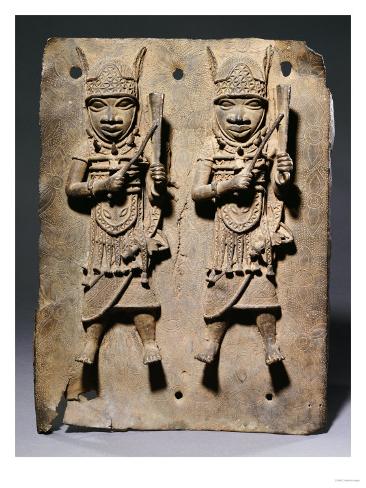
https://imgc.allpostersimages.com/images/P-473-488-90/14/1421/KE3R000Z/posters/a-benin-bronze-plaque-with-two-relief-figures-circa-1600.jpg A Benin Bronze Plaque with Two Relief Figures, circa 1600 (I might have already posted this, not sure) |
| Culture › Re: Benin Art And Architecture by PhysicsQED(m): 2:44am On Jul 29, 2012 |
| Culture › Re: Benin Art And Architecture by PhysicsQED(m): 2:37am On Jul 29, 2012 |
https://img607.imageshack.us/img607/5608/benintestacommemorativa.jpg Not quite sure what that is on top of the head. Any suggestions/ideas are welcome. |
| Culture › Re: Benin Art And Architecture by PhysicsQED(m): 2:34am On Jul 29, 2012 |
| Culture › Re: Benin Art And Architecture by PhysicsQED(m): 2:28am On Jul 29, 2012*. Modified: 2:51am On Jul 29, 2012 |
https://img96.imageshack.us/img96/4061/portugueseriflemanedope.jpg Portuguese rifleman, Edo peoples, Benin kingdom, Nigeria, 16th century copper alloy Note that in the Benin bronzes, almost all figures are barefoot (including some, but not all of the European figures), regardless of whether they would actually have been barefoot. On soldiers: "Invariably, or almost so, the West African soldier went barefoot, which increased his power of silent movement - as was subsequently noted in colonial wars" [Smith also cites a source that makes note of this] - Robert S. Smith, Warfare and Diplomacy in Pre-Colonial West Africa, p. 58 This makes it hard to know who was barefoot and who wasn't but it seems to be an always adhered to artistic choice or convention. I would assume that most were barefoot though (although the Oba was supposed to have had coral beaded shoes to go with the rest of his coral attire). |
| Culture › Re: Benin Art And Architecture by PhysicsQED(m): 2:16am On Jul 29, 2012 |
| Culture › Re: Benin Art And Architecture by PhysicsQED(m): 2:14am On Jul 29, 2012 |
| Culture › Re: Benin Art And Architecture by PhysicsQED(m): 2:11am On Jul 29, 2012 |
| Culture › Re: Benin Art And Architecture by PhysicsQED(m): 2:00am On Jul 29, 2012 |
https://img820.imageshack.us/img820/9756/beninplaccaconduecaccia.jpg Brass plaque showing the king's leopard hunters. |
| Culture › Re: Benin Art And Architecture by PhysicsQED(m): 1:57am On Jul 29, 2012 |
| Culture › Re: Benin Art And Architecture by PhysicsQED(m): 1:53am On Jul 29, 2012 |
https://img818.imageshack.us/img818/863/beninacquamanileaformad.jpg Water holder in the shape of a leopard. |
| Culture › Re: Is African Culture Becoming Ghetto Culture? by PhysicsQED(m): 1:39am On Jul 29, 2012 |
Blyss: The fact of the matter is this, many African cultures are not only ghetto or Shanty if you prefer,Dude, Italy is corrupt as hell and has been for a long time (since the Borgias and the de Medicis up to the present), but they're "ballin" and their recent troubles are some of the only really great troubles they've had since becoming a nation. Chinese corruption is also very significant and widespread and yet they're working and soon to be "ballin" and really rich(er) as a nation. I'm not going to debate on the so called "ghettoness" of killing gays and deliberately drowning babies that (non-African) Westerners can't seem to stop doing vs. the so called "ghettoness" of certain African cultures. It's pointless because we're both biased. 1 Like |
| Culture › Re: Benin Art And Architecture by PhysicsQED(m): 1:33am On Jul 29, 2012 |
| Culture › Re: Benin Art And Architecture by PhysicsQED(m): 1:27am On Jul 29, 2012 |


 but they are are also corrupt, and it is for this reason that the nation in which were produced and are run by these cultures/people DON'T WORK. That's simple fact.



1 2 3 4 5 6 7 8 ... 61 62 63 64 65 66 67 68 69 (of 154 pages)