PhysicsMHD's Posts
Nairaland Forum › PhysicsMHD's Profile › PhysicsMHD's Posts
1 2 3 4 5 6 7 8 ... 15 16 17 18 19 20 21 22 23 (of 67 pages)
 Politics › Re: Why Does The Nigerian President Dress Like A Clown? by PhysicsMHD(m): 10:43pm On Apr 21, 2011 Politics › Re: Why Does The Nigerian President Dress Like A Clown? by PhysicsMHD(m): 10:43pm On Apr 21, 2011 |
Dumb thread. There's nothing clownish about his attire. I honestly like the robe/gown, but I wish he would lose the hat. |
| Culture › Re: Benin Art And Architecture by PhysicsMHD(m): 10:25pm On Apr 21, 2011 |
| Culture › Re: Benin Art And Architecture by PhysicsMHD(m): 10:25pm On Apr 21, 2011 |
| Culture › Re: Benin Art And Architecture by PhysicsMHD(m): 10:24pm On Apr 21, 2011 |
| Culture › Re: Benin Art And Architecture by PhysicsMHD(m): 10:23pm On Apr 21, 2011 |
| Culture › Re: Benin Art And Architecture by PhysicsMHD(m): 10:23pm On Apr 21, 2011 |
| Culture › Re: Benin Art And Architecture by PhysicsMHD(m): 10:21pm On Apr 21, 2011 |
| Culture › Re: Benin Art And Architecture by PhysicsMHD(m): 10:21pm On Apr 21, 2011 |
| Politics › Re: The Hausas (an Alternate Pespective) by PhysicsMHD(m): 10:04pm On Apr 21, 2011 |
monasor28:You are NOT Edo. People from Edo state don't think along these lines and have too much pride to write crap like this part in bold. Or at least, if you are what you say you are, you're a completely Northernized southerner who grew up licking Northern behind in order to be accepted by his friends in Borno. Grow a spine and get some self-respect. |
| Politics › Re: Nchara:stop The Lies Igbos Are Less Than 10% Of Lagos.bendle Are More Than Igbo by PhysicsMHD(m): 7:50pm On Apr 21, 2011 |
Nchara: Language Application Workshop: Professional Translation/InterpretationSaw this on the first page. For the record, Nchara, the name in bold (Edebiri) is Bini. And there are lots of professors at UNILAG who are not Yoruba, but a considerable number of them past and present are neither Igbo nor Yoruba. Anyway, using academic positions was a silly argument to make in the first place. People will take appointments in Borno, Bayelsa, etc. regardless of whether their people are there in considerable numbers or not. @ topic, I doubt that. . . |
| Culture › Re: African-Americans And Their Igbo Roots by PhysicsMHD(m): 7:17pm On Apr 21, 2011 |
^^^^ Your position is not logical. The Portuguese, Dutch, French, Spanish and British have never suffered from any "curse" and it's unlikely that they will anytime in the future. That's what ezeagu was pointing out. Furthermore, this is the map of Africa: [img]http://cuwhist.files./2011/01/trans-atlantic-slave-trade.jpg[/img] ^^^^ Are you actually asserting that those African countries that are suffering and doing poorly today are specifically those that took part in the slave trade? Look at that map again. Ghana is improving each and every day, while Zimbabwe isn't. There are also some other examples. And are you even claiming that those communities within each country that were either victims or powerless bystanders to the slave trade are also bearing the brunt of the "curse" from the actions of those around them, for no reason? Moreover, there is really no such thing as a curse. There isn't even karma, anyway. The history of humanity strongly attests to that. Take a more rational approach to history and you'll see that the strong overpower and exploit those with less power, regardless of who is right or wrong. 2 Likes |
| Politics › Re: Why Not The Russian Model For Nigeria by PhysicsMHD(m): 4:06am On Apr 20, 2011 |
gadogado:1. What's the relationship between the actual VP and the Prime Minister? That is, what's their ranking with respect to one another? If the president is incapacitated, who takes over government? I would assume it's the VP, but I can see a situation where the PM could claim the right to head the government because of experience or something. . . 2. Appeases the region? You're assuming a North-South scheme here, but what about rotation within regions? Is the SE necessarily "appeased" because a SW man or woman is made Prime Minister and vice versa? Is the SS necessarily "appeased" because a SE man or woman is made Prime minister? Is someone in Kwara or Kogi state "appeased" because someone from Borno is made Prime minister? 3. You stated: "The President will control Defense, foreign affairs, security and the economy (this includes all departments of state that pertain to the economy or economic development such as agriculture, petroleum etc)." But also stated: "The Prime minister who can only be removed from office through impeachment will control the civil service (meaning office of the SGF will be scrapped) national planning and the federal capital territory (fct minister will be scrapped) The president shall appoint a total of two thirds of the cabinet while the PM will appoint the remainder." You don't see a contradiction between assigning economic development to the president and assigning national planning to the prime minister? Are these things unrelated? What do you mean by national planning? Also, what would the PM need 1/3 of the cabinet for? 4. The issue is not who would win the political battle, but whether regionalism/sectionalism, an "unreasonable" perspective on foreign or domestic policy, or gross incompetence and bad decision making by one of the two leaders (especially the more powerful one - which is the president in your scenario) could make the other leader strongly opposed to his or her actions. The result would be a crisis, but this time not merely along political lines, but with an added North-South (or other relevant regions) element to the tension. |
| Politics › Re: Why Not The Russian Model For Nigeria by PhysicsMHD(m): 3:33am On Apr 20, 2011 |
gadogado:What if the President orders the military to do something (possibly controversial) and the Prime Minister strongly objects and attempts to stop the action or issues contrary/opposing statements or orders? After the Prime minister is unable to do anything, and the action is carried out, the Prime minister is a sitting and exposed enemy or source of opposition to the President within the President's own government. If you don't already get why I'm painting this scenario, I'll make it explicit: I'm making an allusion to both the constitutional crisis between Zik and Balewa and the recent heated disagreement between Putin and Medvedev over the invasion of Libya by Western forces. The first is relevant because it was a clash between interests or perspectives of different regions (or at least their political representatives) on what was right with respect to a national situation. The second example is relevant because it was a disagreement over what was right with respect to an international situation. I'm not sure that polycephaly is really an ideal characteristic for the executive branch of a government. |
| Politics › Re: A Prime Minister For Nigeria by PhysicsMHD(m): 3:03am On Apr 20, 2011 |
auwal87:Bizarre idea. Too silly to even bother addressing in detail. It's not like CPC and PDP or any other two (or more) opposing parties would needlessly form a coalition when one of the parties already has the upper hand by a large margin. . . Anyways people would just run for prime minister and leave the presidency to the runner up if such a power sharing agreement were implemented. |
| Politics › Re: Jonathan Suspends The Minister Responsible For Internal Security by PhysicsMHD(m): 2:52am On Apr 20, 2011 |
ndu_chucks:Did the electorate - particularly that of the North - indicate that enough was enough after the much more heavily criticized 2007 elections that saw the late Umaru Musa Yar'Adua into power? Where was the rioting, murder, and destruction then? Or does this kind of indignation only occur at certain specific times?  |
| Politics › Re: Jonathan Suspends The Minister Responsible For Internal Security by PhysicsMHD(m): 2:34am On Apr 20, 2011 |
^^^^ Where was all this indignation when Obasanjo - who could not even win in his home state - was rigged in? The North was silent then. |
| Politics › Re: How BBC Caused Crisis In The North by PhysicsMHD(m): 2:09am On Apr 20, 2011 |
I doubt the BBC was really responsible for the entire crisis, but if this story is true, then that was extremely irresponsible and unprofessional. Then again, how do we know the people responsible for the slip up were not Hausa speaking British Nigerians with a pro-Buhari bias? It's a possibility. |
| Culture › Re: The True Extent Of Alaigbo (Igboland) by PhysicsMHD(m): 8:35pm On Apr 19, 2011 |
ChinenyeN:Very good explanation. I also saw this: "Alagoa and Fombo have postulated that Hgwa-lgbo immigrants who settled in Bonny probably in the 14th century, were amongst the founders of the earliest dynasties which ruled that town (4). The fact that the Ngwa are associated with the , " in one of the little Google Books snippet previews that your second link showed (obviously "Hgwa" is supposed to be Ngwa here). So that was why you were referring people to those authors in your earlier posts. Really clears the whole thing up. I have to ask though, what are you going to do about the fact that the people of Bonny are widely regarded and described as a sub-group of the Ijaw rather than acknowledged as a mix? Or are you fine with that? (from this thread, it's clear that some other people aren't) |
| Culture › Re: The True Extent Of Alaigbo (Igboland) by PhysicsMHD(m): 8:36pm On Apr 18, 2011 |
Apparently Ijaws do produce salt: http://books.google.com/books?id=MdaAdBC-_S4C&pg=PA236&lpg=PA236&dq=ijaw+making+salt&source=bl&ots=dN4NlGvf8V&sig=1j5rJxdrPddethBwTcUdHMFZtEc&hl=en&ei=LpKsTergA8Xi0gG3r7T5CA&sa=X&oi=book_result&ct=result&resnum=6&ved=0CDUQ6AEwBQ#v=onepage&q&f=false http://books.google.com/books?id=fFdeYB1lIPwC&pg=PA249&lpg=PA249&dq=ijaw+making+salt&source=bl&ots=L5NvFbZSRM&sig=QOMGR5MHKGOaB4Exc3tk3CeUy5U&hl=en&ei=LpKsTergA8Xi0gG3r7T5CA&sa=X&oi=book_result&ct=result&resnum=2&ved=0CB4Q6AEwAQ#v=onepage&q=ijaw%20making%20salt&f=false |
| Culture › Re: The True Extent Of Alaigbo (Igboland) by PhysicsMHD(m): 8:21pm On Apr 18, 2011 |
ChinenyeN:Ok. Thanks for the correction. |
| Culture › Re: The True Extent Of Alaigbo (Igboland) by PhysicsMHD(m): 8:18pm On Apr 18, 2011 |
Obiagu1:So if Talbot, Baikie, and Leonard visit Bonny and record names of Bonny kings, and these names seem Ijaw and not Igbo, what would you conclude? Mean what you say or don't say it at all. It makes the whole stuff twisted.By this you mean you have evidence showing that the people of Bonny were grouping themselves with the Igbo groups in the hinterland? I asked you who were those writers that encounter them in Bonny that said such and you're telling me about GI Jones. Reread your initial questions and my reply. GI Jones wrote that in 1963, I only rely on those stuff written before all the confusions started ie pre-amalgamation.By confusions, I take it you're alluding to the possible influence of the Rivers state agitation on interpreting older history? If so, fair enough and I see where you're coming from, but if that's not what you mean, then what confusions are you referring to? Also, the stuff you're relying on may have been written at a time when there was even more confusion (i.e., Brass being referred to as "Ebo proper"  , and less willingness to find out about the culture and history of different groups by asking the people themselves. That's why G.I. Jones is relevant: he bothered to ask. , and less willingness to find out about the culture and history of different groups by asking the people themselves. That's why G.I. Jones is relevant: he bothered to ask. Alagbariye is actually Alagbara, an Ngwa migrant that actually set up Bonny. Read Chinenye and Chyz discussion above.Ok. So Alagbara is a Ngwa migrant. It may be true, but how widely accepted is this statement in Bonny? The Ngwa/Ndoki connection in Bonny is probably not denied by any serious and objective accounts, but this specific claim about Alagbara, where is it from? Again, mean it or leave it. Erinashabo is also Manilla Pepple and Manilla Pepple was Igbo.So Erinashaboo is a corruption/misspelling of a Ngwa name? What name is it supposed to be? As for Pepple being from Pepper, that's fine. But I don't see why it's unreasonable to interpret it as a misspelling of an Ijaw name but reasonable to claim that all of those names, including Alagbariye, are misspellings of Igbo names. [url=http://www.google.com/search?client=ubuntu&channel=fs&q=perekule&ie=utf-8&oe=utf-8#client=ubuntu&channel=fs&q=perekule&oe=utf-8&um=1&ie=UTF-8&tbo=u&tbs=bks:1&source=og&sa=N&hl=en&tab=wp&bav=on.2,or.r_gc.r_pw.&fp=aff20ae66cd53499]Alagoa writes that Pepple is from "Perekule"[/url] and others say it's from Pepper. Either one is possible, but which particular European ship was named Pepper? I'm not saying that a European ship could not have been named Pepper, but if you look at the pattern of naming for European ships, you would see why Pepper seems somewhat unusual. Also, I don't know how familiar you are with Burton's writings, but he has a tendency for flair, wit, exaggeration, and theorizing which make his writing interesting, but not necessarily completely accurate. Nembe is further inland from the ocean but has a huge river or lake beside it. Ijaws are mainly fishermen. So Nembe is still more or less coastal.Yes, there is a lake near Nembe. And Nembe being "coastal" is not in doubt. The question is, if Nembe is coastal, what is Bonny? Bonny is not inland. If anything your whole argument swings in favor of Ijaws definitely being at Bonny in areas other than the coast. A simple look at a Google map of Bayelsa state shows how bizarre this argument is. I never said there was no slave dealings in Bonny but such slaves cannot rise to become leaders, it's not done anywhere in the world. I maintain that those that rose to high positions in Bonny might actually be "odibo" or servants in Igbo trade apprenticeship system. The slave trade of Bonny community might have been confused with those "odibo" because some of them actually live more like slaves than servants, we still see some of them in such situations today.Ever heard of the Mamluks? Apparently some of them became Sultans. Also, They were of varied ancestry but were often Kipchak Turks/Cumans,[1] depending on the period and region in question. While mamluks were purchased, their status was above ordinary slaves, who were not allowed to carry weapons or perform certain tasks. In places such as Egypt from the Ayyubid dynasty to the time of Muhammad Ali of Egypt, mamluks were considered to be “true lords,” with social status above freeborn Muslims.[2]There are other examples still, I'm sure. As for the odibo/servants being confused with slaves, I'm skeptical of that because of the scale on which they make note of slaves or slave descended people and the distinction between free-born people and others. The specific words in European accounts about whether certain people in Bonny are "free-born," "proper free," or have slave origins suggests that they were not merely describing current practices (carrying out slave duties or carrying out servant duties that may look like slave duties) of those individuals, but actually making class distinctions. Is there really room for confusion between an odibo/servant who does not have "slave origins" and is "proper free" (i.e., truly free, to use Burton's words) with a slave who is not born free, when the writer of these words is trying to distinguish between people who belong to one class of the society and another group of a different class? I remain skeptical. I think part of the issue here is defining the role and status of a slave. From what you say about whether a slave could reach a high position in a society, I think you may have a stereotypical idea in your mind of what the role and status of a slave must have been in all societies. To give you just one example, in the Oyo empire, many of the most important functionaries of the Alaafin's palace were considered and called slaves of the king, despite their duties being nothing like what we consider stereotypical slave duties. My point is, slaves could have performed only stereotypically "servant" duties or even performed duties that are not those of a real slave or servant, but rather those of a prominent person or official, in the same way that servants who were in no way slaves could have (as you pointed out) performed stereotypically or seemingly "slave work." And I have to ask, how is it that Richard Burton and others are unreliable in describing servants as slaves, but necessarily reliable in other things? If we can admit that they could have confused servants for slaves, which is certainly possible, why not admit that they might have been wrong in other areas? |
| Culture › Re: The True Extent Of Alaigbo (Igboland) by PhysicsMHD(m): 6:47pm On Apr 18, 2011 |
[ ChinenyeN: I don't get what is so difficult to understand. I've explained this before. Yes, people really do know. Bonny's history isn't shrouded in mystery. ChinenyeN: Maybe people should read into the works of Alagoa, Fombo and Oriji, since some don't want to hear when someone tells them something. ChinenyeN: I don't know why some seem to feel (or behave) like everything is up for debate, especially when someone actually wants to explain things to them. It's like I might as well not even bother taking time out to address some people's posts and questions, in this topic and on this issue.Maybe you could post some specifics? You mentioned Alagoa's works above, and below you wrote: ChinenyeN: It seems like there is a lot people don't know. Like, for example, oral traditions have it that when the Portuguese came to the coast in the 15th century, it was the descendants of the founder (recollected as being Ngwa), led then by Asimini, that met the Portuguese, and got them to trade at Bonny. This effectively made Asimini the first King of Bonny. His [Asimini's] descendants subsequently ruled after him for some generations. Another interesting thing to note, which people for whatever reason tend not to mention (and consequently many people don't know), is the intensification of Ijo presence in Bonny beginning around the 16th century; a century or so after the Portuguese had established trade relations with Bonny people. Alagoa's chronology of Bonny recognizes/suggests this. This intensification (suggested to be Ijo migration from the west through creeks, to Bonny) is then followed by the massive influx of Igbo due to the slave trade (this one we should all be familiar with).Whereas Alagoa and Fombo write in A chronicle of Grand Bonny: "It was during Alagbariye's reign that the Portuguese first arrived in Bonny" http://books.google.com/books?id=VJV1AAAAMAAJ&q=bonny+portuguese&dq=bonny+portuguese&hl=en&ei=n3OsTbP1I7CK0QH9ltX5CA&sa=X&oi=book_result&ct=result&resnum=3&ved=0CDIQ6AEwAg So apparently this founder figure (Alagbariye) is viewed as having a "reign" and is associated with first Portuguese contact. Perhaps the record is not as crystal clear (which is actualyl commonplace for the early history of different societies) as you're saying. Also, there isn't necessarily much significance in the fact of an intensification of Ijaw presence around the 16th century in the context of what was being discussed (Obiagu1's contention that the town was founded by an Igbo group and Ijaws were only later migrants). In the same way that the later influx of a large number of Igbos during the slave trade does not somehow prove or show that Igbos were not originally there to begin with, the increase in Ijaw presence after trade was established with the Portuguese doesn't prove that the Ijaws weren't there to begin with. It's an interesting detail, but it's kind of peripheral. Unless it could be established (archaeologically perhaps? With pottery shards/fragments indicating pottery unique to Igbo groups or Ijaw groups?) that Bonny was only of one stock prior to the 16th century, the situation doesn't seem clear cut when there seem to be different accounts. . . |
| Culture › Re: Benin Art And Architecture by PhysicsMHD(m): 1:01am On Apr 18, 2011 |
A very imaginative illustration of pre-colonial Benin by a modern artist: https://img851.imageshack.us/img851/8016/sillustration.png I got this picture from these sites: http://nok-ind.tumblr.com/post/3143656051/an-image-of-benin-before-colonialisation http://fyeahblackhistory.tumblr.com/post/3156437707/nok-ind-nigeria-before-colonisation Some of the colors are likely to be wrong (the heavy and excessive emphasis on yellow/gold, possibly the blue roof and building, and the absence of white wrappers and the color white in general), but I definitely like the picture and the artist is certainly entitled to some artistic license for his or her effort. |
| Culture › Re: Benin Art And Architecture by PhysicsMHD(m): 12:47am On Apr 18, 2011 |
| Culture › Re: Benin Art And Architecture by PhysicsMHD(m): 12:46am On Apr 18, 2011 |
| Culture › Re: The True Extent Of Alaigbo (Igboland) by PhysicsMHD(m): 12:25am On Apr 18, 2011 |
Obiagu1:1. I concluded that most of the names don't sound Igbo and then asked for correction if I was wrong about that. I'm not sure that asserting that there were huge misspellings is a suitable correction. From some of FACE's posts on here it's obvious that he is Igbo and knows quite a lot about Igbo culture and the Igbo language, so if those names were just misspellings, he only had to say so and give his explanation. You also have to give an explanation. You can't just assert that most are just misspellings without an explanation of what they are supposed to be. You have the advantage here that I don't speak/read Ijaw, but are you honestly telling me that Kiepirima, Epelle, Amanibieyefori, Ibifa, Ibanigo, and Uranta are only misspellings of Igbo names? Would you, in real life, actually say this to an Ijaw man's face? Like I said, I don't know the Ijaw language to be able to prove that they aren't misspellings and that their names can be explained in Ijaw, but I don't see how you can just assert that they aren't Ijaw names unless you have mastery of the Ijaw language and know these names not to have any parallels or similar names among the Ijaw. They seemed Ijaw to me, but this is the first I'm hearing about all these names being misspellings of Igbo names. And my point is not really about whether those heading the trading houses were Igbo or Ijaw - they could easily all have been Igbo. My point was about the kind of names they were using and what that says about Bonny. It seems to clash strongly with your thesis that Ijaws were some peripheral later migrants to Bonny. And if these were actually just misspelled Igbo names, give a reasonable explanation of what names they are supposed to be, and why those names were all misspelled, while Igbo names like Nkwere and Nkeche, among others, were not misspelled. Now let's see what you seem to believe:Well, what I meant is, did they even ask them who their people were or were associated with or what clan/tribe/ethnicity/nationality they claimed? I'm not saying that the people there would actually have answered that "we are of such and such larger general ethnic group" since groups would have been too divided to do that or have any idea of such a thing. I'm just saying that there doesn't seem to be any evidence that the European writers who said that the people and kings of Bonny were Igbo actually got that information (or information that implied that they were an Igbo sub-group) directly[i] from the people[/i] of Bonny. But if there is evidence that they did, then those quotes actually have the significance you were imparting to them. If not, then they could be taken as general, descriptive quotes that could just as easily only say something about the high degree of interaction between Igbos and Ijaws in Bonny, rather than supporting your account of Bonny's history. 2. The European writers who say that the people they encounter at Bonny claim ancient Ijaw descent are necessarily incorrect.An English writer (South African born, actually) who recorded the claim that the ancestors of the people of Bonny migrated out of the "central Ijaw area" is G.I. Jones, who published Trading States of the Oil Rivers in 1963, and researched the Eastern region of Nigeria directly. Here's an overview of G.I. Jones: http://www.independent.co.uk/news/people/obituary-g-i-jones-1575078.html Clearly not a biased individual. His is not a pre-colonial account, but his book is a very detailed study of what happened in that area in pre-colonial times. http://books.google.com/books?id=pIR-mgBiJ-gC&pg=PA72&lpg=PA72&dq=Trading+States+of+the+Oil+Rivers+%281963%29&source=bl&ots=v1fkbrzUfb&sig=QVPLHEmI00p-DHXFI3DfHBtNFYA&hl=en&ei=XWCrTYTmCsuB0QHl26j5CA&sa=X&oi=book_result&ct=result&resnum=1&ved=0CBcQ6AEwAA#v=onepage&q=bonny&f=false Another claim implying that Bonny was Ijaw founded comes from page 24 of Kenneth .O. Dike's Trade and politics in the Niger Delta, 1830-1885: an introduction to the economic and political history of Nigeria (1956): https://img828.imageshack.us/img828/6105/kodiketradeandpoliticsi.png http://quod.lib.umich.edu/cgi/t/text/pageviewer-idx?c=acls;cc=acls;rgn=full%20text;idno=heb02585.0001.001;didno=heb02585.0001.001;view=image;seq=34;node=heb02585.0001.001%3A3;page=root;size=100 He cites P. Amaury Talbot, and Talbot wrote that this tradition of the founding of Bonny by a certain "Alagbariye" (once again, it seems to be an Ijaw name to me, but if it's a misspelling of an Igbo name, do provide an explanation) who brought his people there, was recorded by three different pre-colonial European travelers (John Barbot, William Baikie, and Leonard), who visited Bonny. Here's a mention of their visits to Bonny in G.I. Jones' book: http://books.google.com/books?id=pIR-mgBiJ-gC&pg=PA106&lpg=PA106&dq=baikie+nigeria+bonny&source=bl&ots=v1fkbrBNg4&sig=Nb6MtwdXFUIFp8qNVn5BzBxFeW8&hl=en&ei=dGWrTZL9Bqbi0QGgr-H5CA&sa=X&oi=book_result&ct=result&resnum=2&ved=0CBcQ6AEwAQ#v=onepage&q=baikie%20nigeria%20bonny&f=false So unless they went to pre-colonial Nigeria and were each independently told the same tall tale, it would seem that this tale of an ancient migration led by "Alagbariye" was an old and authentic story in Bonny. This Alagbariye who "brought his people there" implies a migration, and the name implies an Ijaw leader, unless it's a misspelling. 3. The fact that European writers say that most of the trading houses had Ijaw names, that the rulers of Bonny had Ijaw names and adopted an Ijaw war god associated with iguanas, does not make this thesis that Ijaws were later migrants to Bonny who dwelt along the coast and were not central to the founding of the town or ruling it seem implausible.I think we might be getting into semantics, because I phrased this sloppily when I originally wrote it. I meant that the Europeans writers say what the names of the trading houses are, and that, by observation, a large number of them are indeed Ijaw names to anyone who looks at them. But once again, if they are just misspellings of Igbo names, do explain what is being misspelled. I do acknowledge that European writers misspelled African names. That's indisputable. However, from what I have read, they did not miss the mark by so much and in exactly such a manner as to consistently parallel the names of a different African language. And how do you know Erinashabo is not a misspelling of Iringeresibo, an Ijaw name? Please provide a comparable Igbo name, or the name this is supposed to be. As for "Pepple," why can't that just be a misspelling of an Ijaw name? Is there a comparable Igbo name? I genuinely don't know, so I'm asking out of ignorance. 4. "Igbos founded the town."Well, Bonny was founded a very long time ago. Can anyone really know? If there were waves of migrations from different groups, who is to say which group arrived first? 5. "Ijaws lived there mainly along the coast"I really don't understand this argument. Nembe is further from the ocean than any part of Bonny, right? So what are you saying? I think you know that there are multiple places in Bayelsa that are "inland" compared to Bonny. Is any of Bonny really "inland"? I thought I understood your contrast of "inland" and the coast but you seem to be using that word in a different sense than what I assumed. 6. Those people in Bonny who were called Igbo slaves were not slaves.I am certainly no expert on slavery across different African cultures, but the following is a description of slavery in Bonny (and some other areas) that I found: https://img13.imageshack.us/img13/6105/kodiketradeandpoliticsi.png http://quod.lib.umich.edu/cgi/t/text/pageviewer-idx?c=acls;cc=acls;rgn=full%20text;idno=heb02585.0001.001;didno=heb02585.0001.001;view=image;seq=35;node=heb02585.0001.001%3A3;page=root;size=100 From p.25 of Kenneth O. Dike's Trade and politics in the Niger Delta, 1830-1885: an introduction to the economic and political history of Nigeria (1956) Tell me what about these accounts is implausible? This account seems to explain the situation just fine without recourse to your theory that "odibo" was being practiced throughout Bonny. If the society has a huge number of slaves and people descended from slaves as part of the general populace, then why won't some of them become prominent through their own ability? Why won't some of them get their freedom and become ex-slaves and then rise to higher heights? Was revolt really a sine qua non? It's true that it's possible that they could have all been servants, rather than slaves, but given the enormous involvement of Bonny in very real slave purchasing and selling, is this really a reasonable conclusion to reach? Also, in the rest of the different Igbo societies, particularly those of the Delta region, was there a practice of employing enormous numbers of apprentices/servants everywhere in the city/village/region? Even if there was not, this could have been an isolated phenomenon, where the "odibo" practice occurred on a large scale, but I think the slave buying and selling background of Bonny itself makes it more likely that these were actual slaves. That's my conclusion and you are certainly entitled to your own conclusion. It's just that since your statements contradicted a lot of what I had read, I expected stronger supporting evidence for your position. |
| Culture › Re: The True Extent Of Alaigbo (Igboland) by PhysicsMHD(m): 10:56pm On Apr 16, 2011 |
Obiagu1:I don't think you understood me, so let me make it clearer. I didn't mean that I was unaware of the Bonny people being a mix of Igbo and Ijaw. That has been stated all throughout this thread. That's not the issue. I'm talking specifically about the Ngwa migrations. If you say the founders were Igbo, say which Igbos and from where. I was unaware of the Ngwa claim, but upon finding out about it, it seems reasonable. When I said I wasn't aware of them being a mix, I meant I was unaware of them not being originally only of one stock or another. I thought that would have been clear in the context that it was said. As for "indulging in making inferences on my own," you're confused on that account. A lot of the written material on Bonny - and none of what I've read was necessarily written by Ijaws - paints a different account entirely from what you have been asserting, so I was hardly "indulging in making inferences" more than anyone else in this thread. That I wasn't aware of the tradition about the Ngwa migrations hardly means that I was just "making inferences" anyhow prior to that. Much of the written material itself strongly lends itself to conclusions that run contrary to what you're asserting so if you have an issue with the conclusions in the material I gave links to you should say so and point out which specific claims you believe are incorrect, rather than claiming that I'm only "indulging in inferences." (As if you haven't made inferences yourself, like the one you just made in this very post about Ijaws and the coast.) Take this for example: http://books.google.com/books?id=8qvY8pxVxcwC&pg=PA539&dq=war+god+iguana+bonny&hl=en&ei=bv-pTYjvMKuC0QGIzcT5CA&sa=X&oi=book_result&ct=result&resnum=1&ved=0CCgQ6AEwAA#v=onepage&q=war%20god%20iguana%20bonny&f=false ^^^^ What do you object to in the picture being painted in this book? This material seems to strongly contradict your thesis, but I don't accept it as being infallible or not subject to error, so point out to me what the errors are, rather than saying I'm just "indulging in inferences." These are the facts: A. There are instances of Europeans calling Ijaw groups "Ibos" B. Some European explorers successfully distinguished between Ijaws and Igbos. Now let's see what you seem to believe: 1. The European writers who assert, without asking, that the people they encounter at Bonny are "Ibo" are necessarily correct. 2. The European writers who say that the people they encounter at Bonny claim ancient Ijaw descent are necessarily incorrect. 3. The fact that European writers say that most of the trading houses had Ijaw names, that the rulers of Bonny had Ijaw names and adopted an Ijaw war god associated with iguanas, does not make this thesis that Ijaws were later migrants to Bonny who dwelt along the coast and were not central to the founding of the town or ruling it seem implausible. 4. "Igbos founded the town." 5. "Ijaws lived there mainly along the coast" 6. Those people in Bonny who were called Igbo slaves were not slaves. 7. "It's not in Ijaw culture to live inland." The questions I have are: 1 & 2: Don't you see how one cannot assert that (1) is true on account of these being objective written accounts by people who visited the area and made assertions about those they observed, but then assert that (2) is true when the idea that people at Bonny are claiming Ijaw descent is also from an objective account, but from people (like G.I. Jones) who bothered to ask the people and find out about their traditional accounts? 3: What are the implications of this preponderance and importance of Ijaw culture in Bonny for your claim? Answer honestly, please. 4 & 5: Proof? 6: Seems to be contradicted by the huge number of slaves, always identified as primarily Igbo by objective writers (including those European writers who asserted Bonny was an Igbo town), that were sold directly from Bonny. Or were they exporting a huge number of slaves, but not keeping any? Anyway, I don't think reasonable people believe all the Igbos there were slaves. 7. I don't know what your understanding of "inland" is but if parts of Bonny can be called "inland" then Nembe certainly can be called "inland" as well. Or was Nembe also founded by Igbos? So much for "it's not in Ijaw culture to live inland." I don't know if you really even believe this claim yourself.As for Opubo/Obullo being Igbo, do you have any proof? Accounts suggest the kings of Bonny were Ijaw: Ijaw names, Ijaw gods, etc., so what do you base the claim on? I could see them being of Ijaw and Igbo descent, but this statement that this king was Igbo needs some other supporting evidence. You assert that I "went on [to] list houses and instantly deduced that they were not Igbo" which is patently false. I specifically said that a large number (from what I read) were founded by Igbos and implied that Igbos were possibly dominating the trade houses. I don't know how you didn't comprehend that. I said that the fact that the houses had Ijaw names despite not being headed or founded by Ijaws says something about whether or not Ijaw culture was central and widespread in Bonny. Anyway, everything I had seen suggested an Ijaw preponderance of influence in Bonny and showed Ijaw culture with other influences, in stark contrast to a few assertions in this thread that they were latecomers and a later appendage to an Igbo city-state, so it was entirely reasonable to reach the conclusions I originally did. However, after finding about the Ngwa migration story, I find the theory of a joint migration from different areas more satisfactory, as founding groups in older times did not usually allow a "foreign" group to be in huge numbers in their area, have many prominent positions, and have their language and customs become very influential there, etc. So I think it more reasonable to assume that Igbos were foundational to Bonny as well as Ijaws. I also have to ask why for the second time, you're responding to an issue in which you have a biased interest to distort my position ("indulging in making inferences" ? Have you thought about the fact that I don't have any stake in Bonny, Ijaw-Igbo debates, etc., but that I'm just trying to find out whose account is true out of curiosity, since some of the stuff I'm reading here overturns what I've read in Nigerian history? If it turns out Bonny was as you say it was, then I'll readily admit it and move on, but I really did not see a strong case. Don't make this personal. |
| Culture › Re: Benin Art And Architecture by PhysicsMHD(m): 9:19pm On Apr 16, 2011 |
| Culture › Re: Benin Art And Architecture by PhysicsMHD(m): 8:55pm On Apr 15, 2011 |
https://img641.imageshack.us/img641/6076/benin3courtofficialsone.png Plate number 3 from the book Antique Works of Art from Benin (1900) by Pitt Rivers. Three court officials and/or soldiers are depicted and the one in the center is carrying an ekpokin. |
| Culture › Re: Benin Art And Architecture by PhysicsMHD(m): 8:47pm On Apr 15, 2011 |
https://img862.imageshack.us/img862/1575/beninekpokinboxusedforc.png Bronze depicting an ekpokin (gift box for ceremonial presentations) with designs and symbols on the cover and sides. From the book Antique Works of Art from Benin (1900) by Pitt Rivers Compare this object with the one here: https://www.nairaland.com/nigeria/topic-582176.128.html |
| Culture › Re: Benin Art And Architecture by PhysicsMHD(m): 8:43pm On Apr 15, 2011 |
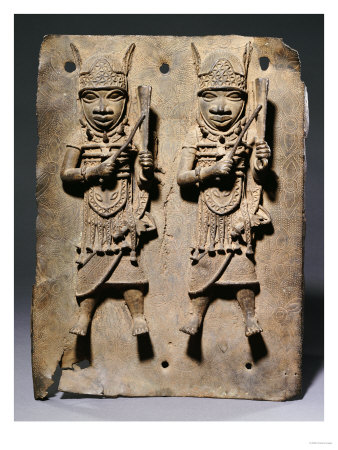
https://img718.imageshack.us/img718/2760/benincourtofficialsmess.png Plate number 2 from the book Antique Works of Art from Benin (1900) by Pitt Rivers. The description given in the book is: "Bronze plaque, representing two figures holding plaques or books in front. Coral chokers, badge of rank. Reticulated head-dresses of coral or agate, similar to that represented in Plate XXI, Fig. 121. Barbed objects of unknown use behind left shoulders, ornamented with straight line diaper pattern. Ground ornamented with foil ornaments incised. Guilloche on sides of plaque." But the other representations of these rectangular objects show that they are not plaques and are too thin to be books. |




1 2 3 4 5 6 7 8 ... 15 16 17 18 19 20 21 22 23 (of 67 pages)