PhysicsMHD's Posts
Nairaland Forum › PhysicsMHD's Profile › PhysicsMHD's Posts
1 2 3 4 5 6 7 8 ... 18 19 20 21 22 23 24 25 26 (of 67 pages)
 Politics › Re: Request For The Creation Of An Urhobo State by PhysicsMHD(m): 12:45am On Apr 13, 2011 Politics › Re: Request For The Creation Of An Urhobo State by PhysicsMHD(m): 12:45am On Apr 13, 2011 |
Kobojunkie:Like I said, it's not really necessary in some cases, such as that of the Urhobo. Creating states just for the purpose of creating states is pointless. Those other states you mentioned (Edo, Bayelsa,etc.) were actually good ideas because by carving away an ethnic group or ethnic groups that were perceived as politically dominating a state (Bendel, old Rivers,) they decrease the chance for ethnic politics to come to the forefront. |
| Culture › Re: Benin Art And Architecture by PhysicsMHD(m): 10:37pm On Apr 12, 2011 |
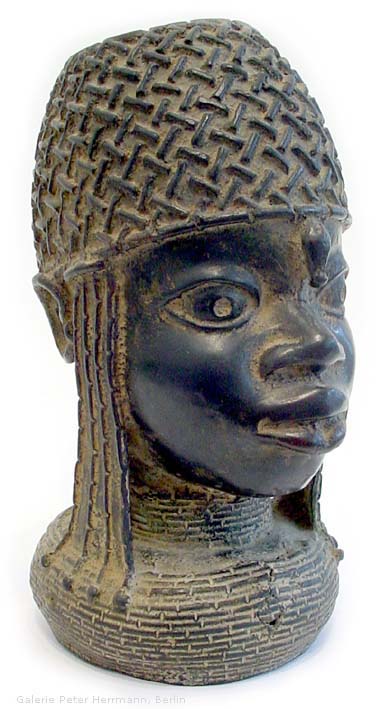
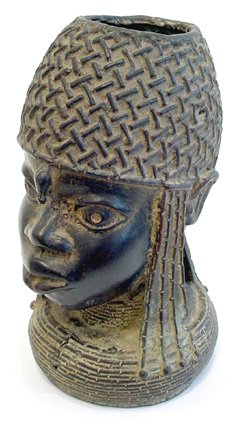
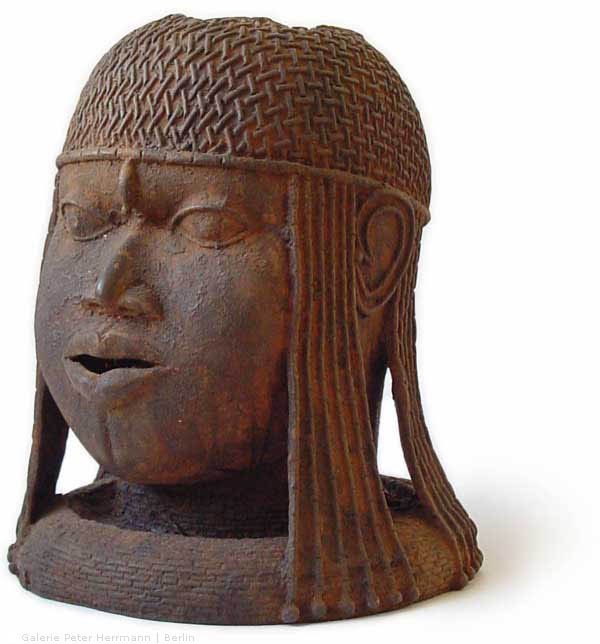
https://www.galerie-herrmann.com/arts/art3/Ife_Benin/11_Kopf_Iviovor/Benin_Iviovor_gr.jpg https://www.galerie-herrmann.com/arts/art3/Ife_Benin/11_Kopf_Iviovor/Benin_Iviovor_Det.jpg Oral tradition dates this object, one of the small memorial heads once housed in the Obaseki shrine, to the year 1884. It is said to have been made in memory of a well-known figure from Benin, presented to us as "Iviovor Edion Edo," aide-de-camp of the exiled Oba after 1900. Unfortunately, a TL analysis is not available to confirm this date as it is in the case of the other three heads because the remains found of a potential clay core are not geologically (i.e. TL) measurable. Stylistically, this head is closely aligned with early heads from Benin, featuring a coral cap, single pearl on the forehead, bulging coral collar and hanging pearl plaits. The face, however, features characteristics more reminiscent of Benin's later, more realistic phase of bronze casting and, furthermore, is smaller than the 16 th -century heads. The typical hole in the back of the head is still present, but its function as a stand for holding ivory was rendered obsolete by the shape of the cast. |
| Culture › Re: Benin Art And Architecture by PhysicsMHD(m): 10:35pm On Apr 12, 2011 |
https://www.galerie-herrmann.com/arts/art3/Ife_Benin/98_Koeniginmutter/Queenmother_gr.jpg Queenmother Benin, Nigeria Bronze 47 cm |
| Culture › Re: Benin Art And Architecture by PhysicsMHD(m): 10:34pm On Apr 12, 2011 |
https://www.galerie-herrmann.com/arts/art3/Ife_Benin/17_Kopf_Benin_Ibo/Head_450J_gr.jpg Benin, Nigeria. 16th century Bronze 23 cm |
| Culture › Re: Benin Art And Architecture by PhysicsMHD(m): 10:32pm On Apr 12, 2011 |
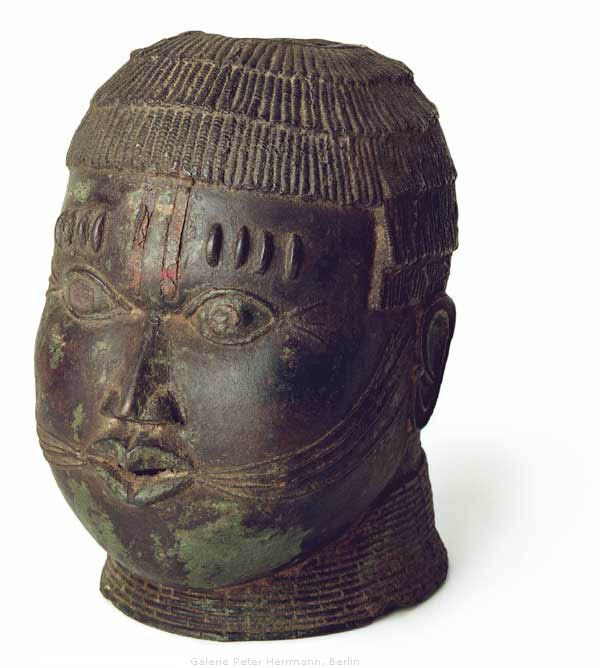
https://www.galerie-herrmann.com/arts/art3/Ife_Benin/19_Kopf_480J/Head_Benin_gr.jpg Benin, Nigeria 16th century Bronze 25 cm It is not known whom this head is meant to represent. In 1919, Luschan held it for a female head, based on the argument that such toric necklaces were worn only by female musicians. The latest research, however, indicates that this is the memorial head of a king. Copies of this head - with coral head covering, a single pearl on the forehead, toric coral necklace and hanging pearl plaits - appeared frequently during the 16 th century. The gentle modelling of the soft and sensitive facial features is noteworthy in and of itself and especially in contrast with the much more diagrammatically rendered ears. The realistic portrayal of the face is typical for Benin bronzes from the 16 th century and is usually seen as evidence of Ife influences. The question of who influenced whom and during what time period, however, has still not yet been adequately explored. Cp.: Felix von LUSCHAN: Die Altertümer von Benin, Band 1, Berlin 1919, S. 357. Philip J. C. DARK: An introduction to Benin art and technology, Oxford 1973, S. 94. Barbara PLANKENSTEINER (Hg.): Benin. Könige und Rituale. Höfische Kunst aus Nigeria, Wien 2007, S. 373. |
| Culture › Re: Benin Art And Architecture by PhysicsMHD(m): 10:31pm On Apr 12, 2011 |
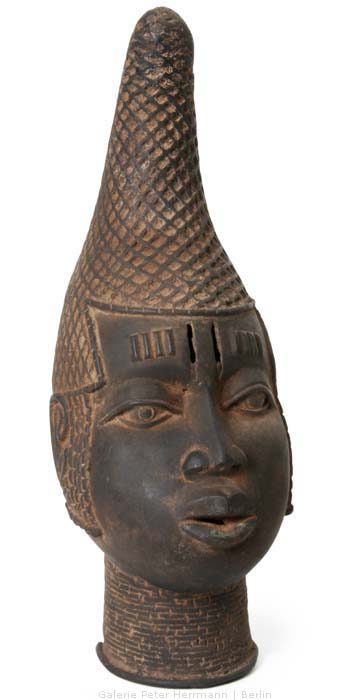
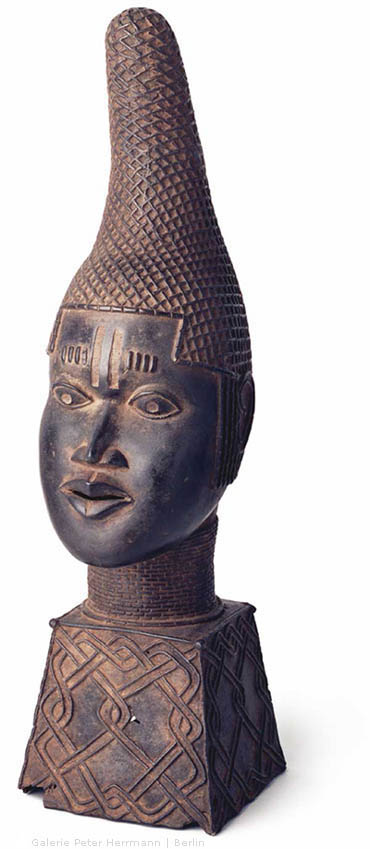
https://www.galerie-herrmann.com/arts/art3/Ife_Benin/01_Benin_Queen/Koenigin_gr.jpg Memorial Head of a Queen Mother Benin, Nigeria 16th-17th century Bronze 55 cm The towering coral headdress is an important adornment of the so-called Queen Mother, an appellation that hearkens back to Oba Esigie, who ruled until 1550. Esigie is said to have conferred the title Iyoba (Queen Mother) upon his mother Idia out of gratefulness and respect and to have thereupon inaugurated this type of representation. Since then, all Obas have had the right to grant their mothers the official title Iyoba three years after their enthronement, though only 17 of the 38 Obas of the current dynasty have done so. In general, the Oba never again sets eyes upon his mother once he has assumed his title. As Iyoba, however, the Oba's mother is the only woman to occupy one of the highest posts in Benin, meaning that her son, the Oba, can consult with her on all matters of state. Conferring the title is thus a particularly important decision. After a Queen Mother's death, the Oba dedicates an entire altar to her to which he brings yearly sacrifices in her honour. He also erects a shrine devoted exclusively to her either in the royal palace or at the Iyoba's residence in Uselu, filling it with corresponding memorial heads. This head - unusually girl-like for the depiction of a mother - is highly idealised, suggesting that the idealised acts of enshrinement and worship were more important than actual remembrance in the form of a realistic image. Most depictions of Iyobas were based on Esigie's model and always outfitted with the following attributes: a tall, coral-adorned coiffeur, customary decorative scars on the forehead, coral neck jewellery and a pedestal decorated with wattling or fish-like ornamentation. Cp.: Paula Girshick BEN-AMOS: The art of Benin, London 1995, S. 35/ 36. Ekpo EYO, Frank Willett: Kunstschätze aus Alt-Nigeria, Mainz 1983, S. 134. Felix von LUSCHAN: Die Altertümer von Benin, Band 1, Berlin 1919, S. 356/ 357. Till Förster: Kunst in Afrika, Köln 1988, S. 110/ 111. Barbara PLANKENSTEINER (Hg.): Benin. Könige und Rituale. Höfische Kunst aus Nigeria, Wien 2007, S. 395 - 398. |
| Culture › Re: Benin Art And Architecture by PhysicsMHD(m): 10:30pm On Apr 12, 2011 |
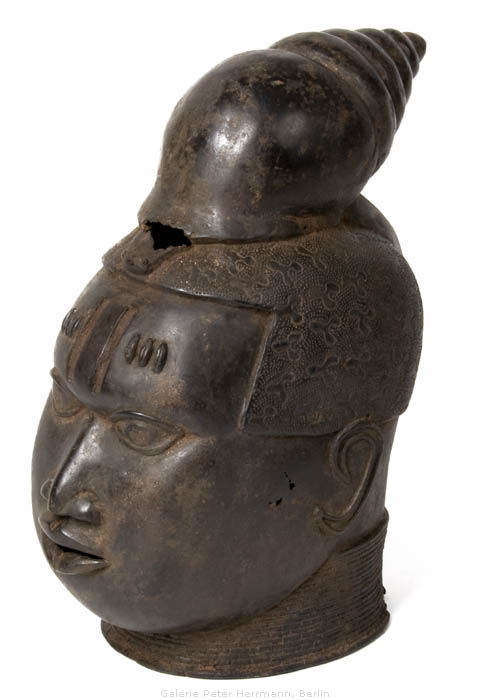
https://www.galerie-herrmann.com/arts/art3/Ife_Benin/97_Kopf_Schnecke/bronze_kopf_gr.jpg Head with Snail Benin, Nigeria About 1550 Bronze 32 cm |
| Foreign Affairs › Re: Can We Rebrand The Image Of Africa? by PhysicsMHD(m): 10:17pm On Apr 12, 2011 |
To actually rebrand the image of Africa would be to change the way history is taught. You can't change the image of Africa to a more positive one when people are constantly still portraying pre-colonial Africa as the "Heart of Darkness" and as a place which had no civilzations south of the Sahara Desert. It's an uphill battle against 300 years of distortion. Good luck with your organization, but you or your organization would need to put out a major work and do years of research to highlight the different cultures and achievements of African societies and synthesize them all in one impactful book. Most of the information that shows that pre-colonial Africa was not the uncreative wasteland and uncultivated jungle it was made out to be is in too many disparate sources and I haven't seen any real good book that goes into detail about all of them. Anyway, like I said, good luck. |
| Politics › Re: Nigeria's First Legal Female Senator Without Court Issues. . . Oluremi Tinubu by PhysicsMHD(m): 10:05pm On Apr 12, 2011 |
This thread is flat out wrong. Anyways, would she even be in politics without her husband? |
| Politics › Re: Request For The Creation Of An Urhobo State by PhysicsMHD(m): 9:58pm On Apr 12, 2011 |
It might be good for the Urhobos to have their own state, but do they really need it? Are they being marginalized by those around them or are they actually major players and stakeholders in Delta state politics? I think the answer is that they are not under anyone's domination. |
| Foreign Affairs › Re: Will Technology Solve Africa's Problems? by PhysicsMHD(m): 7:32pm On Apr 11, 2011 |
AjanleKoko:Tragic.  That's the only word that comes to mind. |
| Culture › Re: Delta Igbo, Bendel Igbo: What Does That Even Mean. by PhysicsMHD(m): 7:26pm On Apr 11, 2011 |
ChinenyeN:No, I'm just saying that as the Igbo ethnicity is presently defined, they (Ika) have to fall into it, regardless of what a few of them proclaim. I think it's not so hard to understand what my view is on this. I just think his denial is purely political, and completely lacking a reasonable "ethnological" basis. |
| Health › Re: Werewolf Boy Appeals To Doctors To Find A Cure by PhysicsMHD(m): 7:07pm On Apr 11, 2011 |
HOLY SH[i]I[/i]T! That poor kid. His face is a rug!What's even stranger is that I recently watched that movie The Wolfman, and they mention that the original werewolf in the movie (Sir John - Anthony Hopkins character) became a werewolf by being bit by a feral wolf-like boy in the mountains of northern India, near where the Gypsies originated from. |
| Culture › Re: Delta Igbo, Bendel Igbo: What Does That Even Mean. by PhysicsMHD(m): 6:35pm On Apr 11, 2011 |
ChinenyeN:I'm not saying he should not take pride in his distinct Ika identity and only say he's Igbo. How do you figure the "without an ethnicity" part?It seems like that's what he's trying to do - say Ikas are only Ikas and not Igbos. I don't see the difference between what he's saying and someone saying "Wodaabes are only Wodaabes and not Fulanis." It just makes no sense. But this isn't my battle to fight anyways. I just hoped that as a non-Igbo outsider who won't be seen by him as being biased, I could bring him back to reason. I think I"ll just let him be. |
| Culture › Re: Delta Igbo, Bendel Igbo: What Does That Even Mean. by PhysicsMHD(m): 4:23pm On Apr 11, 2011 |
agbotaen:Why not just say Ikas are Igbo with Benin influence? Why try to make them into a distinct group without an ethnicity? Don't get me wrong, it's possible for distinct ethnic groups to share a lot of things in common with those around them, but in the case of the Ika, there's evidence on the ground pointing to them being Igbos. Why deny it? As for Jacob Egharevba and Agbor: "Egharevba's Short History is a book that touches on the history of several peoples of south-central Nigeria, hence its thesis has been of much interest to students of the history of this area, including non- Edo speaking peoples. One such people is the Ika (Igbo) of Agbor. The origin of kingship in Agbor and even the very name of the kingdom are still areas of contention." "This story of the origin of kingship in Agbor is omitted in subsequent editions of Short History. Though in the second edition he indicates in a footnote that "the first Obi of Agbor was sent by Oba of Benin,"59 he only makes reference to the Agbor rebellion during the reign of Oba Ehengbuda in the third edition, and another reference to the origin of the name Agbor in the fourth edition. This continued diminution of the role of Benin in Agbor affairs might have been prompted by the opposition of the Agbor Indigenes Association to Egharevba's story after the publication of the first English edition of Short History. This might be a problem of relying on the oral tradition of other people in writing history without the necessary verification." - A Comparison of Jacob Egharevba's "Ekhere Vb Itan Edo" and the Four Editions of Its English Translation, "A Short History of Benin" Author(s): Uyilawa Usuanlele, Toyin Falola Source: History in Africa, Vol. 25 (1998), pp. 361-386 So what was the reason for the Agbor Indigenes Association objecting to Egharevba's story in 1936, if, as you claim, Ikas acknowledge a Benin origin? They clearly rejected it long before the 1950s. |
| Culture › Re: Delta Igbo, Bendel Igbo: What Does That Even Mean. by PhysicsMHD(m): 4:13pm On Apr 11, 2011 |
Abagworo:How much do you know about the Igue festival? (As it was originally practiced) Do you know what it's about? Or are you just making stuff up? If you knew what it was for, I doubt you'd have made this claim. Benin had a lot of influences, but there's no need to just make up stuff. If you had said the cult of the hand practiced in Benin was from Nri or something, it might have made sense and would be plausible, but Igue festival is not from Nri. |
| Politics › Re: Why Is America Full Of Scamming Ceos by PhysicsMHD(m): 11:07pm On Apr 10, 2011 |
buzugee:lol  the juice is a full gallon. its dirt cheap in england. real juice too. no chemicals.Yeah, I believe you. It can't all be due to inflation. I guess American companies are just out to increase their profit at anyone's expense. Probably has to do with the ideology of American capitalism. you know in america i think the tax may even be higher than 25 percent. i know a guy who says they take a third his wages in taxesSurprising. Like I said, I don't know much about taxes, but a third in taxes sounds outrageous. He must work at a specific kind of job where he's vulnerable to that kind of taxation because I can't imagine the average American putting up with that. Whole protests have been staged over much less. |
| Politics › Re: But For Buhari/tinubu, Nigeria Would Have Become One-party State by PhysicsMHD(m): 10:57pm On Apr 10, 2011 |
Kobojunkie:Don't the NASS results imply something about the future presidential election results though? If things look bleak for the entire CPC outside of Buhari, then for some people now might be a good time to elevate Buhari to the status of national hero to compensate for the reality on the ground. As for Tinubu, I'm not sure he should be called a hero of democracy. That just seems like having low standards for heroes. |
| Politics › Re: But For Buhari/tinubu, Nigeria Would Have Become One-party State by PhysicsMHD(m): 10:50pm On Apr 10, 2011 |
aletheia:You may be right. |
| Culture › Re: Black Celebrities, What African peoples could they be from? by PhysicsMHD(m): 10:15pm On Apr 10, 2011 |
I can post wherever I want though. I'll be back to this thread if it gets interesting. |
| Culture › Re: Black Celebrities, What African peoples could they be from? by PhysicsMHD(m): 10:08pm On Apr 10, 2011 |
kandiikane:Threads often get derailed on nairaland. You'll get used to it and it won't piss you off so much eventually. Occasionally it's more interesting than the original topic, but not usually. |
| Culture › Re: Black Celebrities, What African peoples could they be from? by PhysicsMHD(m): 10:06pm On Apr 10, 2011 |
ChinenyeN:Yeah. I didn't want to offend anybody so I didn't make it explicit which group I was referring to before, but since I've already slipped up and mentioned which group in a previous thread, I might as well come out and say it: "Sir Ralph Moor reported in I897 that even after the capture of Benin City by the British, so incomprehensible to the Oba was his surrender, deposition and changed circumstances, that from his jail he asked for permission to send people to Benin water- side to catch some Urhobo slaves for sacrifice as the rains were falling too incessantly for the good of the people and their crops.9 A woman was usually sacrificed on these occasions with a message for the Rain or Sun god put into her mouth and, after death, she was hoisted on a crucifixion tree 'for the rain and sun to see'. 10" - (^^ Pretty gruesome, right? )"By 4 April I897, over thirty outlying villages had submitted to the new regime established in Benin city. Alfred Turner next set free several Urhobo slaves of the king. These were sent back to their villages.28" "A pawn to a non-Bini who ran back to his family was sent to the Oba as one of his slaves. The Oba often gave such persons freedom, and he invariably sent them to live in one of the villages where they paid tribute to the Oba. In Asaba, the running away of a pawn often compelled the pawnee to claim settlement of the debt or the giving of a fresh pawn in place of the absconding one. 18 Under the Yoruba system, an absconding pawn could not be captured by the pawnee, whose only remedy was to bring pressure to bear on the pawn's family to pay his debt. The family might borrow money to liquidate the debt or pawn another member of the family since the first pawn was regarded as having discharged his obligations to the family.'9 In Agbor, run-away pawns were usually flogged as in Benin, but when they were not found, the pawnee demanded a substitute. A curious aspect of the system in Benin was that a man could pawn himself-a situation which brought him near the status of slavery. Under this arrangement the man worked for himself and gave the next day's work to his master alternately until he collected enough money to pay off his debt." These quotes are from: Philip A. Igbafe, Slavery and Emancipation in Benin, 1897-1945, The Journal of African History, Vol. 16, No. 3 (1975), pp. 409-429 Here's the link to the article: http://www.jstor.org/stable/180474 This article doesn't go as far back in time as Ryder's book, but this article is a lot easier to find/access and has some information that Ryder's book doesn't. The basic point is there was a habit of keeping and using slaves in Benin that were non-Bini. This is the only point I'm actually getting at, because one person stated, categorically that no slaves descended from Edo/Bini, and to say such is just (as ezeagu nicely put it) reckless.Like I said, I don't take an extreme position, but not everybody has to agree with me. He (bokohalal) has cultural evidence to support his position, but it doesn't prove that he's right. At the same time, he might be only slightly wrong from my point of view, because there is not much evidence to support the claim that the slaves sold were actually Bini. So any Bini slaves getting sold might have been the exception or as I put it the few that "slipped through the cracks." |
| Politics › Re: All Hail Tinubu . The New Undiputed Heavyweight Champion Of The Sw. by PhysicsMHD(m): 9:36pm On Apr 10, 2011 |
| Culture › Re: Black Celebrities, What African peoples could they be from? by PhysicsMHD(m): 8:08pm On Apr 10, 2011 |
@ ChinenyeN, Take some things some people say on NL with a grain of salt. Taking one extreme to counter another extreme usually doesn't result in getting the truth. There's a very well written and well-researched book called Benin and the Europeans, 1485-1897 by Alan Ryder that discusses slavery in Benin. If you can find it at a library or something, you'll immediately get the answer to your question. |
| Culture › Re: Black Celebrities, What African peoples could they be from? by PhysicsMHD(m): 7:56pm On Apr 10, 2011 |
ChinenyeN:I don't believe that there was no slave from Benin in the "New World', actually. It's just that there doesn't seem to have been a significant market for the export of slaves from Benin and there doesn't seem to have ever have been a slave market except for a brief period of 30 years near the end of the 15th century. During this time of 30 years, there is little to suggest that the relatively few slaves exported were necessarily Bini as they could easily have been from one specific non-Bini group in the "Edoid" language-speaking area which were often slaves in Benin, and because there seemed to have been no significant trade in slaves at Benin with Europeans from the early 16th century onwards (so there would be no reason to assume that before that time they were really into selling Bini slaves, when their later action shows an aversion to doing so). A few could easily have slipped through the cracks and ended up elsewhere, so it is unrealistic to assert that nobody put on a slave ship was of Benin descent, but at the same time, it's not so clear cut that any significant number actually were. As for Benin being isolated, no it wasn't but it's trade does seem to have been limited to certain areas. With regard to ethnicity, Fulanis knew what their ethnicity was and that it was distinct from Hausa and other ethnic groups, to provide one of several examples. |
| Culture › Re: Black Celebrities, What African peoples could they be from? by PhysicsMHD(m): 7:24pm On Apr 10, 2011 |
kandiikane:I'm a terrible debater. I'd lose immediately. I don't know what there is to debate, anyway. |
| Culture › Re: Black Celebrities, What African peoples could they be from? by PhysicsMHD(m): 7:21pm On Apr 10, 2011 |
tpiah!:Teach me, then. Only, don't insult me or others for no reason. As for not knowing much about Benin, I think that's rich coming from you. But this claim about internecine wars seems like it needs justification from sources other than someone's assertion. |
| Culture › Re: Black Celebrities, What African peoples could they be from? by PhysicsMHD(m): 7:12pm On Apr 10, 2011 |
Some groups defined ethnicity and some didn't. It's not black and white, in my opinion. 1 Like |
| Culture › Re: Black Celebrities, What African peoples could they be from? by PhysicsMHD(m): 7:11pm On Apr 10, 2011 |
tpiah!:?? I think history is being changed. This could be right or it could be wrong, but I haven't read this in anyone's history of Benin. I wonder where this claim could come from. |
| Politics › Re: Why Is America Full Of Scamming Ceos by PhysicsMHD(m): 6:53pm On Apr 10, 2011 |
Thirst4Lif:I think you misunderstood me. "Got my hair did" is a specific phrase, occasionally used by some black American women, and with the speaker fully aware that it's not grammatically correct, but stated ungrammatically intentionally for a kind of emphasis. We weren't making comments about education or grammatical competence, actually. |
| Politics › Re: Why Is America Full Of Scamming Ceos by PhysicsMHD(m): 6:44pm On Apr 10, 2011 |
buzugee:At what particular place and how much bread are we talking here? You can get a loaf of bread for $2.50- $3.00 in America. Where are you shopping when you come to America? i am buying juice for 90 pence. in america i buy the same juice for $4How many fl. oz. are we talking here? Half a gallon (64 fl. oz) of orange juice is around $2- $3 usually. A full gallon is around $4 or more though. i did a huge grocery and it all came to 20 pounds. in america i am paying $100 for the same groceryYour grocery cost sounds about right for a huge amount, but did you take into account brand name vs. store brand? Just wondering. This disparity (20 pounds vs. 100 dollars) is pretty shocking, actually. even haircuts are 3 times more in america than in england. got my hair did for 5 pounds. in america i do it for $20. this is 3 times the amount ??Yeah, haircuts are around $15-20 here. Getting $8 haircuts would be pretty nice. It is kind of strange how things seem under priced in the UK. I say under priced because, looking at it from another angle, the American prices seem reasonable to me, while the UK prices seem like they'll make businesses possibly work harder (maybe too hard) for a real profit if they're not getting their supply/equipment/stock/etc. as cheap as their pricing suggests. But maybe they are, and their prices are reasonable while the U.S. prices are inflated. Possibly something to do with the strength of respective economies in terms of inflation. I'm no economic expert by any means, but the following: "In economics, inflation is a rise in the general level of prices of goods and services in an economy over a period of time.[1] When the general price level rises, each unit of currency buys fewer goods and services. Consequently, inflation also reflects an erosion in the purchasing power of money – a loss of real value in the internal medium of exchange and unit of account in the economy." http://en.wikipedia.org/wiki/Inflation seems like a possible explanation. As for taxes, I'm no tax expert (the U.S. tax system seems pretty involved), but I highly doubt that it's as much as 25% of wages in the U.S. Not with the Republican party still up and running, anyway. There are various types of taxes in the U.S. and I'm sure it's the same in the U.K., but I doubt that any of them are up to 25% of anything or that they add up to 25% of wages. I think the very capitalistic nature of the U.S. that you're pointing out (as opposed to a blend of light socialism and capitalism) would prevent anything like 25%. Just a guess on my part though. |


1 2 3 4 5 6 7 8 ... 18 19 20 21 22 23 24 25 26 (of 67 pages)