PhysicsMHD's Posts
Nairaland Forum › PhysicsMHD's Profile › PhysicsMHD's Posts
1 2 3 4 5 6 7 8 ... 37 38 39 40 41 42 43 44 45 (of 67 pages)
 Culture › Re: Benin Art And Architecture by PhysicsMHD(m): 6:34pm On Mar 02, 2011 Culture › Re: Benin Art And Architecture by PhysicsMHD(m): 6:34pm On Mar 02, 2011 |
https://farm4.static.flickr.com/3507/3737320522_603af018bd.jpg Nigeria (Benin City) - Edo Double Gong (ivory) Brooklyn Museum Double Gong (Egogo). Nigeria, Royal Court of Benin. Edo artist, early 16th century. Ivory. Brooklyn Museum |
| Culture › Re: Benin Art And Architecture by PhysicsMHD(m): 6:26pm On Mar 02, 2011 |
[img]http://academics.smcvt.edu/africanart/ashley2/Benin%20layout.jpg[/img] Benin City (Nigeria). Plan of Benin City in the nineteenth century (IV) Benin City was divided into two main sections. The inner city (Ogbe) houses first- and second- dynasty compounds along with the houses of related functionaries and the Outer city, (Ore Nokhua) houses city residents. The six mile moat surrounding the inner city was intended to prevent citizens unhappy with the king's laws from fleeing. The Royal palace, like the Asante, faced north towards Ogiwu the god of death and thunder. "The prominent cardinal positioning of the place no doubt is in reference to the king's identity with temporal and cosmological power" (IV). The palace was also placed at the intersection of the major avenues of the city. The east is linked to Osanobua, the sky god; to the west lives Olokun, god of the sea, to the south reside the health super naturals, Osun and others . Located in the village of Uselu, several miles north of the capital, is the queen mother's residence. Because she was not allowed to see her son after he became king, the two communicated by messengers. "The king undertakes nothing of importance without having sought the queen mother's counsel. The residences of other adult royal princes were also located with the queen mother's compound to pose less of a political threat to the crown. |
| Culture › Re: Benin Art And Architecture by PhysicsMHD(m): 6:23pm On Mar 02, 2011 |
| Culture › Re: Benin Art And Architecture by PhysicsMHD(m): 6:13pm On Mar 02, 2011 |
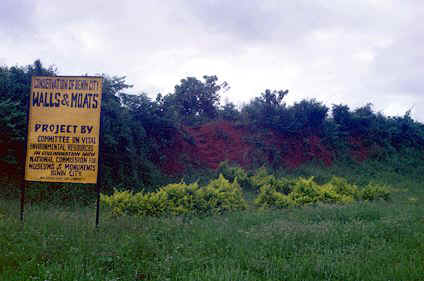
https://www.edo-nation.net/moat1.jpg Benin City Earthworks Benin City, Edo State, Nigeria 1280 to 1460 Part of the world's largest ancient earthwork--a complex system of moats and ramparts spread over some 6,500 square kilometers--the Benin City Walls consist of a set of inner and outer interlocking rings originally built to delineate the royal precinct of the Oba, or king, from the surrounding area. Following their construction, numerous other walls were erected in the surrounding countryside to mark the agricultural boundaries around distinct settlements. Built to an original height of more than 18 meters, and a length of 1,200 kilometers, the earthworks attest the development of urbanization and rise of state societies in subsaharan Africa, a process that began in the seventh century a.d. and culminated in the founding of the Benin Kingdom of Bronze and Ivory in the fourteenth century. The Benin City Walls were ravaged by the British in 1897. Since then, portions of the walls have gradually vanished in the wake of modernization--large segments cannibalized for the construction of other buildings. However, significant stretches of the walls remain, enclosing innumerable red earth shrines and vernacular elite architecture with red-fluted walls. Though the walls and moats have been protected by national legislation since 1961, no conservation plan exists. The earthworks need to be mapped and assessed, a public awareness campaign launched, and a plan for long-term management developed. http://www.edo-nation.net/moat1.htm |
| Culture › Re: Benin Art And Architecture by PhysicsMHD(m): 6:12pm On Mar 02, 2011 |
| Culture › Re: Benin Art And Architecture by PhysicsMHD(m): 6:02pm On Mar 02, 2011 |
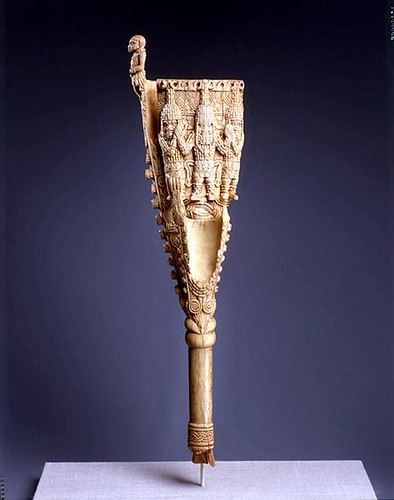
https://www.barakatgallery.com/Auction/ItemImgs/PF2876_t.jpg To the Benin, ivory was more valuable than gold and represented great kings and warriors. When used, the sounds produced by this trumpet represented the voices of the king's enemies praising him. The playing of this trumpet was also said to empower the king with the strength of the elephant it came from. On this specific trumpet we see the mother of the king seated in a place of high honor, on the very top. Below her are depictions of her servants and protectors. She herself is elegantly modeled wearing multiple strands of beads showing her high rank. Also pictured on this stunning piece is the sacred snake. It was believed by the Benin people that it was the snake that connected heaven and earth. - (PF.2876) |
| Culture › Re: Benin Art And Architecture by PhysicsMHD(m): 6:00pm On Mar 02, 2011 |
https://www.barakatgallery.com/Auction/ItemImgs/PF4004t.jpg Benin Bronze/Brass Equestrian Sculpture - PF.4004 (LSO) Origin: Benin City, Nigeria Circa: 1725 AD to 1800 AD Dimensions: 8.75" (22.2cm) high Catalogue: V19 Collection: African Style: Benin Medium: Bronze/Brass This imposing brass sculpture of a man on horseback was made by a master metalworker of the ancient kingdom of Benin. It represents an Oba – one of the polity’s hereditary God-Kings – wearing ornate ceremonial robes drawn up to his waist, clutching the reins in his left hand and a sceptre in the other, clad further in jewellery around his neck and arms, and surmounted by a truly enormous, spiky headdress attached to the apex of a cap that covers his head down to the brows. The horse is elongated but otherwise roughly to scale, unlike Yoruba equestrian pieces in which the rider dwarfs his mount. It stands full-square, its head pointing down, and is wearing a very ornate halter and apparel, and would seem to be attired for some ceremonial occasion. The piece is darkly patinated. In the eyes of the Benin populace, the Obas were divine beings, and paraphernalia such as this was created after their demise in order to be displayed on altars dedicated to their memory. Until the late 19th century, the Benin centres were a ruling power in Nigeria, dominating trade routes and amassing enormous wealth as the military and economic leaders of their ancient empire. This changed with the appearance of British imperial forces, which coveted the wealth of the royal palaces and found a series of excuses to mount a punitive expedition against the Oba’s forces in 1897. It was only at this point, the moment of its destruction, that the true achievements of the Benin polities became apparent to western scholars. Benin royal palaces comprised a sprawling series of compounds containing accommodation, workshops and public buildings. As it grew, the buildings pertaining to previous Obas were either partially refurbished or left in favour of newer constructions; this led to a long history of royal rule written in sculptural works that rank among Africa’s finest; until European industrial advances in the 19th century, they were the finest bronzes that ever made. Metal Oba heads were used to honour the memory of a deceased king. Typically, the son of the dead king – the new Oba – would pay tribute to his father by erecting an altar in his memory. These altars were decorated with various artefacts alluding to the Oba’s achievements in life. These heads were typically arranged in pairs, each supporting an elephant’s tusk that was inserted through the hole in the top of the head. Further decorations included spears, statues, cast brass objects depicting the Oba and his followers, brass bells to awaken the spirits, rattle-staffs (ukhurhe) and magical objects that included Neolithic celts (known as “thunder stones”). The new king would pay homage to his father in this way, guaranteeing the succession and demonstrating the continuity of divine kingship. Dating these pieces is fraught with difficulty as many were taken from their context without recording of important factors and associations. Given the style, patina and signs of usage, one can tentatively assign it to the mid eighteenth to early 19th century, although it may predate this. Taken as a whole, the piece is remarkably effective, powerful and well-rendered, and would take pride of place in any serious collection of African art. - (PF.4004 (LSO)) 1 Like |
| Culture › Re: Benin Art And Architecture by PhysicsMHD(m): 5:55pm On Mar 02, 2011 |
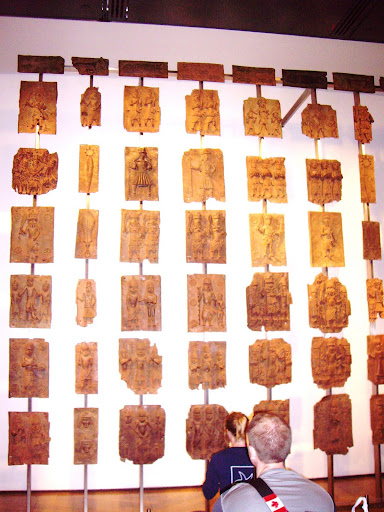
[img]http://2.bp..com/_ALvqZc-q73k/TJeI-aS3SiI/AAAAAAAAFl8/NLPTP1kwnmA/s1600/IMG_8661.JPG[/img] Some of the magnificent 16th / 17th C bronzes from Benin City in Nigeria which were looted by the British during the so-called 'Punitive Expedition' of 1897. They are now displayed in the British Museum which resists all claims from Nigeria to return them. |
| Culture › Re: Benin Art And Architecture by PhysicsMHD(m): 5:52pm On Mar 02, 2011 |
| Culture › Re: Benin Art And Architecture by PhysicsMHD(m): 5:50pm On Mar 02, 2011 |
https://content.ewedding.com/50/1266850/l1119653.jpg BENIN LOCATED IN THE HEART OF BENIN CITY,RING ROAD BENIN CITY |
| Culture › Re: Benin Art And Architecture by PhysicsMHD(m): 5:49pm On Mar 02, 2011 |
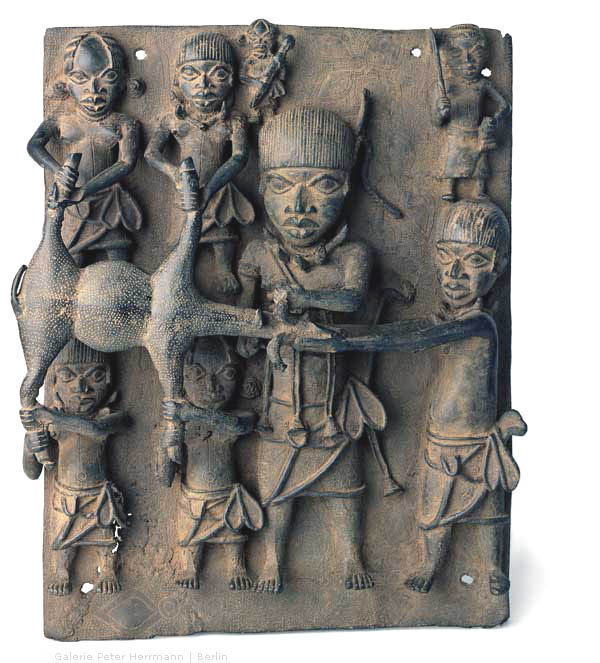
https://www.galerie-herrmann.com/arts/art3/Ife_Benin/58_Relief_Tieropfer/Tieropfer_gr.jpg Relief Plaque with Animal Sacrifice: Ritual activities occurred in a yearly cycle at the palace, the heart of Benin; some were conducted in private for the king, others publicly for the general population. Sacrifices in which the king had a large number of animals killed were integral elements of almost all public rituals in Benin. The public slaying of cattle depicted on this relief was considered the highest form of local immolation. A large master of ceremonies draped with bells stands in the middle of this plaque and is in the process of decapitating a cow with his sickle-like knife. Five aides pull on the head and legs of the probably already dead animal, while two very small figures stand in the background, both also armed. The striking size differential amongst the figures could be an indication of their respective prominence. Accordingly, the large figure in the middle would quite clearly be the plaque's central and most important character, while the two very small figures at the top would be the lowest-ranked. Their relatively small size could, however, instead be interpreted as an attempt at perspective - already in the 17th century. This relief is a masterpiece in more than just the technical sense. A cast-bronze plaque like this one requires a quite complicated casting process, which indicates that at the time of its creation, Benin must already have had a long tradition of bronze casting. Otherwise, it would not have been possible for the slaughtered, sacrificial animal to hover in front of the plaque as it does, creating a wonderful, three-dimensional effect. Cp.: Paula Girshick BEN-AMOS: The art of Benin, London 1980, S. 70. W./ B. FORMAN, Philip DARK: Die Kunst von Benin, Prag 1960, S. 44. |
| Culture › Re: Benin Art And Architecture by PhysicsMHD(m): 5:43pm On Mar 02, 2011 |
https://www.liverpoolmuseums.org.uk/wml/humanworld/worldcultures/africa/graphics/large/altarhead.jpg Edo, Benin City, Nigeria, 15th century AD Accession Number 24.4.1899.20 This realistic head dates from the earliest period of Edo court sculpture, before European contact in the late 15th century, because bronze sculpture progressed from a naturalistic to a more formal style. It is small and finely cast because bronze was scarce. |
| Culture › Re: ~ Countryside Or Big City~ by PhysicsMHD(m): 12:45am On Mar 02, 2011 |
In America: The city. Why? Because the countryside = boring. In Nigeria: The countryside. Safer, cleaner, less noisy, etc. |
| Nairaland General › Re: Buzugee/Nairaland, So I Want To Talk About Living Abroad by PhysicsMHD(m): 12:41am On Mar 02, 2011 |
I can see that I hit a nerve. AGAIN.  Good.  All because I pointed out how pointless this thread is. Hopefully this pointless thread will die a natural death in the near future, and stop cluttering the foreign affairs section. |
| Politics › Re: I Will Stand Up For Tinubu With A Good Conscience!you? by PhysicsMHD(m): 12:29am On Mar 02, 2011 |
More on Tinubu: https://www.nairaland.com/nigeria/topic-612806.0.html ^^^ The behavior of a rascal. Tinubu tried to make half his family legislators. Verdict: https://movie-shop.us/pictures/Rascal.jpg |
| Politics › Re: Senate Stops Withdrawal From Excess Crude Account . by PhysicsMHD(m): 12:18am On Mar 02, 2011 |
"Medicine after death" |
| Nairaland General › Re: Buzugee/Nairaland, So I Want To Talk About Living Abroad by PhysicsMHD(m): 12:13am On Mar 02, 2011 |
[quote author=isale_gan2 link=topic=590933.msg7826538#msg7826538 date=1299020928]"PhysicsMHD 12:06:52 AM Viewing the topic London Company Sells bosom Milk Icecream." hahahahaha. hehehehehe.[/quote]Yeah, that thread was waaaaaay more interesting than this one. |
| Politics › Re: I Will Stand Up For Tinubu With A Good Conscience!you? by PhysicsMHD(m): 12:05am On Mar 02, 2011 |
Tinubu's rascally nature is well established, though. Even the president pointed it out. |
| Politics › Re: Nigeria And Ghana! Why Do Some Nigerians Stoop So Low: by PhysicsMHD(m): 12:01am On Mar 02, 2011 |
cindelite:In English? And this one claims to be educating people. |
| Politics › Re: Nigeria And Ghana! Why Do Some Nigerians Stoop So Low: by PhysicsMHD(m): 11:54pm On Mar 01, 2011 |
lol, fine. I'll leave this thread alone, but it seems like it's just going to start another one of those Ghana-Nigeria internet wars. |
| Nairaland General › Re: Buzugee/Nairaland, So I Want To Talk About Living Abroad by PhysicsMHD(m): 11:51pm On Mar 01, 2011 |
9266 views. . .from 6 people? Sad. This wayward thread should probably just die. |
| Politics › Re: (Oriental Hotel, Lekki) So, What Will Happen When Tinubu Gets To Federal Level? by PhysicsMHD(m): 11:48pm On Mar 01, 2011*. Modified: 9:23am On Nov 16, 2014 |
^^^ Tinubu is a rascal though. I hope you at least acknowledge that. One of the single shadiest characters in Nigerian politics. 1 Like |
| Politics › Re: Nigeria And Ghana! Why Do Some Nigerians Stoop So Low: by PhysicsMHD(m): 11:40pm On Mar 01, 2011 |
cindelite:Uh, I read your entire first post. And then the next one. And then the next one after that. And my question still stands. cindelite: because even d most silly and dumbest person in d world knows that der's no competition there because the ghanaians are disadvantaged in all ramifications. i'll give u lot some points with reasons and references.Why take your time to do all that if you're not obsessed? What good does it do? Your village is probably still a sh1thole. Just sayin'.  |
| Politics › Re: Nigeria And Ghana! Why Do Some Nigerians Stoop So Low: by PhysicsMHD(m): 11:33pm On Mar 01, 2011 |
Why are you obsessed with Ghana? How does claiming to be better than Ghana make your own country better? |
| Nairaland General › Re: Buzugee/Nairaland, So I Want To Talk About Living Abroad by PhysicsMHD(m): 11:23pm On Mar 01, 2011 |
[quote author=isale_gan2 link=topic=590933.msg7826121#msg7826121 date=1299016471]Good lookin' out![/quote]Fixed. [quote author=isale_gan2]This is a general thread to continue our discussion re: America, Life Abroad, whether Buzugee is a misogynist or simply looking out for the womenfolk, etc. This should get you started. I have to go but will add to this when I return. Meanwhile, it's your show, Badagry. Cheesy Go on and elaborate.[/quote]@ OP Pointless thread. |
| Politics › Re: Africans Hunted Down In "liberated" Libya by PhysicsMHD(m): 11:07pm On Mar 01, 2011 |
I suppose you're probably right. I know the Scottish and English have a lot of beef. But the view they probably have of the UK monarchy as English is ironic since it was their (Scottish) king that initiated the unification of the monarchies. Otherwise they might still have a purely Scottish king/queen. |
| Culture › Re: Yorubas Are The Most Educated Tribe In Nigeria by PhysicsMHD(m): 10:48pm On Mar 01, 2011 |
ifele:  |
| Politics › Re: (Oriental Hotel, Lekki) So, What Will Happen When Tinubu Gets To Federal Level? by PhysicsMHD(m): 10:43pm On Mar 01, 2011 |
fstranger3:lol Classic. |
| Politics › Re: Africans Hunted Down In "liberated" Libya by PhysicsMHD(m): 10:39pm On Mar 01, 2011 |
ezeagu:You might be right, although I have never heard the Scottish people denouncing the UK monarchy as not also theirs, so until you provide some evidence for this . . .it's seems like speculation on your part. Obviously there are some Scots that want an independent Scotland, but that's kind of another matter entirely. My comment was referring to the fact that it was actually a Scottish king (James I of "England"  that unified the monarchies of Scotland and England, and not the other way around. So they've been involved since the 1600s. that unified the monarchies of Scotland and England, and not the other way around. So they've been involved since the 1600s.If you saw that movie, The Queen (I saw it on an airplane; I wouldn't have paid to see it), you would have noticed all those royals, including the Queen and her husband, wearing Scottish kilts. Assuming the depiction was reasonably accurate, it would be pretty weird behavior for them to engage in, if they weren't acknowledging their Scottish ancestry. |
| Politics › Re: Africans Hunted Down In "liberated" Libya by PhysicsMHD(m): 8:26pm On Mar 01, 2011 |
ezeagu:The Scots are involved in the UK Monarchy. As for the other two, I agree. |






1 2 3 4 5 6 7 8 ... 37 38 39 40 41 42 43 44 45 (of 67 pages)