Amor4ce's Posts
Nairaland Forum › Amor4ce's Profile › Amor4ce's Posts
1 2 3 4 5 6 7 8 ... 26 27 28 29 30 31 32 33 34 (of 47 pages)
 Culture › Yoruba Naming Ceremony by amor4ce(op): 7:02am On Dec 16, 2011 |
Oriki Esentaye Invocations for an Ifa Naming Ceremony By Awo Falokun Fatunmbi Introduction Ifa has a primary role in traditional Yoruba culture to guide individuals through the rites of passage that mark significant shifts in the development and consciousness of every member of any given community. Typically these rites of passage include a naming ceremony at birth, a puberty rite, a marriage ceremony, a rebirthing ceremony (initiation), a chieftaincy title as a grandparent (marking status as an elder) and a funeral. The naming ceremony is traditionally done within a week after the birth of the child. In some regions of Nigeria it is done in two stages, the first stage is divination to insure the baby is healthy and will continue to mature. The second stage is a rite of passage honoring the arrival of an ancestor who has been reborn including divination on the child’s destiny in this reincarnation. Ifa teaches that we reincarnate within our own family lineage. This means the esentaye is both the celebration of a new life and the welcomed return of a family ancestor. The esentaye starts by welcoming the child to the Earth. The awo marks Eji Ogbe on the opon Ifa (divination tray). Traditionally the father presents the baby to the six directions when the awo invokes the directions by saying: Ìbà'se ilà Oòrùn. I respect the power of the East. Ìbà'se iwò Oòrun, I respect the powers of the West. Ìbà'se Aríwá. I respect the powers of the North. Ìbà'se Gúúsù. I respect the power of the South. Ìbà Òrun Òkè. I respect the Invisible Realm of the Mountains. * Ìbà Oba Ìgbalye. I respect the King of the Seasons of the Earth. * At this point the father touches the feet of the baby to the center of the Odu Eji Ogbe marked on the tray. The word esentaye means feet touch the Earth, this part of the ritual is a symbolic reenactment of the arrival of the child at the moment of birth. At the end of the oriki various foods, which form the basis of the Yoruba diet, are blessed and presented to the baby by touching the food to the lips of the child. Processed honey can be unhealthy for a young baby so simply place the honey near the mouth will singing the blessing. The divination for the baby is generally done in front of the extended family so they can understand the destiny of the child and work to support that destiny collectively. This is the original meaning of the African proverb it takes a village to raise a child. The village is raising the child based on information from Spirit through divination. The child may be given a public name at the ceremony then in private given a secret name known only to the parents. The secret name is used as medicine when the child is sick and the name is usually selected from one of the names of the diviners in the Odu received the child. This book includes a partial list of traditional Yoruba names that may be given to the child as a public name. It is best to select a name that reflects the Orisa who speaks in the primary Odu. Chief FAMA has a more complete list available in book form on her website at: When I do a naming ceremony I usually give an ori pot that holds the child’s Odu. This Odu is in effect until initiation at which time the Odu guiding the person’s ori shifts based on the divination done at initiation (ita). In my experience as awo I have encountered a significant number of adults who did not have a naming ceremony who wanted one. I usually do the esentaye for an adult without presenting the food. When I cast an Odu at a naming ceremony I generally do not ask for na orientation. The Odu from the naming ceremony will be in effect for many years and will over the course of time move through various stages of ire and ibi. I handle this situation by marking the birth Odu of the child every year on the child’s birthday then cast a new Odu to indicate the lessons for the up coming year. At this point an orientation would have value for giving guidance to the child in the upcoming year. Ire Awo Falokun Fatunmbi Egbe Ifa Ogunti Ode Remo ÌBÀ'SE ESENTAYE (Opening invocation for Naming Ceremony) Opé ni fún Olórun. Gratitude to the Owner of the Realm of the Ancestors. Ìbà Olódùmarè, Oba àjíkí. I respect the Creator, the King who we praise first. Mó jí lòní. I awake today. Mo wo'gun mérin ayé. I behold the Four Corners of the World. Ìbà Èlàwòrì. Àgbégi lèré, là'fín ewu l'àdò, ènítì Olódùmaré kó pà'jó e dà, Òmò Olúworíogbó. I respect the Spirit of Purity, He who carves the cloth at Ado in the form of a sculpture, the one whose date of death has not been changed by the child of the Chief Priest who made all the Heads that exist in Creation. Ela omo osin. Ela Omo Oyigiyigi ota omi. Spirit of Manifestation, child of the Ruler. Spirit of Manifestation, child of the offspring of the Stone in the Water. Awa di oyigiyigi. A ki o ku wa. We ourselves become manifestation. The stone that birthed the Spirit of Manifestation will never die. Ela ro a ki o ku mo, okiribiti. Ela ro (Sokale) Orunko Ifá. The Spirit of Manifestation has descended to Earth, we die no more. This is the name we give to Destiny. Entiti ngba ni l'a. Nwon se ebo Ela fun mi. He is the one who saved us. We have made sacrifice to the Spirit of Manifestation. Ko t'ina, ko to ro. He is of no substance. He is too small to be thought of. Beni on (Ela) ni gba ni la n'Ife, Oba - a - mola. Yet He delivered the Immortals from all trouble, the Chief for whom to know is to be saved. Ela, Omo Osin mo wari o! Ela meji, mo wari o. The Spirit of Manifestation, Son of the Ruler, I praise you. The Spirit of Manifestation, the Spirit of Manifestation, I praise you. Ela mo yin boru. Ela mo yin boye. Ela mo yin bosise. Spirit of Manifestation praise the sacrifice that opens the way. Spirit of Manifestation praise the sacrifice that brings life. Spirit of Manifestation praise the sacrifice that proceeds work. Ela poke. Eni esi so wa soro odun. Odun ko wo wa sodun. The Spirit of Manifestation has appeared. The friend has returned for this year's festival. The celebration returns. Iroko oko. Iroko oko. Iroko oko. I come Iroko oko. I come Iroko oko. I come Iroko oko. Odun oni si ko. Ela poke. Ela ro. Ela ro. Ela ro, ko wa gbu're. The celebration has returned. The Spirit of Manifestation has appeared. Holy Spirit descend. Holy Spirit descend. Holy Spirit descend, prayers to accept. Ela takun wa o. Ela ro o. Eti ire re. Ela takun ko wa gbu're. Holy Spirit with string descend. Holy Spirit descend. Be the ears of our prayers. Holy Spirit with string descend to accept our prayers. Enu ire re. Ela takun ko gbure. Oju ire re. Hear the lips of our prayers. Holy Spirit with string descend to accept our prayers. Hear the eyes of our prayers. Ela takun ko wa gbu're. Ela ma dawo aje waro. Ela ma d'ese aje waro. Holy Spirit with string descend to accept our prayers. Holy Spirit with lips of blessing embrace us. Mighty Spirit with lips of blessing embrace us. Atikan Sikun ki oni ikere yo ikere. From door to door remove the hinges. Ipenpe'ju ni si'lekun fun ekun agada ni si'ekun fun eje. He who removes the hinges opens the eyelids for tears. Ogunda'sa, iwo ni o nsilekun fun Ejerindilogun Irunmole. The Spirit of Iron, the Spirit of Wind, the Spirit who opens the door for the Immortals. Ela panumo panumo. Ela panuba panuba. Holy Spirit resounding. Holy Spirit rebounding. Ayan ile ni awo egbe ile, ekolo rogodo ni awo ominile. Near the crack in the wall where the elders meet, Peace ascended to Heaven and did not return. Eriwo lo sorun ko do mo. O ni ki a ke si Odi awo Odi. Upon blockade the Priest for blockade is called to Earth. He asked us to call upon the Priest of Peace. O ni ki a ke si Ero awo Ero. O ni ki a ke si Egún o susu abaya babamba. Upon the shrub thorns he asked us to call. Upon the blockade we call the Priest of the Blockade. A ke si Ero awo Ero, ke si Egún osusu abaya babamba a ni eriwo lo si Orun ko de mo, won ni ki Ela roibale. Upon the thick shrubbery thorns we call, to Heaven calmly ascend. Holy Spirit descend. Ela ni on ko ri ibi ti on yio ro si o ni iwaju on egun. The Peace of the Holy Spirit said; "I have nowhere to descend." Eyin on osusu agbedem'nji on egun osusu, awo fa ma je ki'iwaju Ela gun mori on tolu. I find the front filled with thorns, I find the rear and the middle filled with thorns. Òrúnmìlà ma je ki eyin Ela gun mosi Olokarembe Òrúnmìlà ma je ki agbedemeje la gun Osusu. The humans appealed to the Spirit of Destiny to pray to the Great Spirit of Manifestation. Ela ro. Ifá ko je ki iwaju re se dundun more on tolu. Holy Spirit descend. Remove the thorns from the front and rear. Ela ro. Ifá ko je ki eyin re se worowo. Holy Spirit descend. Remove the thorns from the middle. Ela ro. Ela ni'waju o di Odundun. Holy Spirit descend. At the front place of Peace, the Holy Spirit becomes manifest. Ela ni eyin o di Tete. Ela ni agbedemeji o di worowo. At the rear place of Peace, the Holy Spirit becomes manifest. At the middle place of Peace, the Holy Spirit becomes manifest. Ìbà'se ilà Oòrùn. I respect the power of the East. Ìbà'se iwò Oòrun, I respect the powers of the West. Ìbà'se Aríwá. I respect the powers of the North. Ìbà'se Gúúsù. I respect the power of the South. Ìbà Òrun Òkè. I respect the Invisible Realm of the Mountains. Ìbà Oba Ìgbalye. I respect the King of the Seasons of the Earth. Ìbà Atíwò Òrun. I respect all things that live in the Invisible Realm. Ìbà Olókun à - sòrò - day ò. I respect the Spirit of the Ocean, the one who makes things prosper. Ìbà aféfélégélégé awo ìsálú - ayé. I respect the power of the wind, the Mystery of the Mysterious World. Ìbà Ògègè, Oba. I respect the Mother Earth who sustains the Universal alignment of all things in Nature. Ìbà títí aiyé ló gbèré. I respect the perpetuity of the World into eternity. Ìbà Oba awon Oba. I respect the King of all Kings. Ìbà Òkítí bìrí, Oba tí np'òjó ikú dà. I respect the Averter of the final days, the King who can change the time of Death. Ìbà àté - ìká eni Olódùmaré. I respect the mat that cannot be rolled up once laid out. Ìbà Òdému dému kete a lénu má fohun. I respect the power that extracts Goodness from the Realm of the Invisibles. Ìbà'se awón ikù emesè Òrun. I respect the Spirits of the Dead, the messengers of the Invisible Realm. Ìbà se Ose - Oyeku. I respect that sacred scripture that guides our communication with the ancestors. E nle oo rami oo. I am greeting you my friends. Eiye dudu baro Babalawo la npe ri. The black bird that touched the dye in the name of all diviners. Eiye dudu baro Babalawo ma ni o. The blackbird that touched the dye in the name of all diviners in his name. Igba kerìndínlogun a dana igbo Ose. The sixteenth time we make a fire in back of Ose. O digba kerìndínlogun a dana igbo Ose'na oo rami o. The sixteen fires do not harm me. O jo geregere si owoko otun. The roaring fire burns to the right. O gba rere si tosi o. The roaring fire burns to the left. Ora merìndínlogun ni won ima dana Ifa si. The sixteen places that we make fires of wisdom. Emi o mona kan eyi ti nba gba r'elejogun o. When I did not know the road to follow, I should have followed destiny. Ìbà Orí, I respect the Spirit of Consciousness. Ìbà Orí inú. I respect the Spirit of the Inner Self. Ìbà Ìponrí ti ò wa'l'Òrun. I respect the Spirit of the higher Self who lives in the Invisible Realm of the Ancestors. Ìbà Kórí. I respect the Creator of the Calabsh that contains the Inner Self. Ìbà Àjàlà – Mòpín. I respect the Spirit of the Guardian of all Inner Spirits who are chosen from the Invisible Realm of the Ancestors. Ìbà Ódò - Aró, ati Ódò – Ejé. I respect the Spirit of the Guardian of all Inner Spirits who are chosen from the Invisible Realm of the Ancestors. Òrun Orí nilé, e óò jíyín, e óò jábò oun tí e rí. The Invisible Realm of the Ancestors is the permanent home of the Inner Self, it is the Inner Self, it is there that the Inner Self accounts for what it has done during the journey to Earth. Bí o bá maa lówó, bèèrè lówó orí re. Bí o bá máa sòwò, bèèrè l’ówó orí re wo. If you want to have money, inquire of your head. If you want to start trading, inquire of your head. Bí o bá máa kolé o, bèèrè lówó orí re. Bí o bá máa láya o, bèèrè l’ówó orí re wo. If you want to build a house, inquire of your head. If you want a relationship, inquire of your head first. Orí máse pekùn dé. Lódò re ni mi mbò. Wá sayéè mi di rere. Inner spirit please do not shut the gate. It is you that I am coming to. Come and make my life prosperous. May it be so. Èsù, Èsù Òdàrà, Èsù, lanlu ogirioko. Okunrin orí ita, a jo langa langa lalu. Divine Messenger, Divine Messenger of Transformation, Divine Messenger speak with power. Man of the crossroads, dance to the drum. A rin lanja lanja lalu. Ode ibi ija de mole. Ija ni otaru ba d'ele ife. Tickle the toe of the Drum. Move beyond strife. Strife is contrary to the Spirits of the Invisible Realm. To fi de omo won. Oro Èsù, to to to akoni. Ao fi ida re lale. Unite the unsteady feet of weaning children. The word of the Divine Messenger is always respected. We shall use your sword to touch the earth. Èsù, ma se mi o. Èsù, ma se mi o. Èsù, ma se mi o. Divine Messenger do not confuse me. Divine Messenger do not confuse me. Divine Messenger do not confuse me. Omo elomiran ni ko lo se. Pa ado asubi da. No ado asure si wa. Let someone else be confused. Turn my suffering around. Give me the blessing of the calabash. Ìbà Òsóòsì ode mátá. I respect the Spirit of the Tracker, Owner of the Mystery of Spotted Medicine. Ìbà Ògún awo, Oníle kángu - kángu Òrun. I respect the Mystery of the Spirit of Iron, the owner of innumerable homes in the Realm of the Ancestors. Ìbà Obàtálà, Òrìsà Òséré Igbó. Oni kùtúkùtú awo òwúrò, Ikù iké, Oba pàtà - pàtà tí won gb'odé ìranjè. I respect the Spirit of the King of White Cloth who is praised at the Sacred Grove. Owner of the Ancient Mystery of the White Cloth, the Spirit Who is praised on the sacred day of the Forest, Guardian of those with physical disabilities. King of all future generations. Ìbà Yemoja Olúgbé - rere. I respect the Mother of Fishes, the Giver of Good Things. Ìbà Osun oloriya igún aréwa obirin. I respect the Spirit of the River, owner of the hair comb for beautiful women. Ìbà Òlukósó aira, bàmbí omo arigbà según. I respect the King who does not die the Child of the Thunderstone. Ìbà Àjáláiyé Àjàlórun Oya Olúwèkù. I respect the Winds of Earth, the Winds of the Invisible Realm of the Ancestors, the Spirit of the Wind is the one who guides the mediums of the Ancestors. Ìbà Ìbejì orò. I respect the Transforming power of the Spirit of the Twins. Ìbà Ajé - ògúngúlùsò Olámbo yeye aiyé. I respect the Spirits of Wealth and Good Fortune, honor is coming to the Mothers of the Earth. Ìbà Awòn Ìyáàmi, Alágogo èìswù áp'oni ma hagun. I respect the Society of Wise Women, the White Bird of Power is the Source of their Medicine. Ìbà Òrúnmìlà Elérì ìpín, Ikú dúdú àtewó. I respect the Spirit of Destiny, Witness to Creation, the Averter of Death. Oro tó sí gbógbó òná. The Power of the Word that opens all roads. Ìbà Awo Àkódà. I respect the Diviner named Aseda. Ìbà Awo Àsedá. I respect the Diviner named Aseda. Ìbà Ojubo ònòméfà. I respect to the shrine of the six directions. Ìbà Ejiogbe. I respect the holy Odu Ejiogbe. Bi a ba bo oju, Bi a ba bo imu, Isale agbon ni a pari re. When we wash our face, when we wash our nose, we finish off beneath our chin. A da fun Orunmila nigbati o nlo gba ase lowo Olodumare. Ifa was consulted for the Spirit of Destiny on the day that he was going to receive authority from the Creator. O rubo Olodumare si wa fi ase fun u. He made the sacrifice and the Creator gave him authority. Nigbati gbogbo aiye gbo p o ti gbo ase l’owo Olodumare nwon si nwo to o. When all the world heard that he had received authority they came to him. Gbogbo eyiti o wi si nse. All that he said came to pass. Lati igbana wa ni a nwipe ase. From that day on we say, "May it be so." Ìbà Oyeku Meji I respect the holy Odu Oyeku Meji. Ìyòyò ke wa yo fun mi o. Ìyòyò ke wa yo fun mi o. Joyfulness let people come with joy to me. Joyfulness let people come with joy to me. A mi yò nilé, a mi yo lájò. Ìyòyò ayè e, Ìyòyò. Be joyful at home and be joyful at the farm. Joyfulness let the world be filled with joy. Ìbà Iwori Meji I respect the holy Odu Iwori Meji Mo bolu tayò mo kan re o. Mo bolu tayò mo kan re o. Mo bolu tayò lóyìnbó o. Mo bolu tayò mo kan re e e e e e e. I played with Olu, I reached goodness. I played with Olu, the stranger. I played with Olu, I received blessings. Ìbà Odi Meji I respect the holy Odu Odi Meji Ni nri'di joko pe nile aye. Kiema jeki nba won ku - Iku ajoku. Let me sit quietly in the world. Let me not die in an epidemic. Okan ewon kiike. One link in a chain will not make a lock. Ki e se - Odi agbara yi mi ka, Ki owo mi ka'pa omo araye bi omo Odi tiika'lu. I pray that you will rally around me, in the same way that we put a garden around a yard. Ìbà Irosun Meji. I respect the holy Odu Irosun Meji. Baba ma je nikan je nikan je. Iyán ti mo gún. Baba ma je nikan je. Father don't let me eat along. I have prepared soup. Father don't let me eat alone. Obè ti mo se. Baba ma je nikan je. I have my knife. Father don't let me eat alone. Iba Owonrin Meji. I respect the holy Odu Owonrin Meji. Owon mì jó, Owon mì yó, Owon ti mí ota oye b'ofò. Owon day dance, Owon day be joyful. Owon has brought the staff of his chieftaincy from the sea. Owon mì jó, Owon mì yó. Owon day dance, Owon day be joyful. Iba Obara Meji. I respect the holy Odu Obara Meji. Odán nbi, Odán nre. Odán ti esele ibùdó o. Odán ti esele ibùdó o. Odan born, Odan survives. Odan has established himself. Odan has established himself. Iba Okanran Meji. I respect the holy Odu Okanran Meji. Sàkòtó mo léwà. Awo ire dun bo nífè. Sàkòtó mo léwà. Awo ire dun bo nífè. Sakoto is beauty. Good Awo is sweet to worship. Sakoto is beauty. Good Awo is sweet to worship. Iba Ogunda Meji. I respect the holy Odu Ogunda Meji. Kiedai ni'de Arun Ilu ejo, egbese ati beebee, ki e d a'ri ire owo, Release me from the tie of Death, release me from the tie of Misfortune, direct me towards the good fortune of Abundance, ise oro omo ola ola emigigun, aralile ati beebee s odo mi, direct me towards the good fortune that comes from good and fruitful children, direct me towards the good fortune of honor, prosperity, good health and long life. Ki e da mi ni tiyoo bimo rere ti won, yoo gb'ehin si - sinu aye ati beebee. let me be known as a parent who produces good children, who will stand behind me, follow my guidance and bury me at the end of my life. Ogunda Meji. Ase. The Creator. May it be so. Iba Osa Meji I respect the holy Odu Osa Meji. Ki e jeki ndi arisa-ina, akotagiri ejo fun awon ota, Let me be as a fire from which people flee, or as the snake that is greatly feared to it's enemies, kieso mi di pupo gun rere, ki'mi r'owo san owo ori, kimi r'owo san awin Orun mi ati beebee. Osa Meji. Ase. let me be blessed for good, that I will always have the money to pay my debts, may I always do good things in the world. Run-away. May it be so. Iba Ika Meji. I respect the holy Odu Ika Meji. Okò mi sí, okò mì gbò. Okò mi sí, okò mì gbò. Sea boats day has come, sea boat shake. Sea boats day has come, sea boat shake. Èbúté ire l oko mi lo. Èbúté ire l’oko mi lo. The boat is going on a good journey. The boat is going on a good journey. Iba Oturupon Meji. I respect the holy Odu Oturupon Meji. Ki o r'omo gbe sire, ki e jeki oruko mi han si rere, ki ipa mi laye ma parun. let my name not be spoken of badly in the world, let my name be famous in the world, let my lineage flourish in the world. Omi kiiba'le kiomani'pa, ki'mi ni'pa re laye ati beebee. Oturupon Meji. Ase. Just as water never touches the ground and moves without having a path, so I will always have a good path in the world. The Bearer. May it be so. Iba Otura Meji. I respect the holy Odu Otura Meji. Oso gegege - obeke, odewu greje gereje ofi iboka mole, I threw a missile, and hit a trickster, eni toba yole da ohun were were. Aamayo Oluware se. Ase. who made a long dress to conceal his treachery. Whoever lies to me will have their lies turned against them. May it be so. Iba Irete Meji. I respect the holy Odu Irete Meji. Ko de si omo láte. Omo wun mi ju ileke. There is no child on sale. I love children more than bread. Ko de si omo láte. Omo wun mi ju ileke. There is no child on sale. I love children more than bread. Iba Ose Meji. I respect the holy Odu Ose Meji. Ki nsegun awon ota mi loni ati ni gbogbo ojo aye mi, kiemaa bami fi ise se gbogbo awon eniti nwa Ifarapa ati beebee fun mi. that I may conquer all my enemies today, and in all my life let them suffer in poverty. Ki e jeki ngbo ki nto ki npa ewu sehin. Ose Meji. Ase. Let me live long and see my hair turn white. The Conqueror. May it be so. Iba Ofun Meji. I respect the holy Odu Ofun Meji. Ogbe funfun ken ewen o difa fun Òrì sanla, won ni ki rúbó pe gbogbo nkan to nto ko ni wó, Ogbe the stranger cast Ifa for The Spirit of White Light on the day that everything he was doing was sanction. Alaake - n'igi - ewon. Oro - l'o - n'ida. The ewon tree is at the mercy of the ax-man. The spoken work is as powerful as the sword. Ida - ni - ij'Ifa - akoni, awon l'o sa 'gede f 'Òrúnmìlà, eyiti iku at'arun nleri re. The word is the subdurer of the brave, they composed powerful incantations for the Spirit of Destiny, when he was being threatened by Death and Disease. Òrúnmìlà ni; "E ko le pa mi." The Spirit of Destiny said; "You cannot kill me." Nwon ni kini Òrúnmìlà gb'oju le. They asked the Spirit of Destiny where he received his confidence. O ni; "Mo ti je iku tan, owo Iku ko le to mi." He said; "I have completely consumed Death, the hands of Death cannot touch me." O ni; "Ori ti abahun fi apegede oun naa ni ifi isegun, k'igede ti nwon naa s'emi lagbaja." He said; "The head that the tortoise uses to invoke Spirits in powerful incantations, he uses to conquer the power of Spirits." Yii ma sise k'o ma ri mi gbe se o. Ase. Render ineffective the incantations being used against me. May it be so. Olorun ku ise. Ki Olorun ka a jun wa. Ki Olorun ba wa wo o. Ase. Well done Creator. May the Creator grant the child long life. May the Creator assist us in looking after this child. May it be so. • Blessing the food. ORIN OMI (Water Song) Omi li a mbu we. Omi li a mbu mu. Eda to wu ti o mba. Omi s'ota a ku iku ait'ojo. Omi kiiba'le ko ma n'ipa. Ki n'ipa rere s'owo. K'o ni'pa rere s'omo. K'o ni'pa rere ninu ohun rere gbogbo. Awayemate oruko ti aipe omi. Motuntemise oruko ti aipe omi. Abudi oruko ti aipe omi. ORIN EPO (Palm Oil Song) Ero Li epo riro ni i ro igba elop. Amororo li oruko ti aipe epo. Didun-mimu li a i ran'hin iye. Yiyo ni araye i ye fun oniyo. Ki aye ki o ni adun ati ayo. ORIN OYIN (Honey Song) Iwaye oyin ki i koro. Ki aye dun ju oyin lo. ORIN ATARE (Hot Pepper Song) Atare kiiko ile re ki o ma kun un. Ki iru-omo po bi omo atare. Ata ti a fi newure ni a npe ni atare. Nitorina atare iyo maa wi chun rere gbogbo wa fun. Atare kanna ni omo-araye npe ni Oluya. Oluya ki o ya ni Olola Oniyi Olorulo rere ninu-aye. Olowo Olomo ati ohun rere gbogbo. Ki ara re ki o da. Ki ara re ki o ya. ORIN OBI (Obi Cola Song) Obi li araye fi nbi Iku. Oun li araye fi nbi arun. Oun li araye fi nbi ejo. Oun li araye fi nbi ofo. Ati ohun ibi gbogbo danu. Ki obi maa ba wa bi Iku arun ejo. Ofo ibanujhe ati ohun ibi gbogbo danu fun. Ki won gbo bi obi. Ginnugun kiiku l'ewe afuwape ni ti pepereku. Agba l'obi nda ki gbo ki won to. ORIN OROGBO (Orogbo Song) Ori ogbo ori ato aiteteku airun. Ire gbogbo ni i to orogbo lowo. Ire gbogbo ni iyo ma to l’owo ninu aye. Ki ni isokan pelu ara won bi orogbo. • Divination ALAFIA OPON (Greeting the Tray) Iwaju opon o gbo o. Eyin opon o gbo. May the head of the tray listen. May the circle of the tray listen. Olumu otun, Olokanran osi, aarin opon ita Orun. Ase. Spirits of understanding to the right, Spirits of prophecy to the left. The middle of the tray is the crossroad of Heaven. May it be so. ORÍKÌ IKIN (Praising the Sacred Fruit of the Tree of Life) *Cover the Ikin with both hands Òrúnmìlà o gbo o. Òrúnmìlà iwo'awo. Spirit of Destiny listen. Spirit of Destiny reveal the Mysteries. Oun awo. Owo yi awo. Illuminate the Mysteries. Bless us with the mystery of abundance. Emi nikansoso l'ogberi. A ki'fa agba Merindinlogun sile k'asina. Spirit that creates perfect harmony. Show us the wisdom of the sixteen principles that mold the Earth. Eleri Ipin f'ona han mi. Ase. Witness to Creation reveal yourself to me. May it be so. ORÍKÌ IFÁ (Praising the Wisdom of Nature to open Divination) Òrúnmìlà Eleri - ipin ibikeji Olodumare. Spirit of Destiny, Witness to Creation, second only to the Creator. A - je - je - ogun obiriti - a - p'ijo - iku sa. He who has the medicine to overcome Death. Oluwa mi amoimotan - a ko mo o tan ko se. The Creator who knows everything that we do no know. A ba mo o tan iba se ke. If we had known everything there would be no suffering. Oluwa mi Olowa aiyere omo Elesin Ile - Oyin. The Creator of Good Things on the Earth, Son of the Owner of the House that is made of honey. Omo ol'ope kan t'o s'an an dogi - dogi. Son of the owner of the tree that always stands firm. Oluwa mi opoki a - mu - ide - s'oju ekan ko je k'ehun hora a saka – saka akun. The Creator Opokoi who put the gold chain of protection in his eyes so that the finger of the lion would not scratch and make a rash. Omo Oso - ginni tapa ti ni - ewu nini. Son of Oso-ginni from the Tapa tribe where everyone dresses in fine cloths the Owner of Egun who walks on stilts. Omo Oso pa'de mowo pa'de mese o mbere at epa oje. Oso's son who put beads on his wrist and ankles, the gold chain of Oje. Oluwa mi igbo omo iyan birikiti inu odo. The Creator, Spirit of the Bush, Son of the Round Powdered Yam in the Mortar. Omo igba ti ns'ope jiajia. Son of the Calabash who created many palm trees. Iku dudu at ewo Oro aj'epo ma pon. The wise Ancestor with a wordly hand who eats palm oil that is not ripe. Agiri ile - ilobon a - b'Olowu diwere ma ran. Agiri from the House of Wisdom with plenty of small cotton seeds that never spread. Oluwa mi a - to - iba - jaiye Oro a - b'iku - j'igbo. Creator it is good living on Earth even with the Spirit of Death lurking in the bush. Oluwa mi Ajiki ogege a - gb'aiye - gun. Creator we go to greet you in the morning with Ogege who lives to make Peace on Earth. Odudu ti idu ori emere o tun ori ti ko sain se. The person whose Spirit defends those who die at birth re-shapes bad heads. Omo el'ejo ti nrin mirin - mirin lori ewe. Son of the sanke who moves serenely along the top of the leaves. Omo arin ti irin ode - owo saka - saka. Son of the Grinder who rules with a clean hand. Òrúnmìlà a boru, Òrúnmìlà a boye, Òrúnmìlà a bosise. Ase. I beg the Spirit of Destiny to lift your burden from the earth and offer it to Heaven. May it be so. ADURA ATI IJUBA (Praising the elders in support of divination) * Call the names of the elders of your lineage. Ìbà luwo, ìbà jugbona, ìbà Akoda, ìbà Aseda, ìbà Araba egbe Ifá Ogun ti Ode Remo, ìbà baba, ìbà yeye, ìbà yeye baba. A juba enikan kode enikan ku. Ase . FIFO IKIN (Greeting the Ikin Prior to divination) *Place the listed number of Ikin in the left hand Erun Osi. Five Ikin (Present to the left side of the tray) Erun Ora. Five Ikin (Present to the right side of the tray) Eta Egutan. Three Ikin (Present to the top of the tray) Eji Ereye. Two Ikin (Present to the bottom of the tray) Eniti o ba fin idan. One ikin (Present to the middle of the tray) ORIN IKIN (Song for marking Odu) Call; Ejiogbe a buru a boye akala o. Response; A akala, a akala o. Call; Oyeku meji a buru a boye akala o. Response; A akala, a akala o. (Call the Odu in sequence until all eight marks are on the tray) * Selection of names ORÚKO OBATALA Oláolú - Crown of High estate. Opéolú - Thanks to the Creator. Odùola - Source of Honor. Èmiola - Spirit of Honor. Àánúoú - The Mercy of the Creator. Agbolá - Circle of Honor. Èbùn - Gift of the Creator Àárinolá - The Center of Honor. Babalolá - Father is the Source of Honor. Oládèjo - Honors become eight. Oládiméji - Honors become two. Olúsolá - The Creator Elevates. Olúsàánú - The Creator brings Mercy. Odunéye - Diviners have dignity. Olúwolé - The Creators comes to the house. Olúfúnláyò - The Creator gave me joy. Sólànké - Give birth to a seer. Olayínká - Honor surrounds me. Olùtóyìn - The Creator is enough to praise. Alálàádé - Here comes the one in white. Olóládé - Here comes the honorable one. Olúfémi - The Creator loves me. Olátundé - Honor is born again. Olánipèkun - Elevation has no limit. ORÚKO YEMOJA Oláiya - The Gorious Inflence of the Mothers. Soléye - Seers have dignity. Olúsànyà - The Creator compensates for suffering. Omítókí - Water is enough to praise. Omíkúnlé - Water fills my house. Omítólá - Water is enough for honor. Omísadé - Water made a crown. Omísoore - Water did a kind deed. ORÚKO AGANJU Akínyelé - A valiant man confers dignity on the house. Akínlabí - Give birth to a brave man. Akíntúndé - The valiant man is born again. Akíntóla - Valour is enough for honor. Akínlàdé - The valiant man arrives safe. Akínléye - Valour has honor. Akíntáyò - Valour is joy. Akíntóyè - Valour is enough of a title. Akínkúnmi - The valient man. Akínbólá - Valour goes well with honor. Mákindé - Bring home the valiant man. Onìíyìídé - Here comes the dignified one. Adáramólá - One who is good and honorable. ORÚKO SANGO Odugúwà - Divination straightens character. Akínyemi - Valour befits me. Sangoyomi - Sango saved me. Sangoyemi - Sango befits me. Sangobemi - Sango supports me. Owólabí - Give birth to money. Sango Oládàpò - Sango mixes honors together. Sango Agbájé - Sango carries wealth to the throne. Sango Folásadé - Sango makes a crown of honor. Sangowánwá - Sango came to look for me. Sango Akínyelé - A valiant man confers dignity on the house. Sango Akínlabí - Give birth to a brave man. Sango Akíntúndé - The valiant man is born again. Sango Akíntóla - Valour is enough for honor. Sango Akínlàdé - The valiant man arrives safe. Sango Akínléye - Valour has honor. Sango Akíntáyò - Valour is joy. Sango Akíntóyè - Valour is enough of a title. Sango Akínkúnmi - The valient man. Sango Akínbólá - Valour goes well with honor. Sango Mákindé - Bring home the valiant man. ORÚKO OYA Abóyadé - One who arrives with the Oya River. Oyafowóra - Oya brings money. Oyawoye - The Oya River assumes a title. ORÚKO OSUN Osun Oyinolá - Osun the sweetness of honor. Osun Wúraolá - Osun the Honor of Gold. Osun Kóladé - Osun brings honor home. Osuntókun - Osun is as big as the Ocean. Osuntókí - Osun is enought to praise. Osunyadé - One who arrives with the Osun River. Osunfúnmiláyò - Osun gives me joy. Osunonafowókà - Osun the artist who creates abundance in her hands. Osunbólù - Osun is worthy of praise. Osunyemi - Osun loves me. Osungowùwá - Osun's art is the cream of existence Osunkúnlé - Osun fills the house. Osunniyi - Osun has dignity. Osunjòya - Osun champions the cause of suffering. Osunbunmi - Osun gave me. ORÚKO ESU Esubiyi - Esu gave birth to this one. Esugbàyi - Esu saved this one. ORÚKO OSOOSI Odébùnmi - The hunter gave me. Odéjobí - Hunters gave birth to us all. Odébíyí - A hunter gave birth to us all. Odérìnde - The hunter walked in this place. Odékù - There are hunters left. Odéyalé - The hunter called in the house. Odétólá - The hunter is enough status for me. Odébùnmi - The hunter gave me. Odédínà - The hunter blocked the way. Odégbároòyé - The hunter listens to my problems. ORÚKO OGUN Ogunladé - Ogun is our Crown. Ogundèjì - Ogun becomes two. Ogundiran - Ogun becomes hereditary. Ogunbuyì - Ogun receives respect Ogunsolá - Ogun does an honorable thing. Ogunléye - Ogun has dignity. Ogunsinà - Ogun opens the way. Ogunlànà - Ogun cuts a path. Ogunyemi - Ogun befits me. Ogunyànkin - Ogun does not leave a brave person in the lurch. Ogunlèsì - Ogun is our defense. Ogunsèye - Ogun brought glory. Ogunjobi - Ogun gave birth to us all. Ogunkeye - Ogun brough dignity. Ogunóla - Ogun with honor. Ogundipè - Ogun substitutes for a ransom. Ogunsinà - Ogun opened the gate. Oguntìméhìn - Ogun backed me up. Ogunnúgà - Ogun has a palace. Ogungbè - Ogun is good to me. Ogunrìndé - Ogun walked there. Ogunbiyi - Ogun gave birth to this one. Ogunbà - Ogun lives. Ogunmódedé - Ogun makes the hundter arrive safe. ORÚKO ORISA * These names can be used in conjunction with any of the above Orisa. (Name of Orisa)fémi - Loves me. (Name of Orisa)sànyà - Avenges punishment. (Name of Orisa)jìnmi - Gave me. (Name of Orisa)kémi - Holds me. (Name of Orisa)yomi - Rescues me. (Name of Orisa)yémisi - Honors me. (Name of Orisa)káyòdé - Brought joy. (Name of Orisa)ségun - Won a victory. (Name of Orisa)sèye - Brought a person of dignity. (Name of Orisa)láàánú - Has mercy. (Name of Orisa)bùkúnola - Fills honor to the top. (Name of Orisa)kòya - Defends against insults. (Name of Orisa)dáre - Exonorates. (Name of Orisa)wèmímó - Washes me clean. (Name of Orisa)tóyè - Did this. (Name of Orisa)mìídé - Comes to me. (Name of Orisa)mbe - Exists. Yoruba Pronunciation There are twenty-five letters in the Yoruba language, seven vowels and eighteen consonants. The vowels are A E E I O O U. The marks under the letters E and O create different sounds from the letters E and O, without the marks. Any mark under a Yoruba means you add an H sound to the letter. Marks are found under E, O and S. The Yoruba alphabet with English words that have the same sound or intonations. A (ah) Sounds like the A in Ark B (bee) Sounds like the B in Bee D (dee) Sounds like the D in Deal E (ay) Sounds like the E in Eight E (eh) Sounds like the E in Egg F (fee) Sounds like the F in Feel G (gi) Sounds like the G in Give GB No English equivalent H (hee) Sounds like the H in Hill I (ee) Sounds like the I in Bee J (gee) Sounds like the J in Jeep K (kee) Sounds like the K in Keep L (lee) Sounds like the L in Leaf M (mee) Sounds like the M in Milk N (nee) Sounds like the N in Nil O (aw) Sounds like the O in Odd O (oh) Sounds like the O in Oh P (pi) Sounds like the P in Pit R (ree) Sounds like the R in Read S (cee) Sounds like the S in Sea S (Sh) Sounds like the S in Sheep T (tee) Sounds like the T in Tea U (oo) Sounds like the U in You W (we) Sounds like the W in We Y (yee) Sounds like the Y in Yield Yoruba language is tonal meaning the relative pitch of letters effects the meaning of the word. There are three basic tones used in Yoruba that be described as do re mi or the first three notes of the tempered scale. Normal speaking voice would be re an accent slanting from left to right would be mi and an accent slanting from right to left is do. http://destee.com/index.php?threads/yoruba-naming-ceremony.59306/ 1 Like |
| Culture › Re: The True Identity Of The Yoruba People by amor4ce(m): 8:59am On Dec 15, 2011 |
What if we consider this essay and the comments that followed on this forum: THE HEBRAIC BIBLICAL MYTHS AND THE YORUBA HISTORICAL NARRATIVES THE HEBRAIC BIBLICAL MYTHS AND THE YORUBA HISTORICAL NARRATIVES OF PARTRIACH ARAMFE (ABRAM), OONI (ISAAC), AND URUOBA (JACOB): SHOULD WE ALL BE COMPLACENT? NO!!! |
| Culture › Re: The True Identity Of The Yoruba People by amor4ce(m): 9:30pm On Dec 14, 2011 |
In my opinion, using the name to identify a people might not be enough if we consider the technique that has been tried by the cuckoo (your description of the current occupants of Israel). To further buttress your assertion that the Ewe and Yoruba peoples are one, a big evidence is the oral traditions, worship, and the Ifa divination. As for origin of the word Hebrew (Ewe), any chance that it is derived from Eber (the name of on of Abraham's ancestors)? |
| Culture › Re: Christians And Traditional Chieftaincy Titles by amor4ce(m): 9:31pm On Dec 13, 2011 |
Romans 3:2 |
| Culture › Re: The True Identity Of The Yoruba People by amor4ce(m): 11:19pm On Dec 12, 2011 |
Aren't the Edomites Hebrews as well? |
| Culture › Re: The True Identity Of The Yoruba People by amor4ce(m): 3:26am On Dec 12, 2011 |
I've gone through the sample pages and noted some observations. Remember that Israel was divided into 2 kingdoms, the northern kingdom of Israel and the kingdom of Judah. Israel was carried away into captivity by the Assyrians while the Babylonians attacked Judah. Jeremiah preached to some of the people of Judah who went into Egypt. As for Israel, consider this from 2 Esdras 13: 2 Esdras 13:39 And whereas thou sawest that he gathered another peaceable multitude unto him;and Zephaniah 3:10 From beyond the rivers of Cush, my worshipers, even the daughter of my dispersed people, will bring my offering.Also, “the nations” in page 246 – doesn’t it refer more properly to dispersal via slave trade? I have read somewhere that Yoruba might be derived from Jerubaal (Yerubaal? Judges 6:32; 1 Samuel 12:11) and elsewhere that it is actually derived from Uruoba (said to be the original pronunciation for the name Jacob). If it is the latter then the names Ewe and Yoruba would not be surprising. One more thing, have you considered how the name of the Messiah was pronounced 2,000 years ago? |
| Culture › Re: BBC's Documentary On The 'Bronze Cast Head Of The Ife King' by amor4ce(m): 1:29am On Dec 12, 2011 |
em, food? |
| Culture › Re: The True Identity Of The Yoruba People by amor4ce(m): 9:55pm On Dec 11, 2011 |
Note that I did not post that comment with negative intentions. |
| Culture › Re: The True Identity Of The Yoruba People by amor4ce(m): 9:23pm On Dec 11, 2011 |
Do you have any proof that the Yoruba people were originally known as the Hebrews when they migrated to West Africa (below the 10th parallel)? |
| Culture › Re: BBC's Documentary On The 'Bronze Cast Head Of The Ife King' by amor4ce(m): 1:09am On Dec 11, 2011 |
TerraCotta:Haven't you posted one of the worst statements in the history of Nairaland? Haven't you referred to the contributions (including perhaps GOD-inspired contributions) of all Nairalanders, including the efforts of the owner, as an embarrassment? Aren't the publishing/declaration of research findings subject to peer review which can sometimes sound vitriolic (remember the likes of Gregor Mendel whose work was initially discredited)? How much more or less that of Nairaland? Won't you humbly apologize to the Nairaland community for the blanket assertion? PhysicsQED, there's a saying in Yoruba: Bi o ba to asiko ati su Idi a la [When the time to defecate comes The anus gives way] |
| Culture › Re: BBC's Documentary On The 'Bronze Cast Head Of The Ife King' by amor4ce(m): 10:00pm On Dec 10, 2011 |
When conducting experiments adjustments for noise are included, likewise efforts at its elimination. Also, in various facets of this world today there is noise and we have been given the capacity to sift the wheat (useful information) from the chaff(noise). Despite the noise many people with useful information still preach what they have to say. For instance, Noah still preached about the flood before it happened, some financial analysts preached about the US sub-prime mortgage crisis before it happened, and many more. If you have important info that is of benefit to your fellow man don't hold it back; or do you perceive others as swine? Remember that GOD lets the rain fall and the sun shine on both the good [/i]and [i]bad. Your info could be just what someone needs to answer certain pertinent questions. Don't use noise as an excuse, some might perceive you as having a condescending attitude. |
| Family › Re: Olden Days Vs Modern Days Marriages by amor4ce(m): 8:18am On Dec 10, 2011 |
Have you all been drinking of the wine of the fornication of the Amorites? In Yorubaland women have lots of rights and have been treated with respect before colonialism. Is it so for other neighbouring cultures? Aren't there some cultures in the Niger Delta that have the women doing farmwork while the men drink ogogoro. Weren't fellow women involved in getting their womenfolk to suffer, in those days and up till today? |
| Culture › Re: BBC's Documentary On The 'Bronze Cast Head Of The Ife King' by amor4ce(m): 9:35pm On Dec 09, 2011 |
Let us not focus on seeing their fall but rather let's look at why we fell. We should admit and confess confess our iniquities and the iniquities of our fathers, and earnestly turn to GOD and not IMF and the likes. |
| Culture › Re: Traditional Yoruba Religion by amor4ce(m): 10:35pm On Dec 08, 2011 |
Romans 3:2 |
| Politics › Re: Fulani Herdsmen Kill Many In Benue Communities And Villages by amor4ce(m): 9:46pm On Dec 08, 2011 |
The 10th parallel - latitude 10 degrees north |
| Culture › Re: BBC's Documentary On The 'Bronze Cast Head Of The Ife King' by amor4ce(m): 12:25am On Dec 08, 2011 |
A 1948 article in the Illustrated London News was headlined: "African art worthy to rank with the finest works of Italy and Greece" and "Donatellos of medieval Africa."anonymous6, the above is from that CNN link. If you read the article closely you would notice that it seems to be laced still with the same superiority complex attitude of some of the oyinbo. Specifically, they do not want to admit the possibility that the Ife and related artworks were and are of higher quality than theirs. 1 Like |
| Culture › Re: I’m Sure, Igbo Are Descendants Of The Jews -noam Katz, Israeli Envoy by amor4ce(m): 10:54pm On Dec 07, 2011 |
In Igbo oral traditions, was any mention made of the Redeemer? Can you prove that the similar customs were not adopted from your neighbours eg Edo? How is it that your males don't prostrate when greeting elders as it was done in the House of Israel? |
| Culture › Re: BBC's Documentary On The 'Bronze Cast Head Of The Ife King' by amor4ce(m): 12:53am On Dec 07, 2011 |
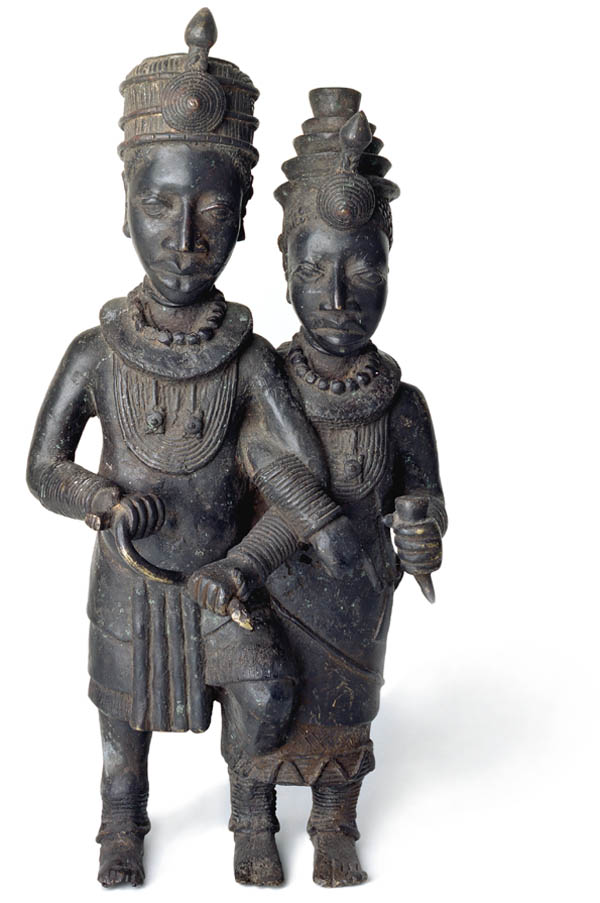
https://www.galerie-herrmann.com/arts/art3/Ife_Benin/28_Doppelfigur_250J/Ife_Paar_250J_gr.jpg The lips look quite huge and the queen seems to be pointing at something with her right hand. I'm not yet sure of what the king is holding. https://www.antiques.com/vendor_item_images/ori__288280203_1070985_Ife_Style_Terracotta_Standing_Figure_-_DB.051.jpg https://artoftheancientworld.com/Auction/ItemImgs/AM.0428cw.gif The pictures here offer more detail (I couldn't get screenshots with the desktop I'm currently using). As for replicas, what if some really are originals that were smuggled out of Nigeria to private collectors? |
| Culture › Re: BBC's Documentary On The 'Bronze Cast Head Of The Ife King' by amor4ce(m): 12:07am On Dec 07, 2011 |
At this moment I wouldn't mind having wooden replicas for my personal study. 1 Like |
| Culture › Re: BBC's Documentary On The 'Bronze Cast Head Of The Ife King' by amor4ce(m): 11:37pm On Dec 06, 2011 |
Is this really a Benin bronze head as indicated on the webpage? From another website - there are other photos of the same bronze head (already sold) but from different angles. [img]http://www.genuineafrica.com/Ife_Statuette_1.htm#African-Bronzes-FL[/img] http://www.genuineafrica.com/Ife_Statuette_1.htm#African-Bronzes-FL |
| Christianity Etc › Re: World’s Largest Church Inaugurated In Lagos by amor4ce(m): 11:30pm On Dec 06, 2011 |
Isn't there only one place and centre of worship, Jerusalem, which will be restored when HE comes to collect HIS people? If so, what is the point of erecting the largest church buildings? Shouldn't we be seeking for HIM to allow us worship HIM in HIS Kingdom when HE comes? Also, how does the TAC plan to handle commuter and vehicular traffic? |
| Culture › Re: Yoruba Names/Oriki For God by amor4ce(m): 11:15pm On Dec 06, 2011 |
Does Oluwa actually mean Lord? I ask because lords do not sit on thrones. Why not Our Benefactor or Our Provider? |
| Culture › Re: Meaning Of Dawodu by amor4ce(op): 8:16am On Dec 05, 2011 |
Some Edo people, Igarra to be specific, also bear Dawodu according from what I read on the Dawodu facebook page. |
| Culture › Re: BBC's Documentary On The 'Bronze Cast Head Of The Ife King' by amor4ce(m): 7:09am On Dec 05, 2011 |
[quote author=Negro_Ntns link=topic=797242.msg9694050#msg9694050 date=1323046647]Amor4ce, That blog site is interesting. I know Yorubas also use the totem as a social emblem of lineage and class but never connected it that far into the roots . My lineage totem is 'Erin".[/quote]Okay, you've partly answered my questions at post #342. I'm guessing that they were also used as symbols of authority and proof of lineage. As was mentioned on that blog it seems this was why Rachael held on to Laban's teraphims. Do you know if there is any link between the these family lineage totems and their [b]oriki[/b]s |
| Politics › Re: Ancestral DNA Results of Nigerians. by amor4ce(m): 6:56am On Dec 05, 2011 |
Nneoma123, when my Maker formed me, HE made me beautiful. Are you saying that is a lie and that I'm actually one of the shameless idiots or that you just mentioned a terrible lie? Remember that the devil is the father of lies. |
| Culture › Re: Traditional Eastern Ijaw Attire In Pictures by amor4ce(m): 6:47am On Dec 05, 2011 |
What do the plates held by some women as seen in some of the posted pictures signify? |
| Culture › Re: BBC's Documentary On The 'Bronze Cast Head Of The Ife King' by amor4ce(m): 2:09am On Dec 04, 2011 |
I hadn't paid much attention to the holes till I read this blog. |
| Culture › Re: BBC's Documentary On The 'Bronze Cast Head Of The Ife King' by amor4ce(m): 1:18am On Dec 04, 2011 |
https://galerie-herrmann.com/arts/art3/Ife_Benin/16_Kopf_Ife/Head_Ife_750Y_gr.jpg http://galerie-herrmann.com/arts/art3/Ife_Benin/16_Kopf_Ife/e_Head_Ife_750Y.htm Memorial Head: This larger-than-life, 750-year-old head from Ife was very thinly cast and, accordingly, is quite light. Its enormous size indicates that it does not belong to the tradition of heads that were bedecked with the Oni's actual crown after his death. More likely, this head was outfitted with a similarly-cast bronze crown. The various holes that dot the face were originally ornamented with small pearls, leading Willett to suspect that they were perhaps intended as a means to seal the mouth. This practice hearkens back to various traditions according to which the Oni, as a type of divine king, was not permitted to show his mouth publicly - neither while talking nor while eating (cf. Willett, p. 30). Cp.: Frank WILLETT: Ife. Metropole afrikanischer Kunst, Bergisch Gladbach 1967, S. 36. Barbara PLANKENSTEINER (Hg.): Benin. Könige und Rituale. Höfische Kunst aus Nigeria, Wien 2007, S. 272. https://www.artnews.com/wp-content/uploads/2011/05/article-2884.jpg http://www.artnews.com/2010/03/01/a-head-of-its-time/ |
| Culture › Re: BBC's Documentary On The 'Bronze Cast Head Of The Ife King' by amor4ce(m): 12:54am On Dec 04, 2011 |
What was/is the purpose of making these figurines? Were they buried in the graves of the concerned individuals? Which other African culture produced similar and individualistic figurines for similar purposes? Perhaps I've missed the responses to these earlier on this thread. |
| Culture › Re: BBC's Documentary On The 'Bronze Cast Head Of The Ife King' by amor4ce(m): 7:07am On Dec 03, 2011 |
Doesn't pride come before fall? |
| Culture › Re: Traditional Yoruba Religion by amor4ce(m): 9:56pm On Dec 02, 2011 |
By northern lights I was making a comparison with the so-called Osumare goddess. Also, is the devil same as Olosi? If Esu is concerned with choices and the devil is associated with temptations, it wouldn't be hard to see why Esu has been portrayed as the devil. |




1 2 3 4 5 6 7 8 ... 26 27 28 29 30 31 32 33 34 (of 47 pages)