 Travel › Re: Jigawa State Airport - Nigeria's Newest Airport U/C(pictures) by emiye(m): 8:26pm On Dec 22, 2013 Travel › Re: Jigawa State Airport - Nigeria's Newest Airport U/C(pictures) by emiye(m): 8:26pm On Dec 22, 2013 |
ujoinme: until then, its a plan just like the lekki airport and all the other planned airport in Nigeria same with the proposed akwa ibom airport after 7 years. |
| Travel › Re: Jigawa State Airport - Nigeria's Newest Airport U/C(pictures) by emiye(m): 7:55pm On Dec 22, 2013 |
ujoinme: Like i said all APC airports are in the pipeline! all your links points to newspaper clips of MOU and contracts awards when you have something concrete with planes flying in and out you can come back and post it. All the 4 airport i mentioned are on ground not on some politician drawing board like yours. When did akwa ibom commission its airport ?,the incumbent govt. will be 7 yrs old soon in less than 6 months from now, a 3 yr old government will commission a airport in osun state with the longest runway in Nigeria. |
| Politics › Re: Mass Defection To Hit PDP Again by emiye(m): 7:02pm On Dec 22, 2013*. Modified: 8:29pm On Dec 22, 2013 |
Slyp: So when APc eventually win now Nigerian will be happy that opposition has taken over the power. So now who re they opposing? it will mean Nigeria will have a greater chance of uprooting a non-performing incumbent at least every 4 years. A non performing government can not be removed with a weak opposition party. Before now, the PDP had been boasting of ruling for the next 60 years and bla bla bla, because they did not have any formidable opposition party. Even in a football team, if the main striker of the team does not have formidable striker on the bench that can replace him, he can afford to mess up. |
| Travel › Re: Jigawa State Airport - Nigeria's Newest Airport U/C(pictures) by emiye(m): 6:48pm On Dec 22, 2013 |
|
| Politics › Re: Mass Defection To Hit PDP Again by emiye(m): 6:11pm On Dec 22, 2013 |
We are gradually having a true opposition party in Nigeria
A heavy weight regional party is not a true opposition party.
True opposition party in all democracies benefits the people.
I see the liberation Nigerians need. |
| Phones › Re: How To Identify An Unknown Caller! by emiye(m): 9:07pm On Dec 21, 2013 |
most likely an emotionally attached ex.
check your "long" list of exes. |
| Politics › Re: APC Has Taken The Right Step-obasanjo by emiye(m): 8:16pm On Dec 21, 2013 |
Great |
| Sports › Re: Brown Ideye: Nigerians Will See My Best In Brazil by emiye(m): 7:24pm On Dec 21, 2013 |
Funny enough, he is one of the very few current eagles who have being to the world cup
Ideye, echiejile and enyeama were at the South Africa 2010 world cup as part of the super eagles 23 man list. |
| Politics › Re: I Hope The Champions Of Breakup Are Monitoring Whats Going On In South Sudan! by emiye(m): 6:12pm On Dec 21, 2013 |
Nuzo':
Some people are experts in hiding their hatred for their fellow human being under satire.
How can a Nigerian who celebrates in the streets whenever any bad thing happens to another Nigerian from another region be now concerned of the welfare of this hated Nigerian should he be granted his own sovereign state.
O ga o. Maybe they are afraid of millions of refugees who will migrate in to their land in the event,.... |
| Politics › Re: I Hope The Champions Of Breakup Are Monitoring Whats Going On In South Sudan! by emiye(m): 3:16pm On Dec 21, 2013 |
i am not an advocate of nigeria's break up, but decentralisation and devolution of power (more power and responsibilities to the state and local governments). South sudan is going through a shameful familiar pattern with virtually all sub saharan african countries after independence, its current phase of disarray might last long because of the country's vast petroleum resources  . For those clamoring for old biafra (1967 ), it is a big disaster waiting to happen. The then biafra minority with the best of mineral resource (oil) will not play second fiddle to the biafra majority. |
| Family › Re: Problems With Sex Is Ruining My Marriage by emiye(m): 3:14pm On Dec 19, 2013 |
|
| Politics › Re: Ekiti 2014: Perm Sec Caught Performing Rituals At Idanre Shrine by emiye(m): 3:33pm On Dec 16, 2013 |
@ OP What is the case connection with Ekiti 2014 ? |
| Politics › Re: The IGR Debate - Reloaded! by emiye(m): 2:49pm On Dec 16, 2013*. Modified: 4:05pm On Dec 16, 2013 |
One_Naira: That's Where You Are Wrong. I Did Not Disregard It Based Only On His Ethnic Group, Though It Was Factor Seeing How Una Are Known To Falsify Information When It Does Not Suit You, But Equally Based My Suspicion In The Fact That His Comments In 2012 Contradicts What's Already Written In 2010, The Year The Actual Figures Were Conducted And Published. Not Only That, It Equally Contradicts The Comments Made By Another National Authorities On The Said Subject. An Authority that've Been Monitoring The Same Figures And Been In Ground For Quite Awhile. Ironically Enough The Other National Authorities Corresponded With The Figures Provided In 2010 But Somehow It Now Contradicts The Same Result In 2012 Where It Was Being Discussed. How A Figure Changes In 2 Years Without Falsification Is Impossible. Also Seeing That The Said Man Has To Publicly Comeout And Denounce The same Figure That Cameout Of His Office In 2011/2012 Due To It Being Falsified And Few Northern Governer Noticing It Says Quite Alot.
Btw: A Reality Matches With Statistical Figures Thus I'm Not Resisting Any Reality But Trying To Understand A Contradiction Of The Reality. Based On Vids Provided On Here On The Said Region Completely Contradicts The Figure. Based On The Incident About A Mere Small Change Of Increase In Food Items By The Same Region Contradicts The Figure. Based On The Comments Made By Your Own Governors During GEJ's Aljamari Schools Completely Contradicts The Figures Thus Like I Mentioned Earlier, I'll Stick With The Actual Figures That Came Out The Year The Actual Research Was Made, Not A Tweaked Version Of It 2 Years Later. common sense dictates that a report for research that covers a particular year will not be out that year. The earliest time a report for year 2013 poverty index can be out is 2014. If i am to cross examine the pix you attached earlier, which you claimed was for 2009 /2010. i can see " AD backs mantu recall bid" Senator Mantu was senator from 1999-2007
AD was technically defunct and voiceless after 2006.How then will a national daily that carries the poverty index histogram for 2010 carry a headline like " AD backs mantu recall".? You see why i should not take you serious? don't you? 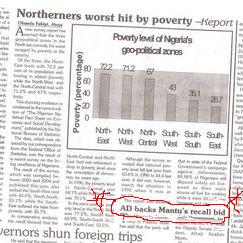
|
| Politics › Re: The IGR Debate - Reloaded! by emiye(m): 11:48am On Dec 16, 2013*. Modified: 12:14pm On Dec 16, 2013 |
mandarin: Good talk. I think the Igbo and Yoruba folks represents the best in Nigeria's sphere. The two groups are living in contest of their lives? Igbos are individualistic while Yoruba are communal and metropolitan. This does not take anything away from the Igbo folks, they are astute educationally and economically. I do not take anything from them.We can sit down and list all their ill contributions to Nigeria but they have contributed positively as well.
I think the culture of individualism is robbing the region of monumental developments , it makes them the highest beneficiary of Nigeria's unity and the worst loser in it. As to the highlighted, it is the absolute truth as regards the three geopolitical zones in the south (south west, south-south and South east). Any sensible govt in any state should prioritise aggresive drive for increase IGR, bacause of the "what if Nigeria breaks" situation. I am certain the south east is bringing in the least to nigerian fiscal table amongst the 3 southern zones. with over 60% of south east igbos out of their SE lands and a landlocked region, the SE will be the biggest loser amongst the se, ss and sw zones should Nigeria break. |
| Politics › Re: The IGR Debate - Reloaded! by emiye(m): 11:34am On Dec 16, 2013 |
One_Naira: What you provided is something written in 2013 at a conference done in 2012 which contradicts what was written in 2009. I think I'll stick with what was reported by the Nigerian newspaper in 2009/2010 when the actual statistics was conducted and the report produced than an article that was written in year 2012 that emphasized what he tried to pass off in year 2011/2012, that he recanted because jigawa complaints about the false information. This time around he still using the same statistics but changing the year to 2010.
Another national poverty program in Nigeria at the same the poverty index was conducted which again contradicts the conference and the figure the man, a yoruba man at that, tried to pass off in year 2012.
https://www.nairaland.com/554457/anambra-poverty-rate-lowest-nigeria
Yeah, I'll stick with the information that came out the actual year the index was conducted, not the ones that came 2 years later with a completely different information. The verbatim report was published in Feb, 2012, carried by the top national dailies (punch, vanguard,...) While i understand your resistance to the obvious and reality, i will suggest you dont throw in the ethnic card to rubbish the real report. DR Kale is a yoruba man, but he did not single handedly conduct the research, and NBS is not a private entity. |
| Politics › Re: The IGR Debate - Reloaded! by emiye(m): 10:54am On Dec 16, 2013 |
ngozievergreen: U have just confirmed that yorubas are poorer what i wrote is not for you, you don't have the capacity to understand it. |
| Politics › Re: The IGR Debate - Reloaded! by emiye(m): 10:46am On Dec 16, 2013 |
One_Naira: Actually this is false. The statistics that showed this was denied by the NBS. They last statistics they conducted regarding poverty was the 2009/2010 figure and the one circulating that was in 2012 was falsified.
https://www.nairaland.com/1174921/nbc-denies-recent-poverty-rating
This is real rank. The 2009/2010 one
[img]http://www.nairaland.com/attachments/212244_poverty20level20in20Nigerian20zones-Punch20newspaper2020031_jpg41bdcb734786e57c46ab47dd1cbd99fd[/img]
https://www.nairaland.com/371485/regional-poverty-nigeria-north-south-west Nigerian Poverty Profile Report 2010 - NBS
Category: Nigerian Economy
Read (9213)
Nigerian Poverty Profile Report 2010 - NBS
PRESS BRIEFING BY THE STATISTICIAN-GENERAL OF THE FEDERATION/CHIEF EXECUTIVE OFFICER, NATIONAL BUREAU OF STATISTICS, DR. YEMI KALE HELD AT THE CONFERENCE ROOM, 5TH FLOOR, NBS HEADQUARTERS, CENTRAL BUSINESS DISTRICT, ABUJA ON MONDAY, 13TH FEBRUARY, 2012.
1. PROTOCOL
PREAMBLE
2. It is with great pleasure that I present to you today, highlights of the “Nigeria Poverty Profile Report 2010”, a report which emerged from the recently concluded Harmonised Nigeria Living Standard Survey (HNLSS) conducted by the National Bureau of Statistics (NBS) with support from the World Bank, DFID (UK) and UNICEF.
3. As part of its functions to produce statistics for evidence-based policy-making and as the authoritative source and custodian of all official statistics, NBS periodically conducts the Harmonized Nigeria Living Standard Survey which is used, amongst other things, to determine poverty and inequality trends in Nigeria. The data collected by NBS through our regular surveys and via our system of administrative statistics around the country present a vital source of evidence, as they provide us with clear, objective, numerical data on all aspects of our lives and the state of our country. NBS has presence in every state of the federation with staff who collect data on various socio economic indicators on a regular basis to fulfill our mandate. This way we are able to monitor various trends across the country at a disaggregated level. To demonstrate that NBS remains committed to improving statistical development in Nigeria, the institutional capacity to deliver on its mandate is being strengthened regularly with increased levels of collaboration between NBS and our partners in the public and private sectors, including the press.
4. In recognition of the fact that it is impossible, given limited financial resources, to collect data on every area of life, we are ensuring that the data collected by NBS is demand-driven and user-specific. Concomitantly, we are expanding our scope to include more aspects of socio-economic life, deepening our analytical competence and NBS Press briefing on Nigeria Poverty Profile 2010 Report 2 enhancing the professionalism of staff. A recent innovation is to announce, in advance, the expected dates of publication of survey results and data releases, which can be found on the official website. For example, a visit to our website at www.nigerianstat.gov.ng would reveal that we plan to publish inflation data for January 2012, the first since the partial removal of fuel subsidy, next Monday. The planned dates of release for other types of data can be found on the website.
5. As you may have observed our data releases have been mixed: some positive and others negative. We would therefore continue to publish accurate and timely data regardless of whether it is positive or negative because the information we provide is useful as a guide for government policy, business investors, as well as a veritable tool for the public to evaluate the performance of government and the progress of our society in the interest of growth and development in Nigeria.
PART I:
OVERVIEW OF THE HNLSS 2009/2010 SURVEY
6. Nigeria’s efforts at monitoring and evaluation of national programmes and policies started with the analysis of a series of National Consumer Expenditure Surveys which led to the assessment of poverty in Nigeria over a period of sixteen years from 1980 – 1996, and the publication of the report on poverty trend in Nigeria in 1999.
7. The Harmonized Nigeria Living Standard Survey (HNLSS) 2009/2010 is an enlarged scope of previous National Consumer Surveys and also a follow-up to the Nigeria Living Standard Survey (NLSS) 003/2004. The scope of the HNLSS 2009/2010 was enlarged to include: Demography; Health; and Fertility behaviour, Education and Skills/Training; Employment and Time-use; Housing and Housing Condition; Social Capital, Agriculture; Household Income & consumption, and Expenditure. Two statistical reports (Nigeria Living Standard Survey Report 2010 and the Poverty profile of 2010 will be produced to assist various levels of government to evaluate and monitor their social and economic programmes.
OBJECTIVES, JUSTIFICATION, SCOPE AND COVERAGE OF THE SURVEY
8. In a broad sense, the concern of the study was to generate detailed, multi-sector and policy relevant data using welfare and expenditure approaches. More specifically, NBS Press briefing on Nigeria Poverty Profile 2010 Report 3 the HNLSS was aimed at providing information on the conditions and trends of poverty, households’ income & consumption expenditure, and unemployment at a greater level of disaggregation. It was also to provide valid and reliable data for the development of effective intervention and provision of important tools for designing, implementing and monitoring of economic growth and poverty reduction.
9. It is widely acknowledged that data needed to drive government anti-poverty programmes is often not available or inadequate at such disaggregated levels as to inform policymakers and business decisions takers. Therefore, the HNLSS is a worthwhile effort because the information gathered would generally aid decision makers in the formulation of economic and social policies, by identifying target groups for government intervention.
METHODOLOGY AND SAMPLE DESIGN
10. The HNLSS used four different approaches in the computation of poverty indicators:
i) Relative Poverty Measurement: Relative poverty is defined by reference to the living standards of majority in a given society and separates the poor from the non-poor. Households with expenditure greater than two-thirds of the Total Household per Capital expenditure are NON-POOR whereas those below it are POOR. Further desegregation showed that households with less than one-third of total Household Per Capita expenditure are CORE-POOR (EXTREME POOR) while those Households greater than one-third of total expenditure but less than two-thirds of the total expenditure are MODERATE POOR.
Accordingly, the poor category is sub-divided into those in extreme poverty and those in moderate poverty, where extreme poverty is more severe than moderate poverty. Those in moderate poverty constitute a greater portion of the growing middle class in Nigeria who are at the point of crossing over to the non-poor category. Similarly, the non-poor is divided into the fairly rich and the very rich.
iii.) Absolute poverty measurement approach: Here, Poverty is defined in terms of the minimal requirements necessary to afford minimal standards of food, clothing, healthcare and shelter. This method considers both food expenditure and non- food expenditure using the per capita expenditure approach. This method is otherwise known as Food Energy Intake measure of poverty. First you obtain the food basket of the poorest 40 percent of NBS Press briefing on Nigeria Poverty Profile 2010 Report 4 the population. Then compute the food expenditure that can give 3000 calorie per day based on the national food basket for the poorest 40 percent.
iii. Dollar per day measurement approach: refers to the World Bank’s Purchasing Power Parity (PPP) index, which defines poverty as the proportion of those living on less than US$1 per day poverty line.
iv.) Subjective Poverty Measurement approach: is based on self-assessment and “sentiments” from respondents interviewed. Unlike the other three statistical measurements of poverty, it considers the respondents’ opinion on whether or not they consider themselves to be poor.
11. In addition, NBS computes the Gini Coefficient as a measure of inequality and income distribution in a country. The Gini-coefficient is a number between 0 and 1, where 0 corresponds with perfect equality (in which case everyone earns the same income); and 1 corresponds with perfect inequality (where only one person earns all the income and all others have zero income).
12. Different countries use any one or more of these measures to calculate poverty.
NBS however adopts the relative poverty method as Nigeria’s official measure of poverty.
PART II:
HNLSS 2010 SURVEY RESULTS
13. The 26-page report provides details of the conditions of poverty and income distribution across the country, as well as technical notes regarding the various definitions and methodologies employed for the survey. The full report can be found on our website later this afternoon. The attached tables, however, provide detailed breakdown of the survey results. The major findings from the survey are as follows:
i[b]. Relative poverty is defined by reference to the living standards of majority in a given society. In 2004, Nigeria’s relative poverty measurement stood at 54.4%, but increased to 69% (or 112,518,507 Nigerians) in 2010. The North-West and North-East geo-political zones recorded the highest poverty rates in the country with 77.7% and 76.3% respectively in 2010, while the South-West geo-political zone recorded the lowest at 59.1%. Among States, Sokoto had the highest poverty rate at 86.4% while Niger had the lowest at 43.6% in the year under review.[/b]
ii. Absolute Poverty is defined in terms of the minimal requirements necessary to afford minimal standards of food, clothing, healthcare and shelter. Using this measure, 54.7% of Nigerians were living in poverty in 2004 but this increased to 60.9% (or 99,284,512 Nigerians) in 2010. Among the geo-political zones, the North-West and North-East recorded the highest rates at 70% and 69% respectively, while the South-West had the least at 49.8%. At the State level, Sokoto had the highest at 81.2% while Niger had the least at 33.8% during the review period.
iii. The-Dollar-per-day measure refers to the proportion of those living on less than US$1 per day poverty line. Applying this approach, 51.6% of Nigerians were living below US$1 per day in 2004, but this increased to 61.2% in 2010. Although the World Bank standard is now US$1.25, the old reference of US$1 was the standard used in Nigeria at the time that the survey was conducted. The North-West geo-political zone recorded the highest percentage at 70.4%, while the South-West geo-political zone had the least at 50.1%. Sokoto had the highest rate among States at 81.9%, while Niger had the least at 33.9%.
iv. Subjective Poverty is based on self-assessment and “sentiments” from respondents. In this regard, 75.5% of Nigerians considered themselves to be poor in 2004, and in 2010 the number went up to 93.9%. FCT recorded the most number of people who considered themselves to be poor at 97.9%. Kaduna recorded the least number of people who considered themselves poor at 90.5%.
v. 2011 Poverty level estimates: For completeness and to guide policy, NBS has also forecast the poverty rate for 2011 using various economic models. It is important to stress at this point that these estimates are constrained by the assumption that the status quo in 2010 was maintained in 2011. Accordingly, it ignores the potential positive impact various poverty alleviation strategies implemented since 2011 may have had on reversing the poverty trend. This will become clearer once the 2011 Annual Socio-Economic Survey is completed later in the year. Thus, using the relative, absolute and dollar-per-day poverty measures, NBS estimates that poverty may have further risen slightly to about 71.5%, 61.9% and 62.8% respectively in 2011.
vi. Income inequality: The survey suggests rising income inequality in the country as measured by the Gini-coefficient. By this measure, income inequality rose from 0.429 in 2004 to 0.447 in 2010, indicating greater income inequality during the period.
vii. Consumption Expenditure Distribution: Lastly, analysis of consumption expenditure distribution indicates that the top 10% income earners was responsible for about 43% of total consumption expenditure, the top 20% was responsible for about 59% of total consumption expenditure while the top 40% was responsible for about 80% of total consumption expenditure in the year under review.
FURTHER ANALYSIS OF RELATIVE POVERTY
14. As earlier stated, NBS adopts the relative poverty measurement for monitoring poverty trends in the country. It remains a paradox however, that despite the fact that the Nigerian economy is growing, the proportion of Nigerians living in poverty is increasing every year, although it declined between 1985 and 1992, and between 1996 and 2004.
Accordingly it is important to take a closer look at poverty trends using this approach. Distributing the population into extremely poor, moderately poor and non-poor, the proportion of the extremely poor increased from 6.2 percent in 1980 to 29.3 percent in 1996 and then came down to 22.0 percent in 2004 before reaching 38.7% in 2010. For the moderately poor, the picture was quite different as the proportion rose between 1980 and 1985 from 21.0 percent to 34.2 percent. It went down between 1996 and 2004, from 36.3 percent to 32.4 percent, and even further in 2010 to 30.3 percent. On the other hand, the proportion of non-poor was much higher in the country in 1980 (72.8 percent) compared to 1992 (57.3 percent). It dropped significantly in 1996 to 34.4percent, falling further in 2010 to 31 percent.
CONCLUSION
15. The results of the HNLSS 2010 as contained in the Nigeria Poverty Profile 2010 Report indicate that poverty and income inequality in Nigeria have increased since 2003/2004. In addition, NBS estimates that this trend may have increased further in 2011 if the potential positive impacts of several anti-poverty and employment generation intervention programmes are not taken into account, but this can only be ascertained at the conclusion of the 2011 survey later this year.
16. Ladies and gentlemen, it is my expectation that the Nigeria Poverty Profile 2010 Report will serve as a useful tool for candid and constructive public discourse to enable all stakeholders in the Nigerian economy make informed decisions for the good of our dear country.
http://www.proshareng.com/news/16302.html. You can open the link to download the report. This report shows the venue, date, time, i choose to believe it. |
| Politics › Re: The IGR Debate - Reloaded! by emiye(m): 9:03am On Dec 16, 2013 |
MajeMedia: This is the result of the two philosophies and why igbo land looks the way it does.
In igbo land, public facilities are inferior, but people's houses and businesses are superior
www.nairaland.com/attachments/1287167_aba2_jpg006a70b121903b92a1390b36c1f86b51
in yoruba land, public facilities are superior, but people's houses and businesses are inferior.
So while Yoruba land can boast for great schools, many live in substandard slums and inferior huts
www.nairaland.com/attachments/1287121_ibadan_jpg5c2714d71a450f0536627abbdcc8f2d5
In igbo land, people's homes and businesses look great, but the roads are a mess and the presence of government is hard to feel.
With yoruba land people's homes and businesses leave a lot to desire, but the presence of 'heroic' government is felt (Fashola, Aregbesola, Mimiko).
the igbos value land and property a lot. The culture believe is if you create it, it's yours. You're the lord of it and nobody can tell you anything about it let alone tax you. The Yoruba have a strong sense of nationhood and the civic duty that comes with it (paying your taxes, while government is pressured to perform for the people)
It's two methods of self organization that I respect. Though as an igbo, I prefer my people's method because it encourages the individual to be enterprising and government to keep it's mismanaging hands out of people's affairs.
and while igbo land can boast of great Misinformation at its peak. it is important you realise that : (1) There is a linkage between house ownership and poverty reduction (2) The culture of home ownership among low income households is way prevalent in the SW than the SE . (3) Lands are more readily available and cheaper in the sw, low income households can easily get access to lands and build their own house, a state like Oyo state (28,454 sq. km) is roughly the size of the whole south east states (anambra,ebonyi,enugu,imo and abia= 29,095 sq.km) (4) Statistics show that the level of poverty in the SW is the lowest in the 6 Geo-political regions. |
| Sports › Re: Super Eagles Brazil 2014 New Jeysey by emiye(m): 9:30pm On Dec 15, 2013 |
jimmyroger: It's your choice Nigerian...Super Eagles needs the Best cos they are champions of African.
And we need to stand-out in Brazil!!! The jerseys designed by the nairalander should not have numbers engraved in front. |
| Fashion › Re: What I Wore To My Sister's Wedding Yesterday by emiye(m): 4:29pm On Dec 15, 2013 |
we av seen the calabar cloth and face, what of the calabar shoes ? |
| Romance › Re: How To Guard Your Man Properly By Michelle Obama (Pictures) by emiye(m): 4:01pm On Dec 15, 2013 |
Indeed Photos can lie. The photos have been carefully arranged to manipulate our perceptions.
Perceptions is not reality, although most people can not separate perception from reality |
| Romance › Re: How Do I Stop Being His Booty-call Girl. by emiye(m): 9:26pm On Dec 11, 2013 |
Fhemmmy: Assume the man really enjoy the B**ty call, and you tell him all that - You actually think he will be honest with you and say he is with you for the b**ty call? Ah Ah, it is funny how most girl thinks. It is like a girl asking a guy at the "heat of the moment" if he truly loves her.  |
| Sports › Re: Argentina Knows Nothing About Super Eagles - Coach Sabella by emiye(m): 3:38am On Dec 11, 2013 |
SuyaEater: Actually at the 2002 world cup ...Argentina didn't advance from the group......naija sha smfh Argentina also placed third (3rd) in Usa 94 grouping, but was lucky to advance to the second round on best looser, since there were 24 teams in that tourney. World cup comes with surprises like spain also lost to switzerland 1-0 in south africa 2010. |
| Politics › Re: Panic And Confusion As Student Attacks Teacher With Machete | See Photo by emiye(m): 6:45pm On Dec 08, 2013 |
Bishop Magic: If you believe that horse sh1t from the press statement in this thread then you will believe anything.
This has nothing to do with school merging per se but it is down to the extreme religious elements thinking that this is their time and other religious groups take second.
This my friend is the true state of osun; a state witnessing the first signs of extreme religious fanatics bent on subjugating other religions.
Nah their way. Can you explain the religious undertone in this attack on a teacher ?. in public secondary schools across the country , Students attack on teachers do occur occasionally and go unreported, osun schools are currently in the spotlight, that is why this is news on a daily Methinks, there are sharp differences in education quality and administration of public schools across the state. I went to a public secondary school, and i know public secondary schools in a state have different quality and administration, there are certain public schools that are notorious , where anything goes, school administration is lax and teachers can barely control the students, and when students from such academic environment are moved and merged to a school where it is no longer business as usual, there is a tendency to have student misdemeanor and revolt as reported, be that as it may, the merger will lead to standardisation of school quality. Unfortunately, political failures and riff raffs of yesteryears who were way less fruitful in 7.5 years want to induce religious sentiments to balkanise the populace |
| Politics › Re: Panic And Confusion As Student Attacks Teacher With Machete | See Photo by emiye(m): 3:37pm On Dec 08, 2013 |
At the end, enthrophy from the merger in some schools will settle, and the quality in osun schools will be better for it.
From what i can observe, the merger is bringing about a standardisation across the schools that is upsetting some former students of the really backward and comparatively low quality schools in osun ,where anything goes. |
| Crime › Re: Pictures Of Demolished Baby Factory Building In Aba by emiye(m): 2:29pm On Dec 08, 2013 |
The building could have been offered to a govt approved or registered orphanage for expansion.
Or betterstill NGO's working on child trafficking and child abuse e.t.c
The building has not commited any offense , neither is it offensive, it is the evil people who has choosen to commit their evil in it. |
| Sports › Re: Nigeria In The World-cup Group F With Argentina, Iran and Bosnia Herzegovina by emiye(m): 4:38pm On Dec 07, 2013 |
[quote author=CARLISTO77][/quote]you are absolutely correct |
| Sports › Re: Nigeria In The World-cup Group F With Argentina, Iran and Bosnia Herzegovina by emiye(m): 1:14pm On Dec 07, 2013 |
texasbreed: My honest prediction goes forth,
Argentina wins opener against Bosnia
Nigeria wins against iran(Expect usual scare, iran scores, but we end up fighting back to show we are african champions)
Second Matches,
Argentina plays iran and wins easily
Nigeria plays Bosnia(Match ends with a narrow win for nigeria as its a very tightly played matched)bosnia are technically out of the competition
Third Match.,
Bosnia wins/draws iran
Nigeria vs argentina decider of who wins the group, Both sides end up using their second string teams, Nigeria already winning the match, argentina calls on their maestros2 cme do the dirty job, and they salvage a win cos of bad defence.
Final standings,
Argentina 9
Nigeria 6
Bosnia 3
Iran 0
Second possibilty,
Argentina vs bosnia(Draw/-bad 4 argentina) Argentina does not loose opening matches in world cup history says so (arg could end up winnig)
Nigeria vs iran(Nig musters a win)
Argentina vs iran(Arg wins)
Nigeria vs bosnia(nigeria wins or it ends in draw----we have strong record against european teams when we are in top form)
Arg vs nig( arg wins---lets be honest we have bad record against southamerican teams)
bosnia vs iran(iran defies all odds and draws to save their head/or bosnia wins)
Final standings,if nig/bos ends in draw n bos draws with iran
Arg 7
Nig 4
bos 3
iran 1
if nig/bos ends with win 4 nig/ bos wins iran
arg 7
nig 6
bos 4
iran 0
if bos draws nig and arg, wins iran , we are out technically. Argentina lost its opening game against cameroon 1-0 in italia 90, courtesy of a goal scored by Roger milla. |
| Sports › Re: Nigeria In The World-cup Group F With Argentina, Iran and Bosnia Herzegovina by emiye(m): 11:29am On Dec 07, 2013*. Modified: 1:11pm On Dec 07, 2013 |
Soso990240: thanks for saying the fact.Bosnia won 8matches out of 10 and lost just 1.And nigerians are writing dem off? Funny.Even against Iran is not an easy game.But wit hardwork,we can top the group..so that we can meet a more easy team on round16 . yeah, and if we are to draw parallels, this 2014 world cup grouping for Nigeria is very similar to the south africa 2010 own (arg, greece, south korea, nig) Iran qualified ahead south korea as it defeated the koreans home and away in the 2014 qualifiers. Bosnia defeated greece at home and held greece to a draw in the away match in its 2014 qualifiers. i am tempted to say the south africa 2010 group for Nigeria was easier than this. In South Africa 2010, all we needed was to win our last match, even after losing the first two games . Although, i must confess, we have the most favourable groupings amongst all the african teams. |
| Politics › Re: Ojukwu Is The Mandela Of Our Time(with Memorable Pics In The Army)!!!! by emiye(m): 10:19am On Dec 07, 2013 |
|
| Politics › Re: Ojukwu Is The Mandela Of Our Time(with Memorable Pics In The Army)!!!! by emiye(m): 1:32am On Dec 07, 2013 |
It is a case of contrast , One ran away , the other stood and was imprisoned for 27 years |
| Politics › Re: Delta State, IGR More Than All States In The Southwest [COMBINED] Minus Lagos. by emiye(m): 12:26am On Dec 07, 2013 |
|


