Ezeagu's Posts
Nairaland Forum › Ezeagu's Profile › Ezeagu's Posts
1 2 3 4 5 6 7 8 ... 93 94 95 96 97 98 99 100 101 (of 349 pages)
 Politics › Re: Buhari's Presidency: Tribalism Wins Competence by ezeagu(m): 9:51pm On Apr 01, 2015 Politics › Re: Buhari's Presidency: Tribalism Wins Competence by ezeagu(m): 9:51pm On Apr 01, 2015 |
brownlord:The problem is that you guys are stuck in 1968, which will be your greatest downfall. |
| Politics › Re: 10 States Buhari/osinbanjo Will Not Work On. by ezeagu(m): 7:56pm On Mar 31, 2015 |
elego1:Most of these states went under near annihilation and came back after marginalisation to have the highest human development in Nigeria today. The entire economy depended on some of them at very large intervals in Nigeria's history. I don't think you should be worrying about them as much as maybe a Yobe or a Niger. 16 Likes 3 Shares |
| Politics › Re: Post-Election: "I See Death Of 'Great' Politician In Nigeria" - TB Joshua by ezeagu(m): 4:27pm On Mar 30, 2015 |
stanlomite:Did you just equate this con artist to Jesus Christ, the sun of the high god? Did Jesus Christ's building collapse on anyone? In fact me too, I'm a man of God. Who the hell isn't a man of God? |
| Culture › Re: Help With Ibibio Translations Please. by ezeagu(m): 5:27am On Mar 30, 2015 |
margaritav:Bull. |
| Culture › Re: Help With Ibibio Translations Please. by ezeagu(m): 5:25am On Mar 30, 2015 |
Mbakara means white devil, slave master, over lord, serpent. That's what it means. Brainwashed Africans use it as a term of endearment now, but it doesn't change the fact that the Efik and Ibibio and most 'Nigerians' saw the white people as evil, devilish and spirit-like. That's all. Drops mike. |
| Politics › Re: Post-Election: "I See Death Of 'Great' Politician In Nigeria" - TB Joshua by ezeagu(m): 11:30pm On Mar 29, 2015 |
Why is this guy still relevant, didn't his build kill dozens of people? Why couldn't he predict that and help his congregation? 7 Likes |
| Politics › Re: Igbo Man Defeats Incumbent In Lagos For Reps by ezeagu(m): 11:27pm On Mar 29, 2015 |
KanwuliaJara:Guy I gi nwere nwanyo coolizie down. Agha ga dakwa oh! |
| Politics › Re: Igbo Man Defeats Incumbent In Lagos For Reps by ezeagu(m): 11:22pm On Mar 29, 2015 |
KanwuliaJara:What's the point of this? |
| Politics › Re: Igbo Man Defeats Incumbent In Lagos For Reps by ezeagu(m): 11:22pm On Mar 29, 2015 |
Adegbodolu1:Guy cool down. 1 Like |
| Politics › Re: Igbo Man Defeats Incumbent In Lagos For Reps by ezeagu(m): 11:00pm On Mar 29, 2015 |
Adegbodolu1:Is that how you really feel? 2 Likes 1 Share |
| Politics › Re: Igbo Man Defeats Incumbent In Lagos For Reps by ezeagu(m): 10:59pm On Mar 29, 2015 |
collynzo2:This website sef. |
| Culture › Re: Can Any Ibo or Yoruba Speakers Help Me? by ezeagu(m): 10:57pm On Mar 25, 2015 |
bigfrancis21:I was wondering about 'he le', sounded familiar. Do you also mean 'this is Legba' as in these are Legbas offerings? Also, Carriacou1985, I think we can confirm that 'wo yo' is ewoh and that 'Ibole' is Igbo lé. And I like that you also noticed Jamaicans say awoh. Cha may also be Igbo related. 3 Likes |
| Culture › Re: Can Any Ibo or Yoruba Speakers Help Me? by ezeagu(m): 9:15pm On Mar 25, 2015*. Modified: 9:34pm On Mar 25, 2015 |
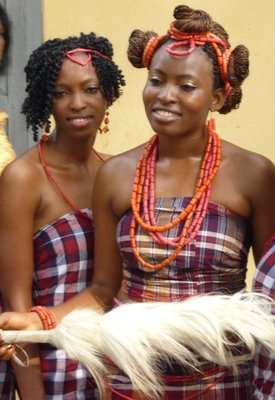
Carriacou1985:Hello Carriacou1985. This is a stretch, but after reviewing the words and twisting them into something intelligible I've transliterated the words into what it could be in Igbo then I've given the English translation. You're correct about the amount of Igbo and Akan peoples to your island and the Leewards Islands. It's funny because Igbo people are also known to wear those imported 'madras' (or "tartan" ) cloths the ladies are wearing in your post. https://cdn.bellanaija.com/wp-content/uploads/2010/08/Chika-Fagoyinbo-Ikenna-Nwakanma-Traditional-Wedding-Bella-Naija009-600x401.jpg https://26.media.tumblr.com/tumblr_l7227d3j711qcr5cbo1_400.jpg So here are the proposed translations (question marks are unintelligible): Igbo: Gongo (?) Banana, Plantain mu ewoh yo! Igbo lé! Igbo lé! Ewoh yo! Hanile bú Legba ewoh yo - or - Hé lé bụ Legba ewoh yo! English: Gongo (?) my Bananas, Plantains, ewoh! (ewoh is an expression like 'oh my god', or 'lord god') Igbo nation! Igbo nation! ewoh yo! All of them go to Legba (vodou deity) ewoh - or - They are all Legba ewoh yo! Conclusion: to me this is an offering to Papa Legba in the Igbo language of plantains and bananas possibly, from a brief search on the net, Papa Legba indeed is given offerings of sweet fruits including plantains and bananas. Vowels at the beginning and end of words often blend in Igbo so in 'me wo yo', the 'me' could be 'mu e[woh]' > 'mewoh', if you see what I mean. Also, in Haiti (who also have Legba) there is a song of the Igbo nation called Ibo Lele. Interesting. Hopefully this helps. By the way Ibo is the older (European) way of spelling Igbo just for future reference. 7 Likes 1 Share |
| Culture › Re: Nigerian Tribes: List Of Major Tribes In Nigeria by ezeagu(m): 8:51pm On Mar 25, 2015 |
Igbo is not a tribe, it's an ethnic group. |
| Politics › Re: African Lingua Franca - Between Hausa And Kiswahili by ezeagu(m): 8:49pm On Mar 25, 2015 |
mobutuseseko:Who and what did English divide? What intimate relationship did Nigerian groups have within their ethnic borders, let alone a pan-African brotherhood? The idea of Europe dividing Africans is mostly not true, what happened was that sentiments were created and strife was heightened. The idea of an African continent is not even African, no African language has a pre-European name for the continent of Africa and Swahili would have seemed as foreign and as strange to pre-European contact 'Nigerians' as English did. Now who is the Negropean? Just stick with major regional languages, Asia doesn't seem to need to knock down all its borders and sing kumbaya for them to have a healthy or healthier economic climate. 1 Like |
| Travel › Re: New Pictures Of Completed Sections Of Enugu-port Harcourt Express by ezeagu(m): 7:12pm On Mar 21, 2015 |
The road is tiny. |
| Culture › Re: Etymology Of The Word Oyinbo by ezeagu(m): 2:54pm On Mar 15, 2015 |
GenIgrigi:"In the Igbo language, the word for "white man" is "beke" – a corruption of the surname Baikie - and the word for "Britain" is "ala Beke," or "Baikie's country." William Balfour Baikie [Wikipedia] |
| Culture › Re: Etymology Of The Word Oyinbo by ezeagu(m): 8:29am On Mar 15, 2015 |
macof:Why don't you just stick to what you knooooow!? [size=20pt]Igbuzo, Akwukwu Igbo[/size] 1 Like |
| Culture › Re: Etymology Of The Word Oyinbo by ezeagu(m): 9:17pm On Mar 14, 2015 |
For goodness sakes, Yoruba people are the most documented group in Nigeria, and probably West Africa, by Western missionaries, colonial governments, and anthropologists. I've provided three solid sources that have cited Igbo people using oyibo ('Oye-Eboe, 'oh eboe', 'oibo') well before 1850 (before Saro influence) and as far back as an anecdote from a 1750's Igbo childhood (whether Gustavus Vassa was Igboland-born or not does not negate his 18th century Igbo sources which are evident from his recognisable description of Igboland and the use of Igbo words including his name). Even Ajayi Crowther, a Yoruba-born was called an oyibo by ndi Onitsha. The honest and courteous thing to do now would be to field sources from Europeans that document Yoruba, or Oyo, etc, referring to Westerners/foreigners as oyibo. Is this fair, or is this far? 2 Likes |
| Culture › Re: Etymology Of The Word Oyinbo by ezeagu(m): 3:45pm On Mar 14, 2015 |
"We have also markets, at which I have been frequently with my mother. These are sometimes visited by stout mahogany-coloured men from the south west of us: we call them Oye-Eboe, which term signifies red men living at a distance." Olaudah Equiano, The Interesting Narrative of the Life of Olaudah Equiano, [size=20pt]1789[/size]. [Link] "John Taylor and Ajai Crowther, were called by the people of Onitsha black Europeans, oyibo ojii, or native foreigners." Augustine Okwu, Igbo Culture and the Christian Missions, 1857-1957, 2010. [Link] "Other words, phonetically closer to 'ebo' (e.g.ibo,oyibo), also had classificatory meanings. In [size=14pt]1832[/size], R. A. K. Oldfield recorded that on the middle reaches of the Niger near 'Eboe' (Aboh), locals hid in the bushes and called out to them what he heard as 'Oh, Eboe! Oh, Eboe!' (meaning 'White man, white man!'); in the 1850s at Onitsha another such 'stranger', Revd J.C. Taylor, was called by the people oibo, to mean 'whiteman'." Paul E. Lovejoy, Identity in the Shadow of Slavery, 2009 [Link] https://media1.policymic.com/site/article-items/31427/1_gif.gif |
| Culture › Re: Etymology Of The Word Oyinbo by ezeagu(m): 3:37pm On Mar 14, 2015 |
SirShymexx:"We have also markets, at which I have been frequently with my mother. These are sometimes visited by stout mahogany-coloured men from the south west of us: we call them Oye-Eboe, which term signifies red men living at a distance." Olaudah Equiano, The Interesting Narrative of the Life of Olaudah Equiano, [size=20pt]1789[/size]. [Link] "John Taylor and Ajai Crowther, were called by the people of Onitsha black Europeans, oyibo ojii, or native foreigners." Augustine Okwu, Igbo Culture and the Christian Missions, 1857-1957, 2010. [Link] "Other words, phonetically closer to 'ebo' (e.g.ibo,oyibo), also had classificatory meanings. In [size=14pt]1832[/size], R. A. K. Oldfield recorded that on the middle reaches of the Niger near 'Eboe' (Aboh), locals hid in the bushes and called out to them what he heard as 'Oh, Eboe! Oh, Eboe!' (meaning 'White man, white man!'); in the 1850s at Onitsha another such 'stranger', Revd J.C. Taylor, was called by the people oibo, to mean 'whiteman'." Paul E. Lovejoy, Identity in the Shadow of Slavery, 2009 [Link] [size=18pt]!!![/size] |
| Culture › Re: Etymology Of The Word Oyinbo by ezeagu(m): 3:35pm On Mar 14, 2015 |
whitecat1:[size=14pt]Early Ceramics from Calabar, Nigeria: Towards a History of Nsibidi[/size] http://www.mitpressjournals.org/doi/abs/10.1162/afar.2007.40.1.18 [img]http://www.mitpressjournals.org/na101/home/literatum/publisher/mit/journals/content/afar/2007/afar.2007.40.issue-1/afar.2007.40.1.18/production/afar.2007.40.1.18.fp.png_v03[/img] [size=18pt]!!!!![/size] "The modern Japanese writing system is a combination of two character types: logographic kanji, which are [size=18pt]adopted Chinese characters[/size]" http://en.wikipedia.org/wiki/Japanese_writing_system [size=18pt]!!!!![/size] |
| Culture › Re: Etymology Of The Word Oyinbo by ezeagu(m): 3:32pm On Mar 14, 2015 |
"We have also markets, at which I have been frequently with my mother. These are sometimes visited by stout mahogany-coloured men from the south west of us: we call them Oye-Eboe, which term signifies red men living at a distance." Olaudah Equiano, The Interesting Narrative of the Life of Olaudah Equiano, 1789. [Link] "John Taylor and Ajai Crowther, were called by the people of Onitsha black Europeans, oyibo ojii, or native foreigners." Augustine Okwu, Igbo Culture and the Christian Missions, 1857-1957, 2010. [Link] "Other words, phonetically closer to 'ebo' (e.g.ibo,oyibo), also had classificatory meanings. In 1832, R. A. K. Oldfield recorded that on the middle reaches of the Niger near 'Eboe' (Aboh), locals hid in the bushes and called out to them what he heard as 'Oh, Eboe! Oh, Eboe!' (meaning 'White man, white man!'); in the 1850s at Onitsha another such 'stranger', Revd J.C. Taylor, was called by the people oibo, to mean 'whiteman'." Paul E. Lovejoy, Identity in the Shadow of Slavery, 2009 [Link] [size=18pt]!!![/size] 1 Like 1 Share |
| Culture › Re: Etymology Of The Word Oyinbo by ezeagu(m): 3:30pm On Mar 14, 2015 |
whitecat1:"Nsibidi is an ancient system of graphic communication indigenous to the Ejagham peoples of southeastern Nigeria and southwestern Cameroon in the Cross River region. It is also used by neighboring Ibibio, Efik and Igbo peoples. Aesthetically compelling and encoded, nsibidi does not correspond to any one spoken language. It is an ideographic script whose symbols refer to abstract concepts, actions or things and whose use facilitates communication among peoples speaking different languages." http://africa.si.edu/exhibits/inscribing/nsibidi.html [size=18pt]!!!!![/size] 4 Likes |
| Culture › Re: Etymology Of The Word Oyinbo by ezeagu(m): 3:28pm On Mar 14, 2015 |
whitecat1:https://upload.wikimedia.org/wikipedia/commons/thumb/0/00/Ikpe_nsibidi.jpg/800px-Ikpe_nsibidi.jpg !!!! 1 Like |
| Culture › Re: Etymology Of The Word Oyinbo by ezeagu(m): 3:26pm On Mar 14, 2015 |
whitecat1:[img]http://4.bp..com/-hDA8r-ztbb8/TYJhkhTRf-I/AAAAAAAAARg/Lo-3uYpnE9c/s400/Nsibidi%2BSheet%2B2.png[/img] !!! 2 Likes |
| Culture › Re: Etymology Of The Word Oyinbo by ezeagu(m): 3:24pm On Mar 14, 2015 |
"We have also markets, at which I have been frequently with my mother. These are sometimes visited by stout mahogany-coloured men from the south west of us: we call them Oye-Eboe, which term signifies red men living at a distance." Olaudah Equiano, The Interesting Narrative of the Life of Olaudah Equiano, 1789. [Link] "John Taylor and Ajai Crowther, were called by the people of Onitsha black Europeans, oyibo ojii, or native foreigners." Augustine Okwu, Igbo Culture and the Christian Missions, 1857-1957, 2010. [Link] "Other words, phonetically closer to 'ebo' (e.g.ibo,oyibo), also had classificatory meanings. In 1832, R. A. K. Oldfield recorded that on the middle reaches of the Niger near 'Eboe' (Aboh), locals hid in the bushes and called out to them what he heard as 'Oh, Eboe! Oh, Eboe!' (meaning 'White man, white man!'); in the 1850s at Onitsha another such 'stranger', Revd J.C. Taylor, was called by the people oibo, to mean 'whiteman'." Paul E. Lovejoy, Identity in the Shadow of Slavery, 2009 [Link] !!! |
| Jobs/Vacancies › Re: Are You Kidding Me? Loose Your Braids Or Loose You Job? [photo] by ezeagu(m): 3:16pm On Mar 14, 2015 |
PHgirl:When you get hit with racism you will understand. Until then, enjoy the fact that you don't have to work in a completely white workplace where every article of your being is criticised. Nigerians in Nigeria just do not understand racism, and in a way they're lucky. 2 Likes |
| Culture › Re: Etymology Of The Word Oyinbo by ezeagu(m): 3:08pm On Mar 14, 2015 |
Aigbofa:"We have also markets, at which I have been frequently with my mother. These are sometimes visited by stout mahogany-coloured men from the south west of us: we call them Oye-Eboe, which term signifies red men living at a distance." Olaudah Equiano, The Interesting Narrative of the Life of Olaudah Equiano, 1789. [Link] "John Taylor and Ajai Crowther, were called by the people of Onitsha black Europeans, oyibo ojii, or native foreigners." Augustine Okwu, Igbo Culture and the Christian Missions, 1857-1957, 2010. [Link] "Other words, phonetically closer to 'ebo' (e.g.ibo,oyibo), also had classificatory meanings. In 1832, R. A. K. Oldfield recorded that on the middle reaches of the Niger near 'Eboe' (Aboh), locals hid in the bushes and called out to them what he heard as 'Oh, Eboe! Oh, Eboe!' (meaning 'White man, white man!'); in the 1850s at Onitsha another such 'stranger', Revd J.C. Taylor, was called by the people oibo, to mean 'whiteman'." Paul E. Lovejoy, Identity in the Shadow of Slavery, 2009 [Link] 4 Likes |
| Jobs/Vacancies › Re: Are You Kidding Me? Loose Your Braids Or Loose You Job? [photo] by ezeagu(m): 2:51pm On Mar 14, 2015 |
Vision4God: pretydiva:Nigerians just do not understand racism, and it's sad because they are indirect casualties of racism, and when 'expatriates' come to their country they grovel at their feet because of attitudes like the above. 1 Like |
| Culture › Re: The Kongo Kingdom...A underrated Kingdom by ezeagu(m): 2:37pm On Mar 06, 2015 |
RandomAfricanAm:Nairalands Culture section is low-key an African history centre for the internet. |


 Ekiti
Ekiti




1 2 3 4 5 6 7 8 ... 93 94 95 96 97 98 99 100 101 (of 349 pages)