ExAngel007's Posts
Nairaland Forum › ExAngel007's Profile › ExAngel007's Posts
1 2 3 4 5 6 7 8 ... 88 89 90 91 92 93 94 95 96 (of 140 pages)
 Politics › Re: Hadiza Isma El-Rufia: "My Husband Has Been Substituted With Fresh, Relaxed One" by ExAngel007(f): 8:46am On Mar 22, 2019 Politics › Re: Hadiza Isma El-Rufia: "My Husband Has Been Substituted With Fresh, Relaxed One" by ExAngel007(f): 8:46am On Mar 22, 2019 |
hmmm |
| Crime › Re: Police Storm Rivers State College Of Health Port-Harcourt, Arrest Students by ExAngel007(f): 12:52pm On Mar 21, 2019 |
what nonsense is this |
| Politics › Re: Buhari, APC Begging Atiku Not To Go To Court - Buba Galadima by ExAngel007(f): 5:31am On Mar 21, 2019 |
let him go to court and stop telling us trash. 7 Likes |
| Politics › Re: I Was Warned By Northern PDP Leader Not To Attack, Criticise Buhari Again - FFK by ExAngel007(f): 12:38am On Mar 20, 2019*. Modified: 8:45am On Mar 20, 2019 |
this ffk guy talks rubbish always 16 Likes 3 Shares |
| Romance › Re: Zimbabwe Policeman Sends Wife Bedroom Pics With His Girlfriend With Big Buttocks by ExAngel007(f): 11:29pm On Mar 19, 2019 |
but some men are so bitter about their ex that they can do anything to get to her. 1 Like |
| Health › List Of Nigerian States And Their HIV Prevalence Rate by ExAngel007(op): 11:22pm On Mar 19, 2019 |
The Nigerian HIV/AIDs Indicator and Impact Survey (NAIIS) has released the prevalence rate of the disease in Nigeria state by state. According to the result, Akwa Ibom tops the prevalence rate chart with about 5.5 per cent of its residents living with the virus. The report also indicated that Akwa Ibom is followed by Benue which has a prevalence rate of 5.3 per cent while Rivers is third with a prevalence rate of 3.8 per cent. According to the result, about one per cent of Nigerians (1.9 million people) are currently living with HIV/AIDs, Premium Times reports. Here is the full list States HIV prevalence (%) Akwa Ibom 5.5 Benue 5.3 Rivers 3.8 Taraba 2.9 Anambra 2.4 Abia 2.1 Cross River 2.0 Enugu 2.0 Nassarawa 2.0 Bayelsa 1.9 Delta 1.9 Edo 1.9 Imo 1.8 Ogun 1.6 Plateau 1.6 FCT 1.6 Lagos 1.4 Gombe 1.3 Adamawa 1.2 Borno 1.2 Kaduna 1.1 Ondo 1.1 Kwara 1.0 Kogi 0.9 Osun 0.9 Oyo 0.9 Ebonyi 0.8 Ekiti 0.8 Niger 0.7 Kano 0.6 Kebbi 0.6 Bauchi 0.5 Zamfara 0.5 Sokoto 0.4 Yobe 0.4 Jigawa 0.3 Katsina 0.3 HIV prevalence according to Geopolitical zones Zones HIV prevalence (%) South-South 3.1 North-Central 2.1 South-East 1.9 South-West 1.2 North-East 1.1 North-West 0.6 Recall that Legit.ng had reported that the National Agency for the Control of AIDS (NACA) on Thursday, March 14, disclosed that the south-south region of the country has the prevalent record of people leaving with the HIV disease. https://www.legit.ng/1228430-hiv-prevalence-nigeria-state-by-state.html lalasticlala dominique Sissy3 |
| Politics › Re: To Arrest Fani-kayode, Odumakin, Follow Due Process, Court Tells EFCC, DSS, Poli by ExAngel007(f): 7:23pm On Mar 12, 2019 |
jail awaits you Mr FFK 1 Like 1 Share |
| Crime › Re: Aiye And Eiye Cult Clash In Ogun, People Killed (Graphic Photos) by ExAngel007(f): 7:21pm On Mar 12, 2019 |
good luck to heaven |
| Politics › Re: Pessimists Versus Atiku: History Can Change by ExAngel007(f): 6:55pm On Mar 09, 2019 |
rubbish 5 Likes 1 Share |
| Politics › Premium Times Reporter Abducted At Governor’s Polling Unit Over Underage Voting by ExAngel007(op): 5:48pm On Mar 09, 2019 |
A PREMIUM TIMES journalist, Kunle Sanni, was on Saturday morning abducted by political thugs for taking pictures of underage voters at a polling unit in Plateau State. Mr Sanni, who was monitoring the elections in the area, was accosted by an agent of the ruling All Progressives Congress who had spotted him while photographing several young children as they lined up on the queue to vote. The journalist took photographs of the children and their voter cards before APC agents at the centre instructed thugs loyal to the governing party to surround the polling unit and bar the reporter from exiting. The stalemate lasted hours as this newspaper worked its contacts in the area to try to ensure Mr Sanni’s safety. Eventually, after the journalist emerged, he unknowingly walked into an ambush and was promptly forced into a taxi and driven to an unknown destination where his abductors forced him to delete the images. Mr Sanni said the incident occurred at the polling unit of Governor Simon Lalong, Polling Unit 15, Ward 04 of Shendam local government area of the state. “After observing and taking pictures at the government polling unit, I was on my way out when some APC party agents ambushed me and forced me into the car and drove off, the journalist said. “The men collected my phone which was dead at the time, parked in a bush and plugged the phone to see who I was sending the pictures. When the men confirmed I had deleted them, they offered me money in return,” he said. Mr Sanni said their countenance changed when he declined the offer. “I had to accept it so that they did not harm me because the place was bushy and I could get killed,” he said. Mr Sanni said he was given N20,000. While recounting how he was taken from the polling unit, Mr Sanni said the whole thing happened in the presence of the chairman, Nigeria Union of Journalist, Plateau State chapter, Paul Jatau, and the police. “They could not stop them although the NUJ chairman approached me and asked me to delete the pictures,” he said. The Independent National Electoral Commission (INEC) had earlier warned underage voters not to go near polling units in Plateau State ahead of Saturday’s governorship and state assembly elections. The head of department for Voter Education and Publicity, INEC Plateau State, Osarentin Imahinyereobo, said underage voters should stay away from the polling units because the security (team) would arrest them. The minimum voting age in Nigeria is 18. Underage voting has been a major issue in Nigeria’s political discourse since the return of democratic government in 1999. While underage voting is prominent in some regions of the country, it is hardly noticed in some other parts. Underage voting has become a national challenge and a threat to Nigeria’s democracy. However, the electoral umpire, INEC, has not done much to curb the problem. https://www.premiumtimesng.com/news/top-news/318834-premium-times-reporter-abducted-at-governors-polling-unit-over-underage-voting.html
|
| Politics › Ballot Box Snatcher Shot Dead By Soldiers In Akwa Ibom by ExAngel007(op): 5:35pm On Mar 09, 2019 |
A young man has been shot dead in Ukanafun in Akwa Ibom State, after he snatched a ballot box on Saturday during the governorship and state house of assembly elections in the state. He was shot dead by soldiers at a polling unit in Ikot Udo Ossiom village, Ukanafun Local Government Area of Akwa Ibom State. According to The Nation , the election materials had just arrived from the office of the Independent National Electoral Commission (INEC) in the morning, and the man had attempted to snatch it, but soldiers in the area at the time prevented him from carrying out the act. However, he came back a second time and took away the box. The soldiers opened fire on him and shot him dead. His corpse was left at the scene of the incident, just as the area has been thrown into mourning. http://saharareporters.com/2019/03/09/breaking-ballot-box-snatcher-shot-dead-soldiers-akwa-ibom 3 Likes 1 Share |
| Politics › Buhari: I Expected Atiku To Go To Court by ExAngel007(op): 1:43pm On Mar 09, 2019 |
President Muhammadu Buhari says he expected
Atiku Abubakar to go to court after the results of
the 2019 presidential election were announced.
The Independent National Electoral Commission
(INEC) declared Buhari the winner of the February
23 poll. Buhari and his wife, Aisha, voted on Saturday at the Kofar Baru 003 polling unit, Daura, Katsina state, in the governorship and state assembly elections. Asked to react to the decision by the PDP to challenge the outcome of the presidential election, Buhari replied: “I expected that to happen.” Atiku had said he was going to court to challenge the outcome because of malpractices. He said: “One obvious red flag is the statistical impossibility of states ravaged by the war on terror generating much higher voter turnouts than peaceful states. The suppressed votes in my strongholds are so apparent and amateurish, that I am ashamed as a Nigerian that such could be allowed to happen. How can total votes in Akwa Ibom, for instance, be 50% less than what they were in 2015? “Another glaring anomaly is the disruption of voting in strongholds of the Peoples Democratic Party in Lagos, Akwa-Ibom, Rivers and diverse other states, with the authorities doing little or nothing and in some cases facilitating these unfortunate situations. “The militarisation of the electoral process is a disservice to our democracy and a throwback to the jackboot era of military dictatorship.” Buhari also commented on the tension and violence across the country over Saturday’s elections. “I will leave it to the law enforcement agencies especially the police because they have been meeting virtually on a 48-hour basis to make sure that they have identified the flashpoints, as you mentioned, wherever they are and make arrangements to counter it,” he said. https://www.thecable.ng/buhari-i-expected-atiku-to-go-to-court/amp |
| Crime › How Katsina Boy 'became Igbo' After Disappearance by ExAngel007(op): 1:34pm On Mar 09, 2019 |
Ukashatu was six years old when he was taken away by a strange woman. Found after eight years, he can now only communicate in Igbo language and pidgin. But how did this all happen? The Friday of a fortnight ago was the day 50-year-old Malama Daharatu, a beggar in Lagos, had earnestly prayed and waited for. It was the day she was reunited with her son Ukashatu, whom she lost about eight years ago. In a chat with Daily Trust Saturday, Malama Daharatu of Rogogo area in Baure Local Government Area of Katsina State narrated how she lost Ukashatu. “It was one faithful Thursday night in an area called Bakin Masallaci in Orile, Lagos State. I sent him to dump refuse and since then I never saw him again until two weeks ago. Daharatu, who is blind, said she went to Lagos pregnant with Ukashatu and started begging because of her condition. When she lost him, she, in the company of some friends, searched for him in hospitals and went to the police station all in vain. On how she was able to get him back, Daharatu said, “ I was at Maryland Mosque on that day. After the congregational prayer, we started begging and my phone rang. I was asked to come to the house we were staying in because some people brought Ukashatu. When I got there, I did not meet him because he had been taken to the police station. So, we went there with one Tasiu. To be sure he was my son, the police tested him. They told me to stand at a distance but he came directly to me and hugged me. We both started crying. Malama Daharatu added that the police told her how they traced and got back her son through a Yoruba girl living in the same house with Ukashatu. The girl had complained to the police that the people she had been staying with for five years were maltreating her. When the police arrested Christiana (the mother of the house) and the house boys, they interrogated Ukashatu, who told them about himself. Luckily, he was able to answer their questions properly though he was six years old when he was abducted. However, Malama Daharatu said after she was reconciled with her son, she did not bother to follow up on the case or ask what happened to Christiana. Asked if she will stop begging in Lagos, she said she can’t because begging in Lagos is lucrative. But to be on the safe side, she had decided not to take her children with her again. Daily Trust Saturday gathered that Malama Daharatu has been begging in Lagos for over 20 years, and only returns to Katsina for a week or some days before going back. On one of her journeys to Lagos, she had an accident and lost a leg. After he was abducted, Ukashatu’s name was changed to Michael. When Daily Trust Saturday spoke to him, he said he can no longer speak Hausa and only communicates in Pidgin English and Igbo. Ukashatu said: “ On the day I went to dump refuse, a woman asked me to come and collect bread. She then said I should follow her to collect some rice also and so I did. From one house, we entered another and afterwards I could not tell what happened. “Her name is Christiana Onuchukwu and her husband is Mathew. I met two other children in the house – Emmanuel and Ifeanyi. They brought a Yoruba girl later on.” The couple told him that he is Igbo and that they were his parents. “They enrolled me in Goody Primary School where I am presently in JSS 2. They really took good care of me.” From then onwards, Ukashatu started going to church with them. On how he was found, Ukashatu said, “the Yoruba girl told me that she wanted to run away because they were maltreating her and that I should keep quiet. So, she ran away and reported to the police. I just saw my mother when they brought me to the station and I can’t remember how I was able to recognize her. When the police asked me about my background, I told them that my mother is a beggar and she is blind.” But what would Ukashatu integrate with his people now that he is unable to communicate in Hausa? “I am just happy that I am back to my people.” Malam Kasimu Abdu, one of Ukashatu’s brothers, said since Ukashatu’s disappearance, they have been praying for him and never ceased until he was found. Unfortunately, Daily Trust Saturday was unable to speak to Ukashatu’s father. Share this news: https://www.tori.ng/news/117903/how-katsina-boy-became-igbo-after-disappearance.html
|
| Politics › I'm Not Afraid Of Losing Election - El-rufai by ExAngel007(op): 1:21pm On Mar 09, 2019*. Modified: 1:49pm On Mar 09, 2019 |
The governorship candidate of the All Progressives Congress, APC, Malam Nasir el-Rufai, Saturday said that he is not afraid of losing the ongoing gubernatorial election. Disclosing this before he cast his vote at polling unit 024, Runka/Marnona, Angwan Sarki, the governor of Kaduna opined that he is lucky that President Muhammadu Buhari won the presidential election. He said that he would get a job if the election did not favor him but the same cannot be said of those working with him. His words, “I am not under any tension since President Muhammadu Buhari has won. Even if I lose, I already have a job.” “It is my staff that are jittery. I always share this joke.” https://www.thecable.ng/just-in-im-not-afraid-of-losing-its-my-staff-who-are-jittery-says-el-rufai |
| Romance › Re: Another Nigerian Cross Dresser Hassan Who Is A Disciple Of Bobrisky Crawls Out by ExAngel007(f): 10:37am On Mar 09, 2019 |
this is getting way out of line 2 Likes |
| Nairaland General › Re: Dangote Truck Crushes Vehicles On Kaduna-Abuja Road, Many Dead. Photos by ExAngel007(f): 10:21am On Mar 09, 2019 |
so sad |
| Celebrities › Re: Stray Bullet Stuck In Uche Novia Son’s Hand - Pics by ExAngel007(f): 1:04pm On Mar 08, 2019 |
menh he's really lucky 1 Like |
| Politics › Re: Nnamdi Nsorom Shot By Assassins In Imo (PHOTOS) by ExAngel007(f): 6:01pm On Mar 07, 2019 |
hmmm... |
| Crime › Re: Cocaine, Tramadol, 'Suck And Die' Recovered As Police Nab Drug Dealers. Photos by ExAngel007(f): 7:31pm On Mar 06, 2019 |
ha! this is too much Na say no to drugs 3 Likes |
| Sports › Re: Mansur Calar Uses Razor Blade To Attack Ferhat Yazgan, Haci Dogru On The Field by ExAngel007(f): 6:13am On Mar 05, 2019 |
crazy footballer 13 Likes |
| Education › Check Out 5 Clears Ways To Tell If Someone Is Lying To You Today - Science by ExAngel007(op): 6:06am On Mar 05, 2019 |
https://www.tori.ng/userfiles/image/2019/mar/04/history.jpg
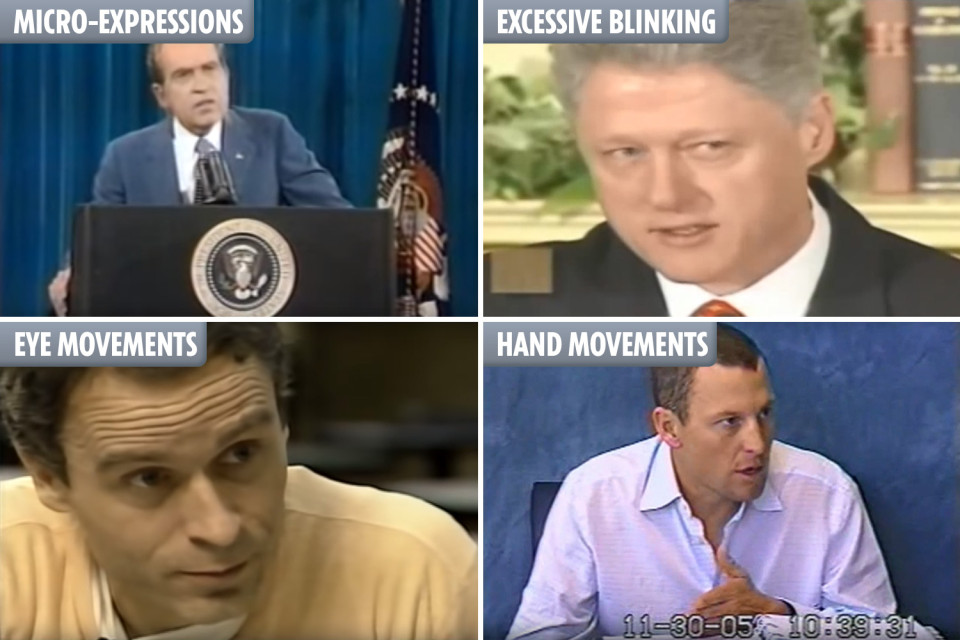
Some of history's most famous liars had clear
giveaways The average person tells at least four lies a day – but even the most adept fibbers have a tell or two. Scientists have figured out five dead giveaways that you can watch out for if you suspect someone is feeding you porkies. They mostly involve tiny movements in a liar's face or hands that reveal they're not being totally honest with you. 1) Eye movements People say the eyes are the window to the soul, and the phrase rings especially true with liars. Most people will look up and to the left when recalling memories, and if they're making up their story are more likely to glance down. In the clip below, notorious serial killer Ted Bundy is questioned about his childhood while on death row in Florida. The murderer, who is believed to have slaughtered as many as 50 women during his 1970s rampage, frequently glances down while recalling his early years, claiming he was a "normal person" with "good friends". This goes against reports from his classmates and neighbours, who said Bundy was an isolated and unusual child who didn't spend much time with others. 2) Micro-expressions Micro-expressions are small but subtle changes to your face and body language that give your true emotions away. They happen subconsciously and only an extremely skilled fibber knows how to stop them, making them an excellent way to spot a liar. Often the tells last less than a quarter of a second before our faces take on the expression we want. When disgraced US President Richard Nixon famously claimed "I am not a crook" after he was accused on illegal spying operations on his political rivals, his body language gave away his porkies. The slippery politician crossed his arms and stepped backwards, revealing that he was feeling defensive and insecure. His crimes were later confirmed and he remains the only US President to have ever been impeached. 3) Hand and feet movements It's not just a liar's face that gives them away – their hands and feet can also reveal an aversion to the truth. When we lie, we're more likely to subconsciously squirm with discomfort, increasing our leg and feet movements. Raising their heels from the ground, crossing and uncrossing their legs and wrapping one foot round the ankle of the other leg are all signs someone is feeling uncomfortable. 4) Blink rate A liar's blink rate can either increase or decrease when they're misleading you. It's a sign they're uncomfortable with being put on the spot. In the video below, former US President Bill Clinton attempts to deceive the world by claiming he did not have a sordid affair with White House staff member Monica Lewinsky. Watch how his blink rate increases as he delivers the now famous line: "I did not have sexual relations with that woman". 5) Hand movements As well as their face, feet and legs, fibbers will also move their hands in strange ways. In particular, hand movements become more erratic and are often out of sync with what they're saying. That's because their hands flutter as their brain tries to work the story out. Disgraced cyclist Lance Armstrong lied for years about taking performance enhancing drugs. https://www.thesun.co.uk/tech/8557912/five-signs-someone-lying-science/ lalasticlala |
| Politics › Islamic State ‘sacks’ Al-barnawi, Factional Boko Haram Leader by ExAngel007(op): 12:48am On Mar 05, 2019 |
The Islamic State has sacked Abu Mus’ab Al- barnawi as the leader of Islamic State West Africa Province, a faction of the Boko Haram insurgent group. Ahmad Salkida, a journalist known to have access to the leadership of the group, disclosed this on Monday night. According to him, the new leader of the group is Abu Abdullah Ibn Umar Albarnawi. Salkida said no reason was given for the development . “The Islamic State has sacked Abu Mus’ab Albarnawi as the leader of its West African affiliate (ISWAP),” Salkida wrote on Twitter. “ The new Wali, according to an 18:13 audio recording, is Abu Abdullah Ibn Umar Albarnawi. No reason was given for the sack of Abu Musab (Habib).” Ahmad Salkida @A_Salkida Just In: The Islamic State have sacked Abu Mus'ab Albarnawi as the leader of its West African affiliate (ISWAP). The new Wali, according to an 18:13 audio recording, is Abu Abdullah Ibn Umar Musab is the eldest surviving son of Mohammed Yusuf, founder of Boko Haram, who was killed in 2009. He was the spokesman of Boko Haram before the group pledged allegiance to Islamic State of Iraq and the Levant (ISIL). Boko Haram joined IS in 2015. It, however, split with the group in 2016 over leadership issues. https://www.thecable.ng/islamic-state-sacks-al-barnawi-factional-boko-haram-leader |
| Culture › Do The Igbo And The Yoruba Know They Are Sons Of "Oduduwa"? by ExAngel007(op): 12:11am On Mar 05, 2019*. Modified: 12:28am On Mar 05, 2019 |
And the Supreme Being commissioned Oduduwa, a “sky-god”, to carry out a terrestrial task; he descended from heaven with a cockerel which had six fingers. And the earth was made by him through the ingenious deployment of his avian subject. But that was after ‘Atewonro’ had sprinkled some dirt on the ocean to found Ile-Ife. And he had wives, and sons who founded other kingdoms. So the mythic origin of the Yoruba says. In Igbo mythic origin, the Supreme Being sent Eri down to earth to establish balance and social order. The “sky-god” founded Nri, and he had wives, and sons who founded other Igbo towns and communities. The Yoruba and the Igbo share a lot more than similar mythic origins. They are the oldest inhabitants of the areas they live in. In other words, the Yoruba and the Igbo are indigenous to the geographical area called “Nigeria”. And it has also been argued that both groups are of a singular ancestry. The two groups have had established trade-links dating to the period before contact with the first Europeans. And they are known to share passion for industry; are convivial, accommodating and peace loving. Also, there is no documented history of war between the Igbo and the Yoruba despite occupying the same “southern hemisphere”. In the precolonial times, wars among kingdoms and natives were common, but there appears to be no recorded incident of battle between the clans and kingdoms of the two groups. In language, they are both of the Kwa-group Niger-Congo origin. The similarities between the Yoruba and the Igbo language are remarkable, if not uncanny, which point to an identical fount. Despite having so much in common, politics has been a pesky point of dissonance for both groups. Though the Igbo and the Yoruba do not have a romantic political history; they have kept the dagger away from their rivalry. The outcome of the Western Region elections of 1951, in which Nnamdi Azikiwe claimed he was sabotaged by Obafemi Awolowo, perhaps laid the molten magma of political rivalry between the two groups. Some associates of Azikiwe alleged that Awolowo, leader of the Action Group, bought over members of the NCNC, after they had won elections on the platform of the party in the western region, to scuttle Zik’s plan of being the leader of the regional assembly. They also claimed that Awolowo scuttled Zik’s “one-Nigeria” agenda, and introduced tribal politics. However, there is no proof to substantiate these claims. In fact, the allegation regarding Awolowo’s sabotage of Zik was disproved by the colonial government at the time. So, over the years, stories have been revised and passed down to generations who do not probe the information but hold it as a grudge against the other. Most young people trading hate on social media cannot actually say their grievance against those they are tugging with, except to echo the refrain of revised stories handed down to them and to act on stereotypes they have been socialised by. But can the Igbo and the Yoruba ever unite? Yes, they can. And they will. There will come a time when there is no option, but for them to hold each other in a warm embrace as “descendants of sky-gods.” There will come that time. Fredrick is a media personality. Twitter: @FredrickNwabufo https://www.thecable.ng/do-the-igbo-and-the-yoruba-know-they-are-sons-of-oduduwa https://f5p3e9e4.stackpathcdn.com/wp-content/uploads/2017/09/Pic.15.-Yoruba-Agenda-for-Restructuring-in-Ibadan-653x365.jpg |
| Politics › Re: What's The Electricity Situation In Your Area Like? by ExAngel007(f): 6:14pm On Mar 04, 2019 |
at least 18 hrs 6 Likes |
| Crime › Re: Court Remands Nursery School Staff For Negligently Killing Three-year-old Girl by ExAngel007(f): 3:34pm On Mar 04, 2019 |
the story do not add up 2 Likes |
| Education › Re: ASUU ‘Thinking Of Another Strike’ - See Reactions by ExAngel007(f): 6:35am On Mar 04, 2019 |
the people comments are so funny |
| Politics › Re: I Founded APC, Have Sacked Oshiomhole For Anti-party Activities - Okorocha by ExAngel007(f): 6:25am On Mar 04, 2019 |
werey |
| Politics › Re: “APC Will Produce Kwara’s Next Governor” – Bukola Saraki’s Sister Gbemisola by ExAngel007(f): 6:07am On Mar 04, 2019 |
All these Saraki people self. I don't like seeing them in power 1 Like |
| Romance › Re: Check Out This Simple And Beautiful Wedding Pictures by ExAngel007(f): 4:55pm On Mar 03, 2019 |
she's very young |
| Science/Technology › Re: Python Kills A Dog In Port-Harcourt, Gets Killed Too (Photos) by ExAngel007(f): 7:49am On Mar 03, 2019 |
so sad for the poor dog 1 Like |
| Romance › Re: "The World Is Coming To An End": Slay Grandmama In G-string Causes Stir Online by ExAngel007(f): 7:06am On Mar 03, 2019 |
I give up |
| Politics › Re: Poll Results: We’ve Presented Atiku’s Grievances To Buhari –abdusalami by ExAngel007(f): 7:46am On Mar 02, 2019*. Modified: 11:14am On Mar 02, 2019 |
Atiku is just wasting his time. Let him go to court if he feels like 8 Likes |



1 2 3 4 5 6 7 8 ... 88 89 90 91 92 93 94 95 96 (of 140 pages)