Lukgaf's Posts
Nairaland Forum › Lukgaf's Profile › Lukgaf's Posts
1 2 3 4 5 6 7 8 ... 35 36 37 38 39 40 41 42 43 (of 98 pages)
 Islam › What Are The Conditions For Wiping Over Socks? by Lukgaf(op): 8:09am On Dec 10, 2021 Islam › What Are The Conditions For Wiping Over Socks? by Lukgaf(op): 8:09am On Dec 10, 2021 |
Praise be to Allah.https://islamqa.info/en/answers/9640/conditions-of-wiping-over-socks 16 Likes 4 Shares |
| Islam › Ruling On Bullying And Stern Warning To Those Who Do It by Lukgaf(op): 7:58am On Dec 10, 2021 |
Recently, the story of Sylvester Omoroni, an alleged bullied student of Dowen surfaced on the internet. Many people who linked this to bullying gave several accounts of bullying in Nigeria. What does Islam say concerning it? This thread provides an answer Praise be to Allah.https://islamqa.info/en/answers/285352/a-word-about-bullying 7 Likes 2 Shares |
| Islam › Adopting A Gentle Approach When Advising People by Lukgaf(op): 8:27am On Dec 03, 2021 |
When Allah Ta'ala commanded Prophet Moosa and Haroon to go to Fir'aun, He instructed them with the following; “Speak to him (Fir'aun) in a gentle (soft) manner, perhaps he will accept or he will fear (Allah).” (Surah Taha) The companion of the Prophet, Abdullah bin Mughaffal narrates that Nabi (Sallallahu Alaihi Wasallam) said, “Verily Allah is gentle (kind) and loves gentleness. He gives (rewards) for being gentle (in actions) what He does not give when being harsh.” (Abu Dawood) Our mother, Ayesha narrates, “I was on a camel that was stubborn.” Nabi (Sallallahu Alaihi Wasallam) said, “Be gentle. Gentleness is not added to something except it beautifies it and it is not removed from something except that it spoils it.” (Muslim) Jareer bin Abdillah (R) narrates that Nabi (Sallallahu Alaihi Wasallam) said, “Whoever is deprived of gentleness (kindness) is deprived of goodness.” (Muslim) Gentleness is the opposite of harshness. A harsh, rude and arrogant attitude is contrary to the Sunnah. From the Quranic advice, we learn how, despite the haughtiness and arrogance of Fir'aun who proclaimed himself to be the Supreme Almighty, the command was to adopt a gentle approach with him. There is a greater chance of a person accepting and taking heed of the message if it is conveyed with gentleness and wisdom. Therefore, be gentle with others and invite towards good with wisdom and kind words. Darul Ihsan 9 Likes 2 Shares |
| Islam › Protection Against Toilet Snakes by Lukgaf(op): 8:04am On Dec 03, 2021 |
PROTECTION AGAINST TOILET SNAKES Following the viral video of the woman killed by a toilet snake in Abuja last week, calls for extra precautionary measures to reed our surroundings of rodents surfaced recently. Physical precautions are good of course, except that we are still vulnerable if we do not take spiritual precautions as well. If you are a Muslim, you must believe in the jinn and that they live in toilets however clean and sophisticated the apartment. It is authentically credited to the Prophet also that they appear as snakes in homes. All snakes in the bush must be killed, but the scholars are divergent on which snakes to spare in our homes with a warning to leave rather than killing them on impulse at first sight; however, they unanimously agree on the efficacy of the zikr taught by the Messenger againnst their evil. Before entering your toilet therefore, always say: اللهم إني أعوذ بك من الخبث والخبائث ( O Allah, I seek refuge with you against (all) male and female jinns.) You may forget to weed your surroundings or take other precautions, but when a zikr becomes a part of your life, you would say it even unconsciously as you step into a toilet. How fortunate it is to be a Muslim and upon the Sunnah. Written by Shaykh Murtadho Adedokun 30 Likes 5 Shares
|
| Islam › Re: Ruling On Health Insurance And All Kind Of Insurance by Lukgaf(op): 9:18am On Nov 26, 2021 |
12rev:No. That's over generalisation of the context 1 Like |
| Islam › Ruling On Health Insurance And All Kind Of Insurance by Lukgaf(op): 7:58am On Nov 26, 2021 |
If you are reading this, then I assume you are a member of an insurance company paying premiums either forcefully or willingly. But as a Muslim, have you ever wondered whether it is permissible in Islam? In this thread, I present an excerpt from IslamQA rulings on health insurance and all kind of insurance. Praise be to Allah.https://islamqa.info/en/answers/170654/health-insurance-and-the-ruling-on-working-in-the-insurance-department-of-the-hospital 8 Likes 3 Shares |
| Islam › The Importance Of Saying "In Shā Allah إن شاء الله" by Lukgaf(op): 7:30am On Nov 26, 2021 |
“And never say of anything, ‘I will definitely do this tomorrow,’ without adding, ‘if Allah so wills!’” (al-Kahf: 23-24) For our Fiqh courses at the Uni., we study the famous explanation to Zaad al-Mustaqni' (Hanbali Fiqh) known as ar-Rawdh al-Murbi' authored by Sh. Mansūr al-Buhūtī (1051h) رحمه الله. Under the chapter of utensils, al-Buhūtī stated that he will expound on a particular issue later on in the book under the chapter of الصيد. Unfortunately, when you goto said chapter, you’re unable to find that commentary.Abu Awzaa'ee Abdus-Salaam al-Makki al-Hanbali 25 Likes 7 Shares |
| Business › Re: Prolific Account For Sale by Lukgaf(m): 2:10pm On Nov 25, 2021 |
Anyone available? |
| Islam › Re: Making Fun Of Islam by Lukgaf(op): 4:02pm On Nov 19, 2021 |
41lady:Sorry, are you a Muslim? |
| Islam › DPO Mahi Ahmad Ali Wins Qur'an Police Competition In Kano by Lukgaf(op): 9:58am On Nov 19, 2021 |
The Kano State Police Command has concluded its Quran recitation competition organized by its officers. The Chief of the Takai Police Station, DPO Mahi Ahmad Ali, came first in the 60 week class, receiving a new refrigerator and other prizes. The competition, which began on Wednesday, includes troops and fighters competing at the 60, 40, 5 and 2 levels. Then there is ASP Salihu Ismail, who is a hero in the 40 Izu class. Kano State Governor Aliyu Harazumi, who represented the Emir of Kano at the event, presented a special gift to Kano State Police Commissioner Samaila Dikko as it was under his leadership for the first time. BBC Hausa https://www.google.com/amp/s/www.bbc.com/hausa/labarai-59336331.amp 17 Likes 3 Shares
|
| Islam › Making Fun Of Islam by Lukgaf(op): 8:27am On Nov 19, 2021 |
Few days ago a video was circulating on social media of a Professor making fun of and humiliating the sacred clothes of female Muslims called Hijab. The most unfortunate part of it was that the Professor himself is a Muslim. Ina Lilah was ina ilae rojiun! I am afraid the Professor is ignorant of the punishment associated with making fun of anything associated to / commanded by Allah. "Undoubtedly mocking and making fun of something that is known to be part of Islam constitutes kufr (disbelief) that puts one beyond the pale of Islam, even if the one who does that does not mean anything more than joking, because this in and of itself is an action that puts one beyond the pale of Islam as Allah, may He be exalted, says (interpretation of the meaning): “If you ask them (about this), they declare: ‘We were only talking idly and joking.’ Say: ‘Was it at Allah, and His Ayaat (proofs, evidences, verses, lessons, signs, revelations, etc.) and His Messenger (blessings and peace of Allah be upon him) that you were mocking? Make no excuse; you have disbelieved after you had believed. If We pardon some of you, We will punish others amongst you because they were Mujrimoon (disbelievers, polytheists, sinners, criminals, etc.)” [at-Tawbah 9:65-66]. " https://islamqa.info/en/answers/221739/making-fun-of-islam-and-repenting-from-it 11 Likes 1 Share |
| Islam › Why Smoking Is Haram and why you should stop smoking today? by Lukgaf(op): 7:51am On Nov 19, 2021 |
Many Muslims think smoking is not Haram because it is not explicitly mentioned in one of the verses of the Holy Quran. I have met some people who even smoke before coming for Solat. Below from IslamQA are some of the reasons why smoking is Haram in Islam and why you have to stop today. https://i0.wp.com/www.icirnigeria.org/wp-content/uploads/2017/05/CSOs-Accuse-Tobacco-Companies-of-Frustrating-Smoking-Control.jpg?fit=640%2C443&ssl=1 1.Islam forbids everything that is harmful Perhaps you know that all nations of the world – Muslim and kafir alike – have now started to fight smoking, because they know that it is very harmful. Islam forbids everything that is harmful, because the Prophet (peace and blessings of Allah be upon him) said: “There should be no harming or reciprocating harm.” Undoubtedly there are foods and drinks which are beneficial and good, and others which are harmful and bad. Allah described our Prophet (peace and blessings of Allah be upon him) in the following terms (interpretation of the meaning): “…he allows them as lawful At Tayyibat (i.e. all good and lawful as regards things, deeds, beliefs, persons and foods), and prohibits them as unlawful Al Khabaith (i.e. all evil and unlawful as regards things, deeds, beliefs, persons and foods)” [al-A'raf 7:157] Is smoking one of the good and lawful things (al-tayyibat) or one of the evil and unlawful things (al-khabaith)? 2.Spending on smoking is spending on something harmful It was narrated that the Prophet (peace and blessings of Allah be upon him) said: “Allah forbids you to trade gossip, to ask too many questions and to waste money.” And Allah forbade wasteful extravagance when He said (interpretation of the meaning): “and eat and drink but waste not by extravagance, certainly He (Allah) likes not Al-Musrifun (those who waste by extravagance)” [al-A'raf 7:31] And He described the slaves of the Most Merciful as follows (interpretation of the meaning): “And those who, when they spend, are neither extravagant nor stingy, but hold a medium (way) between those (extremes)” [al-Furqan 25:67] The whole world now knows that the money spent on smoking is to be considered as money wasted, from which no benefit is gained. Indeed, it is money spent on something harmful. If the money which is spent on smoking worldwide were to be collected, it could have saved entire populations who have died of starvation. Is there anyone more foolish than one who holds a dollar bill and sets fire to it? What is the difference between him and the one who smokes? Indeed, the smoker is more foolish, because the folly of the one who burns a dollar bill ends there, whilst the one who smokes burns his money and also harms his body. 3.Smoking has caused many disasters How many disasters have been caused by smoking, because of cigarette butts which are thrown away and cause fires. Other disasters have been caused in other ways, as when a house was burned down with its occupants inside, when a man lit his cigarette when there was a gas leak. 4.Many people are offended by the smell of smokers How many people are offended by the smell of smokers , especially when you are unfortunate enough to have one of them standing next to you in the mosque. Probably any nasty smell is easier to bear than the smell of the smoker’s mouth when he has just woken up. It is amazing how many women can put up with the smell of their husbands’ mouths! The Prophet (peace and blessings of Allah be upon him) forbade those who had eaten garlic or onions from coming to the mosque so that they would not offend their fellow-worshippers with their smell. The smell of onions and garlic is easier to bear than the smell of the smoker and his mouth. These are some of the reasons why smoking is haram. And Allah knows best. Brethren, please stop smoking today! 16 Likes 2 Shares |
| Islam › Assault On Lautech Muslim Lady: MURIC Asks Oyo Govt To Investigate. by Lukgaf(op): 7:37am On Nov 19, 2021 |
18th November, 2021 PRESS RELEASE : MURIC TO OYO GOVT : INVESTIGATE ASSAULT ON LAUTECH MUSLIM LADY A female Muslim student of the Online Distance Learning of Ladoke Akintola University of Technology, Ogbomosho, Oyo State, had her niqab (veil) brutally pulled off from behind by an official of the institution on Wednesday, 17th November, 2021. The incident occurred in public during the semester’s face-to-face interaction. Reacting to the incident, an Islamic human rights organization, the Muslim Rights Concern (MURIC), has called on the Oyo State Government to set up a panel to investigate the matter. MURIC made the demand in a brief statement issued on Thursday, 18th November, 2021 by the group’s director, Professor Ishaq Akintola. The statement reads : “A female Muslim student of the Online Distance Learning (ODL) of Ladoke Akintola University of Technology, Ogbomosho, Oyo State, had her niqab (veil) brutally pulled off from behind by an official of the institution on Wednesday, 17th November, 2021. The incident occurred in public during the semester face-to-face interaction. “We strongly condemn this act. It is most egregious, reprehensible and despicable. Pulling off a woman’s dress in public is not only bohemian and barbaric, it is also uncultured and preposterous. It is a shameless assault on civilisation, and a disgraceful act of stigmatization. It is equally disturbing that this hate action is coming from a citadel of learning. LAUTECH should know better as an ivory tower. We are disappointed. “Most disturbing is the fact that the detestable, unsavory and unethical assault on the innocent girl-child was perpetrated in the presence and with the approval of the Dean of the Faculty of Nursing, Professor Ajibade Bayo Lawal who himself is described as a Muslim. But we have long discovered that Muslim haters often use infantile, jejune and half-baked Muslims to do their dirty works for them. Some who have converted to Christianity continue to bear Muslim names in a bid to deceive Muslims and in order to kowtow to the poohpooh of their principals. “MURIC has long been monitoring the anti-Muslim acts of Professor Ajibade. In May 2021, Ajibade seized the jilbab of another female student by name Misrafat Gbolahan. A female friend who tried to intercede for Misrafat received a dirty slap. Again on 2nd November, 2021, the same Ajibade seized the jilbab of Marufat Basheer. Ajibade has been hounding male Muslim students who wear beards. The public removal of the niqab of another female Muslim student yesterday was the last straw that broke the camel’s back. “Ajibade’s cup of hate is now filled beyond the brim. He must pay for his anti-Muslim hostilities. LAUTECH is not a primary school, neither is it a glorified secondary school. Why then is this man treating the Muslim students like kids? This is a tertiary institution for crying out loud. Sadists who want to go back to the primary school where they can ferociously wield the ‘teacher’s cane’ while terrified school children tremble and crouch in corners are free to apply for deployment. “MURIC is nonplussed by the emerging scenario in Oyo State. Muslim students, nay, Muslims in the state, have become endangered species. LAUTECH was encouraged by the lukewarm attitude of the state government to the plight of Muslims in the state. This is a precarious precedent and the impact on Muslims in the state is very simple. They may be militarized. They may be forced to defend themselves. “Those who make laws impossible to obey make it impossible for people not to disobey. LAUTECH nursing dress code cannot be at cross-purposes with the laws of the nation. Any rule or regulation which fails to take cognizance of the multiculturality of this country is bound to bring conflict. “MURIC charges the Oyo State Government to institute an investigation into cases of assault, stigmatization, oppression and persecution of LAUTECH Muslim students, particularly the ugly incident of Wednesday, 17th November, 2021. “The rules of LAUTECH must not be allowed to ostracise Muslim students unless Oyo State Government can convince us that LAUTECH is funded with taxes paid by Christians alone. If we are all tax payers, we must all enjoy the dividends of democracy. Anything to the contrary is an open invitation to chaos. The hostile treatment meted out to Muslim students in LAUTECH is capable of causing a breach of the peace. “Already, the Muslims Students in the school have issued an ultimatum for the school and Professor Ajibade to apologise or the school’s programmes will be in jeopardy. We implore Oyo State Government to act before things get out of hand. A panel of enquiry is a desideratum. Meanwhile we appeal to the Muslim students of LAUTECH and the Muslims of Oyo State in general to remain calm and law abiding” Professor Ishaq Akintola, Director, Muslim Rights Concern (MURIC) http://ishaqakintola..com/2021/11/muric-to-oyo-govt-investigate-assault.html 14 Likes 6 Shares
|
| Education › How To Choose A Prudent Supervisor? by Lukgaf(op): 8:07am On Nov 17, 2021 |
Once a wise man advised me to carefully choose a life partner and research supervisor since they may make or break my career. Some people are fortunate enough to have excellent supervisors who assist their students in all aspects of their lives, including personal and research matters. But that is not the case with me; therefore, I am sharing my story, hoping that someone else will benefit. According to my observations, most young students are eager to travel abroad and begin their research without considering that receiving an admissions notice does not guarantee success. Before leaving for your research experience abroad, thoroughly research your supervisor. Here are some guidelines for prospective students. 1. First, you should be certain of your research topic and your expertise in the relevant field of study. 2. Before working with any supervisor, you should: a) Meet his previous students and notice their mental health and attitude. b) Note the number of students who have completed their research under his guidance. c) Find out whether this supervisor has any ongoing projects relevant to your research area. d) Is the professor friendly to his students? In China, where obtaining a supervisor is difficult, universities accept your Ph.D. application without an acceptance letter and randomly assign you a supervisor. Certain universities or supervisors conduct pre-admission interviews. In such cases, students attempt to demonstrate their abilities, efforts, earnestness, and aptitude for that university or research topic. Again, we, as students, assume that they have the right to accept or reject us. Likewise, you have the right to conduct an interview with your professor and ask open-ended questions without fear or reluctance. If you are South Asian, particularly from Pakistan, you may be fearful of taking risks or missing an opportunity, or you may be hesitant to ask a direct question. As I stated at the outset, the supervisor is as critical as your life partner; consider joining his lab and researching his profile, projects, and current students' mental health a hundred times before joining. The Ph.D. is a marathon race; some supervisors will push you so hard and drain your energy that you will be exhausted during your first year of research. The crux: 1- Do not run for the scholarship if the supervisor's research area does not fit yours. 2- Don't be hesitant. There is no difference between being respectful and being straightforward. 3- Keep all chat/email records. 4- During the kick-off meeting, inquire about your graduation requirements. 5- Change supervisors as soon as possible if they do not respect you, do not provide adequate guidance, or do not provide adequate resources. https://hotspotisf.com/viewtopic.php?f=9&t=311&p=894#p894 |
| Islam › How To Make Ghusl (ritual Bath) For Major Impurity by Lukgaf(op): 11:24pm On Nov 11, 2021 |
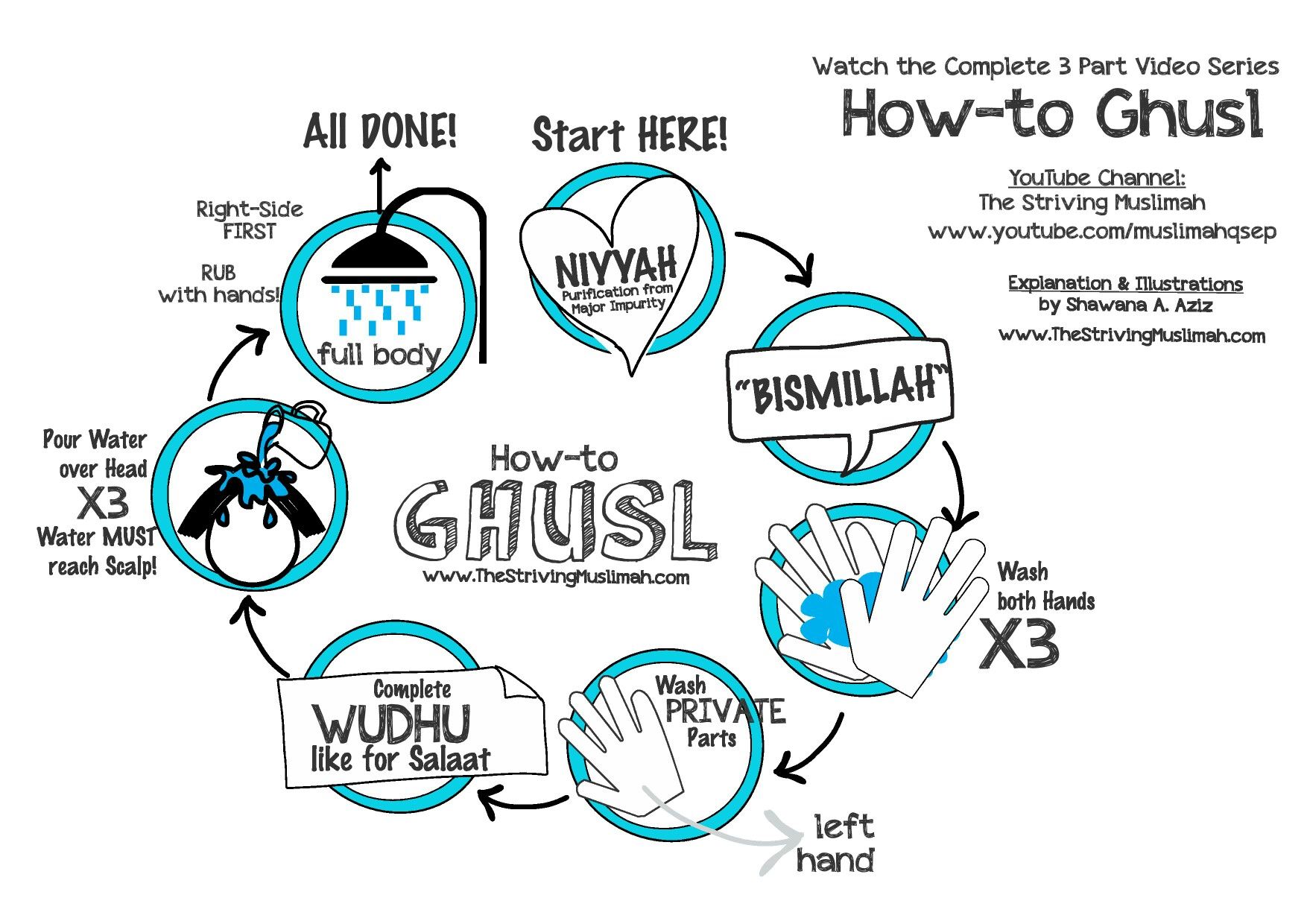
Ghusl is the ritual bath performed by Muslims to remove the majority of impurity such as when there is an emission of maniy (semen) even if it is not through intercourse; meeting of the two circumcised parts when the tip of the penis disappears completely in the vagina, even if no ejaculation takes place; menstruation and nifaas (postpartum bleeding); before Jumuah etc. Unfortunately, many Muslims do not know how to perform this bath. In this thread, you are going to learn how to perform Ghusl. How to perform Ghusl 1- Form the intention to purify oneself from impurity: janabah (impurity following sexual discharge), menses or nifas (postpartum bleeding). 2- Wash the entire body with water once, making sure that the water reaches the roots of the hair and the places that it cannot reach easily, such as the armpits and backs of the knees, as well as rinsing the mouth and nose, according to the correct scholarly opinion. Shaykh Ibn ‘Uthaymeen (may Allah have mercy on him) said in al-Sharh al-Mumti’ (1/423): “The evidence that this ghusl is valid is the words of Allah (interpretation of the meaning): “If you are in a state of Janabah (i.e. after a sexual discharge), purify yourselves (bathe your whole body)” [al-Maidah 5:6]. Allah did not mention anything apart from that. If a person washes his entire body once, then it is true to say that he has purified himself.” How to make the complete form of ghusl As for the complete form, it is as follows 1. Form the intention in the heart to purify oneself from major impurity: janabah (impurity following sexual discharge), menses or nifas (postpartum bleeding). 2. Then say Bismillah and wash the hands three times, then wash any dirt from the private part. 3. Then do wudu as for prayer, a complete wudu. 4. Then pour water over the head three times, and rub the hair so that the water reaches the roots of the hair. 5. Then wash the body, making sure that the water reaches all parts, starting with the right side of the body and then the left, and rubbing it with the hands so that the water reaches the entire body. The evidence for this mustahabb form of ghusl is: ‘Aishah (may Allah be pleased with her) said: When the Messenger of Allah (blessings and peace of Allah be upon him) did ghusl for janaabah, he would wash his hands and do wudu as for prayer, then he would wash himself, then he would run his fingers through his hair, then when he thought that it [the water] had reached his skin, he would pour water over it [the head] three times, then he would wash the rest of his body. (Narrated by al-Bukhari (248) and Muslim (316)) ‘Aishah (may Allah be pleased with her) also said: When the Messenger of Allah (blessings and peace of Allah be upon him) did ghusl from janabah, he would call for something like a vessel used for milking and take water in his palm. He started with the right side of his head, then the left, then he took water in both palms and poured it all over his head. (Narrated by al-Bukhari (258) and Muslim (318)) One of the important rulings concerning this matter is that ghusl for major impurity takes the place of wudu’, so the person who has done ghusl, whether the complete or the acceptable form, does not have to repeat wudu, unless he does something that invalidates purity whilst doing ghusl. And Allah knows best. https://www.ask-a-muslim.com/wp-content/uploads/2020/03/Complete-Ghusl-as-per-the-sunnah.jpeg Reference: IslamQA 20 Likes 4 Shares |
| Islam › Finding The Perfect Spouse by Lukgaf(op): 11:07pm On Nov 11, 2021 |
Not all those who are yet to marry are afraid of financial responsibilities. Many exercise the fear of not finding the right partner. Below thread details the path to finding the right spouse in Islam Every young adult experiences a time in their life where the fear of not finding the right partner eats them away inside. Every boy hopes to wed a princess; every girl dreams to wed a prince charming. Dreams can become a reality. One must walk the path to one’s dream.https://jamiat.org.za/finding-the-perfect-spouse/ 16 Likes 1 Share |
| Islam › Prayer When It Rains And Some Benefits Of Rain In Sunnah by Lukgaf(op): 7:52am On Nov 05, 2021 |
‘Aishah (may Allah be pleased with her) narrated that when the Messenger of Allah (blessings and peace of Allah be upon him) saw rain, he would say: “Allahumma sayyiban nafi‘an {O Allah, (make it) a beneficial downpour).” (Narrated by al-Bukhari, 1032) https://www.topislamic.net/wp-content/uploads/sites/20/2020/07/dua-when-raining.jpeg According to a version narrated by Abu Dawud (5099), he used to say: “Allahumma sayyiban hanian (O Allah, (make it) a wholesome downpour).” Classed as sahih by al-Albani. The word sayyib (translated here as downpour) refers to rain that flows. Allah, may He be exalted, says (interpretation of the meaning): “Or like a heavy downpour [sayyib] from the sky” [al-Baqarah 2:19] (Ma‘alim as-Sunan by al-Khattabi, 4/146) It is mustahabb to expose oneself to the rain and let some of it flow over one’s body, because of the proven report from Anas (may Allah be pleased with him) who said: When we were with the Messenger of Allah (blessings and peace of Allah be upon him) it rained. The Messenger of Allah (blessings and peace of Allah be upon him) lifted part of his garment so that the rain could fall on him. We said: O Messenger of Allah, why did you do that? He said: “Because it has just come from its Lord, may He be glorified and exalted.” Narrated by Muslim (898). When the rain grew severe, the Prophet (blessings and peace of Allah be upon him) said: “Allahumma hawalayna wa la ‘alayna; Allahumma ‘ala al-akami wa’z-zirabi, wa butun al-awdiyah wa manabit ash-shajar (O Allah, (let the rain fall) around us and not upon us, O Allah, (let it fall on) the small mountains and hillocks, the valley bottoms and places where trees grow).” Narrated by al-Bukhari (1014). The time when rain comes down is a time of divine bounty and mercy from Allah to His slaves, when the means of goodness are abundant, and it is a time when it is thought that du‘as will be answered . It says in the marfu‘ hadith of Sahl ibn Sa‘d that the Prophet (blessings and peace of Allah be upon him) said: “Two (du‘as) are not rejected: du‘a at the time of the call to prayer and du‘a at the time of rain.” Narrated by al-Hakim in al-Mustadrak (2534); at-Tabarani in al-Mu‘jam al-Kabir (5756); classed as sahih by al-Albani in Sahih al-Jami‘ (3078). And Allah knows best. Culled from IslamQA 12 Likes 1 Share |
| Islam › The Tafseer Of This Verse And The Death Of Corper Zainab. by Lukgaf(op): 7:26am On Nov 05, 2021 |
Sahara reporter reported the death of a corps member who sought redeployment from Borno state over insecurity. The corps member was said to be one of the victims of the Lagos building collapse. This incident and the story behind it affirms one of the verses of the Holy Quran in suratul-an-Nisa (verse 78) confirming Al-Quran is a true book from Almighty Allah. Allah says in this verse: أَيْنَمَا تَكُونُوا۟ يُدْرِككُّمُ ٱلْمَوْتُ وَلَوْ كُنتُمْ فِى بُرُوجٍ مُّشَيَّدَةٍ ۗ وَإِن تُصِبْهُمْ حَسَنَةٌ يَقُولُوا۟ هَـٰذِهِۦ مِنْ عِندِ ٱللَّهِ ۖ وَإِن تُصِبْهُمْ سَيِّئَةٌ يَقُولُوا۟ هَـٰذِهِۦ مِنْ عِندِكَ ۚ قُلْ كُلٌّ مِّنْ عِندِ ٱللَّهِ ۖ فَمَالِ هَـٰٓؤُلَآءِ ٱلْقَوْمِ لَا يَكَادُونَ يَفْقَهُونَ حَدِيثًا "Wherever you may be, death will overcome you—even if you were in fortified towers.” When something good befalls them, they say, “This is from Allah,” but when something evil befalls them, they say, “This is from you.” Say, ˹O Prophet,˺ “Both have been destined by Allah.” So what is the matter with these people? They can hardly comprehend anything!" — Dr. Mustafa Khattab, the Clear Quran In the Tafseer of this verse which is contained in the book of Maarif-ul-Quran There is no escape from death:May Allah forgive all our dead Muslims and grant us long life in His obedience. 37 Likes 8 Shares
|
| Education › Re: Learn O'level And Undergrad Mathematics In Yoruba And Simple English Accent by Lukgaf(op): 5:40pm On Nov 02, 2021 |
Jimasun:Hi Jimasun. The link is embedded on the first post. Click channel, English or Yoruba |
| Education › Learn O'level And Undergrad Mathematics In Yoruba And Simple English Accent by Lukgaf(op): 8:44am On Nov 02, 2021*. Modified: 4:59am On Jan 01, 2022 |
Without doubts, you'd agree with me that many students preparing for Mathematics at O'level and undergrad really found it challenging. One of the reasons is the way mathematics is being taught. Another challenge is the use of complex terms to explain the concept. I still recall my experiences at High School  . .I came across a channel where O'level mathematics topics are being taught and explained in simple English (simple accent) and Yoruba and I think it is a something our brothers preparing for those exams might find beneficial too. I found the following topics have been covered in the series already and others are still ongoing: - Number base systems - Modular Arithmetic - Indices - Logarithms - Series and Sequence (AP and GP) - Sets - Calculus - Statistical analyses made easy - Complex numbers etc. I think all science subjects we ran away from should be taught and explained in our mother's tongue. What do you think? 1 Like |
| Education › Re: JAMB UTME 2021 Thread by Lukgaf(m): 8:21am On Nov 02, 2021 |
You are preparing for Mathematics in JAMB? I got a channel for you where O'level mathematics is being taught in English and Yoruba. The following topics have been covered already: - Number base systems - Modular Arithmetic - Indices - Logarithms -Calculus You might want to see them here: English: https://www.youtube.com/watch?v=IUAbPhU7DLw&list=PLn0ZvdWhZVXcASYpr4SViyKOip5i58mu5 Yoruba: https://www.youtube.com/watch?v=cjoA-IuQdhI&list=PLn0ZvdWhZVXf8SEkUXGCtOtcIcnReMa48 Other videos: https://www.youtube.com/channel/UCSXNWNp1nEM4o2AbOgONZlQ/videos Good luck |
| Islam › Re: How To Perform Tayammum (sand Ablution)? by Lukgaf(op): 10:53am On Oct 29, 2021 |
ibrutex:Scholars said it is valid for multiple prayer 2 Likes 1 Share |
| Islam › How To Perform Tayammum (sand Ablution)? by Lukgaf(op): 10:25pm On Oct 28, 2021 |
When there is no water or you are not in a state you can use water for ablution (e.g extreme cold and you can not get warm water), then Islam permits you to do Tayammum (sand ablution). Below from IslamQA summarises how to perform it. Al-Bukhari and Muslim narrated the hadeeth of ‘Ammar ibn Yasir describing tayammum . Al-Bukhari narrated it in a number of places in his Sahih. One of these reports (no. 347; 1/455 of Fath al-Bari) says: “ ‘It would have been sufficient for you to do this’ – then he struck the palms of his hands on the ground, then dusted them off, then wiped the back of each hand with the other, then he wiped his face with his hands.” Abu Dawud (317; 1/515 of ‘Awn al-Ma’bud) narrated it with the same isnad as al-Bukhari, apart from the Shaykh of al-Bukhari (Muhammad ibn Salam), instead of whom he mentioned Muhammad ibn Sulayman al-Anbari, of whom al-Hafiz said in al-Taqrib (2/167): he is saduq (truthful). This version of the report says: “He struck his hands on the ground and dusted them off, then he struck his right hand with his left hand, and his left hand with his right hand, then he wiped his face.” Al-Hafiz mentioned in al-Fath (1/457) that al-Ism’ili narrated it with the wording: “It would have been sufficient for you to strike your hands on the ground, then dust them off, then wipe your right hand over your left and your left hand over your right, then wipe your face.” What should be wiped first in tayammum? Al-Shanqiti said in Adwa’ al-Bayan (2/43): “This hadith of al-Bukhari states that the hands should be wiped before the face.” Shaykh al-Islam said in al-Fatawa (21/423): “The report of al-Bukhari clearly shows that the back of the hand should be wiped before the face. The fact that in another report he said ‘the back of the hand’ indicates that he wiped the back of each with the palm of the other.” He also said (21/425: “But the report which was narrated only by al-Bukhari shows that he wiped the backs of the hands before the face.” (See al-Fatawa, 21/422-427) Based on this, the way in which tayammum is done is to say Bismillah with the intention of doing tayammum , then strike the ground once with the palms of the hands, then wipe the back of the right hand with the palm of the left, and the back of the left hand with the palm of the right, then wipe the face with both hands. Then the same du'as that are recited after wudu’ should be recited after tayammum. And Allah knows best. Summary 1- Say Bismillah. 2- Strike the ground once with the palms of the hands. 3- Wipe the back of the right hand with the palm of the left, and the back of the left hand with the palm of the right. 4- Wipe the face with both hands. 5- Recite the same dua's that are recited after wudu. 22 Likes 4 Shares |
| Islam › Is Riba (Usury) Forbidden In Islam? by Lukgaf(op): 10:12pm On Oct 28, 2021 |
Riba is the act of lending money with interest. This action is forbidden in Islam and Allah places His wrath on those who engaged in it. Why is this forbidden in Islam? This thread provides an answer. Praise be to Allah.Culled from IslamQA 4 Likes 1 Share |
| Islam › How To Treat Elders According To The Sunnah? by Lukgaf(op): 9:41pm On Oct 28, 2021*. Modified: 9:58pm On Oct 28, 2021 |
Islam enjoins us to respect elderly people. This thread explains how to treat elders according to the Sunnah. Know that seniors (those greater in age) have tremendous standing and rights. Therefore, if you walk beside an elder walk on his right side, slightly behind him. When you come to an entrance or exit, put him before you. When you encounter him give him is due by way of greeting with salam and showing respect.Muslim Village 10 Likes 1 Share |
| Islam › The Law Of Contrast And The Breakdown Of Muslim Relationships by Lukgaf(op): 8:32am On Oct 22, 2021 |
And it is among His signs that He has created for you wives from among yourselves, so that you may find tranquillity in them, and He has created love and kindness between you. Surely in this there are signs for a people who reflect. [30:21] https://jamiat.org.za/wp-content/uploads/2015/09/strong-marriage-660x495-e1441196251367.jpg Psychologists have long known about the contrast principle and it is easily demonstrated in university campuses around the world with the simplest of experiments. Teacher brings in three buckets of hot, cold and tepid (room temperature) water and a student each (while blindfolded) is asked to place their hand in the hot water bucket and the other in the cold one. Then, both are asked to dip the same hand in tepid (room temperature) water and describe the sensation. Wow! The student who had earlier dipped his hand in hot water describes it as cold while the other describes it as hot. That’s because they had different “comparison points” and anchors. Marketing gurus and sales people use this principle to maximum effect! In the US estate agents are taught to show “overinflated and mediocre” properties first before showing the actual property which they want to sell and the instant glow in the eyes of the unsuspecting customer tells its own story. The first “overinflated and mediocre” property contrasts and extenuates the second property and the customer views it much better than it actually is. Car dealers are taught to always negotiate the base (sticker price) of the car before selling options (tinted windows, sunroof, alloys etc) because the cost of £780 for tinted windows seems miniscule compared to the £18,000 which has been agreed for the car. Similarly department store sales staffs are trained to offer you an additional £60 silk tie after the sale of £600 suit. Overpriced deserts and drinks at restaurants work on the same principle. Here is the kicker! Sara Gutierres, Ph.D., and Douglas Kenrick, Ph.D conducted a series of experiments where male college students were offered a photo of a potential blind date candidate of average attractiveness. If the men were watching “Charlie’s Angels” the photo appeared to be less desirable (then it actually was) to the point where men wouldn’t bother for a date which was available to them. The glamour girls of “Charlie’s Angels” were to blame because they made average attractiveness look mediocre. We (as Muslims) are bombarded by men and women of “perfect figures” by the media, what do you think it’s doing to our relationships? For men, Allah (SWT) says in the Qur’aan: [3:14] It has been made attractive for people to love the desired things; that is, women, children, hoarded heaps of gold and silver, branded horses, cattle and tillage. That is an enjoyment of the worldly life; but with Allah lies the beauty of the final resort. Women are a source of attraction for men to begin with but when the “curvy beauties of the screen” are watched with intent then the perfectly attractive Sunnah loving home wife won’t seem so attractive anymore. Hollywood or Bollywood, movies, drams, soaps and songs will inevitably downgrade your spouse because Shaytaan is there to exploit the “Law of Contrast” and make the “curvy beauties of the screen” appear much more sensual and attractive than they actually are. Similar is the concept of “intellectual superiority” where the well rehearsed Pundit on the media will make your own spouse look inferior then they really are. Islamic Tele-evangelism, Nasheed concerts and pop culture are also nothing but deadly to our Islamic ideology while thinly disguised as “Islamic events”. And then we have the massive “Islamic conferences” where speakers are flown in from overseas paid megabucks and housed in 5-star accommodations to deliver “Islamic talks” to thousands of fans. Where are we heading with all of this? In our communities, how many of us have heard stories of marital breakdowns where the spouse is deemed to be “physically unattractive” or “intellectually inferior” while we scratch our heads and say, “There isn’t a lot wrong with him or her!”. Can the “Law of contrast ” be discounted in the breakdown of Muslim family epidemic which every community is experiencing? Fortunately, the Qur’aan gives solid advice to limit the damage as follows: Guard your gaze: The poison of “contrast” enters your heart and mind through your eyes so the Qur’aan commands the first barrier to be placed on the sight: [24:30] Tell the believing men that they must lower their gazes and guard their private parts; it is more decent for them. Surely Allah is All-Aware of what they do. [24:31] And tell the believing women that they must lower their gazes… 2. Dolled up Hijabees & Macho Bearded men: How many times have you been to the Masjid and noticed “dolled up Hijabi Sisters” with layers upon layers of makeup and skin tight clothes OR men with tight clothes to show their bodies which they have worked tirelessly at the gym for weeks on end? These “creatures of self-indulgence” must be told that they are committing Haram while enticing others. [24:31] ….and guard their private parts, and must not expose their adornment, except that which appears thereof, and must wrap their bosoms with their shawls, and must not expose their adornment, except to their husbands or their fathers or the fathers of their husbands, or to their sons or the sons of their husbands, or to their brothers or the sons of their brothers or the sons of their sisters, or to their women, or to those owned by their right hands, or male attendants having no (sexual) urge, or to the children who are not yet conscious of the shames of women. And let them not stamp their feet in a way that the adornment they conceal is known. And repent to Allah O believers, all of you, so that you may achieve success. 3. Thanking Allah (SWT): Next time your spouse does something which pleases you don’t forget to “Thank Allah (SWT)”. [14:7] (Recall the time) when your Lord declared, .If you express gratitude, I shall certainly give you more, and if you are ungrateful, then My punishment is severe. 4. Mr Perfect & Miss Right? There is a saying “Nobody is perfect” but it’s time to implement it. Next time you are searching for perfection in your spouse, direct that gaze to yourself instead and follow the command of Allah (SWT) for the “dear wife”: [4:19] O you who believe, it is not lawful for you that you should forcibly take women as inheritance. Do not hold on to them so that you may take away some of what you have given them, unless they commit a clearly shameful act. Live with them in the recognized manner. If you dislike them, then it is quite likely that you dislike something and Allah has placed a lot of good in it. So before reaching for that remote control next time remember what it’s doing to your relationship! Jamiat ULAMA 10 Likes 2 Shares |
| Islam › Re: Reasons Why You Shouldn't Celebrate Mawlid Nabiyy by Lukgaf(op): 8:52am On Oct 15, 2021 |
2468iyajo:It is good not to say it ma 3 Likes |
| Islam › The Intense Love Of The Holy Prophet Muhammad To The World by Lukgaf(op): 7:45am On Oct 15, 2021 |
Anas (Radhiyallahu Anhu) reports that Rasulullah (Sallalahu Alayhi Wasallam) said, “Every Nabi was blessed by Allah Ta’ala with a special duaa which was guaranteed to be accepted. Every Nabi had made his duaa in this world for his ummah, and I wish to reserve my special duaa for the day of Qiyaamah so that I may intercede to Allah Ta’ala on behalf of my entire ummah.” (muslim) Rasulullah (Sallallahu Alaihi Wasallam)’s deep and intense love for his ummah can never ever be comprehended. It is a love that far surpasses the love of any mother for her infant child.The following incident presents a glimpse of his extreme love for his entire ummah. Our mother Aaisha (Radhiyallahu Anha) reports that once I had seen Rasulullah (Sallallahu Alaihi Wasallam) in a happy state. I said to him, “O Rasul of Allah (Sallallahu Alaihi Wasallam), make (a special) duaa for me.” Rasulullah (Sallallahu Alaihi Wasallam) began making duaa in the following words: “O Allah, forgive Aaisha, forgive her for her past and future, open and secret sins.” Aaisha (Radhiyallahu Anha) became extremely pleased and began to laugh out of joy to such an extent that she placed her mubaarak head on her lap. Rasulullah (Sallallahu Alaihi Wasallam), noticing the extreme happiness of Aaisha (Radhiyallahu Anha) upon the duaa he made for her, said, ‘O Aaisha, are you happy on account of the duaa I made for you?” Aaisha (Radhiyallahu Anha) replied, “Certainly I am happy! Why should I not be happy, whereas you made such a special duaa for me today?” Rasulullah (Sallallahu Alaihi Wasallam) then said: “I swear by Allah, after every salaah, I make this special duaa for my entire ummah.” (Saheeh ibn Hibbaan #7111) May Allah Ta’ala bless us with His special love and the love of his beloved, Rasulullah (Sallallahu Alaihi Wasallam), and keep us steadfast and firm on the mubaarak sunnah in every facet of our lives until our last breath. Source: Ihyaauddeen 52 Likes 5 Shares |
| Islam › Reasons Why You Shouldn't Celebrate Mawlid Nabiyy by Lukgaf(op): 7:23am On Oct 15, 2021 |
It's the month of Rabbiul awwal and starting from next week, people across Nigeria will be celebrating Mawlid Nabiyy - some will celebrate it till after Ramadan. In essence, they have turned this into a celebration of some sort. Meanwhile, Our prophet when he was alive did not celebrate his day of birth nor was he celebrated by his Sahaba after his demise. So what's now our problem of doing what he and his companions did not do? Below are some reasons why you should not join them in celebrating Mawlid Nabiyy culled from Omar Faroouq's Islamic page. 1. "Milad" (birthday) is not in Islamic shariah, it was later introduced by the Shia Fatimd in Egypt. 2. Historians differed about the date of birth of Prophet Muhammod (s.a.w.s). Some said it's Ramadan, some in Shaban and some in Rabiul awwal. 3. Birthday celebrations have pagan roots, celebrating birthday is not allowed at all in Islam. 4. The celebration is neither from sunnah nor Qur'an. Anything that is not part of these two can not be part of islam. 5. Prophet s.a.w.s said, "stick to my sunnah and the sunnah of my rightly guided caliphs, beware of newly invented matters, for every new matter is a Bid'ah and every Bid'ah is misleading." (Trimidhi 2676). 6. Allah says in surah Al Maidah,ayah 3. "This day, I have perfected your religion for you." when Islam is perfect and complete, then who gave the authority to these people to introduce new concepts in Islam? 7. Celebrating 'Milaad' is the imitation of Christians and Jews. Jews celebrate the birthday of Uzair, while Christians celebrate the birthday of Isa (A.s). 8. Prophet Muhammod (s.a.w.s) said, " Whoever imitates a sect or people becomes one of them". (Abu Dawood). 9. Prophet Muhammod also said, "be different from Mushrikeen (the Unbelievers)." (Sahih muslim). 10. Prophet Muhammad(s.a.w.s) again said, "Do not exaggerate in praising me". Wa Allahu Ahlam. I Pray Allah increase our Eeman and guide us to the right path. Aameen In addition, with respect to the above Hadith "The Prophet ( ﷺ ) said: "Whoever innovates into this affair of ours something that we have not commanded it is to be rejected" The key concept here is innovation in acts of worship (bid'a — بدعة). One of the things that distinguish Islam from other religions is that we have the sources of Islam (the Qur'an and Sunnah) that tell us the best way to worship Allah. We can't make up new ways to worship Allah. If we did, it would imply a few things that contradict some of the core beliefs of Islam: 1) That Islam is imperfect or incomplete. But the Qur'an says (part of Surat Al-Ma'idah [5:3]): This day I have perfected for you your religion and completed My favor upon you and have approved for you Islam as religion. 2) That we know better than the Prophet how to worship Allah or that the Prophet failed to teach Islam to us?? 3) That the sahabah, tabi'een and tabi' tabi'een did not practice Islam as well as we do. But the Prophet ( peace be upon him ) said: "The best generation is my generation, then those that follow them, then those that follow them." Since all three propositions are clearly false, we must conclude that one should not make new ways to worship Allah. Now that this is clear, let's take the example of the birthday of the Prophet. Firstly, there is no evidence whatsoever that he celebrated his birthday. If it was good to celebrate his birthday, he would have done so himself. Second, the generations after the Prophet did not celebrate it. If the Prophet muhammmad ( pbuh ) said that they are the best generation after his and they did not celebrate it, are we better than them? Third, there's the practical issue: there is not consensus on the actual date — there is only scant evidence that it was actually on the 12th of Rabi' al Awwal — so we may actually be celebrating on the wrong day. We don't even have a range (like, say, laylatul qadr). Anas ibn Maalik (ra) said: "The Prophet (saw) arrived in Madeenah while people were celebrating two particular festivals, so he asked: “What is (the significance of) these two days?” Some people replied: ‘They are days which we used to celebrate during the pre-Islamic era.’ So the Messenger replied: “Allaah has replaced them for you with two days which are better, the day of ‘Eed Al-Fitr and ‘Eed Al-Adh-haa”" [Abu Daawood]. This statement of Prophet Muhammad (saw) has made it clear that in Islam we only have two festivals, which are Eed Al-Fitr and Eed Al Adh-haa and there is no other festival apart from these two festivals for we Muslims to celebrate and NO MATTER what names we give to others festivals apart from Eed Al-Fitr and Eed Al Adhaa, it could be New Year of Gregorian calendar (1 January ) or New Year of Hijri calendar (1 Muharram ) or Christmas or Maulud Nabi or Easter or Chinese New Year, etc all these festivals are forbidden for Muslims to celebrate. Allah says ”If anyone contends with the Prophet (saw) even after guidance has been plainly conveyed to him and follows a path other than that of the believers, we shall leave him in the path he has chosen and land him in Hell, what an evil destination (Surah An-Nisa 115 ). May Allah grant us the understanding of His religion. 26 Likes 3 Shares |
| Islam › What Is The Actual Date Of Prophet Muhammad's Birth And Death? by Lukgaf(op): 7:00am On Oct 15, 2021 |
Different views on the day and month of Prophet Muhammad’s birth The biographers and historians differed concerning the day and month of the birth of the Prophet (blessings and peace of Allah be upon him). This is something for which there is good reason, as it was not known what status this newborn would achieve; his situation was like that of any other newborn. Hence no one can state with certainty the date of his birth (blessings and peace of Allah be upon him). Different views on defining the month and the day of the month of Prophet Muhammad’s birth With regard to the point on which there is scholarly disagreement, that has to do with defining the month and the day of the month. We have come across many opinions concerning that, including the following: 1. That he was born on 2nd Rabee ‘ al-Awwal. Ibn Kathir (may Allah have mercy on him) said: “It was said that he was born on the second of the month. This was stated by Ibn ‘Abd al-Barr in al-Isti'ab, and was narrated by al-Waqidi from Abu Ma‘shar Nujayh ibn ‘Abd ar-Rahman al-Madani.” (As-Seerah an-Nabawiyyah, 1/199) 2. It was said that he was born on 8th Rabee‘ al-Awwal. Ibn Kathir (may Allah have mercy on him) said: “It was said that he was born on the eighth of the month. This was narrated by al-Humaydi from Ibn Hazm, and was narrated by Malik, ‘Aqeel, Yunus ibn Yazeed and others from az-Zuhri from Muhammad ibn Jubayr ibn Mut‘im. Ibn ‘Abd al-Barr narrated that the historians regarded it as sahih; it was stated definitively by al-Hafiz al-Kabeer Muhammad ibn Musa al-Khawarizmi, and was regarded as most likely to be correct by al-Hafiz Abu’l-Khattan ibn Dihyah in his book at-Tanweer fi Mawlid al-Basheer an-Nadheer.” (As-Seerah an-Nabawiyyah, 1/199) 3. It was said that he was born on 10th Rabee ‘ al-Awwal. Ibn Kathir (may Allah have mercy on him) said: “It was said that he was born on the tenth of the month. This was narrated by Ibn Dihyah in his book, and was narrated by Ibn ‘Asakir from Abu Ja‘far al-Baqir. It was also narrated by Mujalid from ash-Sha‘bi.” (As-Seerah an-Nabawiyyah, 1/199) 4. It was said that he was born on 12th Rabee ‘ al-Awwal. Ibn Kathir (may Allah have mercy on him) said: “It was said that he was born on the twelfth of the month. This was stated by Ibn Ishaq. It was narrated by Ibn Abi Shaybah in his Musannaf from ‘Affan from Sa‘eed ibn Mina that Jabir and Ibn ‘Abbas said: The Messenger of Allah (blessings and peace of Allah be upon him) was born in the Year of the Elephant on Monday 12 th Rabee‘ al-Awwal; on Monday his mission began, on Monday he was taken up to heaven, on Monday he migrated, and on Monday he died. This is the well-known opinion according to the majority. And Allah knows best.” (As-Seerah an-Nabawiyyah, 1/199) It was also said that he was born in Ramadan or in Safar or some other month. What appears to us to be the case is that the strongest opinion concerning the birth of the Prophet (blessings and peace of Allah be upon him) is that he was born between the eighth and the twelfth of Rabee‘ al-Awwal. Some Muslim mathematicians and astronomers have determined that the Monday in question was the ninth of Rabee‘ al-Awwal. It may be that this is another opinion, and it has some merit. That corresponds to 20th April 571 CE. This is what the authors of some modern books on Seerah (Prophet’s biography) regard as most likely to be correct, including Professor Muhammad al-Khudari and Safi ar-Rahman al-Mubarakfuri. Abu’l-Qasim as-Suhayli (may Allah have mercy on him) said: “The mathematicians say that his birth occurred in the solar month of April, on the twentieth of that month.” (Ar-Rawd al-Unuf, 1/282) Prof. Muhammad al-Khudari (may Allah have mercy on him) said: “The Egyptian astronomer Mahmoud Basha (d. 1885 CE) who was well-versed in astronomy, geography and mathematics, and wrote several books based on his research stated that it was on the morning of Monday 9th Rabee‘ al-Awwal, which corresponds to 20th April 571 CE. That corresponds to the first year following the elephant incident. He was born in the house of Abu Talib in Shi‘ab Banu Hashim.” (Nur al-Yaqeen fi Seerat Sayyid al-Mursaleen (p. 9). See also ar-Raheeq al-Makhtum, p. 41) Date of the death of our Prophet Muhammad With regard to the date of the death of our Prophet Muhammad (blessings and peace of Allah be upon him), there is no difference of opinion concerning the fact that it occurred on a Monday. The report narrated from Ibn Qutaybah, saying that it occurred on a Wednesday, is not correct. Perhaps what he meant is that the Prophet (blessings and peace of Allah be upon him) was buried on Wednesday, which is correct. With regard to the year of his death, there is no difference of opinion concerning the fact that it was in 11 AH. With regard to the month of his death, there is no difference of opinion concerning the fact that it was in Rabee‘ al-Awwal. Different views on the date of Prophet Muhammad’s death in Rabee` al-Awwal With regard to the date of his death in that month, there is a difference of opinion among the scholars. 1. The majority are of the view that it occurred on 12th Rabee‘ al-Awwal. 2. al-Khawarizmi was of the view that it occurred on 1st Rabee‘ al-Awwal. 3. Ibn al-Kalbi and Abu Makhnaf were of the view that it occurred on 2nd Rabee‘ al-Awwal. As-Suhayli was inclined to favour this view and al-Hafiz Ibn Hajar (may Allah have mercy on him) regarded it as most likely to be correct. The most well-known view is that of the majority, which is that the death of the Prophet (blessings and peace of Allah be upon him) occurred on 12th Rabee‘ al-Awwal 11 AH. May peace and blessings of Allah be upon the noble soul of the holy Prophet Muhammad, his households and companions References Ar-Rawd al-Unuf by as-Suhayli, 4:439-440. As-Seerah an-Nabawiyyah by Ibn Kathir, 4:509. Fath al-Bari by Ibn Hajar, 8:130. And Allah knows best. IslamQA 3 Likes 1 Share |
| Islam › Re: You're A Traveller Praying Behind A Imam, Can You Still Shorten Your Solah? by Lukgaf(op): 12:36pm On Oct 08, 2021 |
Gratitudes081:Wa alekum salam waramotulah wabarakatuh Cf; https://islamqa.info/en/answers/60358/they-travelled-for-twenty-days-during-which-they-shortened-their-prayers-do-they-have-to-make-them-up |
| Islam › Is The Below Hadith On Offering Congratulations On Rabiu 'l Awal Authenticc by Lukgaf(op): 7:45am On Oct 08, 2021 |
According to the sultanate counting, today is the 1st of Rabiu l'awal. Is the below Hadith on offering congratulations in this month authentic? "Whoever offers congratulations to people for this blessed month, the Fire will be forbidden for him.” How sound is this hadith? Praise be to Allah.Source: https://islamqa.info/en/answers/215135/a-baseless-hadith-about-congratulating-one-another-on-the-beginning-of-rabee-al-awwal |




1 2 3 4 5 6 7 8 ... 35 36 37 38 39 40 41 42 43 (of 98 pages)