PhysicsMHD's Posts
Nairaland Forum › PhysicsMHD's Profile › PhysicsMHD's Posts
1 2 3 4 5 6 7 8 ... 50 51 52 53 54 55 56 57 58 (of 67 pages)
 Politics › Re: Ndigbo In The Fourth Republic by PhysicsMHD(m): 4:47am On Jan 31, 2011 Politics › Re: Ndigbo In The Fourth Republic by PhysicsMHD(m): 4:47am On Jan 31, 2011 |
"The backwardness of the Southern Cameroons was not due to any inherent economic deficiencies, and there was no substance in the argument that the territory necessarily depended on aid from Nigeria."0 The effects of the Nigerian connexion were especially evident in education and government employment. When the British replaced the Germans, they restored the five government primary schools, at Victoria, Buea, Kumba, Mamfe and Bamenda, to the standard six level. Apart from these five schools, and the teacher-training centre at Kumba, all other schools in the territory were run either by Native Administrations or by missions. There were no institutions for secondary education until 1939, when the Roman Catholic Mill Hill Fathers opened St Joseph's College at Sasse, in Victoria division. Thus it was extremely hard for Cameroonians to pursue higher learning and catch up with their contemporaries in Nigeria. They were liable instead to be relegated to the meanest and dirtiest jobs, whether in the plantations, in Government offices or in business firms, while the more lucrative and respectable jobs tended to be held by Nigerians, particularly Igbo." Up to the outbreak of World War II, very few Cameroonians found their way to Nigeria in search of secondary or higher education. Those who did acquired a grasp of English education and culture which enabled them to associate fully with Nigerians and to appreciate their strengths and weak- nesses - especially those of the Igbo. Such Cameroonians were liable to find that even with a good education they were at a disadvantage: their path into the public service was blocked by Nigerians who had entrenched themselves in the days when there were no qualified Cameroonians. This point was only reinforced as Cameroonians after the war began to emerge from St Joseph's College: their difficulties in obtaining appointments in public service were attributed to obstruction and corrupt demands by senior Igbo clerks in government offices.'2 To support this view, the principal of St Joseph's compiled in 1948 a list of those who had left the college in 1946-7 and were finding it hard to get a government job in the Cameroons. S. Ndely, from Bojongo (Victoria division), was an excellent shorthand typist with a grade II school certificate, yet despite many applications supported by references from the principal, he could not get a job locally and remained unemployed for ten months: in the end, he was taken on by the Secretariat in Enugu. S. Nyenti, with a grade III school certificate, had to wait nine months before finding work as a stenographer in Lagos. This was the irony: Cameroonians found it easier to get work outside the Cameroons than within it. This lent credence to their claim that the local administration was controlled by Igbo. D. Tiku, a Bayangi with a grade II school certificate, had his application to the Forestry Office turned down by the Igbo clerk in charge during the absence of his white superior. The post required the applicant to have either a grade I school certificate or an exemption from London matriculation. The clerk insisted on the first condition because he knew that Tiku satisfied only the second. " |
| Politics › Re: Ndigbo In The Fourth Republic by PhysicsMHD(m): 4:46am On Jan 31, 2011 |
"The original owners of the land began to resent such Igbo.6 Igbo also came to work on plantations: by I932 these employed nearly a thousand Nigerians, most of whom were in Kumba division, where they comprised a quarter of the plantation workforce. By I937 - when the total workforce on Kumba plantations had risen to over 4,000 - Nigerians still accounted for 15 per cent.7 Many such migrants were brought by canoe by Efik (Ibibio) from Calabar, who were paid by their passengers once they had found employment. In 1955 there were 5,732 Igbo and Ibibio on Victoria estates, and I,540 on those in Kumba belonging to the Cameroons Development Corporation (which had taken over the property of German planters). Most of the Igbo came from the Owerri and Okigwi divisions of Owerri Province, which included some of the highest population densities in Eastern Nigeria; most of the rest came from around Afikpo. The Ibibio mostly came from a densely populated area in Uyo division. Ac- customed to a cash economy, quick to react to labour markets and undeterred by distance, Igbo were generally predisposed to become migrant workers. But by the same token they were on the alert for other ways to make money. Cameroonian workers often complained that things left lying around vanished when Igbo were in the camps, and claimed that Igbo had introduced the practice of bribing headmen and overseers; they further accused Igbo of arrogance, disrespect towards older men, causing trouble at work and seducing the wives of local workers. The Igbo did not help matters by regarding Cameroonians as unsophisticated and backward.8 What really mattered, though, was the way in which the Igbo turned to advantage the economic backwardness of the Southern Cameroons. Even after World War II there was a marked contrast between them and the local population in terms of access to education as well as commercial aptitude and experience. Igbo made the most of this, and consolidated their position in trade and government in face of mounting hostility.9 The backwardness of the Southern Cameroons was largely due to the very fact of the British Mandate. While the French administered their mandate as if they would never leave, the British considered theirs a liability - a mere appendage to Nigeria. In I944 the Colonial Secretary admitted to the House of Commons that the British Cameroons had been neglected, and attributed the lack of public or private investment to the uncertain political future of the territory. The British had scarcely improved the German system of roads and communications, and the second departure of German planters, in I939, was a major setback to economic growth. By I 946 the territory had become a 'lost world', isolated from the French mandate, yet deriving no material advantage from its administrative incorporation in Nigeria. On the contrary, the efforts of indigenous merchants were frustrated by the near-monopoly of trade by foreign combines such as John Holt or the United Africa Company. " |
| Politics › Re: Ndigbo In The Fourth Republic by PhysicsMHD(m): 4:45am On Jan 31, 2011 |
@ asha 80, This is what happened in Cameroon. Cannot possibly be compared to non-Igbo Southern Nigerians: "ON I February I96I, the southern part of the British mandate in the Cameroons voted, by a large majority, to leave the newly independent federation of Nigeria and join instead the Republic of Cameroun, successor- state to the French mandate. A major factor in this plebiscite was fear of Igbo domination in trade, education, public and private sector employment, politics and social life. Igbo had begun to move into the Cameroons in the I920s, and by I955 there were nearly 1o,ooo Nigerians in the two southern- most divisions of British Cameroons, most of them Igbo or Ibibio. This immigration had been facilitated by the fact that, ever since the League of Nations had assigned mandates over the former German colony, Britain had administered the divisions of Victoria, Kumba, Mamfe and Bamenda as part of south-eastern Nigeria.1 With the approach of independence, local re- sentment against the immigrants strengthened demands for an end to the Nigerian connection.2 There were indeed some grounds for this resentment, but politicians actively exploited ethnic stereotypes. The nature of these is illuminated by the novelist Chinua Achebe, himself an Igbo. He points out that Igbo culture was receptive to change, individualistic and highly competitive. This gave the Igbo an unquestioned advantage in securing the credentials for ad- vancement in colonial Nigeria. The Igbo were bound neither by a con- servative religion (as were the Hausa), nor by a conservative tradition (as were the Yoruba), and were correspondingly quick to make use of the opportunities created by the white man's civilization. Unfortunately, the Igbo's success bred in them pride and indifference to the feelings of others. Added to this was showiness, noisy exhibitionism, and disregard for humility and quietness. All this excited envy and hatred.3 Another writer has associated Igbo openness to new ideas with the adoption of new standards, an eagerness to be in the mainstream of progress, and an ambition to be noticed. A recurrent feature of Igbo life is a spirit of open rivalry. The man to be admired is he who has wives and children, bestirs himself, and makes money. The humble gentleman is not respected. A further aspect of the Igbo stereotype is 'aggressiveness '; this has been attributed to a combination of high population densities and an absence of large-scale social or political organizations. Characteristic of the Igbo is an egalitarian belief that there are no social and class barriers to self-advancement.4 Increasing contact between Igbo and other cultural groups tended to generate unfavourable stereotypes of Igbo behaviour. What the Igbo took to be virtues were liable to be regarded by others as weaknesses. In the light of values characteristic of many Cameroonians, the Igbo seemed self-centred, obsessed with wealth and lacking in respect for traditional authority. These supposed failings were in no way compensated by Igbo readiness to work hard; if anything, this only tended to exacerbate ill-feeling towards them. It was all too easy to arouse anti-Igbo sentiment where they seemed most threatening, especially in the towns of Victoria, Tiko, Buea, Kumba, Mamfe and Bamenda.5 The Igbo came into the Southern Cameroons in various ways. The first were government employees who had to accept whatever posting they were given. Others left home to work for expatriate firms. Some came to work on the Nigeria-Cameroons road; of these, some died on the job while others returned home, repelled by their working conditions. But the most resilient persevered; they followed the road into the Cameroons and settled in road- building camps. In the course of time, they brought their families and began to farm the land around the camps. Eventually, the road-builders diversified into trade, at first part-time and then full-time. " |
| Politics › Re: Ndigbo In The Fourth Republic by PhysicsMHD(m): 4:42am On Jan 31, 2011 |
Obiagu1:Wow, you're simply not getting it are you? It has such an inappropriate consequence (colonization/expansionism), yet you're expressing it with such childlike innocence that it comes across almost as something else. My question was rhetorical, I know exactly why Igbos can't "have influence" in Cameroon as the articles I will post will show. I didn't say an Igbo in Cameroon was accepted as one of them. I said he was a rich guy in Cameroon. What you're not getting is that 1.5 million, 600,000, or 1.5 billion, a country and its land belongs to certain groups. How hard is that to grasp? If the Europeans had not made countries Africa would be a free for all and if I were a Bini expansionist I would be the first to lead the charge into Gabon to cleanse the land of the cannibal stench.  I said you had to go beg them because you do. That's the reality. If you waltz in in large numbers (and how would you prevent too many more Igbos from coming once you get successful metropolises up and running if you do waltz in ?) without asking how many can stay and what they'll let you set up, then you're screwed. That's my point. I said you had to go beg them because you do. That's the reality. If you waltz in in large numbers (and how would you prevent too many more Igbos from coming once you get successful metropolises up and running if you do waltz in ?) without asking how many can stay and what they'll let you set up, then you're screwed. That's my point.The presence of Yoruba in Togo from pre-colonial times seems to be a fact. The presence of Nago settlers later is not being denied. But saying Yorubas are not native to Togo because of some settlers sounds like pure conjecturing when every objective researcher seems to say otherwise. |
| Politics › Re: Ndigbo In The Fourth Republic by PhysicsMHD(m): 4:27am On Jan 31, 2011 |
asha 80:Dapobear/eku_bear already posted two articles that explain it, I will post parts of them here and you can google the titles of the articles to download them (for a fee if you're not at a university or subscribing public library) from jstor |
| Politics › Re: Ndigbo In The Fourth Republic by PhysicsMHD(m): 4:07am On Jan 31, 2011 |
[quote author=EzeUche_ link=topic=595370.msg7636835#msg7636835 date=1296441855]PhysicMHD You forget that most Igbo clans were warlike as well. Have you heard of Ohafia? Or Abiriba? Or even the head hunters from Abam? We Igbos have a warlike past. And we fear nothing. Why be afraid of the Fang when we Igbos are 30 million +?[/quote]I forgot nothing about Igbos being warriors. That doesn't factor into what the attitude is of the man who an Igbo is coming to beg for land is. What matters is the man giving away the land's pride, sense of history, natural aggressiveness, and other characteristics. Conquering warrior cannibal ancestry suggests non-pushovers. Conquering the land after coming from the northeast suggests not allowing it to be coopted by foreign elements. You're already thinking in an aggressive military confrontational style which is a social, political and diplomatic weakness. You should be worrying about things like deference, courtesy, propriety, assimilation ability, etc, if you're going to go live in another man's land. Obiagu1:So? The richest man in Cameroon is an Igbo. One of the Nigerien ambassadors or government ministers is an Igbo. Why haven't you suggested colonizing these places? They're not fully occupied. Hausas in Ghana aren't like those in Nigeria afterall, so why not try the desert (Niger)? What does this have to do with setting up multiple cities or a colony in another country in 2011? If Igbos in Cameroon are not being strangulated by the cage of Cameroon's politics like Igbos in Nigeria are, why not just go to Cameroon en masse? It's closer, even. By the way, Yorubas are indigenous to Togo, though their indigenous presence attracted some later migrants. http://books.google.com/books?id=ric6OhxbCS0C&pg=PA55&lpg=PA55&dq=yorubas+ketu&source=bl&ots=t9dgcxcbTs&sig=CdbV-hNr2z2Qp119cY6Pn_GE6eM&hl=en&ei=CSZGTae6H4jdgQeir_H9AQ&sa=X&oi=book_result&ct=result&resnum=4&ved=0CCkQ6AEwAw#v=onepage&q=togo&f=false http://books.google.com/books?id=oKXrAAAAIAAJ&q=yorubas+in+togo&dq=yorubas+in+togo&hl=en&ei=liVGTb3_CcvSgQel4cHqAQ&sa=X&oi=book_result&ct=result&resnum=8&ved=0CEsQ6AEwBw (p. 58 at the bottom) Yorubas are accepted as Togolese and there is nothing the other groups can do unless they redraw the borders that the colonials chose to draw which threw Yorubas into Togo. |
| Politics › Re: Ndigbo In The Fourth Republic by PhysicsMHD(m): 3:42am On Jan 31, 2011 |
Obiagu1:Empty for Igbos, or empty for Gabonese? Once again, there is such a thing as nativism. It's a very real phenomenon that has NOTHING to do with Nigerianness or non-Nigerianness. It's worldwide. If you succeed in convincing the ferocious, aggressive, warrior-blood Fang dignitaries you meet with that they should allow their state and homeland to be co-opted by a foreign element, good for you. If you don't succeed and try to set up a base without the go-ahead from the masters (not allies, not economic partners, not co-equals, but the owners) prepare for anti-Igbo decrees and measures to be taken. The Southern Cameroons did so in response to a much smaller influx than whole cities/colonies. If your proposed colony is only about 100,000-200,000 people you might have more luck, although it probably wouldn't meet your goals, but don't do it all at once. And if you do go to negotiate with the Fang, suggest mutual Gabonese + Igbo cities, not Igbo only, and with no Igbo political control, only economic. If you low-ball it like that you won't be rejected outright because they might see the wealth and expertise skilled Igbo professionals could bring and allow it. Otherwise you'll just be laughed at. And when you set foot in Libreville to negotiate with the Fang, make sure to hire some local security. There's no telling what could go down in a discussion with war like people with cannibal fever. |
| Politics › Re: Ndigbo In The Fourth Republic by PhysicsMHD(m): 3:06am On Jan 31, 2011 |
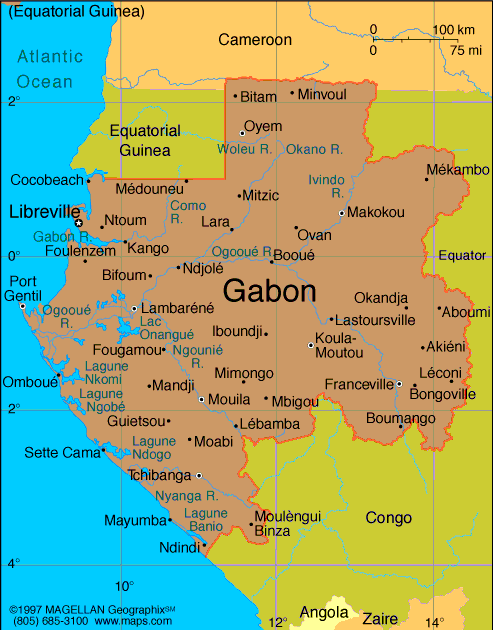
Obiagu1:Do you have any idea of what nativism is? Countries and lands belong to groups before and after the Europeans came. Not everything is for sale. Is Libreville the only city in Gabon? https://i.infoplease.com/images/mgabon.gif How can you think of colonizing another group's area because of the political suffocation of your current country and seriously ask how there will be a problem? I can't even understand this mentality. It's like a carefully calculated, guided, masterful obliviousness. You're setting up your followers for a Ghana-Must-Go worse than anything non-Igbo southern Nigerians could orchestrate. |
| Politics › Re: Ndigbo In The Fourth Republic by PhysicsMHD(m): 2:57am On Jan 31, 2011 |
Obiagu1:Just humor. I was surprised to find out the majority of Gabonese happened to be this aggressive warrior people. Let 5 million Igbos flood Gabon this minute. I just think the idea is basically ludicrous. Go ahead though, if you're serious. Learn French, get the whole idea rolling. Setting up an economic base outside the frustrating political cage of Nigeria is a good idea. Setting up an economic base in aggressive warrior descended Fang central is an awful idea but it has to be better than just sitting around waiting an eternity for Nigeria to somehow progress. And I never brought up Guinea. |
| Politics › Re: Ndigbo In The Fourth Republic by PhysicsMHD(m): 2:43am On Jan 31, 2011 |
"Fang" Damn. I mean, just. . . . .damn! Ferocious. Wouldn't want to piss off a group with badass name like that. Turns out the English language connotations of their name are well deserved: "The Fang mainly inhabit the hot, humid, equatorial rain forests of Gabon, making up 80% of the Gabonese population. They are of medium height and have a relatively powerful build and pride themselves greatly on their physical beauty. The Fang are reported to have moved from the northeast centuries ago and settled in the region to farm. Because they are a warrior like people they quickly conquered the native inhabitants. Many ethnic groups still fear the Fang because of their powerful aggressive tendencies. The Fang are also known for their older practice of cannibalism, which they practiced unashamedly during the 17th centuries and earlier" See Fang, see trouble: [img]http://www.smh.com.au/ffximage/2006/08/07/gabon_wideweb__430x322,0.jpg[/img] [img]http://www.wayfaring.info/wp-content/uploads/2009/01/lbv26.jpg[/img] [img]http://www.wayfaring.info/wp-content/uploads/2009/01/coscongobrazzaville.jpg[/img] And some people believe such people would let strangers come in and build a mega base in their country. |
| Politics › Re: Mend Threatens To Level Oil Industry by PhysicsMHD(m): 1:43am On Jan 31, 2011 |
I saw that a Nigerian's first name was Heineken once and knew immediately that he was from the Niger Delta before even reading his last name. Heineken? Ridiculous.  |
| Politics › Re: Ndigbo In The Fourth Republic by PhysicsMHD(m): 1:27am On Jan 31, 2011 |
[quote author=eku_bear link=topic=595370.msg7636522#msg7636522 date=1296432687]I found this quote interesting: Anyway, we shall see, I guess.[/quote]Assuming fusion by 2060, I think the other major challenge is an engineering challenge. People have already built some sea hotels, but constructing a whole stable artificial landmass, even one the size of Luxembourg, would be a major challenge. I too would very much look forward to starting an independent colony outside of Nigeria limited only to my relatives. Looking at it from another (less ethnic) perspective, the landmass of Nigeria might be too small for its population. Look at Niger. Larger than Nigeria but what's its population? Colonizing the oceans might be inevitable. |
| Culture › Re: Delta Igbo, Bendel Igbo: What Does That Even Mean. by PhysicsMHD(m): 1:21am On Jan 31, 2011 |
lol not a damn thing. I'm stunned that this guy is still at it. |
| Politics › Re: Soludo Says Aganga Is Either Ignorant Or Lying by PhysicsMHD(m): 1:19am On Jan 31, 2011 |
Ouch. Devastating. Tore him to pieces. Like I said in another thread, it's pure professional jealousy on the part of Aganga. Aganga is not fit to be Soludo's houseboy. |
| Politics › Re: Ndigbo In The Fourth Republic by PhysicsMHD(m): 1:05am On Jan 31, 2011 |
[quote author=eku_bear link=topic=595370.msg7636480#msg7636480 date=1296432000]And how realistic is fusion within the next 500 years? I'm not a physicist, but I was under the impression that progress has been almost non-existent. Correct me if I'm wrong.[/quote]That's a very unrealistic impression. I would say definitely within the next 100 years and I wouldn't be surprised if it was even within the next 50 years. Anyways, check out http://en.wikipedia.org/wiki/ITER People are also trying out using lasers to produce fusion. |
| Politics › Re: Ndigbo In The Fourth Republic by PhysicsMHD(m): 12:57am On Jan 31, 2011 |
[quote author=eku_bear link=topic=595370.msg7636461#msg7636461 date=1296431764]This I think is very unrealistic within the next 500 years. We haven't even mastered the desert. And I imagine that it would be easier to conquer the desert than the ocean. Not to talk of outer space. Unless we find some sort of cheap source of energy in enormous amounts.[/quote]Fusion. Also, artificial "fuel" |
| Politics › Re: Ndigbo In The Fourth Republic by PhysicsMHD(m): 12:52am On Jan 31, 2011 |
Obiagu1:That wasn't what I was referring to. Parts of the Southern Cameroons turned anti-Igbo during the colonial era because they couldn't compete with the influx of Igbos. This Gabon thing is a stark impossibility. Think it through honestly. I think technology will reach a point where we will colonize the oceans and outer space. Then you can definitely get out of the Nigeria trap if you and your followers are alive by then. But moving to countries where people are even less able to compete than non-Igbo Nigerians is a recipe for disaster. |
| Politics › Re: Ndigbo In The Fourth Republic by PhysicsMHD(m): 12:32am On Jan 31, 2011 |
Obiagu1:Kind of a repeat of Igbos in west Cameroun, huh? Bad idea. We know how that turned out. |
| Politics › Re: Ndigbo In The Fourth Republic by PhysicsMHD(m): 12:23am On Jan 31, 2011 |
We'll not be seeking dominion over them, rather we'll work along side them to build a great country. They can't turn overly tribalistic to a people that are more than them in number else they'll lose and Igbos are known to be non-tribalist and more nationalistic.lol reread that statement and see if it makes even the slightest bit of sense Also, the thing you haven't thought about is that groups that have more ability and are more competent, like Yorubas, will actually discriminate less than groups that are less able to compete (Gabonese, Cameroonian, etc.) |
| Politics › Re: Mend Threatens To Level Oil Industry by PhysicsMHD(m): 12:09am On Jan 31, 2011 |
https://www.nairaland.com/nigeria/topic-595439.0.html “So, proper vetting was carried out on some of those who showed interest in the job but the proper thing has to be done. For instance, if the president wanted to play politics with it, he would have merely taken one of the nominees from two of the governors from the region who had the backing of a close aide. “And from the look of things, the ex-militants themselves are very desirous of peace as they insisted on a non-partisan individual to handle the post amnesty and the lot fell on Kuku who has been involved in the entire disarmament process since 2009. “They made their inputs to the government which were very genuine and patriotic in all aspects and they followed up to ensure that the position did not go to a politician who could be easily influenced by his sponsors. They opposed the position going to Rivers, Bayelsa and Delta but unanimously went for Ondo State where Kuku comes from, in order to distance the post-amnesty programme from politics.” Efforts to reach Ekpomu-polo, usually referred as Tompolo, were not successful but his aide, Paul Bebenimibo spoke to Sunday Tribune. “The matter is a very sensitive matter, so, everyone must have to do what is right for the region if we have to live in peace in the Niger Delta. Whether or not the ex-militants played a role in the appointment of Kuku is not important. What we should find out is whether he is competent to handle the issue of postamnesty without political interference from any quarters”, he said. I guess it's not about Kuku in particular. These people oppose the whole amnesty idea, and the whole "Niger Delta Affairs" idea. |
| Politics › Re: Jos Burning Now! by PhysicsMHD(m): 11:53pm On Jan 30, 2011 |
ROFL @ "military juggernaut like Yakubu Gowon" LMAO. @ JosBoy4Life, get weapons and protect yourself if you're down there. All this dreamer talk and idealism isn't going to save you from a brainless bloodthirsty jihadist goon. |
| Politics › Re: Efcc Declares Lucky Igbinedion Wanted by PhysicsMHD(m): 11:43pm On Jan 30, 2011 |
Look at that fat disgusting f-uck. Probably spent some of that money on more Canadian pro-stitutes. https://www.nairaland.com/nigeria/topic-38327.0.html |
| Politics › Re: Uganda Gay Rights Activist David Kato Killed by PhysicsMHD(m): 11:40pm On Jan 30, 2011 |
"Early European documenters of the culture were shocked that some men, known as chibadi, took on the social status of women. The Jesuit João dos Santos was quoted in a 1625 publication, "certayne Chibadi, which are men attired like Women, and behave themselves womanly, ashamed to be called men; are also married to men, and esteeme that unnatural damnation an honor."[20] The priests António Sequeira and Gaspar Azevedo similarly recorded men who dressed, sat and spoke as women, and who married men "to unite in wrongful male lust with them."[20] António de Oliveira de Cadornega claimed in his 1680 História Geral das Guerras Angolanas that "Sodomy is rampant among the people of Angola," and that some of the men who took the feminine role in sodomy were also esteemed "wizards" in Kongo society.[20]" http://en.wikipedia.org/wiki/Kingdom_of_Kongo Not a western thing @ tensor, Sagamite, and others. Come to terms with reality. |
| Politics › Re: Uganda Gay Rights Activist David Kato Killed by PhysicsMHD(m): 11:38pm On Jan 30, 2011 |
lol@ the Sagamite/SEFAGO beef, quite entertaining For the record, Georgetown is actually one of the more selective universities in the U.S., but its weakness in the sciences leads to it having lower rankings than what are certainly considered less prestigious or worse universities. Rankings should be taken with that in mind. I had honestly never even heard of this University of Bristol before this thread and yet it produced all those science Nobel laureates many decades ago. I wonder what happened? I guess standards slipped and the British scientific and other elite (students, not faculty) don't go there any more and 1250 SAT types go there. Yet it will undoubtedly stay high in the rankings based on past (many decades ago) scientific achievers. |
| Politics › Re: Uganda Gay Rights Activist David Kato Killed by PhysicsMHD(m): 9:25am On Jan 30, 2011 |
Wow. Well best of luck to you. Try not to catch anything You never know how many lecturers one student could be sleeping with.Got to go to sleep. I'll check up on this thread later. |
| Politics › Re: Uganda Gay Rights Activist David Kato Killed by PhysicsMHD(m): 9:12am On Jan 30, 2011 |
lol, never been to Unilag. Wow, you're serious aren't you? I don't have it in me to take advantage of someone who's supposed to be trusting me or looking to me as a teacher On the naija girls in the U.S. v.s. in Nigeria thing its just about numbers. I've seen some very good looking naija girls in the U.S. If there are are 20 Nigerian girls in your high school and only 6 look good, 5 look average and the rest are ugly then when you step into Nigeria and out of 200 women, 60 are gorgeous, 50 average and the rest ugly, you'll probably still think they're hotter on average just by seeing so many more good looking ones, despite the fact that the ratio wouldn't be any higher, it's only natural to do so. . . I was disappointed with naija girls in the U.S. a while back until the African Students association at my university which had larger numbers. . .it's about size really. |
| Politics › Re: Sule Lamido - Those Championing A Northern Presidency Are Uncivilised by PhysicsMHD(m): 8:58am On Jan 30, 2011 |
oyb:lol |
| Politics › Re: Uganda Gay Rights Activist David Kato Killed by PhysicsMHD(m): 8:52am On Jan 30, 2011 |
SEFAGO: Na wa o Say it ain't so. |
| Politics › Re: Ndigbo In The Fourth Republic by PhysicsMHD(m): 8:43am On Jan 30, 2011 |
There was no way on earth Odili (a southerner) could have succeeded Obasanjo (a southerner). Too much pressure from Northerners (OBJ's bosses). OBJ can't be blamed for scuttling Odili's chances. Anyways, Odili and Obasanjo are good friends, so what does that tell one? And Edwin Clark did meet with Northern political leaders prior to Jonathan being picked as VP. I can't find the article and link now, but somebody already posted it a while back in another thread. |
| Politics › Re: Jos Burning Now! by PhysicsMHD(m): 8:37am On Jan 30, 2011 |
asha 80:You might be right. They (Middle Belters) could somehow see a full scale military intervention and a correction of the Hausanization of Jos as GEJ interrupting their daily lives more (with a temporary police state) and making daily life more unbearable, even if more secure. They could also see it as promoting ethnic division or trying to weaken the "whole" North through divide and conquer tactics (some still prefer Hausa-Fulani to southerners, see JosBoy4Life or DRANOEL on this board for an example) and would react against Jonathan's moves without really thinking about what's in their best interest and then express these sentiments in votes or through politicians. The risk of his actions being misinterpreted is indeed there. That might be the key thing keeping him from doing anything now. |
| Politics › Re: Uganda Gay Rights Activist David Kato Killed by PhysicsMHD(m): 8:29am On Jan 30, 2011 |
SEFAGO:Wow@ that story. Not planning to go into tests like that. Good thing you scored well anyways. Thanks for the link, some impressive profiles on there. Hopefully a higher GRE will improve my chances at the better schools. |




1 2 3 4 5 6 7 8 ... 50 51 52 53 54 55 56 57 58 (of 67 pages)