Lukgaf's Posts
Nairaland Forum › Lukgaf's Profile › Lukgaf's Posts
1 2 3 4 5 6 7 8 ... 53 54 55 56 57 58 59 60 61 (of 98 pages)
 Islam › Re: The Different Types Of Shahid (martyrs) by Lukgaf(op): 9:16am On Aug 02, 2019 Islam › Re: The Different Types Of Shahid (martyrs) by Lukgaf(op): 9:16am On Aug 02, 2019 |
Lol. i am not Shayk sir. However, which of the three is not clear yet. To summarise: 1. Those that were killed in the battle 2. Follows from number 1 3. Like those who did bayatul-ridwan Faad77:Read more about it in the provided link sir 1 Like |
| Islam › Re: Suggest Threads For Frontpage Here by Lukgaf(m): 6:27am On Aug 02, 2019 |
Saudi Arabia Announces August 11th As First Day Of Eid Al-adha https://www.nairaland.com/5336100/saudi-arabia-announces-august-11th The Different Types Of Shahid (martyrs) https://www.nairaland.com/5336094/different-types-shahid-martyrs |
| Islam › Saudi Arabia Announces August 11th As First Day Of Eid Al-adha by Lukgaf(op): 6:26am On Aug 02, 2019 |
Saudi Arabia has announced August 11th as the first day of the Eid al-Adha, one of the Muslims' annual holy festivals. An observatory in Saudi Arabia said on Thursday that the crescent for the last month of the Islamic lunar calendar Zul Hijjah was sighted which will mean August 2nd will be the first day of the Islamic month, as reported by Khaleej Times. During the religious holiday, the majority of the private and public offices across Iraq and the Kurdistan Region are closed. Eid al-Adha is one of the two main feasts in Islam. It is celebrated on the 10th day of Zul Hijjah. Source: http://www.basnews.com/index.php/en/news/kurdistan/537411 5 Likes 1 Share
|
| Islam › The Different Types Of Shahid (martyrs) by Lukgaf(op): 6:16am On Aug 02, 2019 |
1. One who is considered a Shahid in this world as well as in the Hereafter. This is one who dies in combat against the enemies of Islam. A Shahid in this world is one on whom the rules of a Shahid apply, like not being given ghusl (a bath) after his demise. A Shahid in the Hereafter is one who will enjoy the lofty status and rewards of a Shahid in the Hereafter. 2. A Shahid in this world only. In the Hereafter he is not considered a Shahid. This is a person who dies in combat (like the one above) but he had committed a sin in the process, like stealing from the booty, fighting for fame etc. Such a person is considered a Shahid of this world, so he will not receive ghusl, but in the Hereafter, Allah Ta’ala will take such a person to task for his wrong of stealing from the booty etc. Therefore he will not automatically enjoy the privileges of a Shahid in the Hereafter. May Allah protect us. 3. A Shahid in the Hereafter only. This refers to those labelled as Shahids in the Hadith for reasons other than dying in combat against the non Believers. Such a person will insha Allah enjoy the privileges of a Shahid in the Hereafter, but the rules of a Shahid in this world will not apply. For example, a Shahid in this world will not receive ghusl (a bath) but this third type will indeed receive ghusl after his/her death. For complete details, see here 5 Likes |
| Travel › Re: General South Africa Visa Enquiries by Lukgaf(m): 7:19pm On Jul 30, 2019 |
Damimubo:Who did you call? |
| Travel › Re: General South Africa Visa Enquiries by Lukgaf(m): 6:19pm On Jul 30, 2019 |
Okay. Abuja will soon be crowded now too Restricted: |
| Travel › Re: General South Africa Visa Enquiries by Lukgaf(m): 4:50pm On Jul 30, 2019 |
Lagos or abuja? dre44k: |
| Travel › Re: General South Africa Visa Enquiries by Lukgaf(m): 12:19pm On Jul 30, 2019 |
Accompany visa takes how long? |
| Travel › Re: General South Africa Visa Enquiries by Lukgaf(m): 12:21pm On Jul 29, 2019 |
Sorry for that bro. How much is required per head to be in a statement of account for accompany/relative visa Blissfulchild1: |
| Travel › Re: General South Africa Visa Enquiries by Lukgaf(m): 7:44pm On Jul 27, 2019 |
Hi all, I would like to ask if it is compulsory to certify marriage and birth certificate at the ministry of foreign affairs in Abuja. Also, who knows if one can get yellow card at other States than Lagos (Ibadan for example) |
| Travel › Re: General South Africa Visa Enquiries by Lukgaf(m): 7:42pm On Jul 27, 2019*. Modified: 8:01pm On Jul 27, 2019 |
osinawanta:I just renewed my visa though 2 months to expiry and no one arrest me 1 Like |
| Islam › What Is The Reward Of Children Performing Hajj? by Lukgaf(op): 6:13am On Jul 26, 2019 |
Nowadays, children of teen and those that are yet to reach the age of Mukalaf join their parents around the world to perform Hajj (Pilgrimage) in the Holy land, Makkah every year. On this thread, we seek to establish the question of whether their Hajj will be accepted or notPraise be to Allaah. The saheeh Sunnah indicates that a child may do Hajj and be rewarded for it, but that does not count as the “Hajj of Islam” (obligatory Hajj). Muslim (2378) narrated that Ibn ‘Abbaas (may Allaah be pleased with him) said: A woman lifted up a child of hers and said: O Messenger of Allaah, is there Hajj for this one? He said: “Yes, and you will have the reward.” Al-Nawawi said in Sharh Muslim: This is used as evidence by al-Shaafa’i, Maalik, Ahmad and the majority of scholars that the Hajj of a child counts and is valid, and he will be rewarded for it, but it does not count as the Hajj of Islam (the obligatory Hajj), rather it is regarded as a voluntary Hajj. This hadeeth clearly states that. Al-Qaadi said: They are unanimously agreed that it does not count as the obligatory Hajj, which he must do after he reaches puberty, except for a small group who held an odd view and said that it does count. But the scholars did not pay any attention to this view. The words of the Prophet (peace and blessings of Allaah be upon him) “and you will have the reward” mean that this is because of her carrying him and making him avoid the things that are forbidden to the pilgrim in ihraam, and do what the pilgrim does. End quote. Al-Khattaabi said: It is Hajj for him in the sense of reward, without being counted as Hajj in the sense of obligatory Hajj if he lives until he reaches puberty and becomes a man. This is like prayer; he should be told to pray when he becomes able to pray, although it is not obligatory for him, and the reward will be written for him by the bounty of Allaah, and also for the one who tells him to pray and teaches him to do so. If he does Hajj then he must do the all the rituals, such as standing in ‘Arafah and circumambulating around the Ka’bah, being carried if he is unable to walk, and doing saa’i between al-Safa and al-Marwah, and other actions of Hajj. End quote from ‘Awn al-Ma’bood. Al-Tirmidhi (926) narrated that al-Saa’ib ibn Yazeed said: My father took me for Hajj with the Messenger of Allaah (peace and blessings of Allaah be upon him) during the Farewell Pilgrimage when I was seven years old. Classed as saheeh by al-Albaani in Saheeh al-Tirmidhi. And it was narrated from Ibn ‘Abbaas (may Allaah be pleased with him) that the Prophet (peace and blessings of Allaah be upon him) said: “Any child who does Hajj then reaches puberty, he must do Hajj again.” Narrated by al-Shaafa’i in his Musnad; classed as saheeh by al-Albaani in Irwa’ al-Ghaleel (686). We have previously discussed the Hajj of a child and its consequences in the answer to question no. 3240 and 49028. And Allaah knows best. Source: https://islamqa.info/en/85299 Meanwhile, I am available if you are looking for who to send to Hajj and/or Umrah.  7 Likes |
| Islam › Re: Suggest Threads For Frontpage Here by Lukgaf(m): 5:59am On Jul 26, 2019 |
The month of Dhul Hijjah https://www.nairaland.com/5322834/month-dhul-hijjah#80635953 What is the reward of children performing Hajj https://www.nairaland.com/5322859/what-reward-children-performing-hajj |
| Islam › Re: Combining Two Prayers by Lukgaf(m): 5:58am On Jul 26, 2019 |
JazakumLah khaeran Shayk. You should explore this bonus if you fall in any of these categories. May Allah accept our Ibaadah 11 Likes 1 Share |
| Islam › The Month Of Dhul Hijjah by Lukgaf(op): 5:43am On Jul 26, 2019 |
Today, Friday, 26th July 2019 is equivalent to the 23rd of DhulQodah, 1440AH (#Counting of Sultan).This month marks the end of the Islamic calendar and hosts the greatest gathering of mankind - the Hajj. Rasulullah (Salallahu Alaihi Wasallam) said: “There are no days in which Ibadah is more beloved to Allah Ta’ala than the first ten days of Zul-Hijjah. The fast of each day is equivalent to the fast of one year and the Ibadah of each night is equivalent to the Ibadah of Laylatul Qadr.” (Tirmizi) Recommended for those making Qurbani It is Mustahab (recommended - not compulsory) for those making Udhiya (Qurbani) to abstain from removing any hair of the body and from clipping the nails from the first of Zul-Hijjah until completing the Qurbani. Takbeer-e-Tashreeq It is Wajib (compulsory) to recite the Takbeer once after every Fard Salah beginning from Fajr of the 9th Zul-Hijjah till Asr of the 13th Zul-Hijjah. NB: Women should also read the Takbeer (in a soft voice). Fasting on the 9th It is highly rewarding to fast during the first nine days of Zul-Hijjah, especially the 9th (Day of Arafaat). May Allah count us and family among those that will witness more of this months in good health, wealth and sound faith (Ameen). Reference: 1. Nigeria National Moon Sighting Committe, Facebook page 2. Darul Ihsan, South Africa 3 Likes |
| Islam › Re: Suggest Threads For Frontpage Here by Lukgaf(m): 9:59pm On Jul 18, 2019 |
Hajj: The Wisdom Behind Kissing The Black Stone https://www.nairaland.com/5309207/hajj-wisdom-behind-kissing-black |
| Islam › Hajj: The Wisdom Behind Kissing The Black Stone by Lukgaf(op): 9:49pm On Jul 18, 2019 |
Praise be to Allah. The Prophet (blessings and peace of Allah be upon him) explained the wisdom behind tawaaf when he said: “Circumambulation of the Ka‘bah (tawaaf), going between as-Safa and al-Marwah (sa‘i), and stoning the Jamaraat have only been ordained to establish the remembrance of Allah.” The one who circumambulates the House of Allah, may He be exalted, does that whilst feeling awe of Allah in his heart, may He be exalted. Thus he is in a state of remembrance of Allah, may He be exalted, and all his movements – walking, kissing or touching the Black Stone and the Yemeni Corner, or pointing to the Black Stone – all come under the heading of remembering Allah, may He be exalted, because they are all acts of worship, and all acts of worship are remembrance of Allah, may He be exalted, in general terms. As for the words that he utters of takbeer, dhikr and du‘aa’, they obviously come under the heading of remembering Allah, may He be exalted. As for kissing the Black Stone, it is an act of worship in which a person kisses a stone to which he has no connection except worshipping Allah, may He be exalted, by venerating it and following the Messenger of Allah (blessings and peace of Allah be upon him) by doing that, as it is proven that the Ameer al-Mu’mineen ‘Umar ibn al-Khattaab (may Allah be pleased with him) said, when he kissed the Black Stone: I know that you are a stone and have no power to harm or benefit; were it not that I saw the Prophet (blessings and peace of Allah be upon him) kissing you, I would not have kissed you. With regard to what some ignorant people think, that the purpose behind that is to seek blessing (barakah) from it, there is no basis for that, so it is invalid. With regard to what some heretics have said, that circumambulating the Ka‘bah is like circumambulating the graves of their saints, and that it is tantamount to idolatry, this is part of their heresy. The believers only circumambulate it in compliance with the command of Allah, and whatever is done in compliance with the command of Allah, doing it is an act of worship of Allah, may He be exalted. Do you not see that prostrating to anything other than Allah is major shirk (shirk akbar), but when Allah commanded the angels to prostrate to Adam, prostration to Adam was an act of worship to Allah, may He be exalted, and refusing to prostrate to him was an act of disbelief (kufr)? Hence circumambulation of the Ka‘bah is one of the greatest acts of worship; it is the foundation of the Hajj, and Hajj is one of the pillars of Islam. Hence when the mataaf (place of tawaaf) is calm, the one who does tawaaf experiences the joy of tawaaf and feels in his heart that he is close to his Lord, which confirms the virtue and high status of the House of Allah. And it is Allah Whose help we seek. End quote. Shaykh Muhammad ibn ’Uthaymeen (may Allah have mercy on him). Fataawa al-‘Aqeedah (p. 28, 29). Source: IslamQA https://www.google.com/amp/s/islamqa.info/amp/en/answers/118085 7 Likes 1 Share
|
| Islam › Re: Suggest Threads For Frontpage Here by Lukgaf(m): 8:08am On Jul 12, 2019 |
Description Of Hajj https://www.nairaland.com/5296653/description-hajj#80183313 Hajj: To Do Only One Or Multiple? https://www.nairaland.com/5296636/hajj-only-one-multiple |
| Islam › Re: Why Only One Sect Out Of 73 Will Enter Paradise? by Lukgaf(m): 8:06am On Jul 12, 2019 |
JazakumLah khaeran 3 Likes |
| Islam › Re: Why Only One Sect Out Of 73 Will Enter Paradise? by Lukgaf(m): 8:05am On Jul 12, 2019 |
May Allah count us among the only sect that will enter Aljannah Firdaos (Ameen) 6 Likes |
| Islam › Re: Description Of Hajj. by Lukgaf(op): 8:01am On Jul 12, 2019 |
The last thing the pilgrim should do when he wants to leave is to circumambulate the House. If after the farewell tawaaf he stays and waits for his companions or to load his luggage or to buy something he needs on the way, there is nothing wrong with that, and he does not have to repeat the tawaaf, unless he intends to delay his journey, such as if he intended to travel at the beginning of the day and he did the farewell tawaaf, then he delays his travelling until the end of the day, for example; in this case he has to repeat the tawaaf so that it will be the last thing he does in Makkah.Note: The pilgrim who enters ihraam for Hajj or ‘Umrah has to do the following: 1-He has to adhere to that which Allaah has enjoined of religious laws, such as praying on time in congregation. 2-He has to avoid all that Allaah has forbidden of obscene and immoral speech and sin, because Allaah says (interpretation of the meaning): “So whosoever intends to perform Hajj therein (by assuming Ihraam), then he should not have sexual relations (with his wife), nor commit sin, nor dispute unjustly during the Hajj” [al-Baqarah 2:197] 3-He should avoid annoying the Muslims with his words or actions, at the holy sites and elsewhere. 4-He should avoid all things that are forbidden when in ihraam: a.So he should not cut anything from his hair or nails, but removing thorns and the like is fine, even if that results in some bleeding. b.He should not apply perfume after entering ihraam, either to his body, his clothes, his food or his drink. He should not wash with perfumed soap either. But if any traces of perfume remain from that which he put on before entering ihraam, that does not matter. c.He should not hunt. d.He should not have intercourse with his wife. e.He should not touch her with desire or kiss her etc. f.He should not enter into a marriage contract for himself or arrange a marriage for anyone else, or propose marriage to a woman for himself or on behalf of another. g.He should not wear gloves, but wrapping one’s hands with a piece of cloth does not matter. These seven prohibitions apply equally to men and women. The following apply only to men: -Men should not cover their heads with something that stays on the head. Shading their heads with umbrellas, car roofs and tents, and carrying mats etc. (on one’s head, when moving them from one place to another), is acceptable. -They should not wear shirts, turbans, burnouses, pants or leather slippers, unless someone cannot find an izar (waist wrapper), in which case he may wear pants; and if he cannot find sandals he may wear shoes. -They should not wear anything that is akin to the above, such as abayas, cloaks, hats, t-shirts and the like. -It is permissible for men to wear sandals, rings, eyeglasses and hearing aids, and to wear wristwatches, or to put watches on strings around their necks, and to wear money belts. -It is permissible for them to wash with unperfumed soaps, and to scratch their heads and bodies, and if any hairs fall unintentionally as a result, there is no sin on them. Women should not wear niqaab, which is what they use to cover their faces, with holes cut for the eyes. They should not wear the burqa’ either. The Sunnah is for them to uncover their faces unless non-mahram men can see them, in which case they should cover their faces whilst in ihraam and at other times. See in pdf format the following for more info: Manaasik al-Hajj wa’l-‘Umrah by al-Albaani Source: IslamQA 3 Likes 1 Share |
| Islam › Re: Description Of Hajj. by Lukgaf(op): 7:58am On Jul 12, 2019 |
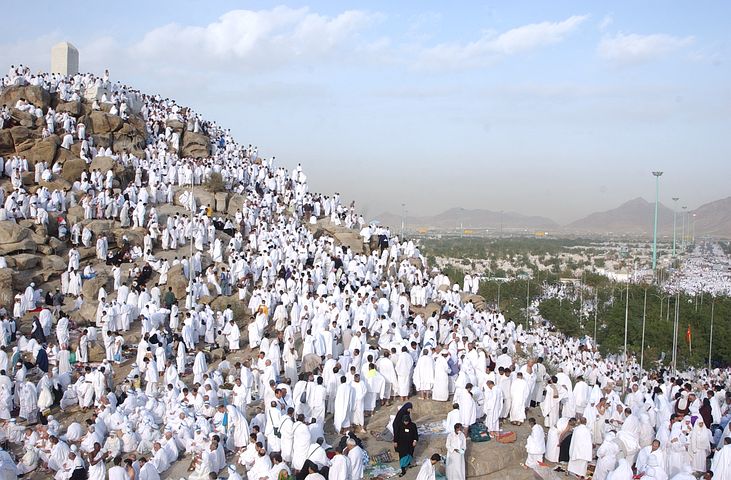
IHRAAM The pilgrim should observe the Sunnahs of ihraam which are mentioned in the question referred to above, namely doing ghusl, applying perfume and praying. Then he should enter ihraam after he finishes the prayer or after boarding his means of transportation. Then if he is doing Tamattu’, he should say, “Labbayk Allaahumma bi ‘Umrah (Here I am, O Allaah, for ‘Umrah).”Then he should say, “Allaahumma haadhihi hijjah laa riyaa’a fiha wa la sum’ah (O Allaah, this is a pilgrimage in which there is no showing off or seeking reputation).” Then he should recite the Talbiyah as the Prophet (peace and blessings of Allaah be upon him) did: “Labbayka Allaahumma labbayk, labbayka laa shareeka laka labbayk. Inna al-hamd wa’l-ni’mata laka wa’l-mulk, laa shareeka lak (Here I am, O Allaah, here I am. Here I am, You have no partner, here I am. Verily all praise and blessings are Yours, and all sovereignty, You have no partner).” The Talbiyah of the Prophet (peace and blessings of Allaah be upon him) also included the words, “Labbayka ilaah al-haqq (Here I am, O God of Truth).” Ibn ‘Umar used to add to the Talbiyah the words, “Labbaayk wa sa’dayka, wa’l-khayr bi yadayka, wa’l-raghba’ ilayka wa’l-‘aml (Here I am and blessed by You, and all good is in Your hands, and desire and action are directed towards You).” Men should raise their voices when saying this, but a woman should recite in such a manner that those who are beside her can hear it, unless there is a man beside her who is not one of her mahrams, in which case she should recite it silently. If the person who is entering ihraam fears some obstacle that may prevent him from completing his pilgrimage (such as sickness, an enemy, being stopped from proceeding any further, etc), then he should stipulate a condition when entering ihraam by saying, “If I am prevented then my exiting ihraam is where I am prevented” – i.e., if something prevents me from completing my pilgrimage such as sickness or delay etc, then I will exit my ihraam. The Prophet (peace and blessings of Allaah be upon him) commanded Dubaa’ah bint al-Zubayr, when she wanted to enter ihraam but she was sick, to stipulate such a condition, and he said, “Your condition is valid with your Lord.” Narrated by al-Bukhaari (5089) and Muslim (1207). If he stipulates this condition and something happens to prevent him from completing his pilgrimage, then he exits his ihraam and does not have to do anything (i.e., offer a sacrifice in compensation). But the one who does not fear that some obstacle may prevent him from completing his pilgrimage does not have to stipulate any conditions, because the Prophet (peace and blessings of Allaah be upon him) did not stipulate conditions nor did he command everyone to do so. Rather he told Dubaa’ah bint al-Zubayr to do that because she was sick. The muhrim (person who has entered ihraam) should recite the Talbiyah a great deal, especially when circumstances and times change, such as when going up to a high place or going down to a low place, or when night or day begin. After that he should ask Allaah for His good pleasure and for Paradise, and seek refuge in His Mercy from the Fire. The Talbiyah is prescribed in ‘Umrah from the moment one enters ihraam until one starts Tawaaf. In Hajj it is prescribed from the moment one enters ihraam until one stones Jamarat al-‘Aqabah on the day of Eid. GHUSL WHEN ENTERING MAKKAH When the pilgrim approaches Makkah, he should do ghusl before entering, if possible, because the Prophet (peace and blessings of Allaah be upon him) did ghusl before entering Makkah. Narrated by Muslim, 1259. Then when he enters al-Masjid al-Haraam he should do so with his right foot first, and say, “Bismillaah wa’l-salaatu wa’l-salaam ‘ala Rasool-Allaah. Allaahumma ighfir li dhunoobi waftah li abwaab rahmatika. A’oodhu Billaah il-‘Azeem wa bi wajhih il-kareem wa bi sultaanih il-‘qadeem min al-Shaytaan il-rajeem (In the name of Allaah, and blessings and peace be upon the Messenger of Allaah. O Allaah, forgive me my sins and open to me the gates of Your mercy. I seek refuge with Allaah the Almighty and in His noble Countenance and His eternal power from the accursed Satan).” Then he should go to the Black Stone in order to start tawaaf… The description of Tawaaf is given in Question no. 31819. Then after he has done tawaaf and prayed two rak’ahs, he should go to the Mas’a (place for doing saa’i) and perform saa’i between al-Safa and al-Marwah. The description of saa’i is given in question no. 31819. The pilgrim who is doing Tamattu’ should do saa’i for ‘Umrah; those who are doing Ifraad and Qiraan should do saa’i for Hajj, and they may delay it until after Tawaaf al-Ifaadah. Shaving the head or cutting the hair When the pilgrim who is doing Tamattu’ has completed seven circuits of saa’i, he should shave his head if he is a man, or cut his hair. If he shaves his head he must shave his entire head, and if he cuts his hair he must cut from all over his head. Shaving is better than cutting because the Prophet (peace and blessings of Allaah be upon him) made du’aa’ three times for those who shaved their heads and once for those who cut their hair. Narrated by Muslim, 1303. But if the time of Hajj is so close that there will be no time for the hair to grow back, then it is better to cut one’s hair at this point, so that there will be some hair left to shave during Hajj. The evidence for that is the fact that the Prophet (peace and blessings of Allaah be upon him) commanded his companions, during the Farewell Pilgrimage, to cut their hair during ‘Umrah, because they arrived on the morning of the 4th of Dhu’l-Hijjah. Women should cut the length of a fingertip from their hair. With these actions, the ‘Umrah of the one who is doing Tamattu’ is concluded, after which he should exit ihraam completely and do everything that those who are not in ihraam do, such as wearing regular clothes, wearing perfume, having intercourse with their wives, etc. Those who are doing Ifraad or Qiraan should not shave their heads or cut their hair, or exit ihraam, rather they should remain in ihraam until they exit ihraam on the day of Eid, after stoning Jamarat al-‘Aqabah and shaving their heads or cutting their hair. Then when the day of al-Tarwiyah comes, which is the 8th day of Dhu’l-Hijjah, the one who is doing Tamattu’ should enter ihraam for Hajj in the morning from the place where he is in Makkah. It is mustahabb for him to do the same when entering ihraam for Hajj as he did when entering ihraam for ‘Umrah, namely doing ghusl, putting on perfume and praying. He should form the intention of entering ihraam for Hajj and recite the Talbiyah, and say, “Labbayk Allaahumma Hajjan (Here I am, O Allaah, for Hajj).” If he fears some obstacle that may prevent him from completing his Hajj, he should stipulate a condition by saying, “If I am prevented then my exiting ihraam is where I am prevented.” If he does not fear any such obstacle then he should not make any such condition. It is mustahabb to recite the Talbiyah out loud until he starts to stone Jamarat al-‘Aqabah on the day of Eid. Going to Mina Then the pilgrim should go out to Mina and pray Zuhr, ‘Asr, Maghrib, ‘Isha’ and Fajr there, shortening the prayers but not joining them, because the Prophet (peace and blessings of Allaah be upon him) used to shorten his prayers in Mina but he did not join them. Shortening the prayers means making the four-rak’ah prayers two raka’ahs. The people of Makkah and others should shorten their prayers in Mina, ‘Arafah and Muzdalifah because the Prophet (peace and blessings of Allaah be upon him) used to lead the people in prayer during the Farewell Pilgrimage and there were people from Makkah with him, but he did not tell them to offer their prayers in full. If it had been obligatory for them to do so, he would have told them to do so as he did on the day of the Conquest of Makkah. But since the city has spread and incorporated Mina so that it is like one of the quarters of Makkah, then the people of Makkah should not shorten their prayers there. Going to ‘Arafah When the sun rises on the day of ‘Arafah, the pilgrim travels from Mina to ‘Arafah and stops in Namirah until the time of Zuhr (Namirah is a place just before ‘Arafah), if he can do so. If he cannot do it, it does not matter because staying in Namirah is Sunnah but it is not obligatory. When the sun passes its zenith (i.e., when the time for Zuhr prayer begins), he should pray Zuhr and ‘Asr, two rak’ahs each, and join them together at the time of Zuhr, as the Prophet (peace and blessings of Allaah be upon him) did, so as to leave a lot of time for standing and making du’aa’. https://wp-media.patheos.com/blogs/sites/776/2018/08/Post-96-Reliving-Hajj-Jabal-Al-Rehmah.jpg Then after the prayer he should devote his time to making dhikr and du’aa’ and beseeching Allaah, and praying as he likes, raising his hands and facing the qiblah even if the mountain of ‘Arafah is behind him, because the Sunnah is to face the qiblah, not the mountain. The Prophet (peace and blessings of Allaah be upon him) stood by the mountain and said, “I am standing here, but all of ‘Arafah is the place of standing.” Most of the Prophet’s du’aa’ in that great place of standing was: “Laa ilaaha ill-Allaah wahdahu laa shareeka lah, lahu’l-mulk, wa lahu’l-hamd, wa huwa ‘ala kulli shay’in qadeer (There is no god but Allaah alone, with no partner or associate; His is the Dominion, all praise is due to Him, and He is able to do all things).” If the pilgrim gets tired and wants to have a break by talking to his companions about useful things or by reading from some useful books, especially things that have to do with the generosity and great bounty of Allaah, in order to increase his hopes on that day, this is good. Then he can go back to beseeching Allaah and praying to Him. He should strive to make the most of the end of the day by making du’aa’. The best of du’aa’ is du’aa’ made on the day of ‘Arafah. Going to Muzdalifah When the sun sets, the pilgrim should go to Muzdalifah. When he reaches there, he should pray Maghrib and ‘Isha’ with one adhaan and two iqaamahs. If he fears that he will not reach Muzdalifah before midnight, he should pray on the way, because it is not permissible to delay ‘Isha’ prayer until after midnight. He should stay overnight in Muzdalifah, then when dawn comes he should pray Fajr early, with the adhaan and iqaamah, and then head for al-Mash’ar al-Haraam (which is the site of the mosque in Muzdalifah) and proclaim the oneness and greatness of Allaah (by saying Laa ilaaha ill-Allaah and Allaahu akbar), and making du’aa’ as he likes, until it has become very light (i.e., when the light of day appears before the sun has actually risen). If it is not easy for him to go to al-Mash’ar al-Haraam, he should make du’aa’ where he is, because the Prophet (peace and blessings of Allaah be upon him) stood there and all of Muzdalifah is the place of standing. When he is reciting dhikr and making du’aa’ he should face the qiblah and raise his hands. Going to Mina When it has become very light, before the sun rises, he should go to Mina and hasten through Wadi Mahsar (which is a valley between Muzdalifah and Mina). When he reaches Mina he should stone Jamarat al-‘Aqabah, which is the last one that is closest to Makkah, throwing seven pebbles one after another, each of which should be approximately the size of a fava bean, saying “Allaahu akbar” with each throw. (The Sunnah when stoning Jamarat al-‘Aqabah is to face the Jamarah with Makkah to one's left and Mina to one one’s right). When he has finished this stoning, he should slaughter his sacrificial animal, then shave his head or cut his hair if he is male; women should cut the length of a fingertip from their hair. This is the first stage of exiting ihraam, in which it becomes permissible to do everything except have intercourse with one's wife. Then the pilgrim should go back to Makkah and do tawaaf and saa’i for Hajj. Then comes the second stage of exiting ihraam, after which everything becomes permissible which was forbidden whilst in ihraam. The Sunnah is to put on perfume when one wants to go to Makkah to do tawaaf after stoning the jamarat and shaving one’s head, because ‘Aa’ishah (may Allaah be pleased with her) said: “I used to apply perfume to the Prophet (peace and blessings of Allaah be upon him) before he entered ihraam and when he exited ihraam, before he circumambulated the House.” Narrated by al-Bukhaari, 1539; Muslim, 1189. Then after tawaaf and saa’i, he should go back to Mina and stay there for two night, the 11th and 12th of Dhu’l-Hijjah, and stone the three jamarats during those two days, when the sun has passed its zenith. It is better for him to go to the jamarats walking, but if he rides that is acceptable. He should stone the first jamarah, which is the one that is furthest away from Makkah and next to Masjid al-Kheef, with seven pebbles, one after another, and say “Allaahu akbar” after each throw. Then he should go forward a little and say a lengthy du’aa’, saying whatever he likes. If it is too difficult for him to stand for a long time and make du’aa’, he should say whatever is easy for him, even if it is only a little, so that he will have done the Sunnah. Then he should stone the middle jamarah with seven pebbles, one after another, saying “Allaahu akbar” with every throw. Then he should move to his left and stand facing the qiblah, raising his hands, and offer a lengthy du’aa’ if he can. Otherwise he should stand for as long as he can. He should not omit to stand and make du’aa’ because it is Sunnah. Many people neglect that because of ignorance or because they take the matter lightly. The more the Sunnah is neglected the more important it becomes to do it and spread it among the people, lest it be abandoned and die out. Then he should stone Jamarat al-‘Aqabah with seven pebbles, one after another, saying “Allaahu akbar” with each throw, then he should go away and not offer a du’aa’ after that. When he has completed the stoning of the Jamaraat on the 12th day of Dhu’l-Hijjah, if he wants he may hasten and leave Mina, and if he wants he may delay his departure and stay there for another night, the night of the 13th, and stone the three Jamaraat after noon as he did before. It is better to delay, but it is not obligatory unless the sun has set on the 12th and he is still in Mina, in which case it is obligatory to stay until one has stoned the three Jamaraat after noon on the following day. But if the sun sets on the 12th and he is still in Mina but not by choice, such as if he had already started out and boarded his means of transportation, but got delayed because of crowded conditions and traffic jams etc., then he is not obliged to stay there, because the delay until sunset was not by his choice. When the pilgrim wants to leave Makkah and go back to his country, he should not leave until he has performed the farewell tawaaf (tawaaf al-wadaa’), because the Prophet (peace and blessings of Allaah be upon him) said: “No one should leave until the last thing that he does is (tawaaf) around the House.” Narrated by Muslim, 1327). According to another version, he told the people that the last thing they should do was (tawaaf) around the house, but he made an exception for women who were menstruating. Narrated by al-Bukhaari, 1755; Muslim, 1328. Women who are menstruating or bleeding following childbirth do not have to do the farewell tawaaf; neither should they stand by the door of al-Masjid al-Haraam to bid farewell, because that was not narrated from the Prophet (peace and blessings of Allaah be upon him). 2 Likes 1 Share |
| Islam › Re: Description Of Hajj. by Lukgaf(op): 7:55am On Jul 12, 2019 |
TYPES OF HAJJ There are three types of Hajj: Tamattu’, Ifraad and Qiraan. Tamattu’ means entering ihraam for ‘Umrah only during the months of Hajj (the months of Hajj are Shawwaal, Dhu’l-Qi’dah and Dhu’l-Hijjah; see al-Sharh al-Mumti’, 7/62). When the pilgrim reaches Makkah he performs tawaaf and saa’i for ‘Umrah, and shaves his head or cuts his hair, and exits ihraam. Then when the day of al-Tarwiyah, which is the 8th of Dhu’l-Hijjah, comes, he enters ihraam for Hajj only, and does all the actions of Hajj. So Tamattu’ involves a complete ‘Umrah and a complete Hajj. Ifraad means entering ihraam for Hajj only. When the pilgrim reaches Makkah he performs tawaaf al-qudoom (tawaaf of arrival) and saa’i for Hajj, but he does not shave or cut his hair and does not exit ihraam, rather he remains in ihraam until he exits ihraam after stoning Jamarat al-‘Aqabah on the day of Eid. If he delays the saa’i of Hajj until after the tawaaf of Hajj, there is nothing wrong with that. Qiraan means entering ihraam for ‘Umrah and Hajj both together. Or entering ihraam for ‘Umrah first then including Hajj in that before starting the tawaaf of Hajj. That is done by intending that his tawaaf and saa’i will be for both Hajj and ‘Umrah. The actions done in Qiraan are the same to those done in Ifraad, except that the pilgrim doing Qiraan has to offer a hadiy (sacrifice) whereas the pilgrim doing Ifraad does not. The best of these three types of Hajj is Tamattu’. This is what the Prophet (peace and blessings of Allaah be upon him) enjoined upon his companions and urged them to do. Even if a person enters ihraam for Qiraan or Ifraad, then it is strongly recommended for him to change his intention to ‘Umrah, then complete ‘Umrah and exit ihraam, so that he will then be doing Tamattu’. He may do that after doing tawaaf al-qudoom and saa’i – because when the Prophet (peace and blessings of Allaah be upon him) did tawaaf and saa’i during his Farewell Pilgrimage, and his companions were with him, he told everyone who did not have a sacrificial animal (hadiy) to change his intention and make his ihraam for ‘Umrah and to cut his hair and exit ihraam, and he said, “Were it not that I have brought the hadiy with me, I would do what I have commanded you to do.” 4 Likes 1 Share |
| Islam › Description Of Hajj. by Lukgaf(op): 7:52am On Jul 12, 2019 |
INTRODUCTION Praise be to Allaah. Hajj is one of the best acts of worship. It is one of the pillars of Islam with which Allaah sent Muhammad and without which a person’s religious commitment is incomplete.Worship cannot bring a person closer to Allaah and cannot be accepted unless it meets two conditions: 1 – Sincerity towards Allaah alone, i.e., it is done to seek the Countenance of Allaah and the Hereafter, and is not done to show off, to enhance one’s reputation or for worldly gain. 2 – Following the Prophet (peace and blessings of Allaah be upon him) in word and deed. Following the Prophet (peace and blessings of Allaah be upon him) can only be achieving by knowing his Sunnah. https://upload.wikimedia.org/wikipedia/commons/9/92/Al-Haram_mosque_-_Flickr_-_Al_Jazeera_English.jpg Hence the one who wants to worship Allaah by doing any act of worship – Hajj or anything else – has to learn the teachings of the Prophet (peace and blessings of Allaah be upon him) concerning it, so that his actions will be in accordance with the Sunnah. In what follows, the description of Hajj as narrated in the Sunnah shall be summarized. 4 Likes |
| Islam › Hajj: To Do Only One Or Multiple? by Lukgaf(op): 7:43am On Jul 12, 2019 |
Praise be to Allaah. With regard to what is obligatory, Hajj is only required once in a lifetime. It was narrated that Abu Hurayrah said: The Messenger of Allaah (peace and blessings of Allaah be upon him) addressed us and said: “O people, Allaah has enjoined Hajj on you, so perform Hajj.” A man said: “Is it every year, O Messenger of Allaah?” He remained silent until (the man) said it three times. Then the Messenger of Allaah (peace and blessings of Allaah be upon him) said: “If I said yes it would be obligatory and you would not be able to do it.” Then he said: “Be content what I leave with you, for those who came before you were destroyed because they asked too many questions and argued with their Prophets. If I tell you to do something then do as much of it as you can, and if I tell you not to do something then abstain from it.” Narrated by Muslim, 1337. https://upload.wikimedia.org/wikipedia/commons/9/92/Al-Haram_mosque_-_Flickr_-_Al_Jazeera_English.jpg It was narrated from Ibn ‘Abbaas that al-Aqra’ ibn Haabis asked the Prophet (peace and blessings of Allaah be upon him): “O Messenger of Allaah, is Hajj every year or just once?” He said: “It is only once, and whoever does more than that, it is a voluntary (act of worship).” Narrated by Abu Dawood, 1721; classed as saheeh by al-Albaani. With regard to what is preferable, the more a Muslim does of Hajj, the better, even if he can do Hajj every year. There are reports which encourage doing Hajj a great deal, such as the following: 1 – It was narrated from Abu Hurayrah that the Messenger of Allaah (peace and blessings of Allaah be upon him) was asked: which deed is best? He said: “Believing in Allaah and His Messenger.” He was asked: Then what? He said: “Jihad for the sake of Allaah.” He was asked: Then what? He said: “An accepted Hajj.” Narrated by al-Bukhaari, 26; Muslim, 83. 2 – It was narrated that Abu Hurayrah (may Allaah be pleased with him) said: I heard the Messenger of Allaah (peace and blessings of Allaah be upon him) say: “Whoever does Hajj for the sake of Allaah, and does not utter any obscenity or commit any immoral action, will go back (sinless) as on the day his mother bore him.” (al-Bukhaari, 1449; Muslim, 1350). 3 – It was narrated that ‘Abd-Allaah ibn Mas’ood said: The Messenger of Allaah (peace and blessings of Allaah be upon him) said: “Make the Hajj and ‘Umrah follow each other closely, for they remove poverty and sins as the bellows removes the dross of iron, gold and silver, and an accepted Hajj brings no less a reward than Paradise.” Narrated by al-Tirmidhi, 810; al-Nasaa’i, 2631. Classed as saheeh by Shaykh al-Albaani in al-Silsilah al-Saheehah, 1200. And Allaah knows best. Source: Islam QA 7 Likes 2 Shares |
| Politics › Don't Carry Drugs To The Holy Land, Dabiri Warns Pilgrims by Lukgaf(op): 1:16pm On Jul 11, 2019 |
The Chairman of Nigerians in Diaspora Commission (NIDCOM), Mrs Abike Dabiri-Erewa, has warned pilgrims to this year’s Hajj in Saudi Arabia to resist any temptation to carry hard drugs to the holy land.Speaking on the heels of the inaugural flight of intending pilgrims, Mrs Dabiri-Erewa reminded them that Saudi laws prescribe death penalty against such act. In a statement by the NIDCOM Head of Media, Abdur-Rahman Balogun, the commission chairman said it was disheartening that some Nigerians still ran foul of Saudi Arabia authorities’ law, despite repeated warnings and workshops for intending pilgrims. She recalled that some Nigerians caught with hard drugs in the last few years were still on death row in Saudi Arabia. The NIDCOM chairman pleaded with pilgrims to shun the shameful act. https://thenationonlineng.net/wp-content/uploads/2019/07/Abike-Dabiri-Abike-Dabiri-Erewa-750x375.jpg Mrs Dabiri-Erewa also reminded the pilgrims that kolanuts and prescription painkillers in large quantities have been banned in Saudi Arabia. The commission chairman warned that if found on anyone, the offence attracts severe penalties according to new Saudi Arabia regulations. She said the Federal Government, through the National Hajj Commission of Nigeria (NAHCON) and various state boards, had made arrangements to attend to the medical needs of the pilgrims in Saudi Arabia. Source: The Nation 3 Likes |
| Politics › Re: Breakdown Of Diezani Alison-Madueke's Jewelry Forfeited To FG by Lukgaf(m): 9:53pm On Jul 05, 2019 |
She want to sell it? |
| Education › Re: HIJAB: Call UI ISI Principal To Order- Muslim Parent Forum by Lukgaf(op): 9:48pm On Jul 05, 2019 |
But people wait, does Muslim force hijab on all children?, sebi it is their daughter alone? This is hypocrisy. Must Muslim even protest in The first instance? 1 Like |
| Education › HIJAB: Call UI ISI Principal To Order- Muslim Parent Forum by Lukgaf(op): 9:42pm On Jul 05, 2019 |
PRESS RELEASE HIJAB: Call UI ISI Principal to order Ibadan, July 5, 2019: The International School Ibadan (ISI) Muslim Parents Forum is hereby using this medium to call on well meaning Nigerians to call Mrs Phebean Olowe, the Principal of ISI to order as she is out to precipitate crisis in the school with her high handedness and religious fanatism taken too far. Following our tactical withdrawal from the ISI Hijab matter from the State High Court in Ibadan on June 25, 2019, the Principal through her agents had embarked on harrasment intimidation and molestation of some of the Muslim girls who took the school to court to enforce their fundamental human rights to wear hijab in the school premises. The Principal reportedly told the girls at the school assembly on Monday that no one should adorn Hijab on school uniform within and OUTSIDE the school premises. We found the directive of the Principal awkward and absurd especially as it relates to wearing hijab OUTSIDE the school premises on the school uniform. The Principal, however, carried out her threat when on Wednesday, July 3 and Thursday July 4, some Muslim girls who normally, remove their hijab at the entrance of the school gate, were barred from coming to the school some 100 metres from the main gate of the school. A parent, Dr Idris Badaru, narrate his experience as follows: "I took my children to school and parked under the shade beside Idia Hall at about 8.00 am and noticed a small crowd of students gathered about 80 metres or thereabout away from the school gate. My children promptly informed me that the Accounts section was checking payment clearance before allowing them in. I decided to wait a bit and to my surprise, after checking my daughter’s clearance, the security man and Mr. Odewale of the Accounts section were issuing some instructions, which my daughter was not happy with. I therefore moved closer and learnt that they wanted my daughter to remove her hijab before walking down towards the gate and she refused. I felt enraged as any reasonable man would when his daughter’s honour is violated. Moreover, that space belongs to University of Ibadan, a Federal institution". This was corroborated by two other parents who said that the Security personnel of UI under the leadership of the Chief Security officer, carried out the directives of the Principal and were physically assaulting any muslim girls adorning hijab outside the gate of the school. As if that was not enough, we were reliably informed that the Principal, Mrs. Olowe went to the affected girl's class to embarrass and scolded her in the presence of her colleagues. We also learnt that the School had hurrriedly put up a Student Disciplinary Panel to try all the girls with the hope of suspending them and later expel them from the school. All efforts by the Muslim Parents Forum representatives to see the Principal or the Vice Principal proved abortive as the gun-wielding security operatives at the entrance said they were under instruction from above not to allow any parents in. We are therefore putting the Principal on notice that should anything untowards happen to any of our girls due to the psychological and emotional harrasment, intimidation or any act of terror on them for wearing hijab outside the school, we shall use all available legal and legitimate means to protect our children. Signed Abdur-Rahman Balogun Chairman, ISI MPF Lalasticlala |
| Education › See An Award Presented To EKSU Best Graduating Student In Civil Engr (pics) by Lukgaf(op): 9:07pm On Jul 05, 2019 |
Come across this picture of the award of #100 (hundred naira) to the best graduating student in the department of Civil Engineering, Ekiti State University, Ado-Ekiti. While BB Naija are receiving millions, see what was given to a Scholar. Funny enough, he was asked to approach the Bursary department to process the award. Without doubt, our leader do not value education. Lalasticlala come and see 3 Likes 1 Share
|
| Islam › Ibadan School Asks Muslim Students To Remove Hijab (Photos) by Lukgaf(op): 9:34am On Jul 05, 2019 |
Watch below a video showing International School, Ibadan staff and security guards waylaying Muslim students, while forcing them to remove the Hijab the girls wore on their school uniforms. Some countries with even strictly less percentage of Muslims are allowed to practice their faith not to talk of a Nigeria with Muslim most populous. Unfortunately, these oppression and victimization on Muslims are coming from our fellow country men and these guys will soon allege Muslim of Islamization. Most annoying thing is bias position of people who have traveled to countries with less percent of Muslim See the video here 6 Likes
|




1 2 3 4 5 6 7 8 ... 53 54 55 56 57 58 59 60 61 (of 98 pages)