Culture › Re: Yoruba Hebrew Heritage by macof(m): 12:14pm On May 27, 2020*. Modified: 5:42pm On May 27, 2020 |
BabaRamota1980:
Macof, i think you dont like me because you think im opposite to your position. Only God knows what we don't. This Yoruba history get as e be. It is confusing. I like this thread because i learn in here. I learn from you, i learn from absolutsucces, i learn from obalufon, obalufon III, i learn from metaphysical, i learn from olu13. So you guys dont even know that you are influencers.  . How many obalufon dey here sef? . I go come back and read again in 2021. I want some good stuff, not fight and ijogbon. One day when im well equipped me sef go be ogbologbo and can join and talk Yoruba history with solid and firm convinction. My guy, nothing in my post suggests that I care if you are of my stand on yoruba origin or not You simply didn't understand what you were quoting and what I've been posting on this thread. There's a great wealth of debunking I've done here Read through it and understand Yoruba history is confusing because no be your work I sure sey your work go confuse me too There's nothing wrong with learning and collecting information, but if you want to be ogbologbo you have to verify every information by asking questions Who no sabi defend him claim na fraud |
| Culture › Re: Yoruba Hebrew Heritage by macof(m): 12:06pm On May 27, 2020 |
Olu317:
Imagery indeed. So, pitchfork , Axe, and horn doesn't have meaning in Yoruba land ? I mock you macof! Continue mocking. The small change they are giving you to attempt to Abrahamize Yoruba and mock her history will put you in trouble if care is not taken |
| Culture › Re: Yoruba Hebrew Heritage by macof(m): 12:00pm On May 27, 2020 |
OmoOlofin:
lú does not mean bypass, He has given multiple somewhat unrelated meanings to Lú Bypass, enroute, open, burrow |
| Culture › Re: Yoruba Hebrew Heritage by macof(m): 11:52am On May 27, 2020*. Modified: 5:53pm On May 27, 2020 |
absoluteSuccess:
Working with etymological homophones
Etymology is the study of the original meaning of a given word. Let's say inflection for instance. The original phrase is Latin, "in flecto", meaning "I bend".
1. Homophones are mostly bends of the same thinking. Homophones don't just happen, there's a reason or more why some words sounds similar in Yoruba and probably other languages.
2. My interpretations should not just occur to me and me alone without any means of validation. The Yoruba language is quite robust with great dynamics. So we have "cloud of witnesses" at our disposal.
And since we're not citing any published Yoruba thesaurus here for the "efiwe" that would not accept principles that's not been tested, how for do? The rule of the thumb is to improvise for one, how?
Consult other wordset where the same syllable has been used in the same culture to mean exactly the same thing from the world go. We'll use ilu as a case study.
3. A good instance is in the oriki orile: Ijebu ode, ajagbalura. From the term ajagbalura, we can see an ancient use. Lú in Yoruba is to burrow through, to punch through, to 'dalu'.
Dálu, meaning "perforate" come across in the same structure as dálû, meaning "create city". At Ado, the ancestors were revered as "owun adaludo", people who created town to dwell in it.
Da implies the origin and lu, opening. We can also say "o lu ja ara" (the points are connected). It's not an accident that the word next to lu is ja, both words are synonyms. Let's do a review.
Interrelativity of homophones
The relationship between ilu as town and ilu as drum is because drum of those times had to be made from wood burrowed through from one end to the other. Thus, lu is to "ja oju meji si'ra won lati selu".
One of the synonyms, lu is what became ilu. The other synonym, ja is the Yoruba for oja, believed to be the foundation of town in early Yoruba, such that ancient kings were called Oloja. Reminder of the correlation of this to Olu.
From this perspective, Olu has the credential of being a "pioneer" in Yoruba history coupled with other primary attributes we may ascribe to it, as it said "idalu niselu". Olu is the "opener", like we have in "taye l'olu ejire".
Today, we can say "bawo ni mo se le ja si...?" There's a programed rule that would disuade us from saying "bawo ni mo se le lu si?" We can't reinvent the wheel.
This is because lu is the original process of burrowing to a new travel destination. Ja on the other hand is using the laid down route to the intended destination.
Thus, the Yoruba word for town developed from the psyche of a traveler who sees town not as "town" (because he's not thinking Anglophone) but as "route" to burst out elsewhere.
The problems I've created
Linguistics is the framework for an in-depth studies of various attributes of words or vocabularies in a language. I'm more of a scientist. No ordering around but sticking to guide.
I am actually thinking in the HTML language by which Yoruba language is written. We are not speaking Yoruba in this language, but we're speaking Yoruba in the interface.
There's sharp contrast between a programmer and a user. A user sees what the programmer wants the user to see. But underneath that runs codes that makes the site work, in ways that will appear gibberish to the user.
4 If I says in Yoruba, "e yoju", I mean "let me see you in a jiffy". But word for word, I've just said "pluck out the eyes". We never hear that version but the version we were "programmed" to hear.
So we heard the frame in it's interface. To understand the program language means we'll learn from the original wordsmiths and think like one.
And we'll always run into trouble with interface users. 1. Homophones are not mostly of the same thought Check any examples of homophones and more than half the words are not etymologically related. Eye / I Bare / bear be / bee Sauce / source Too / two Then examples of etymologically related ones are Brake / break Sure you could call my examples biased but I'd like to see anyone make a list from the top of their head in one minute like I just did with more etymologically related homophones Yoruba is tonal for a reason. Those tones are there for a purpose. Unlike in non tonal languages, where words spelt alike are most certainly etymologically related In tonal languages like all languages of the Kwa language family, words spelt alike Eg. "Ìlú" and "ìlù" would have very different etymologies Infact due to Palatalisation, you would be surprised that etymons often aren't visibly identifiable... One Reason why imagination can never beat professionalism Relax and let linguists do their thing. Or you go study for it, since you talk about Languages all the time Funny how someone who claims to be a bonified Yoruba who decides who is yoruba and who is not doesn't know the basic property of the Yoruba language 2. Unfortunately, your interpretations are you and you alone. Even your band doesn't interpret them like you MetaPhysical said Sigidi is "prostrating" you said it is "open wood" something something Would be great if your interpretations were the case because they sure are exciting and unsuspecting individuals would be drawn to it. I mean Sigidi, Ṣí igi Exciting stuff but anybody can do this 3. With your limited grasp of the Yoruba words, it would be wise to take caution in interpreting people's oriki. That's how you interpreted nonsense with the oriki of the eletu Iwase and that of babtoundey here on nairaland Futhermore, Lú does not mean "opening" or "burrow through" like an animal, it means to mix or mingle (together : Lúpọ̀).. To commune (be a community) Hence Ìlú or Èlú or even Pẹ̀lú It has nothing to do with "ìlù" (drum) from lù (beat, hit) 4. Stop trying to sound like you have esoteric training on yoruba language. Certain things are obvious enough for everyone to see You are not a programmer type personage of yoruba Futhermore, "yọjú" interpreted as "pluck eyes" is lazy It would make more sense for Yọ to be interpreted as "make visible" (to appear out) not "pluck" Máa yọ si wọn.. Can be said to be "I will appear to them" Yọ jáde, (make to) appear outside [to remove/bring out] . Yọ kúrò (appear away) remove So yọjú is "make your face/eyes visible/appear" [let me see you] |
| Culture › Re: Yoruba Hebrew Heritage by macof(m): 6:11pm On May 24, 2020 |
absoluteSuccess:
The bolded is a prove that you are not a Yoruba man. Your intentions betrayed you right there. Is sigidi a plaything? Answer it, for clarity sake because your previous post implies that Yoruba man that doesn't know what sigidi is made of, declaring who is Yorùbá and who is not. Abegy, gfoh if you can't answer the simple question |
| Culture › Re: Yoruba Hebrew Heritage by macof(m): 3:41pm On May 24, 2020 |
Obalufon:
baba sigidi is in ife .he turned to stone And baba sigidi (the person) is not what MetaPhysical was talking about but sigidi (the statue used in different altars) But good thing you said stone not wood |
| Culture › Re: Yoruba Hebrew Heritage by macof(m): 3:06pm On May 24, 2020 |
absoluteSuccess:
Ere from Esie are made from soapstone or carved from rocks. They were called ere, evidently from "Esie elere ajobo". Also, the doll often made for twins when one of them departs is called ere-ibeji. Its a doll made from wood and the same is called ere. So we can see that its either way round.
Sigidi is expected to be an early form of the art because people had the wood before the stone[age] and then their iron smelting. You can argue it whichever way you find convenient for you. Its not funny to imply that a doll is a "plaything" that the other twin can play with instead of his or her dead sibling as not to feel depressed or what have you.
In the other variants of the word i offered here, Im trying to give you what the same latin character could mean, your response is like me mocking you for listing ilu with ilu, it has no orientation with what we are talking about, but rather other implications of the same sound with different stress pattern to make a word.
Move on if I'm giving you problem sir. I never said Ère cannot be made of wood. Here are the two points you made 1. Sigidi is made of wood 2. Ère means mock/Play And here are my points 1. Sigidi is made of clay, not wood, not metal but clay 2. Ère being connected to Eré(play) and Èrè (profit) is quite funny as what do we do about Ìlú and Ìlù? And Sigidi is a plaything? You really believe that? If we are to assume that Ère indeed has some old meaning like "toy" and "mock" which evolve to "statue" (Which is not the worst idea you've had) you have not demonstrated how that can even be possible for you to be taken seriously You are giving yourself problems, and trying to involve the entire Yoruba nation into. You said you are looking for solutions, solutions to what problems that concern the entire Yoruba? |
| Culture › Re: Yoruba Hebrew Heritage by macof(m): 11:10am On May 24, 2020 |
absoluteSuccess:
@Metaphysical, howdy?
It's been a while brother. Would like to call your attention to something that might help your perspective on what you may consider the right interpretation of the word "Sigidi".
I read it somewhere here but never want to continue on an endless tirade that's all talks no solution from the other side.
Possibly I might be the problem here. I better leave the stage for folks with the solution to put it across to all and sundry. However, I can never know this much and still be deceived.
Sigidi
Bro let's take it this way. The Yoruba call the woodcarver "agbegilere". Let's say the phrase means "one who carve wood to statue". But statue doesn't translate to "ere".
With the Yoruba interpretation on the woodcarver, we can get to the idea of the job of the artisan. The second linguistic application of this idea play out on the job "Sigidi".
I've once met this folks behind the office of Osun state broadcasting corporation on my way to Susan Wenger's garden. I interacted with them out of curiosity. Just a detour on my itinerary for Yoruba Heritage Mission at the time.
Ere is not a "statue"
I've said Ere is not a statue, but the word ere translates to "play" within Yoruba language itself. Therefore the closest meaning to the idea on the mind of the wordsmith who coined the word was "play".
But "play" in that sense doesn't imply drama, no. The perfect English equivalent of this sense of the word is "mock". The woodcarver creates the caricature of what originally exists in nature.
The caricature or the mock[ery] of what originally exists used to be the original art form among ancient cultures. That settles the ere concept. It's more like a "mock" of "the real thing".
Now not far from here is the ideology expounded in Sigidi. The woodcarver carves his log to a form by scraping off the bark and subsequent layers off the wood. That's "sigi", so to say.
Next the object takes a form. The process of transformation is reflected in the final name for the form so created: si gi di. To have this in English would give us "open wood form".
The problem however would be how an English speaker would easily assimilate what "open wood form" connotes because no two culture think out their thought the same way.
A home-run example
The other day, I struct on the idea of what the egun means by "gbeta". I readily understood this to mean ogbe-takun, eg "the fringe of the bush". This word gbeta is Egun for the diaspora.
But somehow, gbeta perfectly interpret to Yoruba's "eyin odi". Gbeta thus means "living outside", which conveys the mind of the Egun. But does this match it's Yoruba equivalent?
No it doesn't. Meanwhile, gbeta is indeed a Yoruba phrase that means 'live outside', just as "eyin odi" implies "behind the wall". Both words are Yoruba.
So, words from two different languages could target the same meaning being originally from the same parent source (gbeta, eyin odi) but takes variant orientation in their homeland.
This is because different historical realities could have remould them. The word gbeta (as in o figbe ta) maybe unintelligible in Yoruba yet it's Yoruba language, but it never meant diaspora.
Likewise, eyin odi was favoured as diaspora in Yoruba because it means "behind the wall". So what's the threat to Yoruba for having walled cities in West Africa?
Memoirs as reminder of history
The Yoruba had the memoir of city plan as being walled and gated. A city with one way inlet is called "adiikun". So they were inadvertently adhering to the original city plan with moat and ford.
Now when you pick up a Yoruba word, you pick up instructions from its manufacturer. It's good to study the manufacturer's manual rather than a repairer's acclaimed expertise.
You are walking the path of the manufacturers bro. @Olu, I salute you from here. Good sire. Knowledge don't come from corporate understanding, "awo nii gbo sofawo".
"It takes a master to restore a masterpiece." Except, Sigidi is not made of Igi (wood) but clay. And this your Èrè (profit), Eré (Play), Ère (statue) connection is quite funny Are we to imply that Ìlú (city) and Ìlù (drum) are the same words? PS. You talk of no solution from me and tao, interestingly, there isn't a problem that needs solutions. You are the one creating problems for yourself |
| Culture › Re: Yoruba Hebrew Heritage by macof(m): 10:16am On May 24, 2020*. Modified: 10:33am On May 24, 2020 |
BabaRamota1980:
Your response is unimpressive. I will clear your thoughts. Yoruba has existed over 1000yrs. The lens through which you are now looking at Yoruba is less than 200yrs old. Britain took over our affairs in 1861, we did not immediately acquired written knowledge proficiently until in 1910s, and those who could read and write and translate between Yoruba and English were in missionary works and very few. If we are talking of skills in historical investigation itself our pioneer entry into the field of academic history is less than 100yrs old. Compare that to a long line of heritage and legacy in family lineages who served as official custodians of royal and Yoruba history, and have committed to memory events and accounts spanning into thousands of years. Thats Yoruba national record. What do they say? Bring their accounts here. Again, you fail to understand the post you are quoting. You should ask for clarity where you have none and not just rush to reply |
| Culture › Re: Yoruba Hebrew Heritage by macof(m): 2:45am On May 24, 2020 |
Amujale:
The new information from TAO11 actually puts Yoruba as the founding Kings of the Kush kingdom, hold that thought for a while.
Me, Rashidi Runoko, Dr Ivan Sertima, Cheikh Anta Diop, Dr Henrik Clarke arent the first historians to suggest that there's a connection with the Nile Valley; olden day Arabians and Eurocentrics are the first to suggest this.
Below is a potrait of a Nubian silk and produce trader.
This has nothing to does with Hebrew or any other similar type of foreign culture, this is strictly African history.
Perhaps one should create a new thread for this discussion.
Is there a connection between the people of Nigeria with the Nile Valley as many of these modern historians are claiming? New trend would be a good idea But to that picture... Ask yourself, A nubian from Tunesia? |
| Culture › Re: Yoruba Hebrew Heritage by macof(m): 11:48pm On May 23, 2020 |
TAO11:
Thanks for quickly pointing that out.
Sighs! Our people actually need to read what they will be replying to.
Every seem to be eager to reply, but uninterested in reading the very thing they will be replying to. Honestly babaramota1980 did not understand much of the point that has been made I actually find Yoruba customs and traditions to be brilliant, many cultures around the world cannot stand the examination of historical research but so far every so called Yoruba myth has the promise of fitting nicely into the world's history if properly interpreted and contextualised. |
| Culture › Re: Yoruba Hebrew Heritage by macof(m): 11:37pm On May 23, 2020 |
TAO11:
Got it!
Yes, I did see it. I'm quite jealous about my identity.
So, I was quite hesitant about joining right away.
I will give it careful thoughts anyways. Any time you decide, I will resend it to you the last one is now invalid for very obvious reasons |
| Culture › Re: Yoruba Hebrew Heritage by macof(m): 11:23pm On May 23, 2020 |
BabaRamota1980:
I just read through three pages and had to give up. I think both sides of this argument have valid points but it appears the goal of ascertaining Yoruba beginnings have been put aside and competition for styles and academic scholarship is everywhere. It wil be a great error to dismiss oral and authentic Yoruba customs on the excuse that the account is not affirmed by scientific exploration and, or, historical thesis. We have just concluded ramadhan, the end of fasting is authenticated by a celestial sighting, not by science or scholarship, and Im sure no one here will deny contribution of Muslim world to academy, to science, to arts, to literature, and so one must wonder why they are not using calendar to authenticate eid. Yoruba has not attained breakthroughs in the various fields of advancement like the Arabs, the Jews. The Jews still blow into an animal horn to symbolize festival of passover. They have not dismissed it as folkloric nonsense. Abi, anthropologists don go dig Egypt and found the original horn ni? So what is authentic about the horn, other than its mention in Bible? They preserve and hold on to meaningful values in their past. Let us not speak English so much and scatter our past in the ambition to impress scholarship. We are fooling ourselves. Wole Soyinka is close to grave, we have not repeated his Nobel excellence, yet we speak more grammar and articulate better English than countries that have returned multiple times to collect Nobel prize. Tread carefully brothers, tread carefully. Except, Yoruba traditions and scientific/academic studies do not contradict but complement each other. One helps put the other in neat context, and the other serves as a body of primary sources and auxiliary Also there isn't much competition for academic scholarship. Most historians today are agreed on certain basic points *edited |
| Culture › Re: Yoruba Hebrew Heritage by macof(m): 11:18pm On May 23, 2020 |
TAO11:
I think your perception that there is some discrepancy is itself based on an assumption that there is (or must be) only one Ṣàngó in the Yoruba traditional accounts.
However, as I have demonstrated earlier, my interpretation that this coptic account speaks of an early Ṣàngó did not simply emerge from thin air.
My explanation, as I have demonstrated in the same earlier comment (I apologize if you missed it. I actually updated the comment quite late), is grounded in the Yoruba traditional accounts.
An important Yoruba traditional account which is well-known among Ṣàngó worshippers and devotees actually admit two distinct Ṣàngós -- (a) A very early Ife-born personage who was contemporary with other early god-personages in Ife, and (b) A much latter Oyo-Ile-born personage who ruled as Alaafin.
I have embedded, in my prior comment, a video link of an interview with a prominent Ṣàngó worshipper and devotee, Mr Ṣangosakin Ajala, who spelt out this information in black and white.
Another important information, which identifies the Ṣàngó of this coptic account to be a distinct personage from Ṣàngó Alaafin is found in the coptic account itself as will be demonstrated below:
Your remark that "it is already obviously the Oyo Sango that is referred to here" is quite hasty and inaccurate.
The description -- in this coptic account -- of this Ṣàngó is in very sharp contrast to Ṣàngó Alaafin.
Consider some of these sharp contrasts below:
(a) The Ṣàngó of this coptic account was born at Ife; while Ṣàngó Alaafin, on the other hand, was born at Oyo-Ile (Katunga).
(b) The Ṣàngó of this coptic account was the son of Orougan and Yemadja; while Ṣàngó Alaafin, on the other hand, was the son of Oranmiyan and Torosi (the Nupe lady).
(c) The well-know Ògún (god iron) is one of the brothers of the Ṣàngó of this coptic account; while Ṣàngó Alaafin, on the other hand, does not have such early Ife personage as a brother.
(d) The Ṣàngó of this coptic account is clearly a very early personage given those early Ife god-persons presented as his contemporaries; while Ṣàngó Alaafin, on the other hand, is a relatively much latter personage.
On the overall, it thus appears quite clearly that this early coptic account is deliberate about its very early situation of its Ṣàngó on one hand, and of his Ife birthplace on the other hand.
Although, this coptic account also presents one important information which seems to match Ṣàngó Alaafin -- i.e., the wives' names.
The fact that most of the information in this coptic account has already tilted the scale heavily in favour a relatively early Ife personage, however, explains these wives' names too to be latter borrowings (from the early Ṣàngó) into the ever-evolving oral traditions about Ṣàngó Alaafin.
This especially becomes clear when one considers the fact that it is extremely unlikely that the Osun River truly first appeared during Ṣàngó's era (i.e. c.1300); or that the Yorubas truly waited for such long millennia before they began venerating the River. This may derail the topic here to a Sango topic. Plus there's no need to debate on this here, however I'm very interested in this. I will mention you to a preexisting thread I have. PS. Did you check your Pm, I sent you a link some time ago  |
| Culture › Re: Yoruba Hebrew Heritage by macof(m): 8:44pm On May 23, 2020*. Modified: 9:00pm On May 23, 2020 |
TAO11:
Lol. The account Amujale seem to be referring to didn't actually say he founded ancient Kush per se.
Rather, the account mentions a certain King Chango, a king of Kush, Obba-Kouso, born at Ife.
This account (said to be found in a coptic text, and first translanted from the Arabic into French in the year 1666 in Paris) was alluded to by Dr. Cheikh Anta Diop in his "African Origin of Civilization".
Dr. Cheikh Anta Diop quotes a certain Pédrals, who himself was in turn citing a certain Morié, as follows:
"As Morié puts it, this Obba-Kouso was born at Ife, a locality with which our author is completely unacquainted. Adorned with the title, "first-born of the Supreme God," he resulted from the incestous love of Orougan, god of the south, and Yemadja, mother of Orougan, herself a sister of Agandjou, god of Space. Chango-Obba-Kouso's brothers are Dada, god of nature, and Ogoun, god of hunters and blacksmiths. He has three wives: Oya, Osoun, and Oba. It is quite evident that Orougan and Yemadja resemble the incestous couple Amon (Kham) and Mout. Their son, moreover, has the surname "King of Kush.""
Reference:
Pédrals, quoted in Cheikh Anta Diop, The African Origin of Civilization, pp.148.
The above account, said to be found originally in an ancient coptic text, is so rich and detailed that it can not possibly be mis-attributed to other than Yoruba personages.
(1) What seems to be the case here, considering the foregoing details given about this "Shango", is that he is an early Ife personage after whom the much latter Alaafin-Oyo was named.
This interpretation is in agreement with extant Yoruba traditional accounts about Ṣàngó.
Refer to time stamp 2:43 - 4:15 of the video below for a traditional Yoruba account which identifies this distinction between the Ife personage and the Oyo king by thus same name.
(2) Another apparently obvious conclusion from the account of this coptic text is that this early Ife personage -- Ṣàngó -- who became King of Kush must have been the leader of one of the several Kingdom-founding migrations out of Ife -- whereby Ife princes establish Kingdoms amidst aboriginal peoples in different pre-existing ancient settlements.
This interpretation also fits into the traditional Ife account in which the Ifes pride themselves as the source of all monarchies in the world.
Henry Higgins, the leader of the British agents visitng the Yoruba interior in 1886, makes note of such traditional Ife account:
"The Ifes ... boast that all crowned personages in the" @Amujale As this is my first time hearing this i can only speak on my first impression. But even at first impression there is alot to be noticed In short words, we cannot possibly take this account seriously given its discrepancy...using some known fact about a person in one culture to conjure him in another culture is not as easy to get away with as it appears at first thought I mean..look at it, in order to balance the discrepancy you had to suggest that a whole different Sango must have existed before the Oyo Sango..maybe, but it is already obviously the Oyo Sango that is referred to here |
| Culture › Re: Yoruba Hebrew Heritage by macof(m): 8:07pm On May 23, 2020 |
Olu317:
1. I cant not teach or defend anything before some of you because, intellectual properties are paid for in full blown reality. So,when I am fully ready, you will have to patronise my book and appreciate the Yoruba ancestors work in Africa.
2. Are you even aware that Opa Ogun in Myth of IFe by John Wyndawn was classified as Semitic kind of structure?
3. Mind you,ideograms or pictographs that are not Hieroglyphs are found in Opa Oranmiyah,Opa Ogun, which has been classified as Semitic inscription, some inscription on Eluorogbo wall,etc . And purposely, I didn't mentioned what the nails inserted into the Ivory portrayed in ancient Semitic world ,despite the fact that amongst the Roman,Greek etc, this inscriptions mean something in each culture. Interestingly, Opa Oranmiyah inscription is a ‘Pitchfork' .
4. So, don't make it look like I conjured things without information to it before now. Seriously, your friend macof and nearly all of you have no clue over this ‘Pitchfork' inscription, which is Semitic for a long time even till now. The reason for your lack of knowledge on this thing, is because you paid no attention to it. Besides, ancient princes ,other royalty bloodline, some few priests have long died and the continuum of it died with them but their legacy is for people to have idea of their migration from their homeland.
5. According, to 1950s account, THE PATTERN OF YORUBA HISTORY Dr. SABURI BIOBAKU:
Director of the Yoruba Historical Research Schzme, Nigeria
‘The Yoruba are not indigenous to Nigeria; they were immigrants from a region where they came under the influences of ancient Egyptians, Etruscans and Jews. Their original home must have been in the Near East, and it is probable that the all-Black Kingdom of Meroe in the Sudan played an important part in transmitting Egyptian influences to them. Whether it was in Upper Egypt or the Yemen, the Yoruba came under Arab influences in their old homes, and their subsequent migration was connected with Arab movements. The migrations, which occurred in waves, formed parts of well-known migrations in the Sudan, through which the culture and civilization of North Africa were diffused throughout the regions immediately to the South'
But today, we have many of them not been steady on their account because of doubts and lack of evidence they see but can't interpretate.
Still, some people also believed through self conviction and through certain traits found amongst Hebrew without much evidence which made me delved into Ideograms(pictographs) learning.
6. On Meroe and beyond, ( Egypt), Hebrew; Near East culture, do acknowledged the power of ‘Ram ,which signify authority as also seen in Yoruba culture. There is a vivid example in, ‘Ceramic Spheres and Regional Networks in the Yoruba-Edo Region, Nigeria, 13th-19th Centuries Ac'. In which a piece of pottery with the relief of a ram's head (symbol of power, leadership, and royalty) in Yoruba culture.
In between, there is much in reading, about other culture so as to be well informed on what you don't have knowledge on. After all, the nails inserted into the Ivory were astonishing efforts, ceramic, Terracotta work. which is quite distinct from many part of Africa. 1. Protection of Intellectual property indeed. You have already giving away your conclusion and the whole package is clear. You have raised points from Opa Oranyan containing hebrew inscriptions to yoruba containing egyptian and hebrew words to yoruba having ram symbols of authority like the hebrews etc. All which cannot be verified If you intend to protect the contents of your book before it's release you would not tell us all what you have told already unless your book can contain other ideas that you have never mentioned here..but you have mentioned so many What makes a good history book is that it's content can be verified outside the book. So when asked to verify the claims you make here, you don't say "oh i'm protecting my book", so the book would verify what you the same guy said here? how can you be your own source and critic? 2. Same John Wyndham insinuated a connection between Edi Festival and the Saturnalia. Are Yoruba then Romans? or you ever heard of Monotheist Hebrews who loved Saturnalia so much that would after learning it from the Romans, carry it from the middle east to west africa? Also https://en.wikipedia.org/wiki/John_Wyndham was a fictional writer, known for fantastic stories not history No doubt he knew some yoruba myths, he was obviously interested in the yoruba culture but his format as well as parts of the content reveal that he was delivering a work of fanciful mythology rather than cultural analysis or historical account i. he writes "Aramfe" , which is not known by this rendition of the name in Ife..rather it is Oranfe ii. Aramfe is the supreme being in his writing not Olodumare iii. Whenever he actually used a Yoruba saying, he indicated meaning the rest of his work were not yoruba sayings despite his poetic pattern 3. Ok. the claims here cannot be verified though 4. How is a pitchfork a hebrew inscription? and what makes you think it was indeed a pitchfork inscripted on the Opa Oranmiyan? 5. is this the basis of your yoruba are semitic arguement? Also Tao11 already touched on this, by mentioning how Muslims so conveniently place yoruba origin to arabs and christians to hebrews. 6. This Ram's head symbol of authority you keep mentioning when asked you say you can't go into it because you are protecting your intellectual property. could it be that you are just not willing to admit that you have no basis for this claim |
| Culture › Re: Yoruba Hebrew Heritage by macof(m): 6:19pm On May 23, 2020 |
Amujale:
Olu317 claims that there are certain terms and names that are borrowed from the Yoruba language. I guess he will represent himself in that sense.
As for the new information, The Returning Queen, Kemetic symbolism and the technology used in the Obelix of Oranmiyan, Kemetic type Sun dials, well as the fact of a Yoruba mythological King who we find to have been the founding ruler of ancient Kush.
I have tried to explain to the dude that Yoruba is indigenous to Africa but it seems he’s finding it hard to fathom these facts.
That shouldn’t even be up for debate.
What I want is for us to look into these terms that he claims to have been inserted into the Hebrew language and the to and fro movement of Kemet. Can you direct me to the source of this information. i would like to read more on this "Yoruba King who founded ancient Kush" My guy, there is nothing to look at, i am particularly interested in the subject so if there was i would have looked into the facts. Olu317 and his band have not presented any facts, what they present are imaginary ideas or already debunked old misconceptions by early Yoruba historiographers who i should add were missionary men. Can you mention one valid yoruba term that was inserted into Hebrew or vice versa? let us look at it |
| Culture › Re: Yoruba Hebrew Heritage by macof(m): 5:50pm On May 23, 2020 |
Obalufon:
* KWA kwa people lumpup group of people old school anthropology ....we need to write our own history I usually don't respond to you. But let me do so here, because this here is a very big problem that serves as a block to your acquisition of knowledge. It is very simple actually, the Kwa ethno-linguistic family like any ethno-linguistic family (like Semitic ethno-linguistic family) is based primarily on linguistic evidence and the absence of any relevant indication that the speakers of the languages of this language family only adopted the language I have stated before that, in your quest for Semitic origin of Yoruba people, you should leave language group out of it, yoruba is not a semitic language, that much is settled and dusted. The best that you can do is to show that the Yoruba abandoned their original semitic language and adopted Yoruba (a Kwa language) on arrival in West Africa through a process of language shift, acculturation and intermixing. ..that is the best you can possibly do Of course, it is left for you and those who churches have sent out with this agenda(or deceived by them) to prove that the Yoruba indeed ever spoke a semitic language in the first place...then we can move from there I once made example of Turkish, the largest Turkic language, whose speakers are not originally speakers of a Turkic language but adopted one (turkish) by assimilation and intermixing. Or a better example, the Vikings who were from Scandinavia who on settling close to the French adopted their language and developed Norman French, which in turn would influence English (a secound Viking contribution of some sorts) Despite the influence of the language of the Vikings directly on english, english did not become a north germanic language, despite the norman descendants of the vikings who now spoke a french dialect later influence on english again, english still did not stop being a west germanic language that it always was so get one thing clear, all of you, Yoruba language regardless of where the people actually descend from is and will always be a Kwa [Volta-Niger] language There are Yoruba historians, so I don't know what makes you think we are not writting our own history |
| Culture › Re: Yoruba Hebrew Heritage by macof(m): 11:35pm On May 19, 2020 |
Olu317:
Ignorance beyond redemption. Let me ascertain the following:
1. I have reference this Professor Banji Akintoye in the past when obalufonII hadn't deactivated. So,it is only new to a young lad like you. Kindly go to school and study to have Ideograms knowledge,if you're interested
2. Yoruba language is a franca lingua amongst West Africa in at point in time in history, which made it look as if Yoruba parted ways with some West Africa ethnic groups ( go study).This has been proven by research work over two century agos.
3. Iwo Eleru archeological fit of fossil human of about 7000BC never match Yoruba's ancestors humanoid features.
4. It is a fact that Yoruba's ancestors Art works are unlike Africans Art work, even if such work were done from 1200AD upward in West Africa
5. Professor Akintoye didn't specify where the exact home ancient Yoruba was based. His information is a based on assumption without fact. If the Professor wrote 4000BC, before the split in language, does it mean, he is right ? (Olodo)
6.Pofessor Banji Akintoye can't read the ideograms on Opa Oranmiyah.
7. The Ajami/Anjemi is even an Arabic inscriptions as well that was developed distinctly to fit into Yoruba's writing pattern much later, around 17th century upward which is even different from Hebrew pictographs(Semitic language)
8. Stop lying, and go verify your posts some years ago when you acknowledged pharaohs thrown was Yoruba's in the past. Liar!
9. Have you ever seen the facelaid pavement that was constructed in Ileife around 1200AD/1300AD ,which is different from other African's ? (Go study to understand the scientific technological know how of ancient yorubas) This is just stupid and another shameless scope Never have I seen a more shameless individual who runs from pillar to post in desperation. This is what you said "as if the authors[Akintoye] they mentioned and rely on ever claimed that their research work on Yoruba ethnic group affirm Yoruba people as indigenous to Africa." And I showed you That indeed, Akintoye affirms Yoruba are indigenous to Africa You don't need to say anything else but read the screenshot and shut up This is how you sight imposters and fraud. Maybe you are not even Yoruba trying to tarnish Yoruba history and scholars. Imagine the fool trying to say shitt about Prof. Akintoye, a lowlife o.. Imagine  |
| Culture › Re: Yoruba Hebrew Heritage by macof(m): 10:41pm On May 19, 2020*. Modified: 11:31pm On May 19, 2020 |
Amujale:
Thank you very much for your investigations, kindly dont allow our criticism hault your efforts, peace and power, bless up!
I will keep saying that"
Much of your evidence is good and accurate, however your argument needs to be from the perspective of the African.
As in, noone is trying to prove superiority over othet people but to ascertain certain aspecst of history for all that its worth.
Was our language one of those used to invent this hybrid language outside of our concent?
We've heard these commentary by other reputable historians, they claim that the Hebrew language was invented out of a combination of various African languages.
When i read it the firsr time, the evidence was scanty, my initia thoughts was that to suggest that Yoruba appears in a Semiticsic language is simply , reaching.
It wasnt until our exchange and the evidence you present that i gain some interest.
Plus, there's new information that seemingly puts the Yoruba in the Nile Valley.
I want you to approach this from a secular historical perspective, dont attempt to use your evidence to justify any foreign extremist religion.
You job is to identify the interpollation of the Hebrew language as it refers to Yoruba and not to attempt at proving who are Hebrew.
The few things to consider are
L) Yoruba isnt the only language that exist with the Hebrew language.
M) Hebrew language is of no importance to the African.
As in, in this context, make certain to show in your write up the fact that Yoruba is the dominant language in your presentation.
N) The seeming interpolation must've occurred in the 1800's and onwards. maybe there is something you see, that i don'T see. do highlight the accurate and good evidence Olu317 or his band have ever provided As well as this "new information" |
| Culture › Re: Yoruba Hebrew Heritage by macof(m): 10:26pm On May 19, 2020 |
Olu317:
You see, the propaganda of 500BC of existence of Yoruba at Ileife was overrated and thrown to bin as false information because, it has no true radio carbon dating evidence . This was even mentioned in Susan Blier journal on ‘Ife , the birth place of Yoruba'. And you will see people like macof chanting song as if he know much on these area that he is delved into,yet he has no pinch of any from of knowledge on it .
It is only in Nigeria, you will find educated bigotry at the peak,simply because truth is about emerging and some of these people don't have patience to be tolerant, which even Ifaodu isnt afraid of because, the ifaodu begun the knowledge of one formless God who dwell in Ora; light . Imaging people who don't know the difference between yod/yud and resh/reish claiming they know a language ,I am familiar with ? I doubt even if macof know that 1. Professor Akintoye has also seen the Opa Oranmiyah inscription without him knowing what it mean and the highly respected professor didn't doubt the Hebraic inscription on it  ? But here we are finding people postulating as if the authors they mentioned and rely on ever claimed that their research work on Yoruba ethnic group affirm Yoruba people as indigenous to Africa. Funnily, 2.macof has drifted several times on many view on Yoruba iconic figures, such as who the Ooni was, Pharaohs origin of Yoruba Oonis,East Africa origin of Yoruba people etc
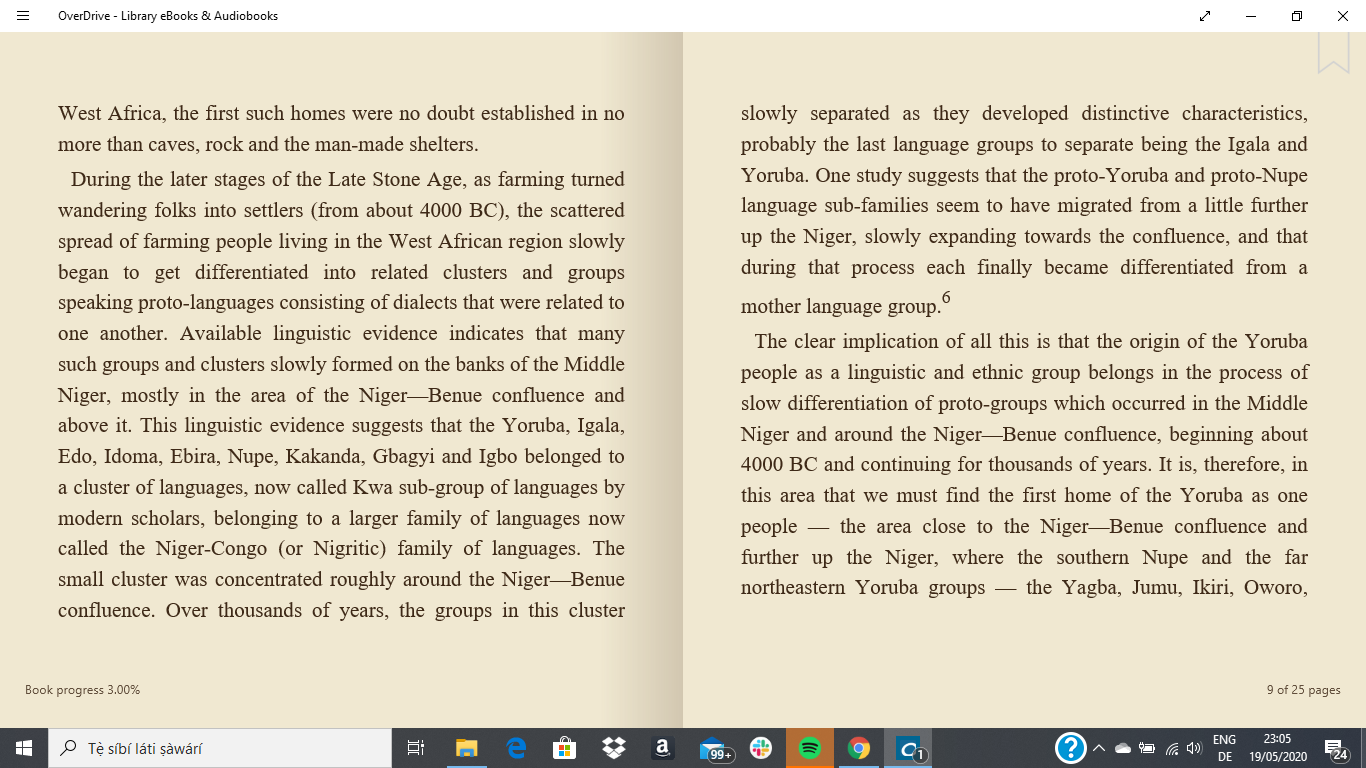
Bro, I am not interested in exchanging messages with people who need ask question, instead of concluding on a language they don't even know the foundation of it nor the religion of her people called Ifaodu. English language is of Germanic origin and of Mediterranean,Roman-latin,etc loaned words. 3. Can any of these people mentioned, where Yoruba language developed from in West Africa or any other part from Africa? Interestingly, [s]West Africa languages don't match Yoruba's lexicon. Even the Edo; who spoke Igodomigodo language,were influence linguistically. While Ibo language became interrelated with yoruba alongside Kabba- Igala mix interaction, which testified to few loaned words across board. [/s] 1 & 3 lmao this guy can lie so shamelessly. so desperate for your hebrew masters sha so you can claim Prof. Akintoye never claims African origin of Yoruba? (see screenshot below from Chapter 1, pages 8- 9 of Prof. Akintoye's "A history of the Yoruba people"  IF you didn't know, now you know , you can't lie here 2. lmao you are just a clown. So I have given diverse opinions on who the Ooni is...really ? Where, when? who did i say the ooni was? And i talked about Pharaohs origin of Yoruba Oonis and East Africa origin of Yoruba people ...lmao Abeg o, don't carrry your nonsense imagination to claim i said what i did not say. Ask your silent confused one time supporter Rossikk about Ooni being of Pharaonic origin 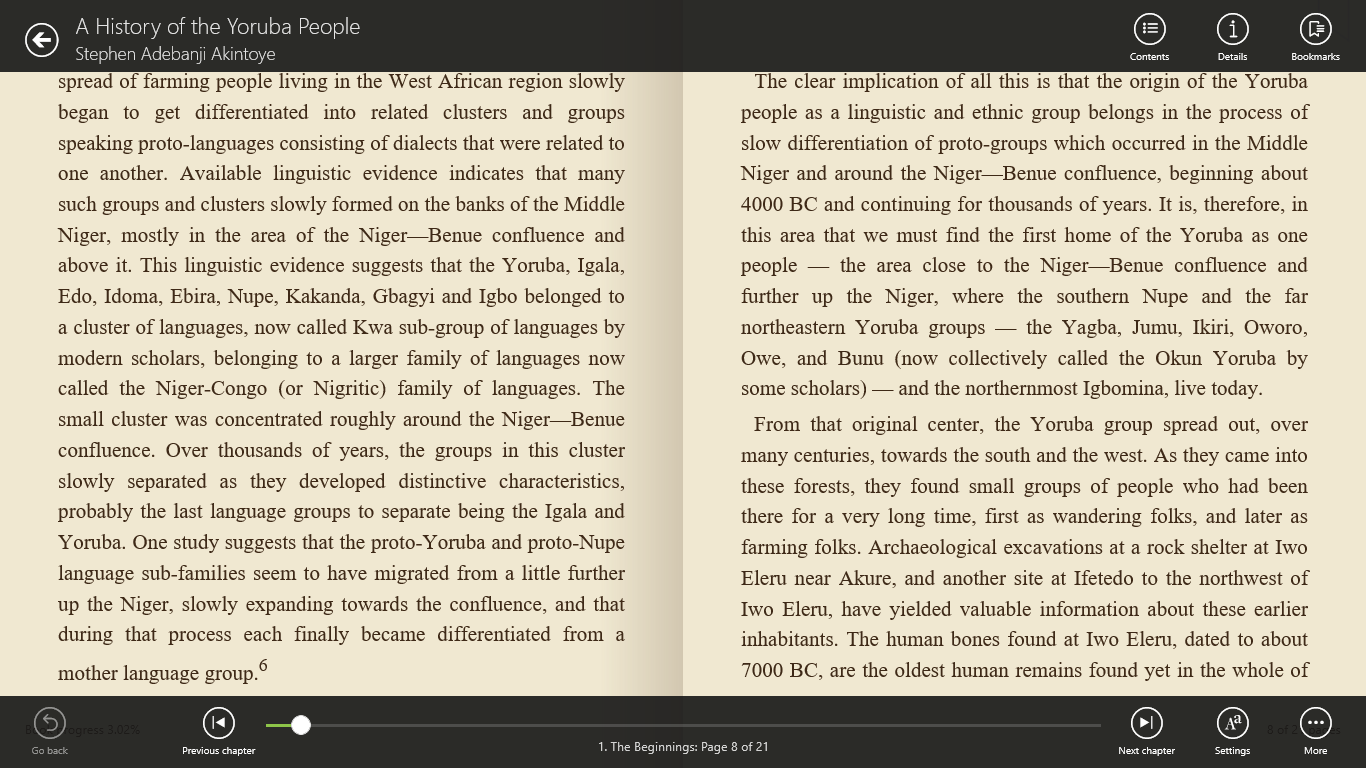
|
| Culture › Re: Yoruba Hebrew Heritage by macof(m): 9:42pm On May 19, 2020 |
Olu317:
Ayo Ogun; Samuel Johnson,
Scribner's Son,
Slideboom
Fatunbi,
Williams ,
Siculus,
Dennet ,
Wi Lizzie etc
have commented on Opa Oranmiyah. So, macof, what is special of this commentator of yours who don't know the meaning of the inscription .Beside, go to IleIfe to see the writing pattern so that you can see difference from picture onlione and the real deal! The issue is not about commenting on the Opa Oranmiyan ( Learn it, his name is Oranmiyan/Oranyan not Oranmiyah
What nonsense is that  ) The issue here is what did they comment and what claims were made and what evidence exist. Scholars usually don't risk their reputation going into ridicule unlike laymen like yourself who have no reputation or face to protect. Having said that, I have dealt you a blow on this ridiculous claim that the Opa Oranyan has Hebrew letters on it. William Fagg and Frank Willet are two out of the handful of renowned anthropologists and archeologists who debunked Johnson's speculative interpretation Williams and Fatunbi have never claimed Hebrew letters appear on the Opa Oranyan And who are Ayo Ogun, Scribner's son, Slideboom, Siculus, Dennet ,Wi Lizzie etc in Yoruba studies? This guy just making up nonsense as usual...this is slideboom https://image.slidesharecdn.com/slideboom-160528052059/95/slideboom-3-638.jpg?cb=1464412895And since you have been to ife to see the Hebrew letters, post the pictures. Pictures are allowed, if you have not been there, go there and post the Hebrew letters since you say the pictures online don't show the real thing see scope Post the real thing then and defend your claim Even renown Professors , who are known historians in Nigeria or across the globe will never delve into what isn't their jurisdiction except such knowledge on hieroglyphs, pictographs, ideograms, Semitic writing knowledge are acquired but here you're, fuming over assumption . Believe me, you're a typical Yoruba man with the biggest Joke because you regurgitate , nothing new......... Precisely the point but you say it you don't understand it, you only say it to seem legit but you don't even grasp the importance of what you just said And this ties in with my earlier statement that renowned scholars don't risk rubbishing their reputation, so they stick with what they know. Just as myself as I make my contribution to the world of academia particularly in History and Anthropology. You don't see me arguing anything outside my discipline Academia aims to be objective and scholars must be able to defend their new position. You are a faceless Jobless guy who doesn't know what else to do to feel relevant and you think going online to push your Church agenda for the Abrahamization of the yoruba is the way to go Is Yorùbá history your sphere of discipline? Is anthropology or linguistics your field? No. So tell me how this comment is relevant for you |
| Celebrities › Re: Funke Akindele's Childhood Throwback Picture by macof(m): 5:55pm On May 16, 2020 |
She actually was a cute child |
| Politics › Re: Minorities Testimonies At Willinks Commission On Life In Western Region (1957) by macof(m): 2:05am On May 15, 2020 |
Fatimaade:
Ahaha we gave them independence when they wanted out
That’s yoruba for you
It took a civil war for igbos to lose their minorities They still have Igala minorities in Anambra You wouldn't hear much about them as igbos have made efforts to silence them |
| Music/Radio › Re: & by macof(m): 2:49pm On May 11, 2020 |
Thank you brother. @isalegan2
This is a scary period indeed, but we are trying to keep safe
Hopefully you are doing your best as well |
| Culture › Re: Yoruba Hebrew Heritage by macof(m): 8:34am On May 11, 2020 |
absoluteSuccess:
I've been lifted up from this crass level conversation already. What a time with psychopaths!
May I not stoop low to it again at any price. If you like write about the beginning of the universe.
Or have the knowledge of all professors that ever lived, you don't have my knowledge. That settles it.
If you like change from joke to morbid sadness. Trolling me never implies you are a great success by your convictions.
I no be una mate in thinking faculty.
You can always change cause you know little, but can't change whoever knows more than you.
Na una sabi.
just look at this mess Basically "if you like know it all and give me the facts, I will not accept because it doesn't come from my imagination" is just what this means @tao11 I told you these guys are gone |
| Culture › Re: Yoruba Hebrew Heritage by macof(m): 2:53am On May 11, 2020*. Modified: 8:38am On May 11, 2020 |
TAO11:
Macof, I swear the above was going to be my next question to you --- that is, if you saw what Olu said about West Africa being uninhabited 200 years ago, when many settlements were already flowering in Ife by the 4th century BC from the archaeological finds of Paul Ozanne 1969.
Ómà ṣe ò! these are the kind of things they claim. No historical fact in their disposal at all I have to say you have a weapon of scholarly texts and books It's no news to anyone who is informed that Ife is set to have settlements as early as 500 BC using archaeological, linguistic evidence and interpretation of traditional records One of the projects I am currently working on is about the Yoruba interaction with Muslim dominated cities in much of africa, which could even shed more light on the name "Yoruba" and just how well travelled the Yoruba were Since apparently a few people think maintaining Yoruba are native west Africans is like saying we were primate isolationist |
| Culture › Re: Yoruba Hebrew Heritage by macof(m): 2:12am On May 11, 2020 |
TAO11:
I saw that post and just ignored.
That post is pregnant with information about the base understanding level of who I was about to engage, so I moved.
And btw, you've been doing a great intellectual work here on these guys. Your effort is not unnoticed.
I hope someday these folks will be matured and bold enough to come into the real-world.
I was once like them. I championed such jokes before.
Cognitive dissonance is heavily at play here. I am extremely glad one person who I engaged in the past was able to be free from this. I imagine it's not easy breaking out of such. My aim is no longer to get them to reason, I have lost hope on that, I'm more concerned about those who don't know basic historical facts that might get pulled into their web of fantastic stories and claims Imagine Yoruba becoming like igboland where they have almost lost their senses with identifying with Israel |
| Culture › Re: Yoruba Hebrew Heritage by macof(m): 1:48am On May 11, 2020 |
funny how your rhetoric changes and lacks consistency. So now my ancestors are "one of those who assimilated into Yoruba" Funny how you know my ancestry so well. Almost as if you just take whatever comes to your imagination as reality Oh and I thought I was an Edo/Igala/Igbo (anything but absolutely not yoruba) man named Makinde Olufemi who's daughter your friend got married to Let me remind you of your last declaration of my origin Olu317:
His name are Makinde Oluwafemi/Olufem . And it seems he is a journalist without substantial portfolio.
Furthermore, there is no way he will agree with you because he is deranged. After all, he claims South Africa and West Africa are same people linguistically. No wonder, he hss been informing with substantial evidence or witnesses.
And again, he said that Yoruba people have spiritual power to overturn delicacy issues as normal. Though it is noormal for misunderstanding to ensues but aftermath effect will be devastating. Now to address this more squarely Olu317:
As usual , you have no regard for scholars, instead, you peddle false information as fact. Little do you know, the inscription on opa oranmiyah isn't a secret ideogram that can be read easily. And the people who have tried to read said it is written in Hebrew. Now, if it is not written in Hebrew, what language is opa oranmiyah written in ?
Perhaps, you will need to explain to us the manner at which, Yoruba ancestors had knowledge of alphabets during the medieval time. After all, Africans inscriptions ,even the old Egypt's hieroglyphs are different from Yoruba's.
Certainly, such as you need be spanked on the head because, you virtually have nothing up in your brain than rhetorics. Interestingly, I know your ancestors. are actually, the type that were assimilated into Yoruba fold, because they were naturally not Yoruba people from inception,which is the reason you have no knowledge beyond West Africa ,which was not inhabited over 200 years ago . Yet , you keep chanting West Africa as if Yoruba ancestors language originated from West Africa. Any way, you remained your humble self; hypothetical mumu. we both know who regards scholarship here My wealth of academic knowledge will floor you Here is an article by Claudia Zaslavsky the author of "Africa counts", here she references johnson respecfully and uses the reviews of William Fagg and Frank Willet to set things straight And in case you don't know what you are actually talking about, I posted a picture of the markings on the Opa Oranmiyan. Do show us the Hebrew alphabets you see in this picture Edit : wait, did I just read, "west africa was not inhabited over 200 years ago"? Like seriously? This mofo is saying at around 1700 West Africa was uninhabited Is this the guy calling me a hypothetical mumu... What does that even mean What a mess 

|
| Culture › Re: Yoruba Hebrew Heritage by macof(m): 1:25am On May 11, 2020 |
absoluteSuccess:
But come to think of it, “seeking historical facts” is not the same as “seeking sociological answers” from survey of random, comical samples. Whoever is directing scientific findings wrongly, is unconscious of scientific principles of writing historical piece when tradition is all you have.
Some folks' sense of "history" is recent "sociological theory" that has replaced the ancient thread of traditions that connects humanity. Its a novel continuous process of "desocializing" to "resocialise" people on another perspective of "history" without history. If you were intelligent enough you would know why TAO11 asked that And wouldn't need to make this outcry Studying the background of the person/persons making "historical claims" without evidence is one way to learn their motivation and tackle the very idea at it's core You of all people, who have claimed that I only question your ridiculous claims because I am igbo should understand the direction of TAO11 but of course you don't...or maybe you do I can't help but laugh at this outcry. Because it could mean you know what the result of such a survey will be Which is as I have always maintained.. Church Boys as yourself want to be Hebrew Quranic boys want to be Arab By implication take out religious sentiments and indoctrination and there wouldn't even be a Yoruba are Hebrew or Arab or whatever other nonsense claim African concerts to Abrahamic religions always want to exterminate the local tradition and knowledge, if they can't, they want to Abrahamize it |
| Culture › Re: Yoruba Hebrew Heritage by macof(m): 1:12am On May 10, 2020 |
Olu317:
I don't need to explain to you because it has been accepted in the scholarly world as classic Hebrew. So how dare you ask me ? Srop peddling falsification! Lmao. Before you want silent for weeks I showed you scholars debunking whatever idea that the marks on the Opa Oranmiyan are Hebrew I know you have a blocked brain so it has quickly flown out of your head again |
| Culture › Re: Yoruba Hebrew Heritage by macof(m): 1:10am On May 10, 2020 |
Olu317:
How does shigidi mean to prostrate in any Yoruba dialect ? You should ask your fellow middle eastern wannabe @metaphysical. that was his own imagination as you people get all your ideas from your crazy imaginations |